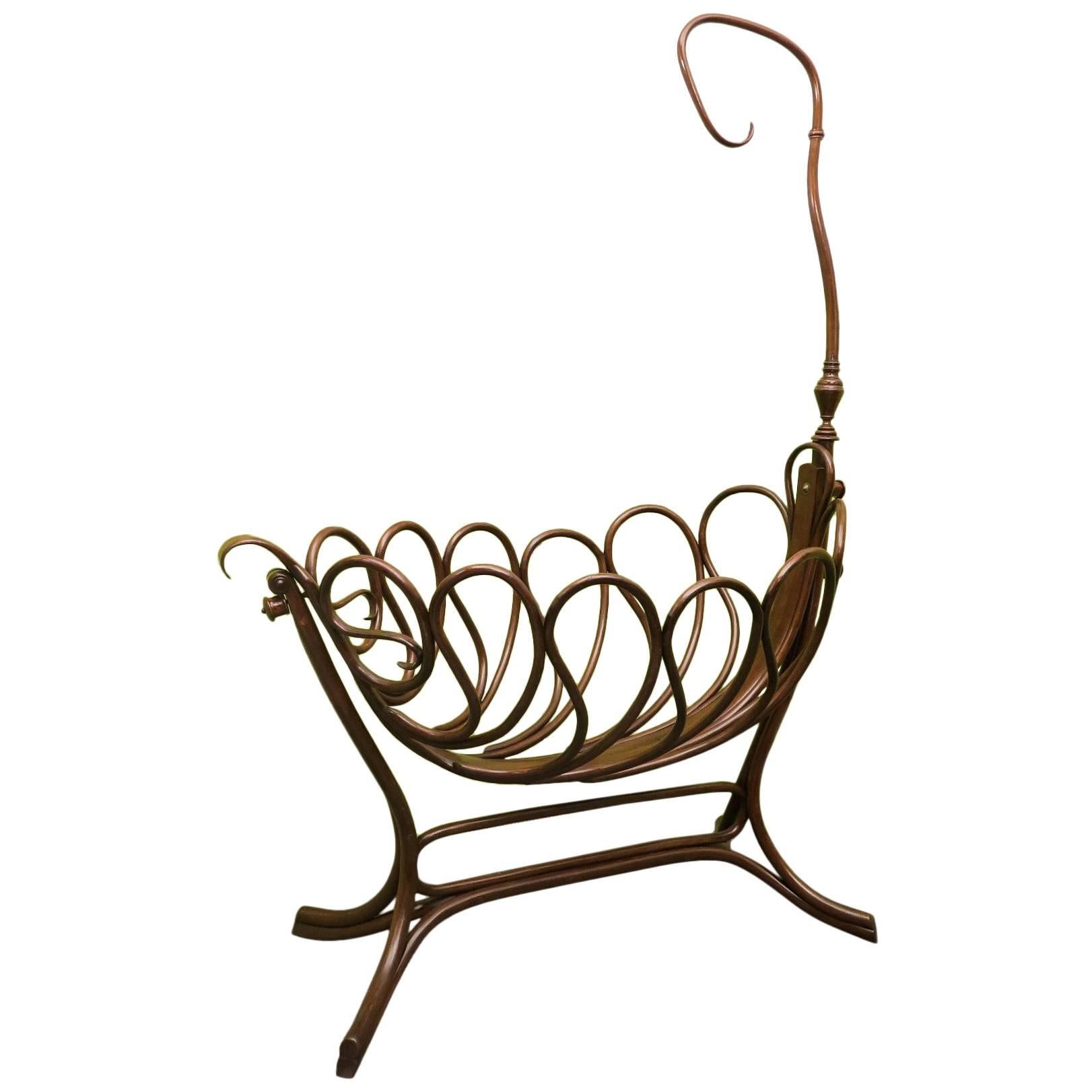
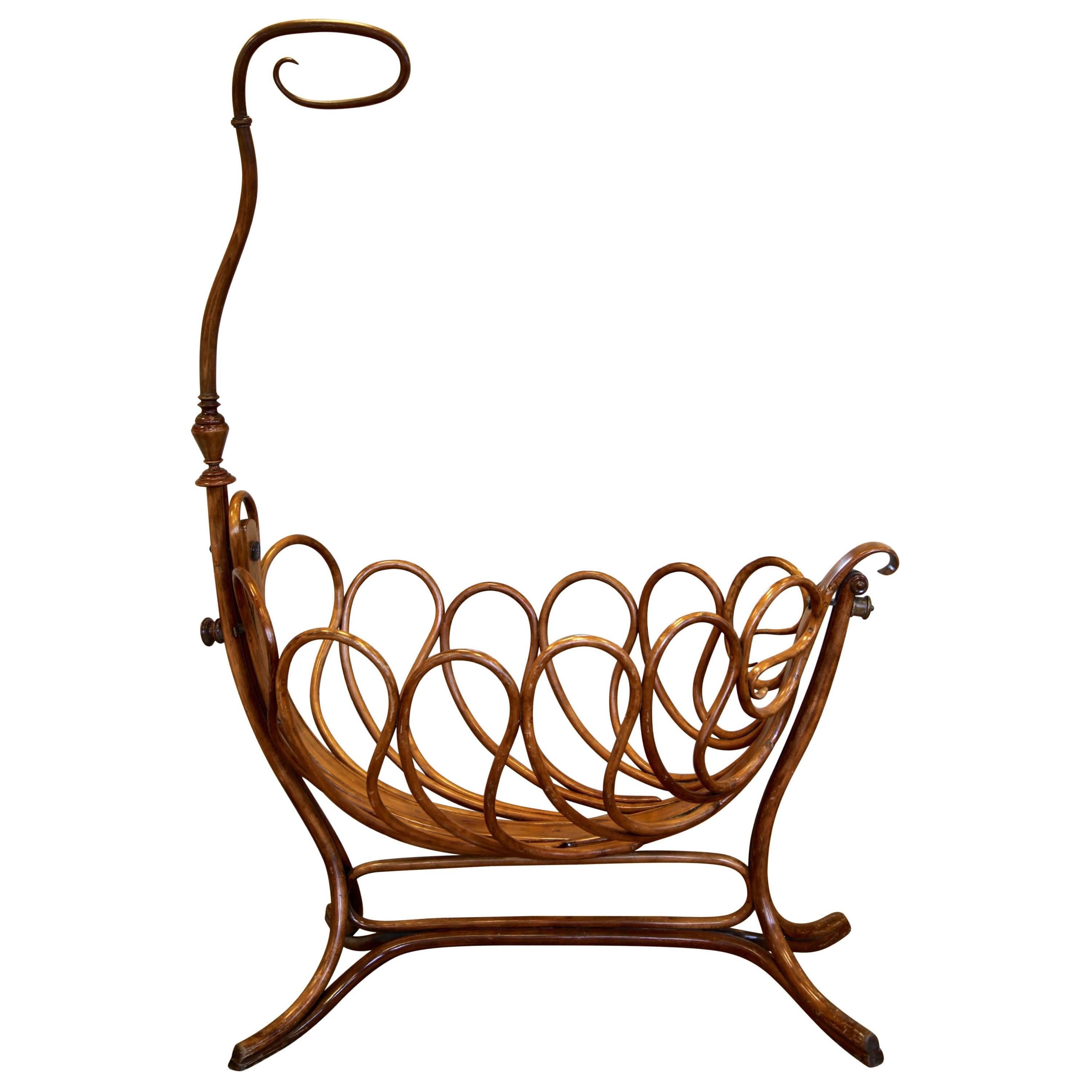
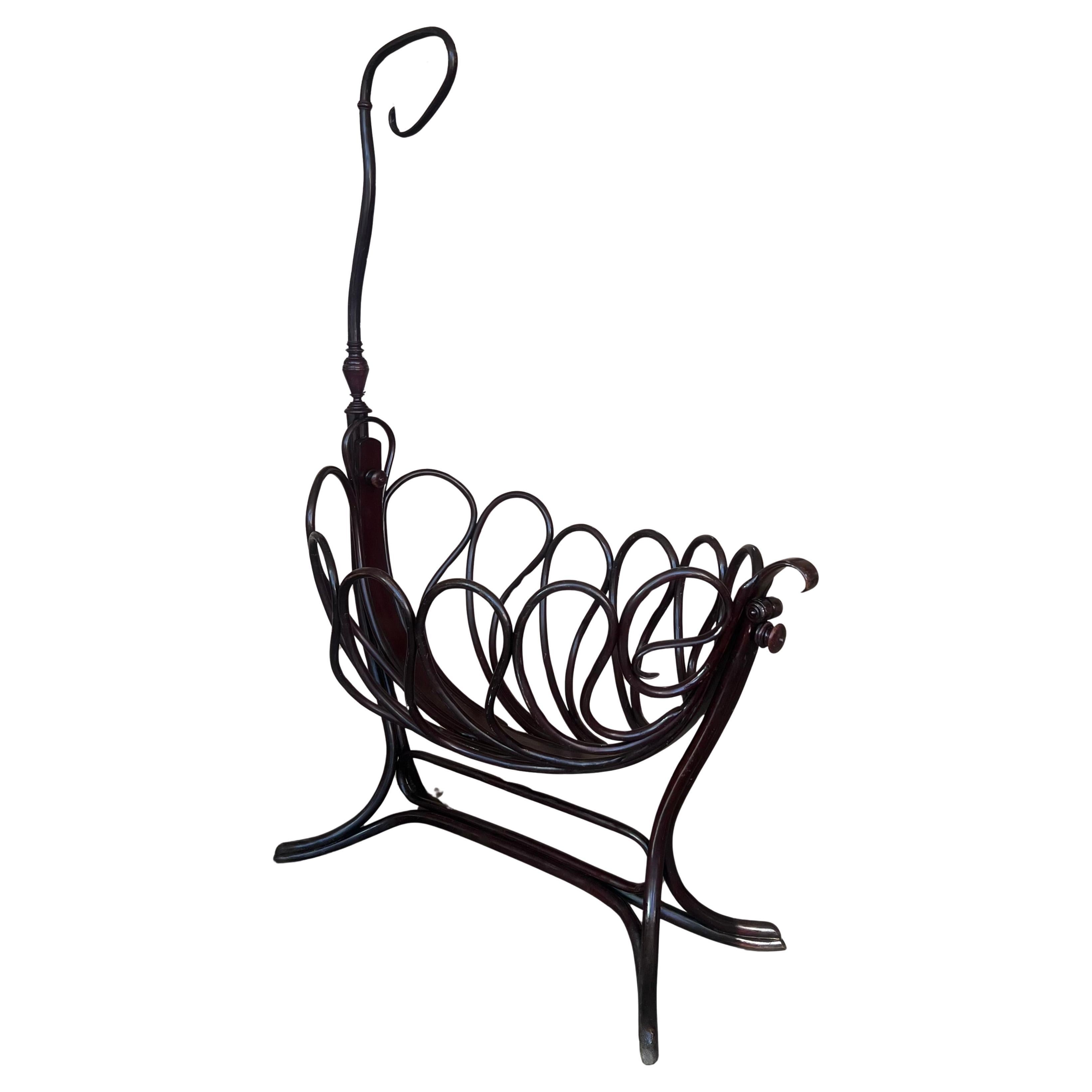
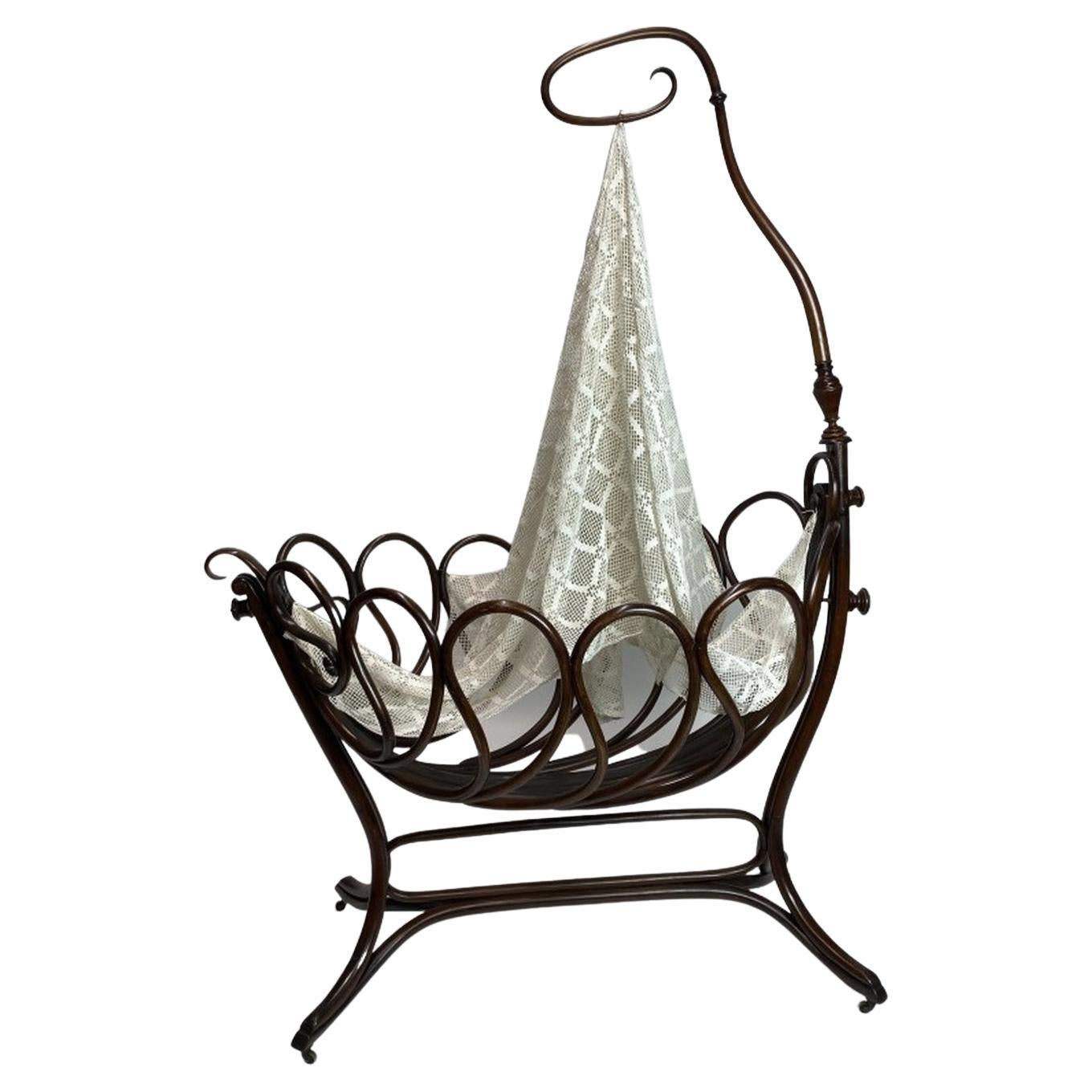
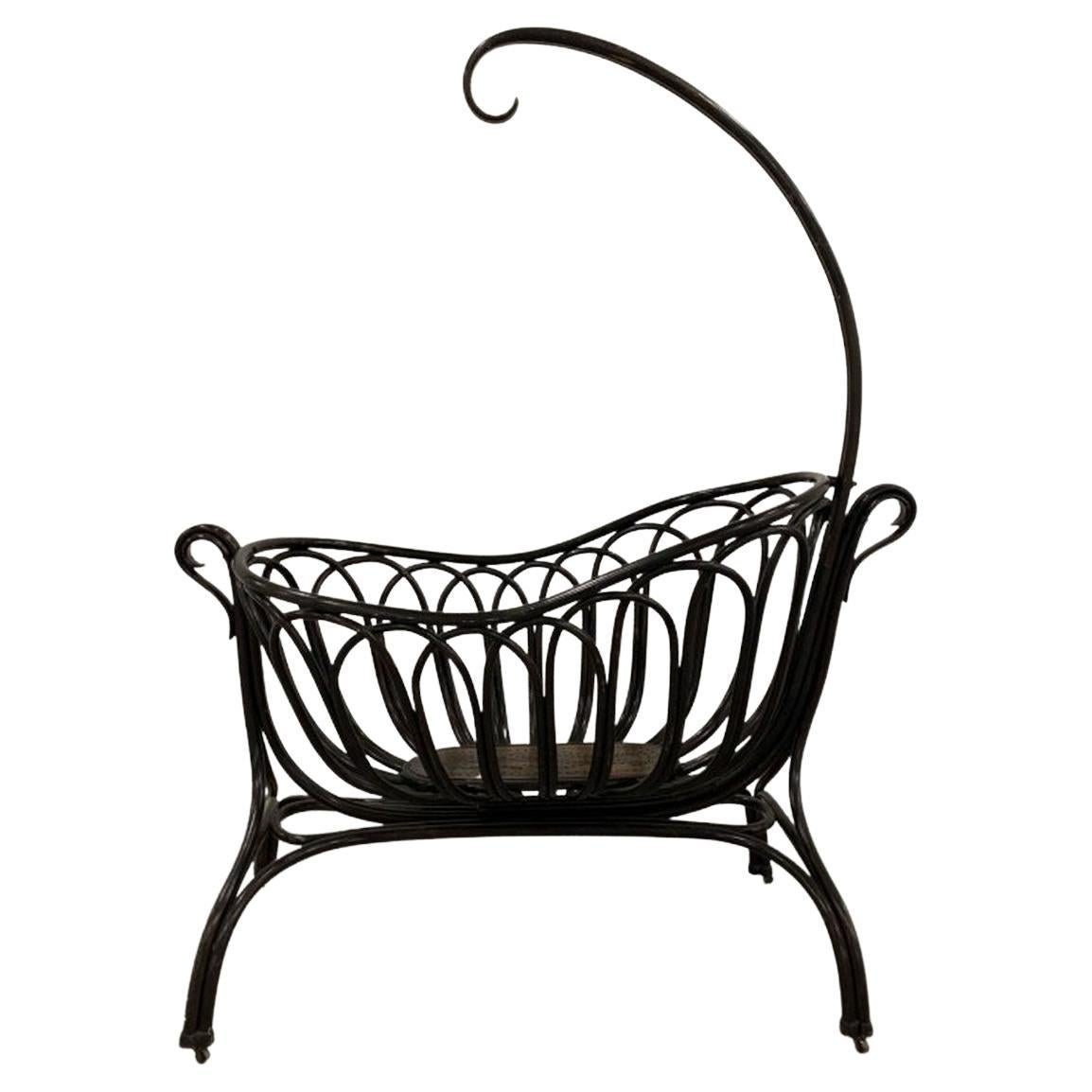
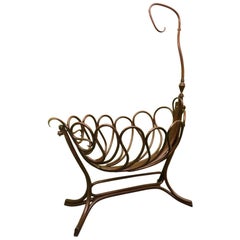
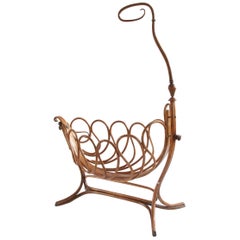
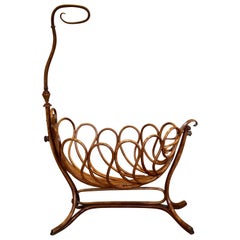
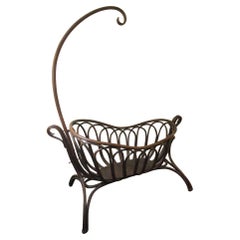
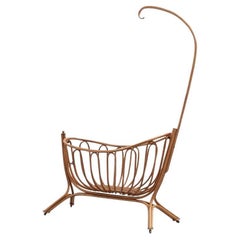
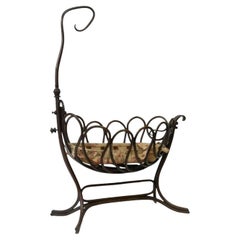
One of a kind children's crib made of bent beech wood, design attributed to the Austrians Jacob and Josef Kohn (father and son) in the purest Art Nouveau style at the end of the 19th century and with a clear Thonet reference. Delicate in shape, the curved wood gives the cradle a complex yet light appearance, endowing it with an elegance and slenderness visible in every part of the piece, from the legs to the vertical arm on which the hook for attaching the canopy is located. The basket is shaped like a boat, and is screwed to the ends, allowing it to remain static or tilt to rock the child. The interior was completed with bedding, large cushions and pillows to create a soft and protected bed. They are known as “tree cradles” and were commonly found in the homes of well-off and bourgeois families throughout the continent.
Curved wood designs became ubiquitous as seating for cafes and gardens and, later, as elaborate, upholstered household furniture. Inexpensive, durable, lightweight and ideal for export, because the components could be assembled after shipment. Pieces such as the J. & J. Kohn crib became perfect symbols of the new industrial age, not to mention the prevailing Art Nouveau style.
This was a highly innovative technique for the time, as furniture was made by steaming pieces of wood to bend them and place them in metal moulds to create the desired curvature, hardening them again by drying in ovens. They were then assembled with fittings, instead of the traditional hand-carved joints. The idea of standardised elements revolutionised the principles of furniture production.
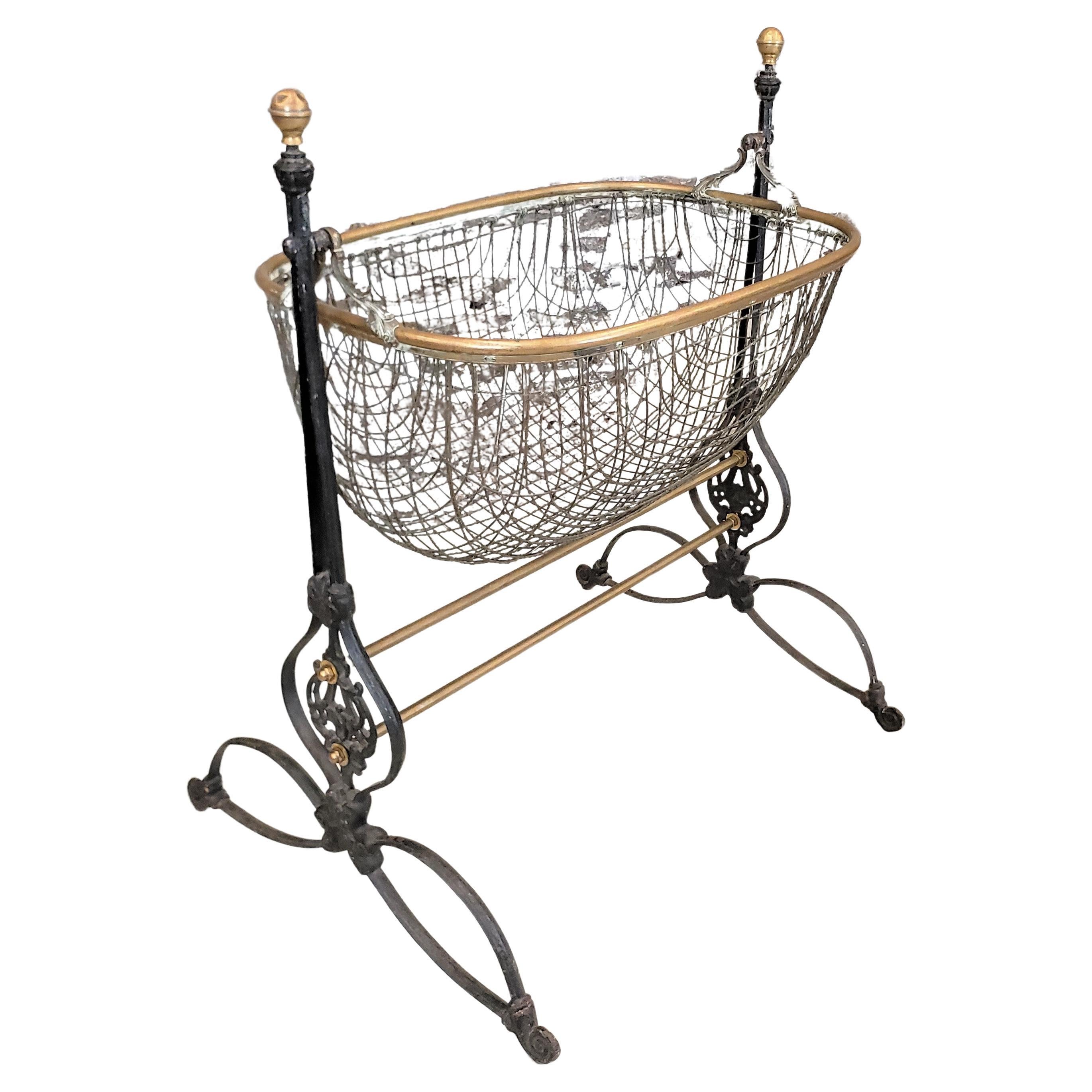
The bentwood process had been developed by the German designer Michael Thonet in the mid-19th century in order to make functional and attractive furniture efficiently and economically. In fact, he patented the system in 1841, but other manufacturers in Austria-Hungary entered the field when the patent expired in 1869, such as the firm J. & J. Kohn, which had already developed models with their own personality since 1867, becoming its main competitor. At the 1878 Paris World's Fair, Kohn presented an entire pavilion made of bentwood in which two pieces stood out above all the others: a bed and a cradle. In reality, neither Jacob & Josef Kohn nor the Thonet Brothers invented wooden cradles, but they did transpose the designs of cradles that existed in the mid-19th century into the language of solid bentwood. As a reference, we can take the example of the wooden cradle by R. Winfield, presented at the 1851 London World's Fair, of which drawings are preserved. J. & J. Kohn specialized in the manufacture and sale of this type of furniture, and thanks to its exports to Spain and Latin America it gained great influence. In our country, it became especially popular in Valencia, where various manufacturers produced reproductions of Kohn-type tree cradles. In fact, Kohn's style was a hit among Spanish manufacturers.
Over time, the models in the Kohn catalogue became simpler, becoming less luxurious and more functional. Specifically, the piece we are presenting corresponds to what appears to be the firm's model no. 3, as attributed (since it is the same model) to the Museum of Modern Art in New York (J. & J. Kohn, Vienna, Josef Kohn, Jacob Kohn. Child's cradle model 1573. c. 1895 MoMA), the Museu del Disseny in Barcelona (Moderniste Cradle by Kohn Disseny Hub Barcelona) and the Montreal Museum of Fine Arts Berceau ,Drawings, photographs of the exhibitions, brand catalogues and postcards are preserved in which the previous ones can be seen to admire the differences.
Forgetting its initial function, its origin, it is much more, it is really a beautiful sculpture!!!! A collector's item!!!
It is in a very good condition and It can be used as a cradle and it rocks perfectly
Model: Children's cradle model no. 3
Designers: Attributed to Josef and Jacob Kohn (J. & J. Kohn)
Style: Art Nouveau / Thonet style
Materials: Bent beech wood
Period: Late 19th century (1895-1899)
Country of origin: Vienna, Austria
Provenance: Private collection France
Good condition considering its age and use
Dimensions: 197.5 x 148 x 67 cm.