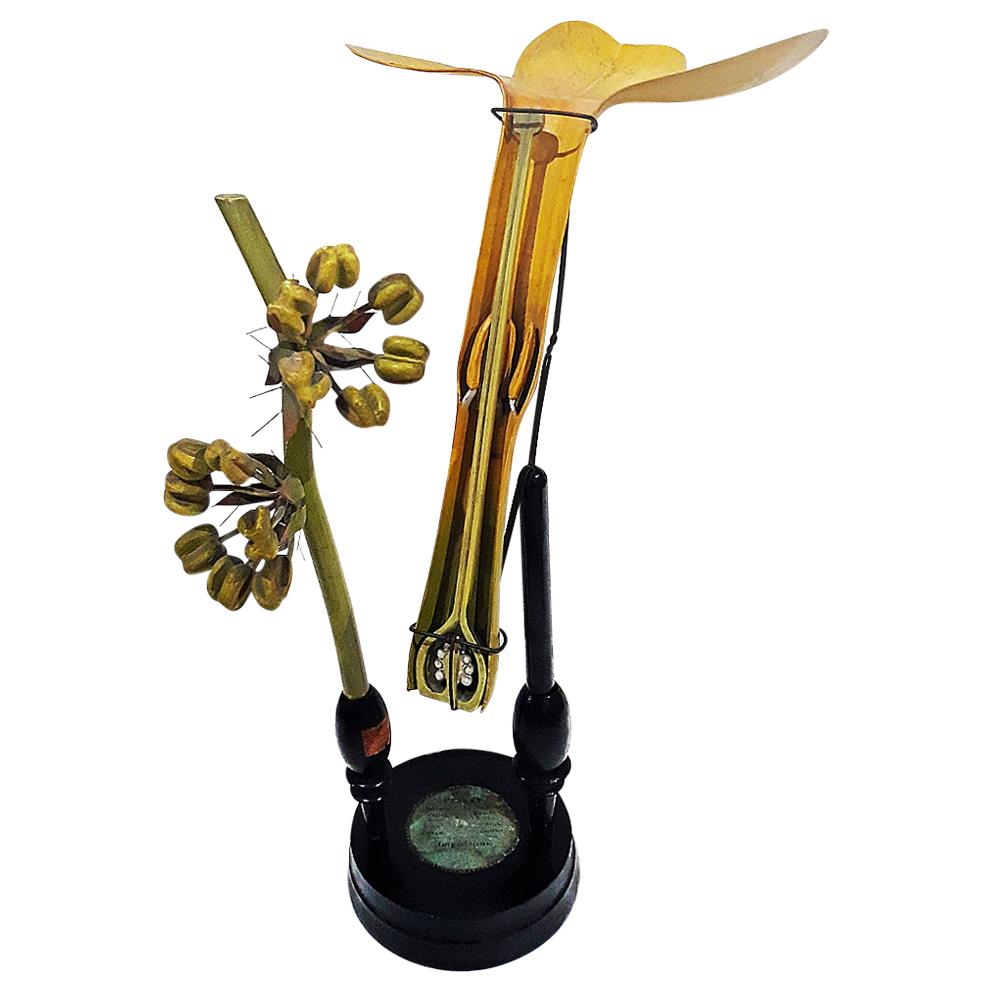
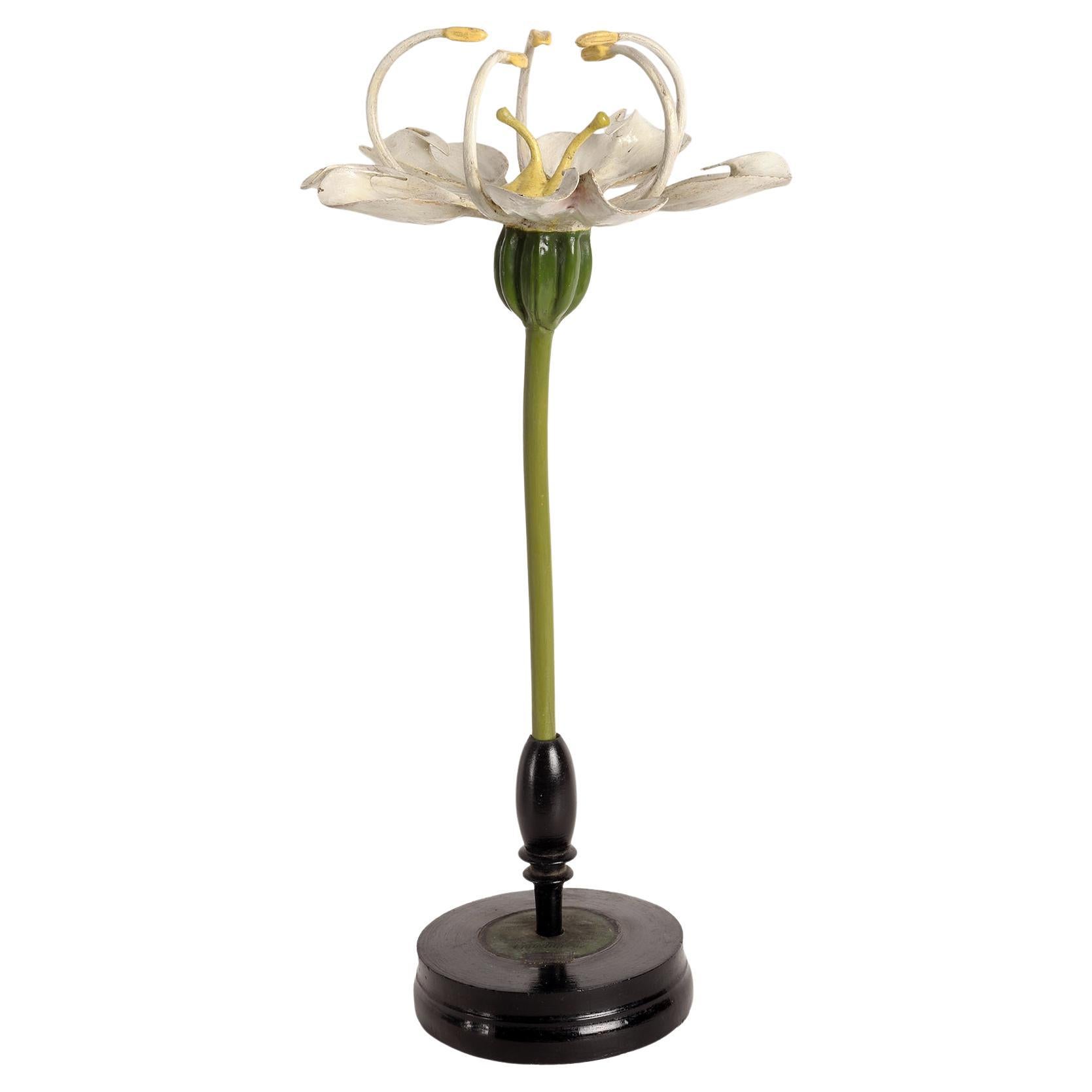
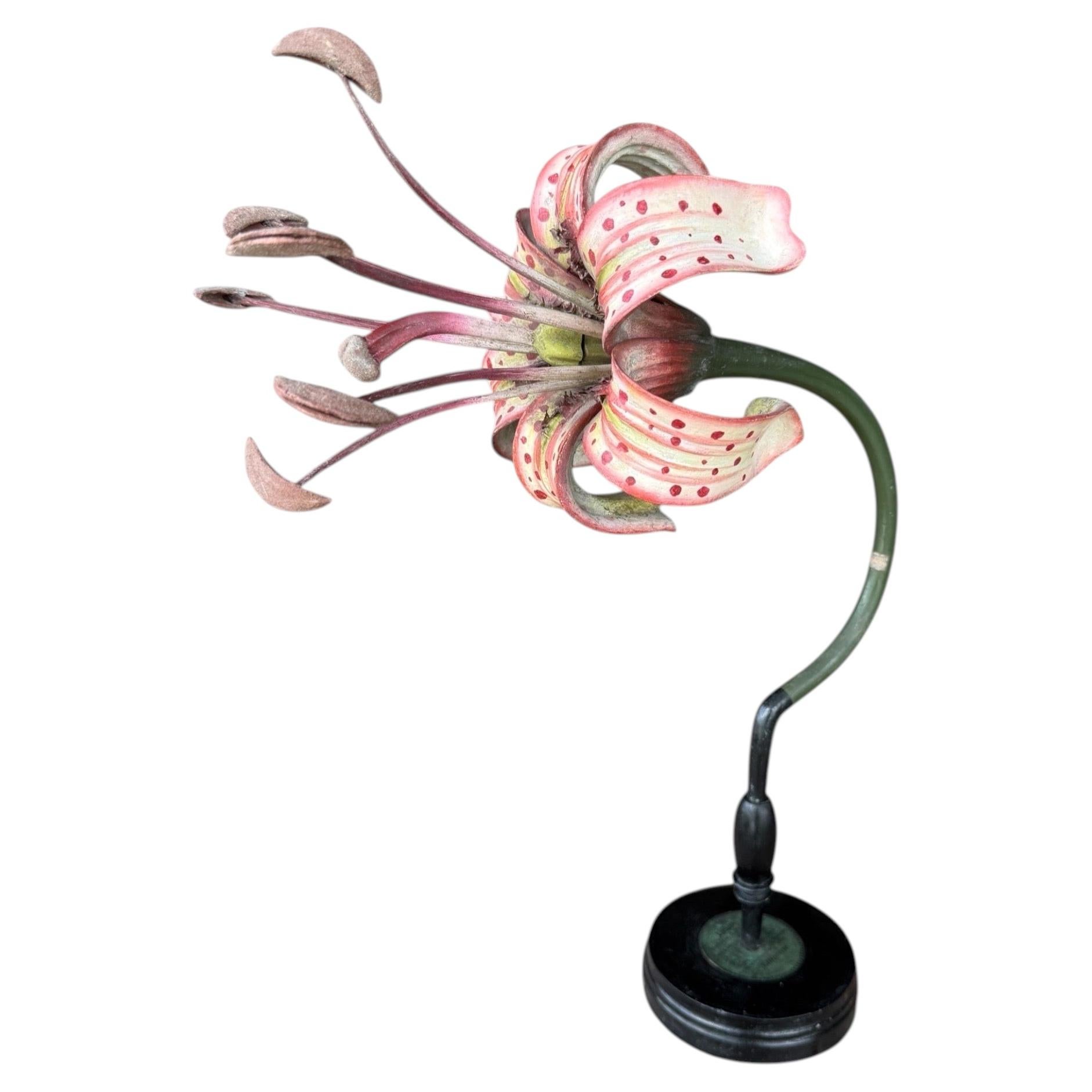
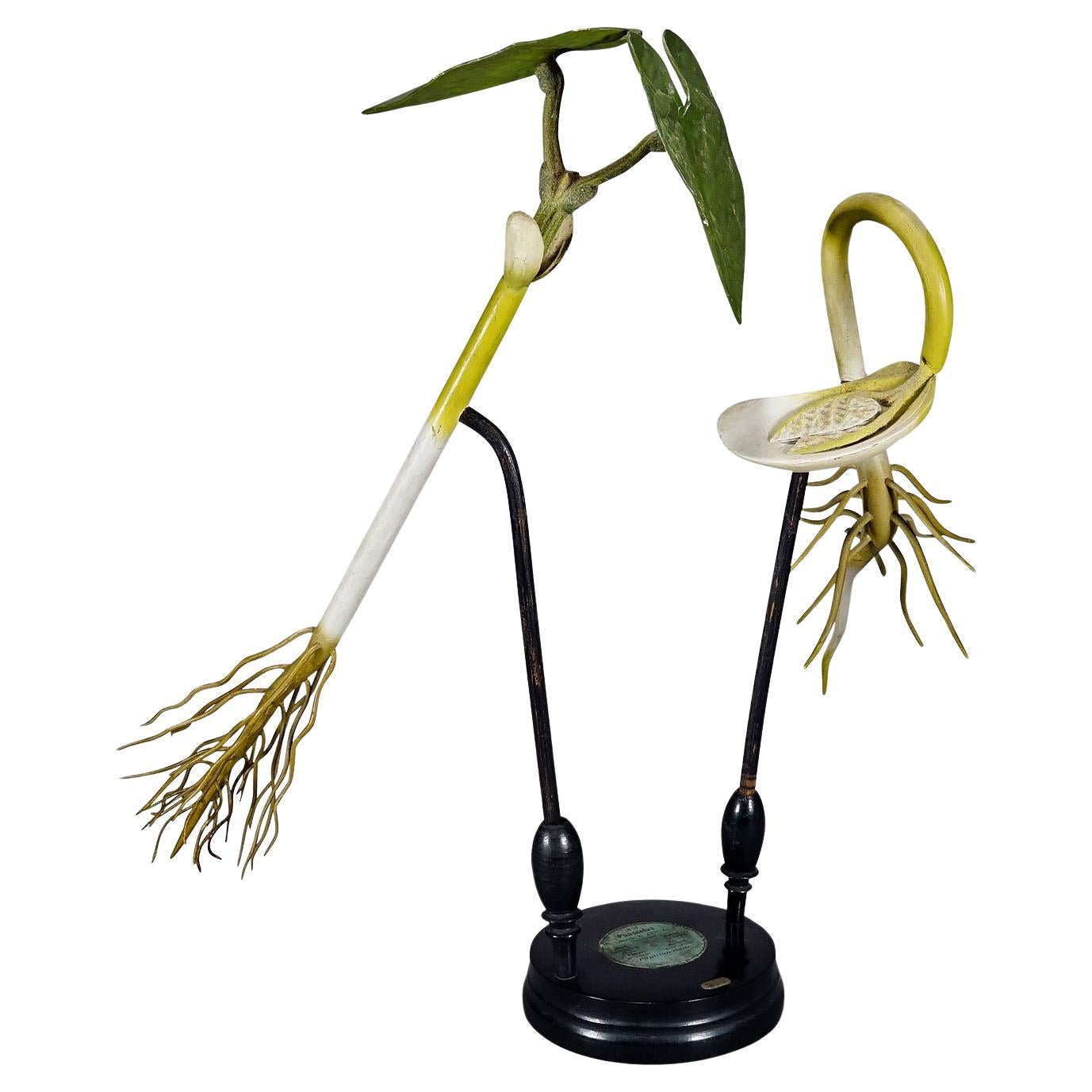
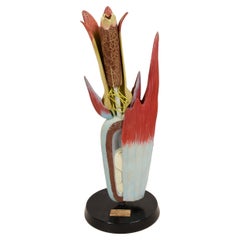
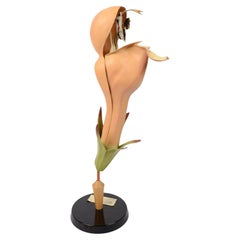
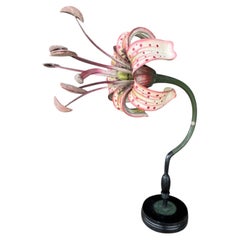
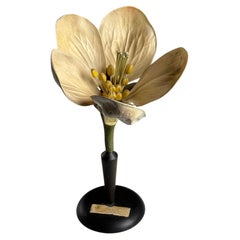
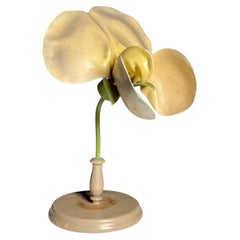
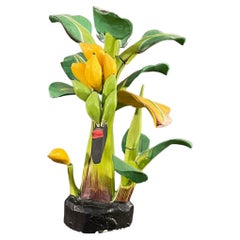
Original Brendel botanical model of the Tulip flower made in Germany around the end of the 19th century by Robert Brendel (1821-1898). The flower is made of wood and papier mache and breaks down into 3 sections and is mounted on a round base in ebonized wood with a label in the center describing its characteristics.
Measurements Height cm 51 - 20 inches, flower dimeter 17 - 6.8 inches.
Tulipa, commonly known by the name Tulip, its name is derived from the Turkish word for turban, this genus of bulbous plants originated from the Pamir Mountains, then extended growth from the Iberian Peninsula, to North Africa, to Northern Europe reaching as far as China.
It is a very popular flower in Turkey, in the 16th century during the reign of Suleiman the Magnificent it was selected in numerous varieties and planted everywhere.
Its cultivation began in the Netherlands around the end of the 16th century, quickly becoming a luxury commodity, not only because of its decorative value but also because of its cost, which grew rapidly. From the trade between 1634-37 came the first speculative bubble in the history of capitalism named the tulip bubble.
The Robert Brendel & Sons manufactory was founded in Breslau by Robert Brendel in 1866 with the production of botanical models of flowers, fruits and plants designed for teaching botany, creating a perfect fusion of science and art.
The need to create paper mache plant models had arisen from the difficulty of finding fresh material.
The activity began with the production of models of medicinal plants, then at the suggestion of the director of the Institute of Plant Physiology at the University of Wroclaw, the first such institute in the world, Robert Brendel extended production to include models of botany and plant anatomy more generally.
The production technique started from the development of casts on which with the prevalent use of papier-mâché, the model maker shaped the models.
The specimens produced were tempera-colored and polished with wax lacquer, each prototype was assembled to be supported by a rattan stand and then inserted into a round wooden base, which in the oldest models was painted black, while the bases inherent in the production since the early 1900s was of light wood. A label was pasted on the base with the name in Latin and the vernacular name and in various languages, as well as the serial number, scale and other details.
This teaching potential was adopted by many educational institutions, resulting in significant improvements in both the teaching and study of botany, compared with earlier methods that were based on drawings or prints, or with the practice of dissecting real plants, with the resulting difficulty regarding rapid decomposition.
Being able to have three-dimensional enlarged models, faithful reproductions of real ones helped greatly in the study of plant anatomy, over time Brendel began to develop paper mache models that could be disassembled, the use of hooks and small hinges allowed for dissection and disassembly of the pieces significantly increasing the importance of teaching.
By the end of the 19th century, the Brendel Manufacture was famous and recognized worldwide, models were displayed and awarded in various world exhibitions, both in Europe and overseas, the catalog included more than 300 different models.
It is likely that the final closure of the business originated with the passing of the racial laws during the Third Reich, as the Brendel family was of Jewish descent.