Bonjour!
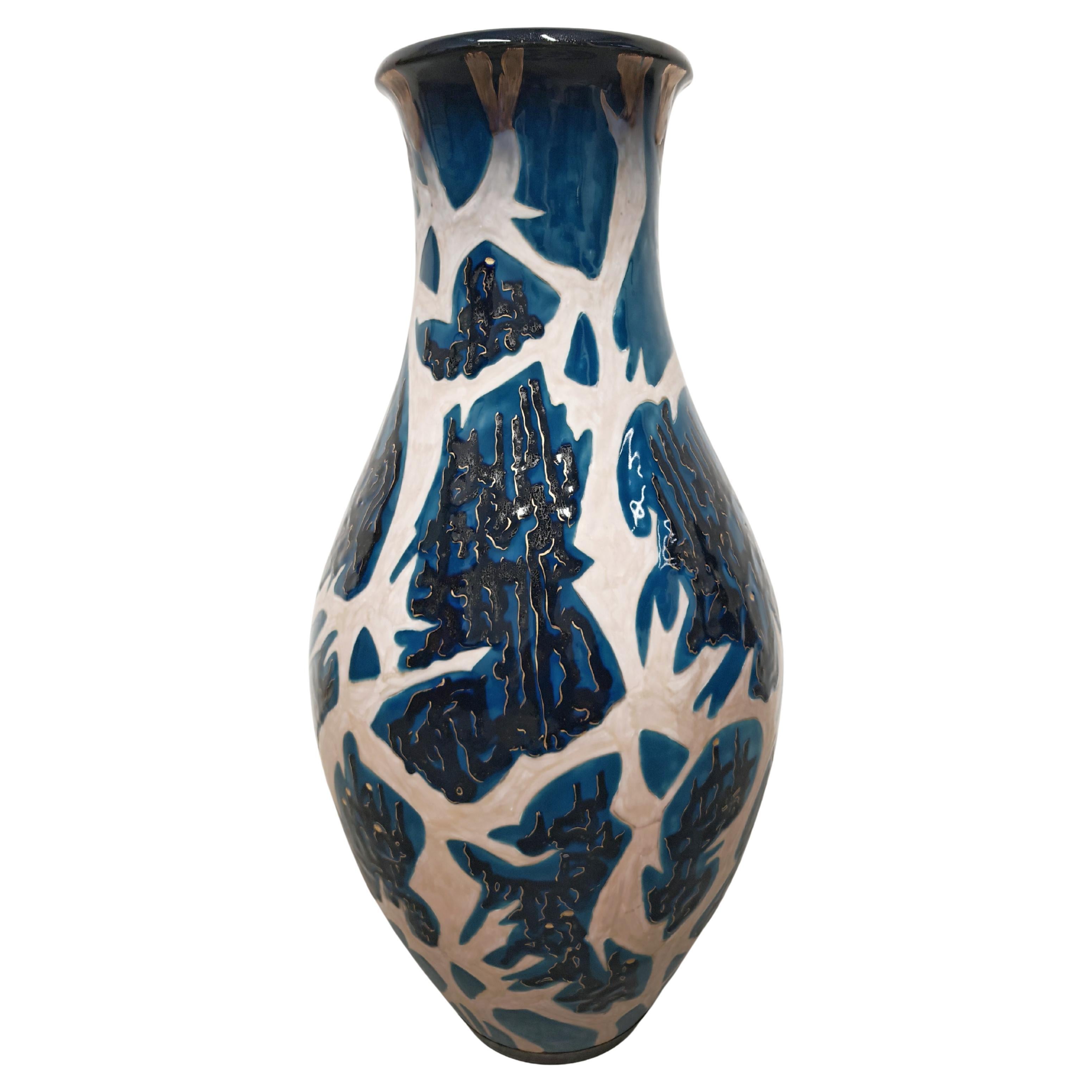
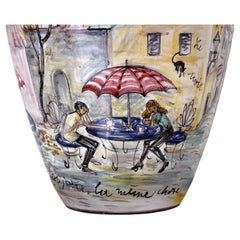
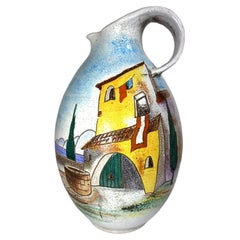
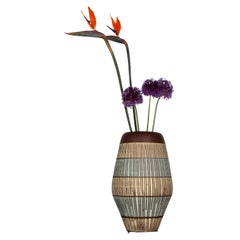
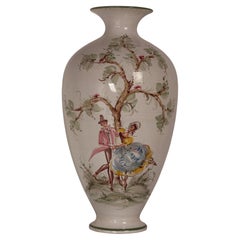
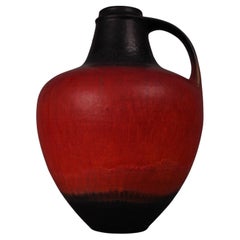
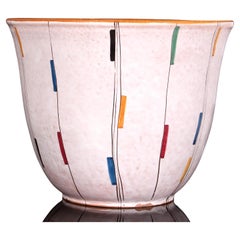
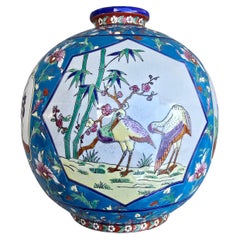
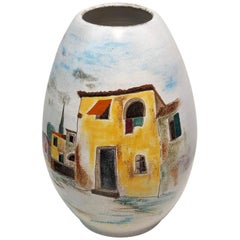
A Paris BiG LoVE Vase !
Ordered by the prop master of a West German movie production.
The film was made in Munich (Bavaria, Geiselgasteig) back in the late 50s!
The vase was certainly subjected to a special inspection by baroness Baronin Sybille von Rothkirch before dispatch.
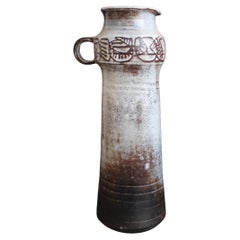
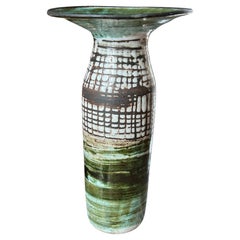
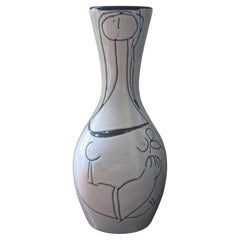
It measures 62 cm in height and 36 cm in diameter, weighs 7.8 kg and has an inner upper rim diameter of 22 cm.
White glove shipping: box-in-box (eventually on a pallet, depending on the destination).
Ulm ceramics
From 1947 onwards, Ulmer Keramik (UK) manufactured a range of ceramic tableware, tiles and promotional items. The company was based in Ulm, later Neu-Ulm. The company ceased operations in 1991.
Company History
The manufactory was founded by Heinz Saur (November 6, 1916, Essen – November 9, 1962, Neu-Ulm) and registered in the [2] The company was registered in the municipal trade register of Ulm on June 7, 1946. Following the conversion and expansion of Fort Prittwitz in Ulm, production of tableware in a red-brown body commenced at the beginning of 1947. On December 19, 1947, UK was officially registered as a commercial entity.
From 1947/1948 onwards, the main product was mainly hand-painted majolica. According to the Chamber of Industry and Commerce, UK had 25 employees on January 13, 1948, the majority of whom were displaced persons from Silesia and Bohemia. Among them was Baroness Sybille von Rotkirch, who had studied art and painting in Berlin and was in charge of the painting department. By April 1948, the municipal trade office had already grown to a team of 50 to 60 employees. Following the currency reform in 1948, we began to experience some initial challenges in terms of sales. Following this challenging period, the company began to make a gradual recovery. In 1952, it assumed responsibility for the machinery of WMF Geislingen. By 1954, the company had grown to employ 200 people and was producing up to 1,500 pieces of the approximately 130 articles with various decorations every day. The motifs were popular, featuring elements such as fauna and flora, traditional costumes, landscapes around the Mediterranean, Paris, the Orient, and the Far East. It would be remiss of me not to mention the extensive decoration of well-known breweries, restaurants, and cafés with hand-painted tiles on their facades and interior walls. The vast majority of items were produced for everyday use and to embellish the home. In 1954, the UK was one of the largest majolica factories in the FRG, with 15 modern kilns (electric spiral kilns).[1] It is worth noting that 40% of production was exported to Europe, the USA, and Canada. This marked the first time a German ceramics manufacturer reached the world market suppliers Netherlands and Italy.
By 1956, the UK had gradually increased its capacity to 17 kilns. A dedicated team of 260 individuals produced an impressive range of items, from 6,000 to 10,000 pieces per day, establishing the UK as the largest majolica factory in the Federal Republic of Germany. From the mid-1950s onwards, major companies began exploring the production of promotional items in runs of up to 50,000 pieces. It is worth noting that the decoration of such a large quantity of items on a mass production scale was only possible with screen printing. The designs for this were created by Ernst Konrad, who remained with the UK from his apprenticeship until his retirement. It was decided that hand painting would be retained for smaller quantities.
For operational reasons, the UK found it necessary to expand. Given the limitations of the existing facilities in Ulm, the construction of a new site in Neu-Ulm was deemed the most viable option. The new plant was inaugurated on July 11, 1959. Following Saur's passing on November 9, 1962, the company was bequeathed in equal shares to the authorized signatory Albin Blechschmidt. The company was also advised by Rudolf Mezger, the former general plant manager, and Hans Forstner from Neu-Ulm, who had been a wartime colleague of Saur's. On August 30, 1963, the company was converted into a limited partnership. Mezger's departure in 1964 led to the relocation of the company's headquarters to Neu-Ulm. Between 1977 and the end of the 1980s, there was a notable decline in turnover. In 1985, Forstner also decided to pursue other opportunities, and his son Johannes Forstner assumed the role of plant manager. In the same year, Blechschmidt made the decision to sell his share to Dr. Erich Merckle from Ulm. He assumed a management role alongside Johannes Forstner. At that time, the UK operation still employed 55 individuals. Due to the challenging economic climate and the rise of imports from Asia, the company faced significant challenges. In 1990, the management team made the difficult decision to close the company.
A clearance sale was held from March 1 to March 28, 1991, and operations came to a close on March 31, 1991. The majority of the factory equipment was sold to Elster-Keramik GmbH in Elsterwerda.