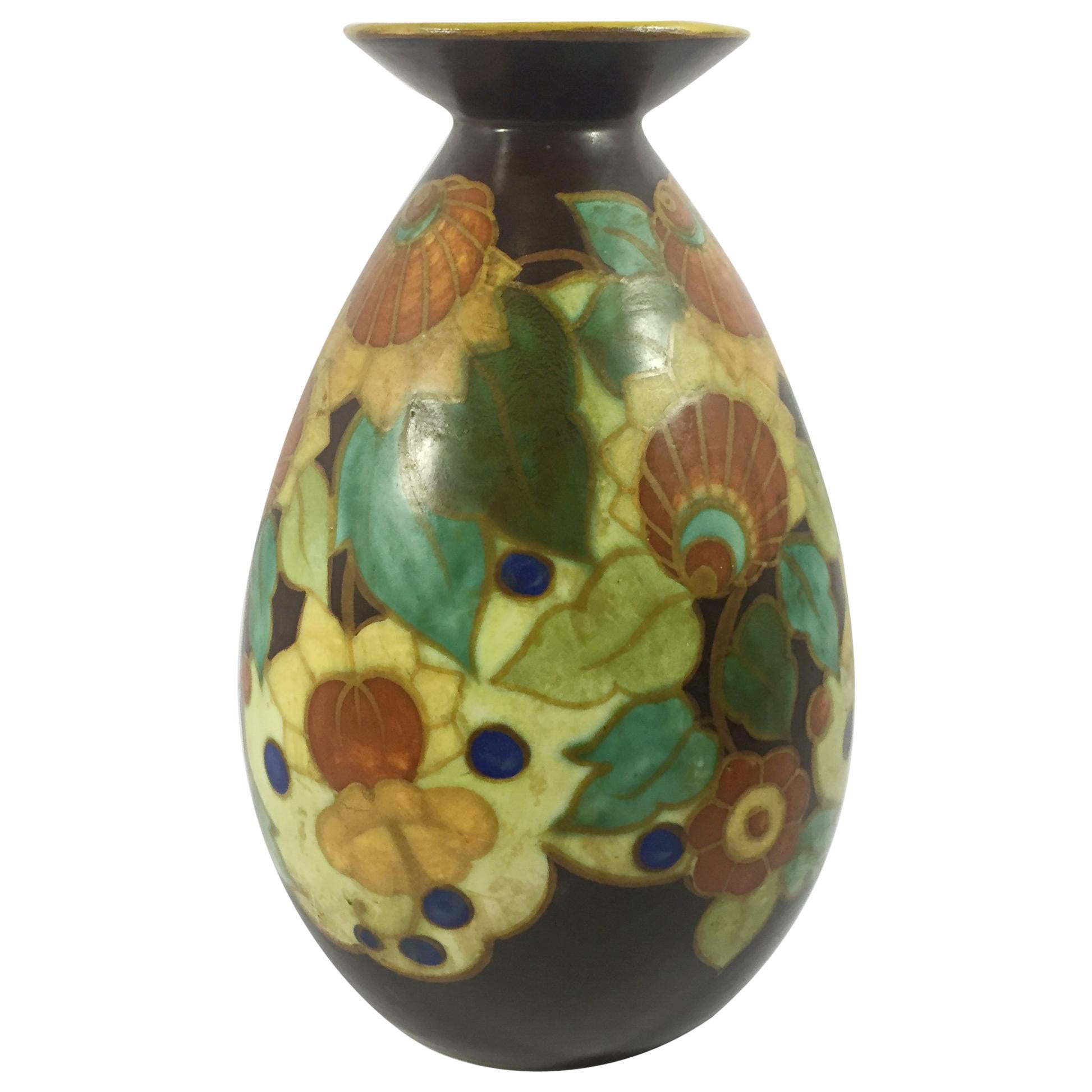
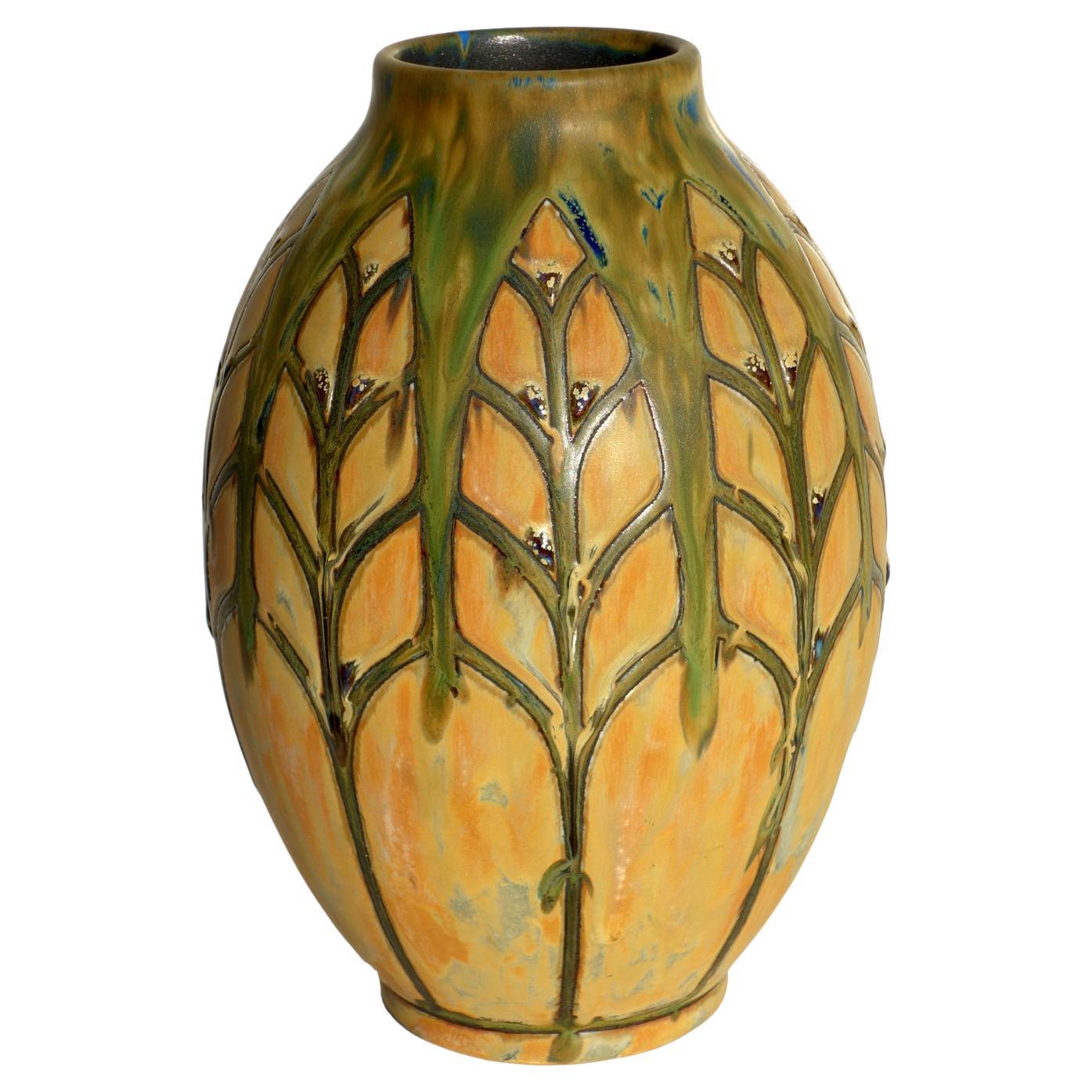
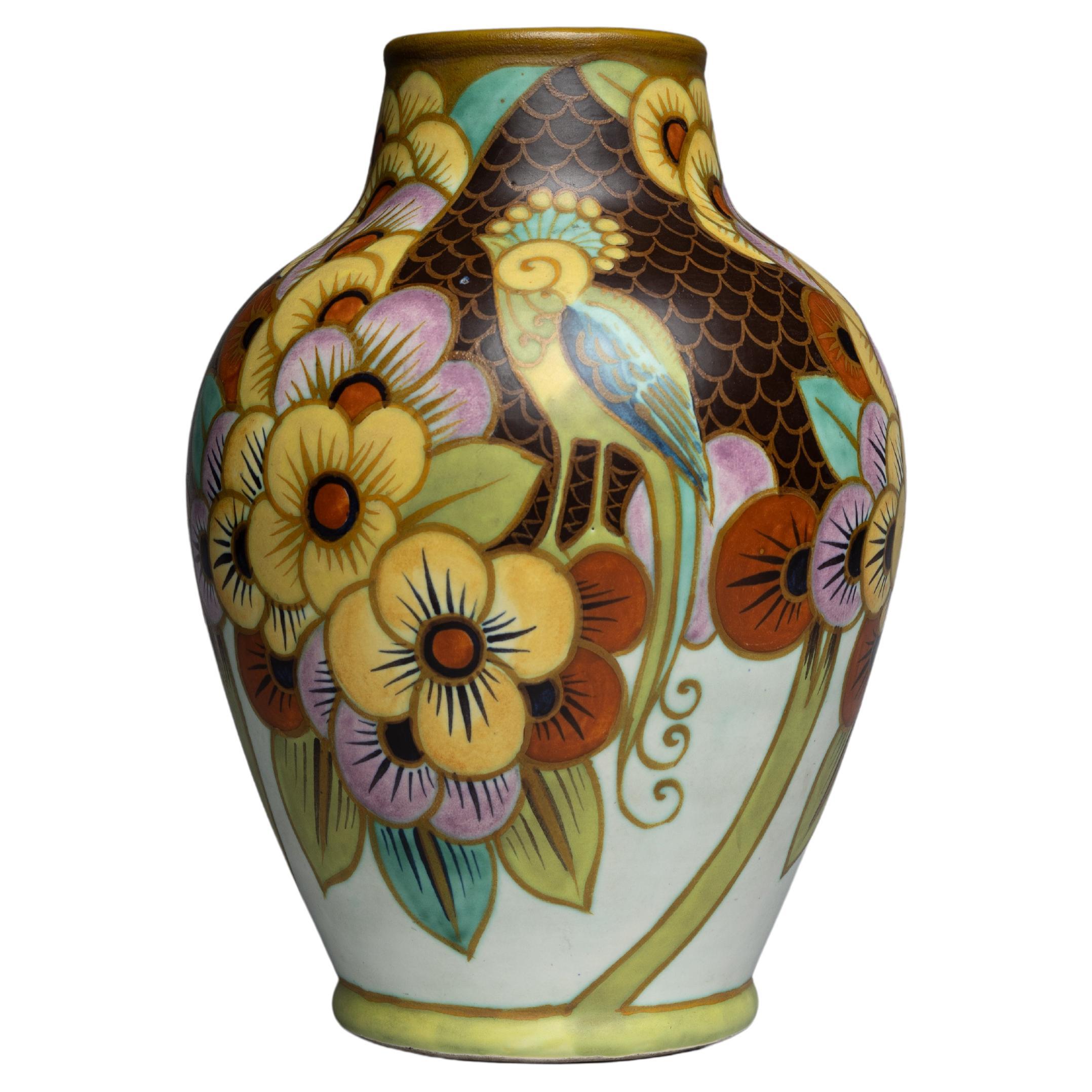
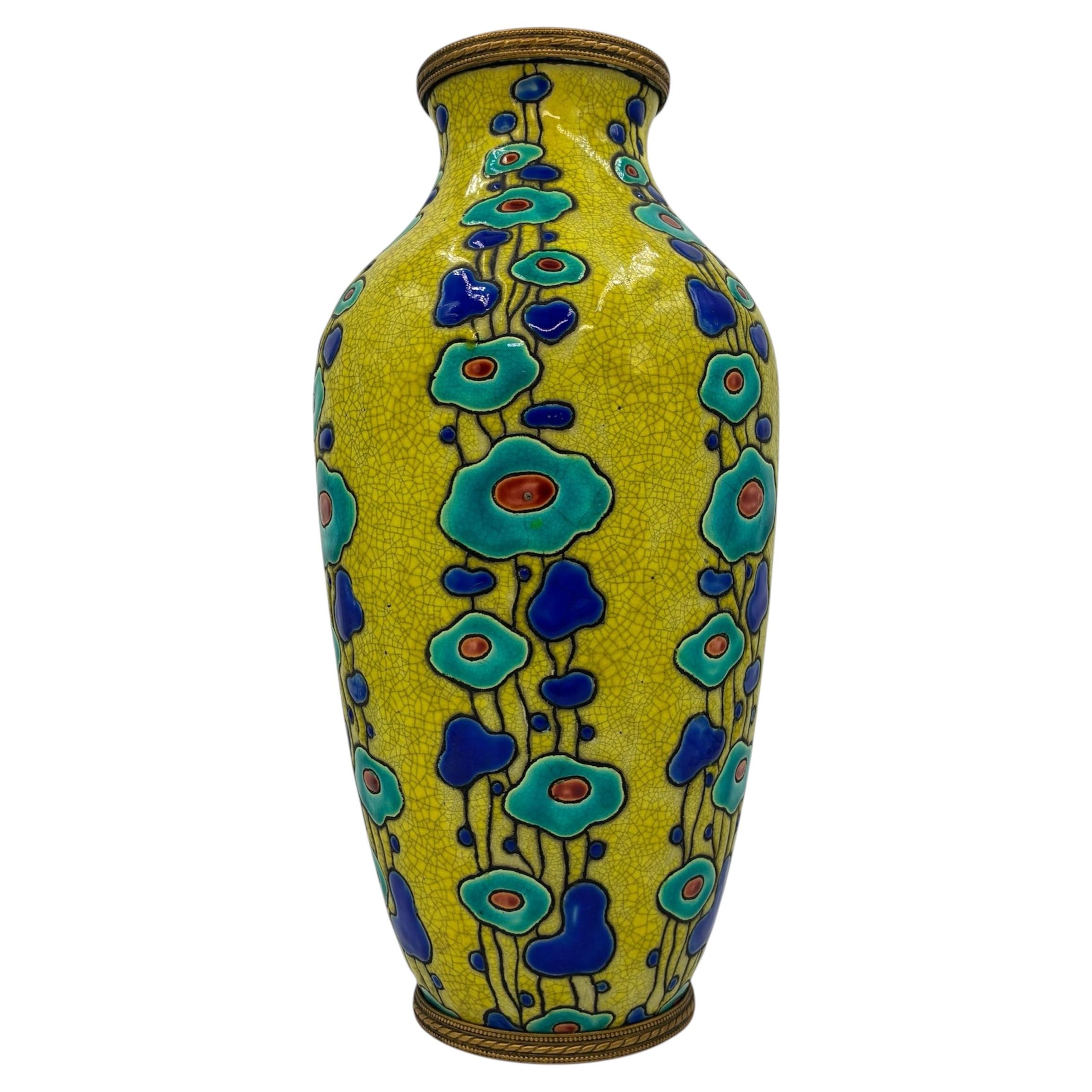
Charles Catteau Art Deco Grès Stoneware Vase, Décor D.1005
Boch Frères Keramis, La Louvière
Circa 1925
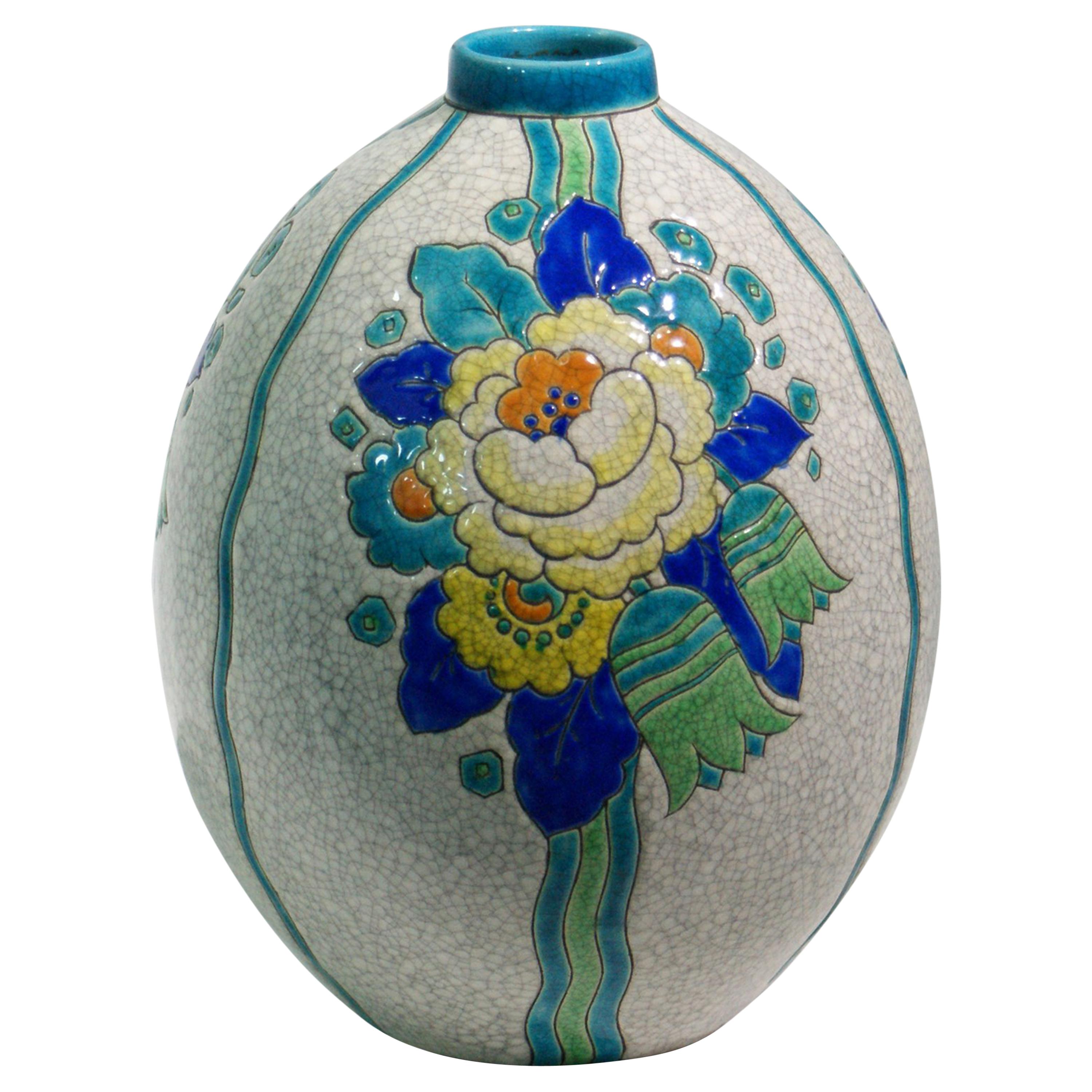
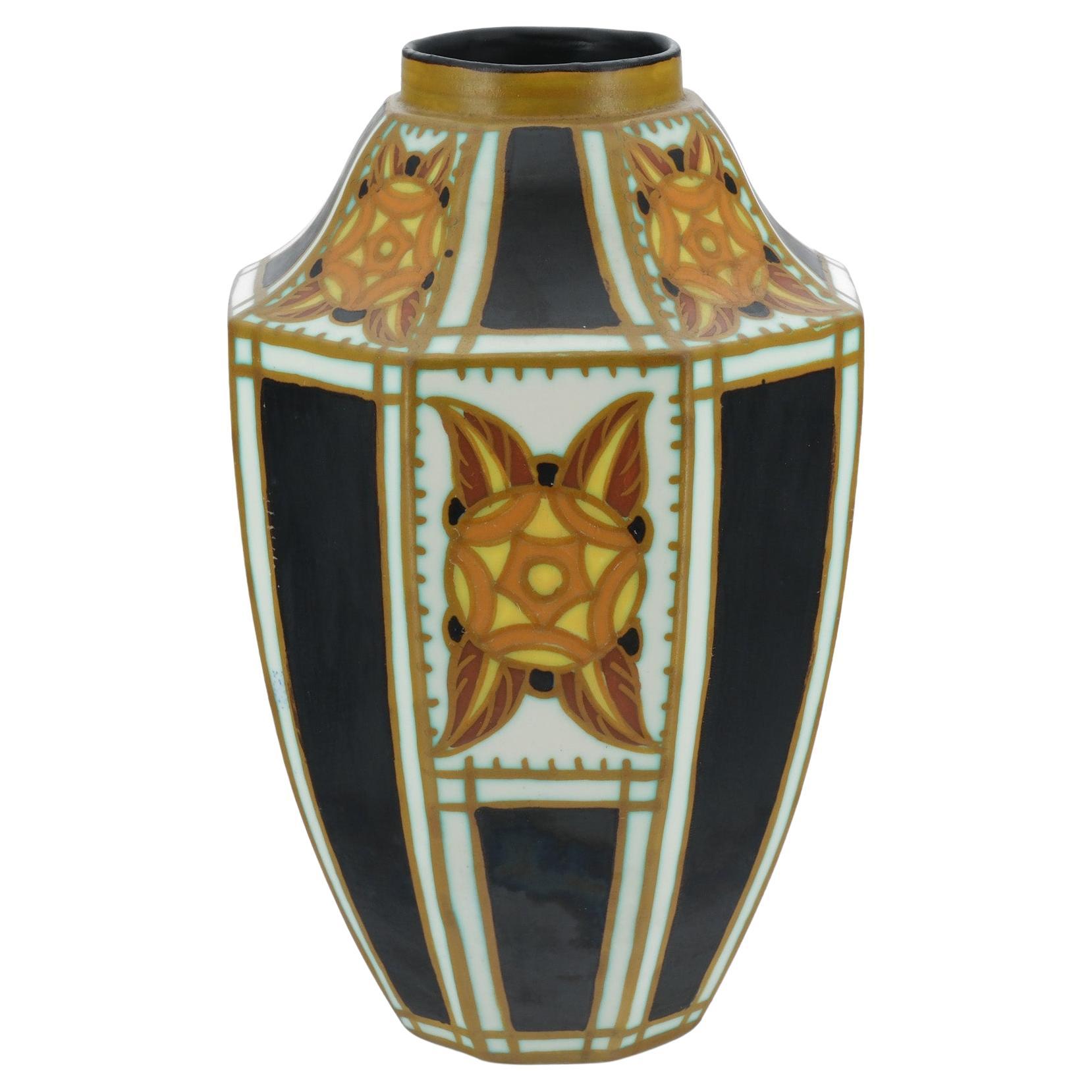
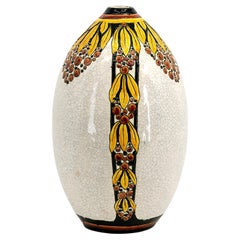
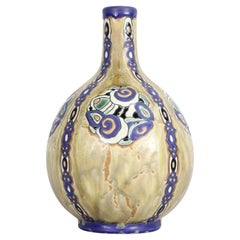
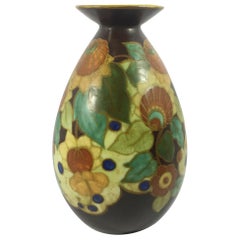
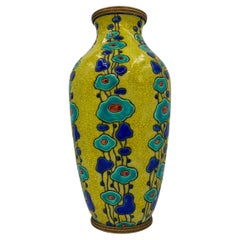
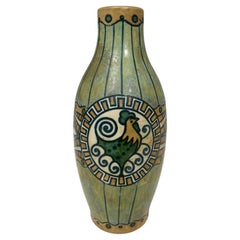
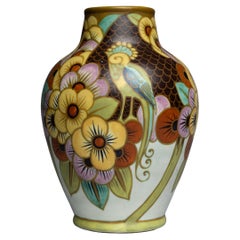
This tall baluster vase carries an all-over design running the full height of the body, in which arching ivory fronds outlined in brown rise from the foot and divide the surface into vertical registers, each frond enclosing a row of faceted apple-green flowerheads within brown surrounds. The ground is a dense matte brown, the neck finished with a rolled collar and the foot with a plain band in the same brown. The crackle is confined to the ivory, where it reads as a fine close web against the flat unbroken color around it, and the whole design is held to three colors — ivory, brown and green — which is the source of its force.
The décor is number D.1005, designed by Charles Catteau and executed by the painters of the Atelier de Fantaisie, the decorating studio Catteau directed at Boch Frères. The pattern was applied by pouncing, the design pricked through a paper stencil and dusted onto the body before the glazes were laid in by hand, a method that gave a large factory the means to repeat an exacting geometric design across a range of shapes without losing the character of hand painting.
The form is the factory’s number 898, the vase balustre. An example of the same form in the King Baudouin Foundation’s Catteau Collection, inventory DP 73, decorated with décor D.821, stands the same 288 millimeters high and carries the identical impressed 898 with the mold letter C. The vase is otherwise unusually well documented for a piece of industrial production: the Catteau Collection records only two other examples of décor D.1005, both now in the Musées royaux d’Art et d’Histoire in Brussels: a small bag-shaped vase of form 903, and a cask-shaped vase of form 895 standing 277 millimeters high, which carries the same incised Grès Keramis mark, the same round blue stamp and its décor number likewise painted in red. Neither is on this form, and neither is as large as this vase.
Dimensions
Height: 11¼ inches (28.6 cm)
Width: 5 inches (12.7 cm)
Marks
Grès Keramis incised in the clay; the signature Ch. Catteau painted in black script and underlined; the décor number D.1005 painted in red; the round blue printed stamp Made in Belgium, Boch Frères, La Louvière, Fabrication Belge; the form number 898 impressed, with a small impressed C for the mold.
Provenance
Canadian Collection
Earle D. Vandekar of Knightsbridge
Condition
Good.
References
Marc Pairon, Art Deco Ceramics Made in Belgium: Charles Catteau (Fondation Charles Catteau, Aartselaar, 2006) — the catalogue raisonné, inventorying more than 1,300 designs and some 450 forms
Michel Draguet, ed., Catteau: Donation Claire De Pauw et Marcel Stal (Fondation Roi Baudouin, Brussels, 2001)
Dominique Corrieras, L’Homme de Kéramis: Charles Catteau (Vivre son Temps, Paris, 1991)
Catteau Collection, King Baudouin Foundation, inventory numbers DP 25 and DP 26, for the two recorded comparable examples of décor D.1005, and inventory number DP 73 for the form 898 vase balustre
Historical Context
Boch Frères established their works at La Louvière, in the Belgian coalfield south of Brussels, in 1841, and traded under the name Keramis. By the 1920s it was the largest ceramics manufacturer in Belgium, employing some thirteen hundred people at its height and supplying the great Paris department stores from 1922. Grès — stoneware — was the more ambitious of the two bodies the firm worked in, fired harder than its fine earthenware and able to carry the deep matte glazes and controlled crackle on which the Art Deco wares depend. After a first bankruptcy in 1985 the works continued under the Royal Boch name until production finally ceased in 2011; the Musée Keramis, opened at La Louvière in 2015 around three surviving bottle kilns, now holds the factory archive.
Charles Catteau (1880–1966) was born at Douai, trained at the École Nationale de Céramique at Sèvres, and worked at the Nymphenburg porcelain manufactory in Munich before joining Boch Frères in December 1906. He took charge of the decorating department the following year and renamed it the Atelier de Fantaisie in 1920, directing it until the late 1940s. His designs drew on Japanese art, on African and Egyptian ornament — the latter sharpened by the opening of Tutankhamun’s tomb in 1922 — and on the Ballets Russes and the geometry of Cubism. Both Catteau and the factory were honored at the 1925 Exposition Internationale des Arts Décoratifs et Industriels Modernes in Paris, the exhibition that gave Art Deco its name, and this vase belongs to precisely that moment.
(Ref: NY11250-namm)