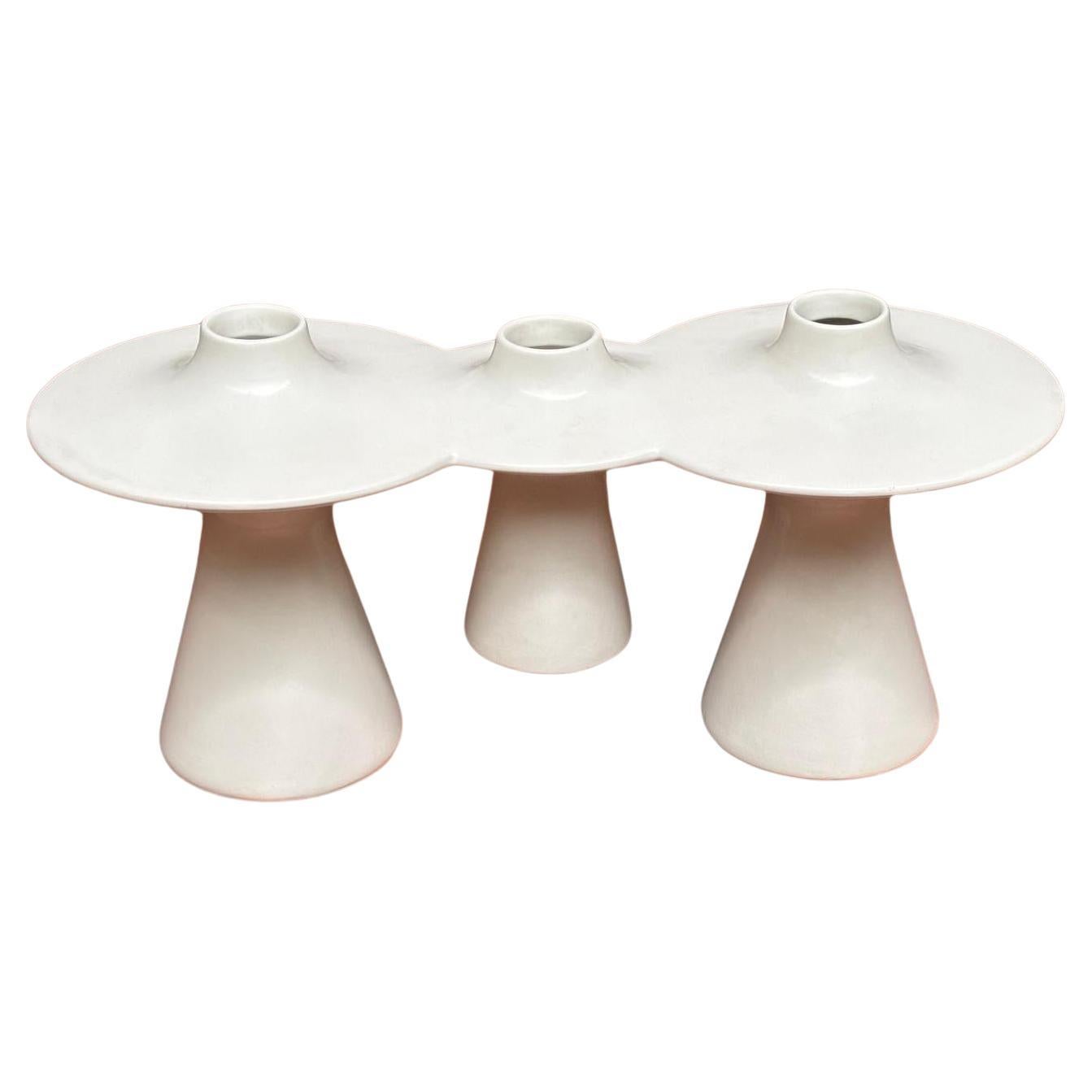
This elegant vase Model 11 of the Portali Collection designed by famous Italian designer and architect Andrea Branzi in 2007 and produced by Superego Editions. Limited edition of 50 pieces. Signed and numbered.
PORTALI
Milan, July 2007
“PORTALI” is a collection of 18 pieces of white pottery, intended as if they were small equal surroundings; yet, in each of these portals a different vase, or tree trunk is arranged.
Therefore, it is conceived as a series of micro-spaces, which create an architectural blossoming landscape; more than a collection of vases, “PORTALI” looks like an environmental project, the persistence of a simple thought that is renewed in time and space, like metrics or a stave.
As it has often occurred to me in these years, the actual center of my interests has been in flowers, due to their mysterious presence, rich in colors and fragrance inside the space of mankind, just like Japanese ikebana around which architecture develops, or tokonoma, which enclose both literature and the most private symbols in small niches.
I think that one of the tasks of design is being able to enrich the world not just with useless ornaments, but with self-sufficient spaces, micro-places devoted to what may seem unnecessary but absolutely necessary to give a sense to everything, such as the space for flowers and for the sacred objects of the lay civilizations.
Andrea Branzi
Biography
Seminal Italian architect, designer and educator Andrea Branzi held a lifelong fascination with how humans interact with objects, and sought to reconcile design and architecture with the evolving challenges of contemporary society. As a leading theorist, Branzi contributed an analytical and academic approach to the discipline.
Born in Florence in 1938, Branzi studied at the Florence School of Architecture, receiving his degree in 1966. From 1964 to 1974, he was a founding member of the experimental group Archizoom, which envisioned the groundbreaking No-Stop-City among other projects. Branzi was a key member of Studio Alchimia, founded in 1976, and went on to associate with the Memphis Group in the early 1980s.
In the 1980s, Branzi turned away from the prevailing, highly-stylized aesthetic of postmodern design. The key expression of this new direction was his seminal Animali Domestici (1985-1986) series, which featured rectilinear forms intersected by unfinished logs, sticks, and wood offcuts, in an attempt to bring the artificial and natural into equilibrium.
Branzi distinguished himself as a co-founder of Domus Academy, the first international post-graduate school for design, and was a professor and chairman of the School of Interior Design at the Politecnico di Milano until 2009. He was a three-time recipient of the Compasso d’Oro, honored for individual or group effort in 1979, 1987, and 1995. In 2008, Branzi was named an Honorary Royal Designer in the United Kingdom and he received an honorary degree from La Sapienza in Rome. That same year, his work was featured in an installation at the Fondation Cartier, Paris. In 2018, Branzi was the recipient of the prestigious Rolf Schock Prize in Visual Arts by the Swedish Royal Academy of Fine Arts.
Branzi’s works are held in the permanent collections of the Centre Georges Pompidou, Paris, France; Centro Studi e Archivio della Comunicazione dell’Università di Parma, Italy; Cooper Hewitt, Smithsonian Design Museum, USA; Fondation Cartier pour l’art contemporain, Paris, France; Le Fonds Régional d’art contemporain (FRAC), Orleans, France; Design Museum Gent, Belgium; Metropolitan Museum of Art, USA; Museum Boijmans Van Beuningen, Rotterdam, The Netherlands; Musée des Arts décoratifs, Paris, France; Musée des Beaux-Arts, Montreal, Canada; Museo del Design Italiano, Triennale di Milano, Italy; Museum of Fine Arts, Houston, USA; Museum of Modern Art, USA; Stedelijk Museum, Amsterdam, The Netherlands; Victoria & Albert Museum, London, UK; Vitra Design Museum, Weil-am-Rhein, Germany amongst others.
Andrea Branzi passed away in October 2023.