Want more images or videos?
Request additional images or videos from the seller
1 of 19

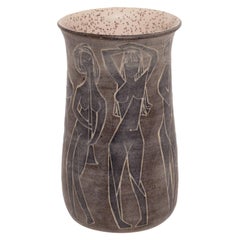
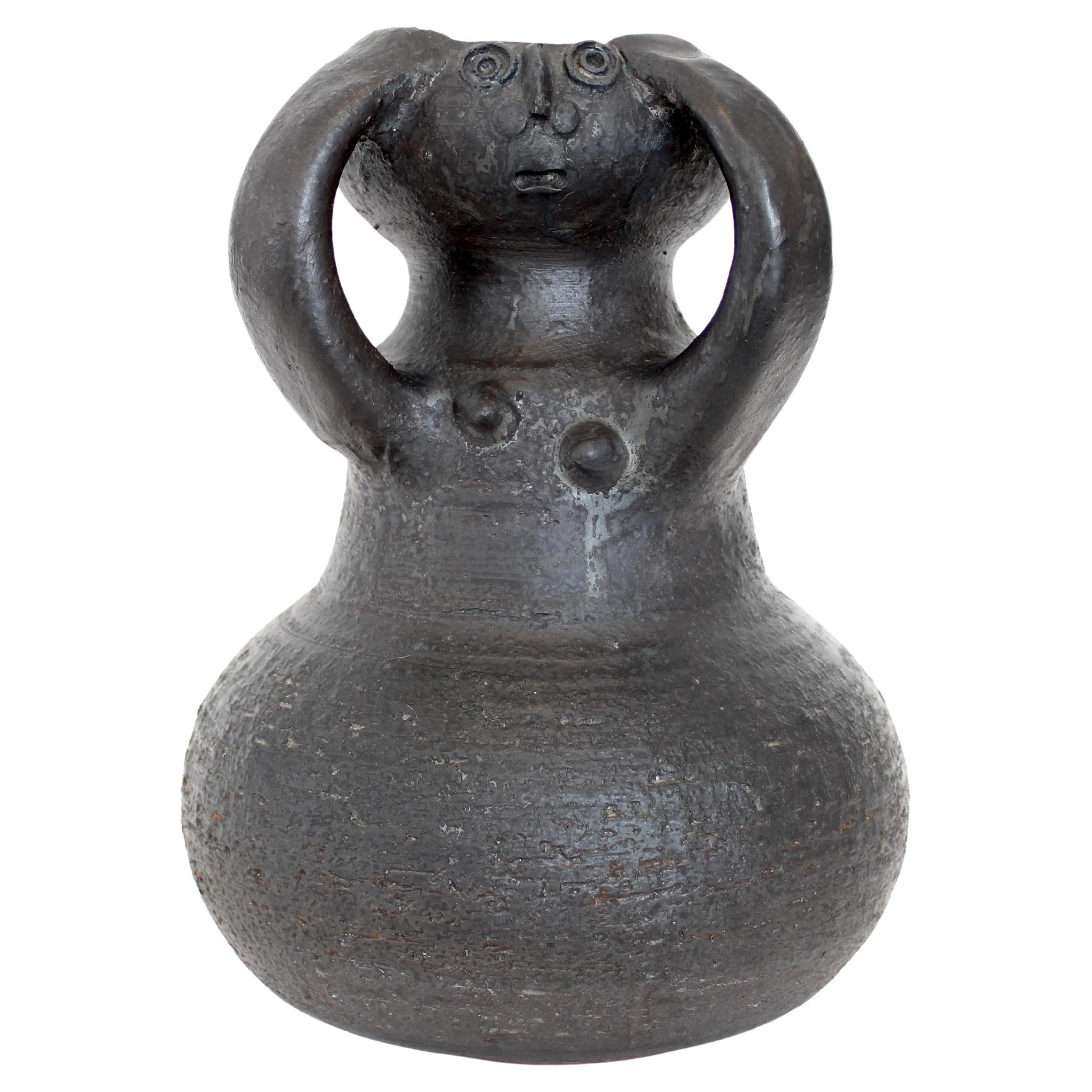
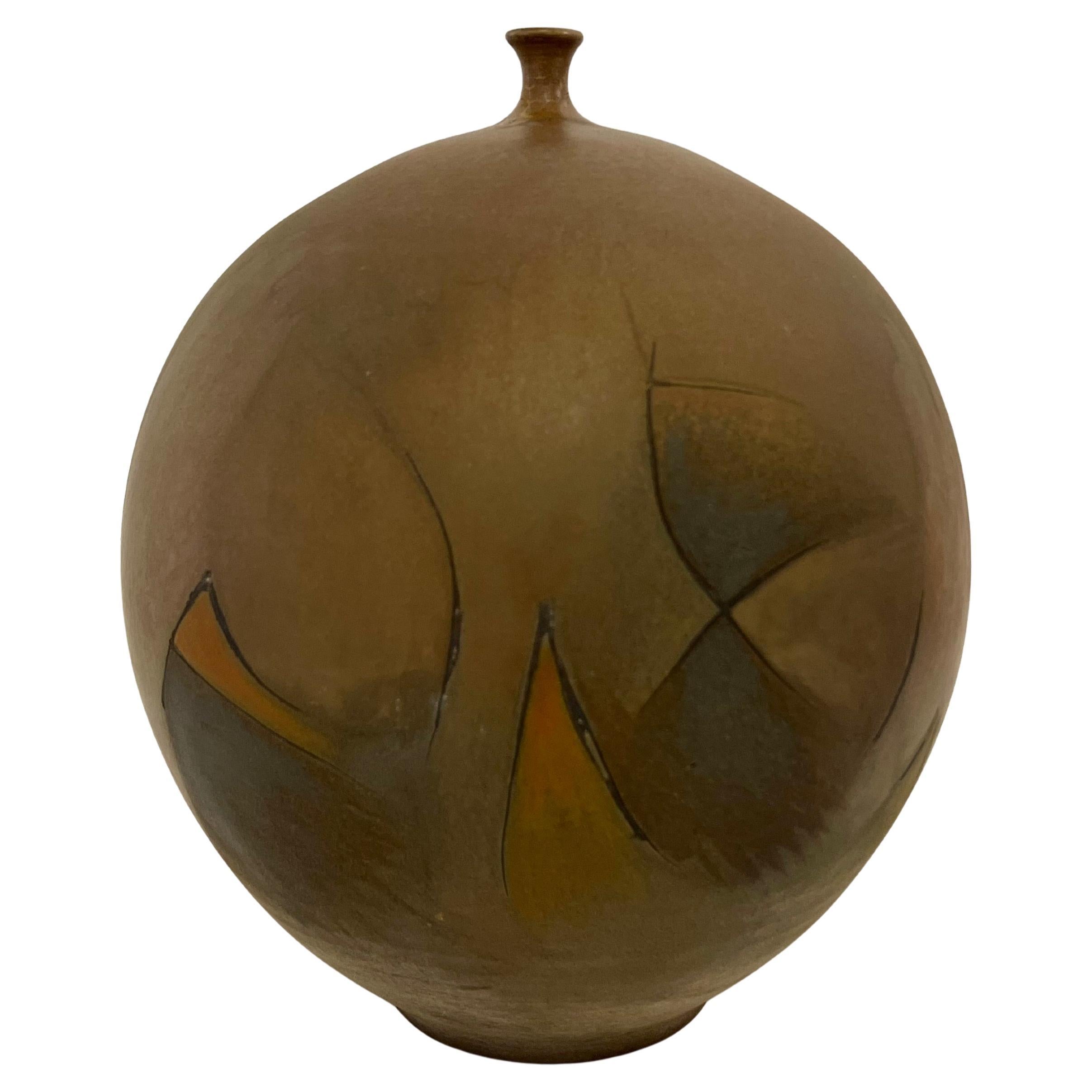
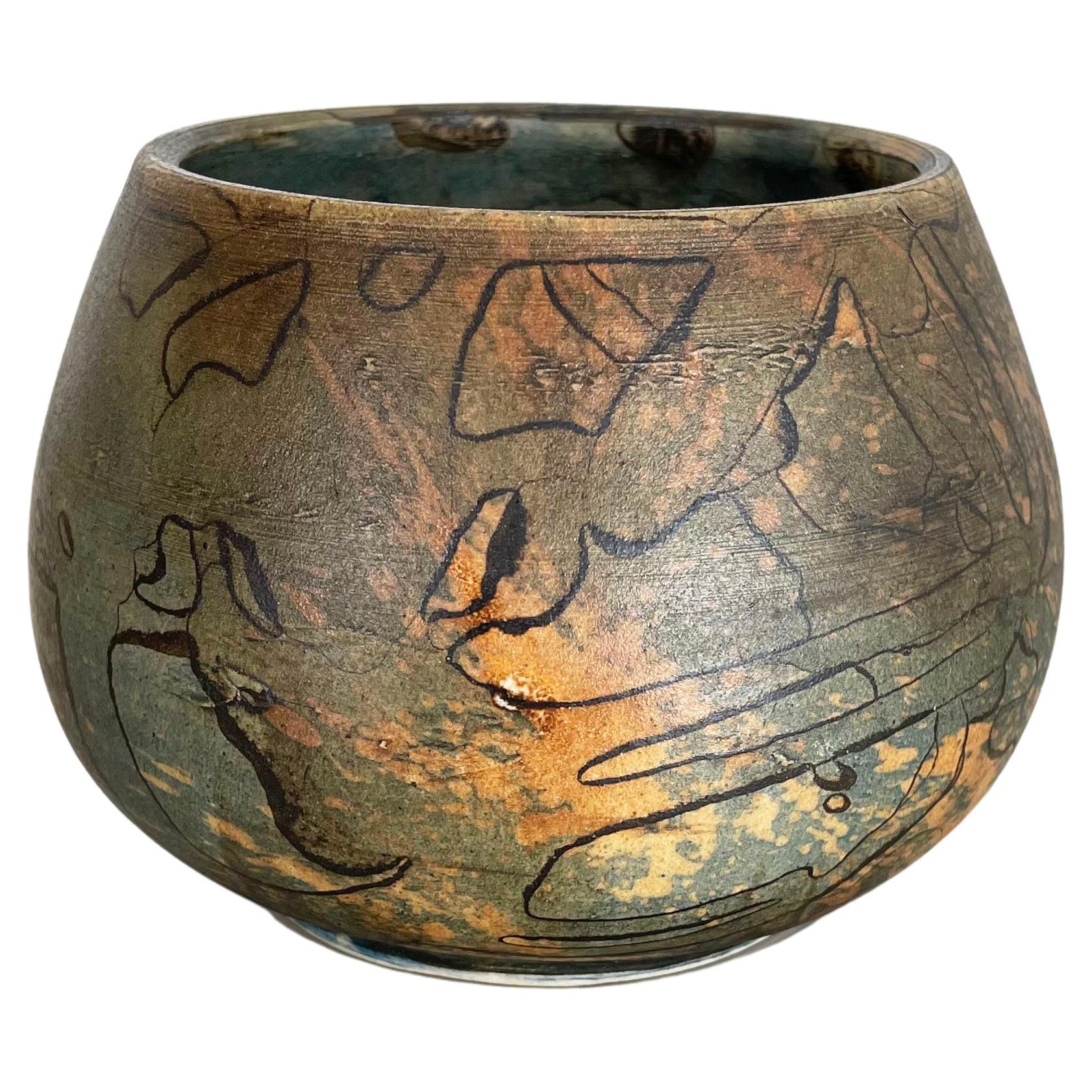
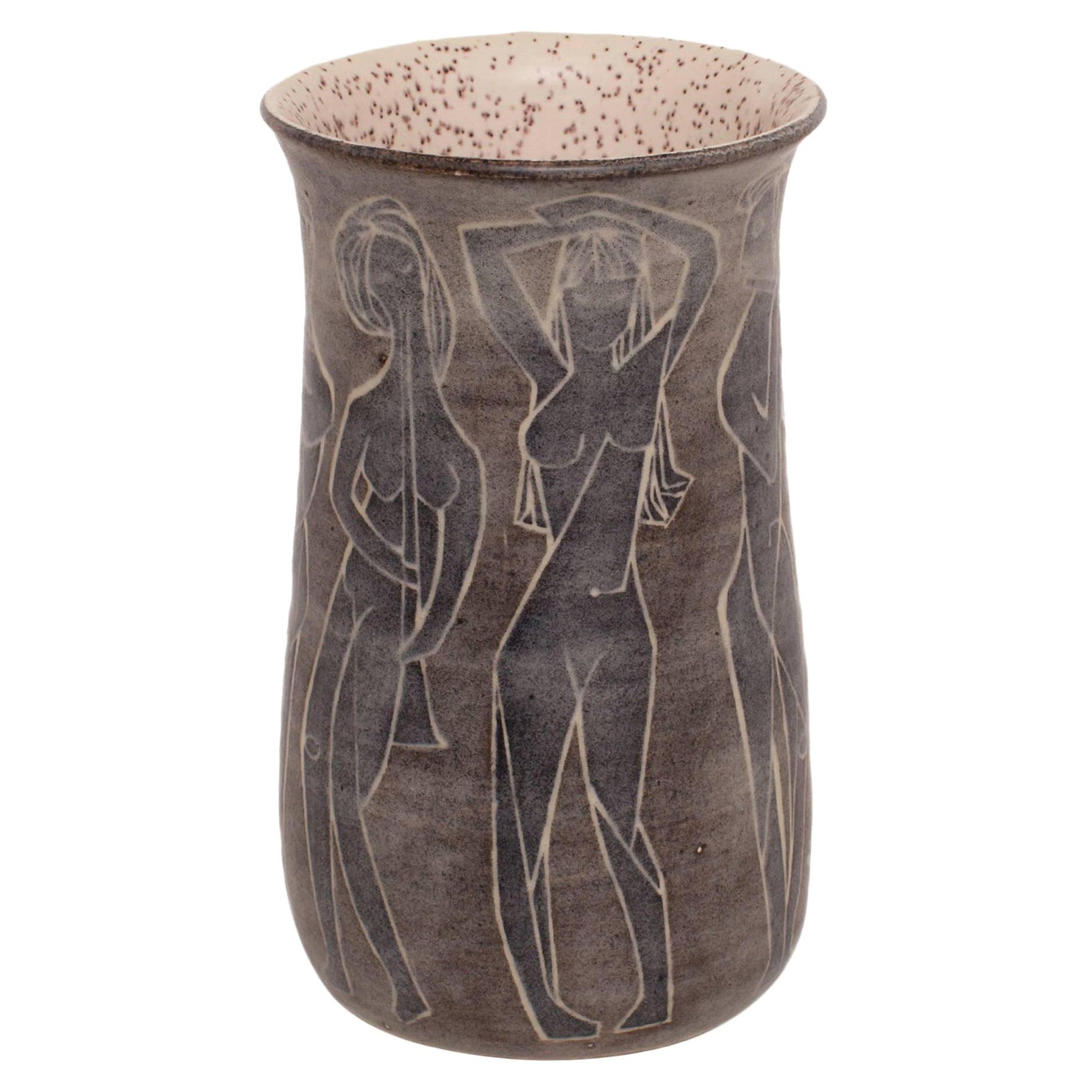
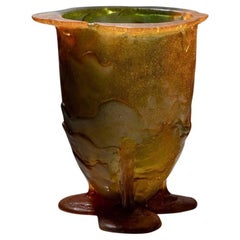
Roger Herman Erotic Ceramic Vessel with Deconstructed Rim, Signed and Dated 97'

$4,300
$5,60023% Off
£3,251.06
£4,236.6023% Off
€3,793.77
€4,951.2423% Off
CA$6,118.69
CA$8,014.7923% Off
A$6,207.19
A$8,143.7123% Off
CHF 3,543.98
CHF 4,613.6123% Off
MX$75,159.37
MX$99,088.9223% Off
NOK 41,721.25
NOK 54,098.9223% Off
SEK 41,582.79
SEK 54,393.6623% Off
DKK 28,368.65
DKK 37,038.1523% Off

About the Item

An original ceramic vessel with an erotic theme by Roger Herman, signed and dated RH 97. Rim of vase is intentionally 'chipped' aka deconstructed. This piece is believed to be important as it is one of his earliest ceramic works, prior to this Roger Herman specialized in large format paintings. ABOUT THE ARTIST: Roger Herman, originally from Germany, is a renowned artist celebrated for his diverse artistic expressions across various mediums. Born in 1947 in Germany, Herman commenced his artistic journey at the Kunstakademie in Karlsruhe. His career took a significant turn in 1976 when he received a fellowship from the German Academic Exchange Service (DAAD), leading him to San Francisco and eventually to California, where his artistic endeavors began to flourish. Herman initially gained recognition for his large-scale paintings, which drew parallels to the Neo-expressionist movement of the 1980s on the West Coast. His works are deeply rooted in art history yet infused with his distinctive humor, characterized by loose and expressive brushwork reminiscent of influential German painters like Markus Lüpertz and Georg Baselitz. His dynamic approach to painting caught the attention of Gagosian, who represented him and positioned him alongside prominent artists such as David Salle and Jean-Michel Basquiat in the California art scene. In the mid-eighties, Herman was offered a position in the art department of UCLA where he continues to teach and explore a broad range of styles. ‘It is about painting, not about subject matter. I don’t have a narrative,’ Herman says about his work. ‘The subject is always painting, which is why there is a repetition always— like Morandi. I’m trying to go somewhere I’m not comfortable.’ In 1998, Herman embarked on a new artistic exploration inspired by his student's influence, transitioning to ceramics. Despite this shift in medium, his painterly origins are evident in his approach to pottery, treating each piece as a canvas for meticulous brushwork. This fusion of painterly techniques with the tactile nature of clay became integral to his artistic evolution. Herman's work has been exhibited extensively across the United States and Europe, including notable solo exhibitions at venues such as George Lawson Gallery in San Francisco, Ace Contemporary Exhibitions in Los Angeles and New York, Larry Gagosian Gallery in Los Angeles, the Santa Monica Museum of Art, Museo del Arte Contemporana in Mexico City, and the Los Angeles County Museum of Art. In the last thirty years, Herman has contributed to the rise of several West Coast artists, who today pay their respects to him. Artist Cyril Kuhn says, ‘Every painter in the last 30 years who has come out of Los Angeles owes a debt to him.’ Currently based in Los Angeles, Roger Herman continues to innovate and inspire through his ongoing artistic pursuits. He has also made significant contributions to the art community through his teaching at UCLA and his role in fostering young artists at the Black Dragon Society gallery in Chinatown. In 2010, Herman curated the 'Los Angeles Museum of Ceramic Art' at ACME gallery, showcasing unconventional ceramics, including his own distinctive pieces adorned with nudes in erotic poses. Howard Singerman (Art Historian) wrote an article about Roger Herman in December 1982 in ArtForum Magazine: "Ocean, 1979, makes clear Roger Herman’s problem as a painter and summarizes something of the condition of current painting. This large, brooding diptych is fashioned of horizontal green, gray, and black sweeps capped with ridges of stark white. Ocean is ostensibly painting in the wild, an attempt to match the power of its subject with the immediacy of paint; but the painting is inscribed in the upper right with the names of Albert Pinkham Ryder and Marsden Hartley, and Herman’s ocean view is a genre painting, a seascape. Herman’s expressionistic style, too, with its roots in German Expressionism and the New York School, is previously painted. His mean colors, thick pigment, and quick strokes are not a direct record of emotion and activity; they are not painting outside language, but signs for that painting, for an emotion and an activity that are no longer available. The expressionist act is recast as romantic aspiration; in his inscription, Herman evokes painting’s past and admits his need for its aura. The past hangs heavily over the exhibition’s more recent work, too, but now Herman’s citings are more pointed and his past a more obviously represented and ironic one. A small painting of Jean Paul Marat, La Crie du Peuple, one of the exhibition’s two best paintings, recalls David’s painting of The Death of Marat, and carries the revolutionary’s name in a lower corner. But Herman’s Marat faces in the opposite direction from David’s; David isn’t his model. Instead, the scene is taken from Abel Gance’s Napoleon, and Antonin Artaud, who acted in the film and whose name is written in the opposite corner of the painting, appears as Marat. The painting is pantingly romantic, with the artist (Artaud) cast as the revolutionary killed by his own madness. Indian’s subject, a painted “red” Indian, is, like Marat, an image of freedom from the bonds of a tired culture. But a splintery woodcut of the same Indian, from a group of four prints that comprise the exhibition’s most effective work (perhaps because they aren’t paintings), is dedicated to Karl May, a German mythologist of the American West. Herman’s Indian, like his revolutionary and his ocean, has always been metaphor." AWARDS: DAAD Grant from Germany National Endowment for the Arts Fellowship Grants MEASUREMENTS: H 9.5" x W 9.25" x D 9.25" CONDITION: Excellent condition, ready for immediate use. Light age and patina. Rim is intentionally deconstructed as seen on many other examples of his ceramic vessels.
  • Creator:
    Roger Herman (Sculptor)
  • Dimensions:
    Height: 9.5 in (24.13 cm)Width: 9.25 in (23.5 cm)Depth: 9.25 in (23.5 cm)
  • Style:
    Modern (Of the Period)
  • Materials and Techniques:
    Ceramic,Glazed
  • Place of Origin:
  • Period:
    1990-1999
  • Date of Manufacture:
    1997
  • Condition:
    Excellent condition with light age and patina. Ready for immediate use.
  • Seller Location:
    Los Angeles, CA
  • Reference Number:
    Seller: AUTOM001861stDibs: LU1330240303592

More From This Seller

View All
'Amazonia' Resin Vase by Gaetano Pesce for Fish Design Italy, Serie 2007, Signed

'Amazonia' Resin Vase by Gaetano Pesce for Fish Design Italy, Serie 2007, Signed

By Fish Design, Gaetano Pesce

Located in Los Angeles, CA

This sculptural 'Amazonia' vase by Gaetano Pesce for Fish Designs, Italy, is an authentic early-21st-century example dating to 2007 (signed with Serie 2007 stamp), produced during a period when Pesce’s resin works were still executed in comparatively limited, workshop-driven batches rather than today’s broader ongoing production. As such, pieces from this era are increasingly sought after by collectors for their closer proximity to the artist’s original intent, material experimentation, and hands-on oversight. The vase is formed in richly pigmented, hand-poured resin with Pesce’s signature organic asymmetry and expressive surface texture. The undulating body evokes aquatic movement, while the integrated fish-like feet give the form a playful yet surreal presence, hallmarks of Pesce’s long-standing fascination with nature, transformation, and nonconformist design. Variations in translucency, air bubbles, and color density are inherent to the work and should be understood as deliberate artistic choices rather than imperfections, reinforcing the individuality of each example. This piece retains its original molded Pesce stamp at the base, confirming authenticity. The warm golden-amber coloration is particularly striking, catching and refracting light in a way that accentuates the sculptural contours and gives the vase a glowing, almost molten quality. Whether displayed as a functional vessel or as a standalone sculptural object, it reads immediately as Pesce - bold, provocative, and unapologetically unconventional. A strong addition for collectors of post-modern and contemporary Italian design, this 2007 Amazonia vase represents a desirable earlier chapter in Pesce’s resin oeuvre and stands apart from later mass-market iterations. ABOUT THE ARTIST: Gaetano Pesce, born on November 8, 1939, in La Spezia, Italy, is renowned as a leading figure in contemporary Italian design and architecture. Fearlessly experimental with materials and color, Pesce has collaborated with Italy’s foremost design companies, including Artemide, Vitra, Cassina, and B&B Italia. Pesce began his journey into design at the University of Venice, where he pursued architecture and graduated in 1965. Influenced by prominent figures such as Ernesto Nathan Rogers and Mario Bellini at the Venice College of Industrial Design, Pesce embraced a commitment to novelty and avant-garde principles. He co-founded the avant-garde architectural collective "Gruppo N," inspired by the Bauhaus aesthetic, during his formative years. Pesce’s portfolio encompasses a wide range of designs, from iconic furniture pieces to monumental architectural projects. His creations reflect a profound contemplation of modernity, exemplified by the La Mamma chair (1969), which evokes a prehistoric fertility figure, and the Organic Building in Osaka (1993), celebrated for its innovative hanging garden motif. Among his most celebrated furniture designs are the Up series for B&B Italia, including the Up5 armchair (La Donna) and Up6 ottoman (La Mamma), which challenge traditional notions of form and function with their bold, anthropomorphic shapes. Other notable designs include the 357 Feltri chair...

Category

Early 2000s Italian Post-Modern Vases

Materials

Resin

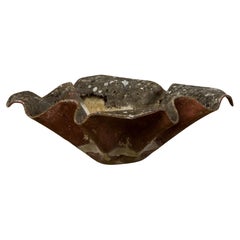
Large 'Handkerchief' Concrete Planter by Willy Guhl for Eternit, c. 1968

Large 'Handkerchief' Concrete Planter by Willy Guhl for Eternit, c. 1968

By Willy Guhl, Eternit

Located in Los Angeles, CA

This beautiful large sized (35" diameter) 'Handkerchief' concrete planter by Swiss architect Willy Guhl for Eternit, circa 1968 Switzerland in a lovely patinated red exterior finish ...

Category

Vintage 1960s Swiss Modern Planters and Jardinieres

Materials

Concrete

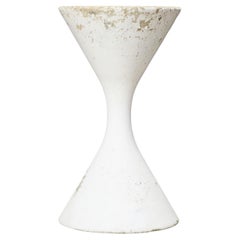
Monumental 38" Willy Guhl for Eternit 'Diablo' Concrete Spindle Planter, c 1968

Monumental 38" Willy Guhl for Eternit 'Diablo' Concrete Spindle Planter, c 1968

By Willy Guhl, Eternit

Located in Los Angeles, CA

Incredibly gorgeous 38" tall 'Diablo' concrete spindel planter by Swiss architect Willy Guhl for Eternit, circa 1968, Switzerland. This sculptural hourglass shaped concrete planter has a white exterior finish. We have a large collection of Willy Guhl for Eternit pots, planters, garden objects, jardinières, and patio furniture. We always have inventory in Diablo's, Tilted and Cone Planters, box and rectangular Guhl...

Category

Vintage 1960s Swiss Modern Planters and Jardinieres

Materials

Concrete

Monumental 38" Willy Guhl for Eternit 'Diablo' Concrete Spindle Planter, c 1968

Monumental 38" Willy Guhl for Eternit 'Diablo' Concrete Spindle Planter, c 1968

By Willy Guhl, Eternit

Located in Los Angeles, CA

Incredibly gorgeous 38" tall 'Diablo' concrete spindel planter by Swiss architect Willy Guhl for Eternit, circa 1968, Switzerland. This sculptural hourglass shaped concrete planter has a white exterior finish. We have a large collection of Willy Guhl for Eternit pots, planters, garden objects, jardinières, and patio furniture. We always have inventory in Diablo's, Tilted and Cone Planters, box and rectangular Guhl...

Category

Vintage 1960s Swiss Modern Planters and Jardinieres

Materials

Concrete

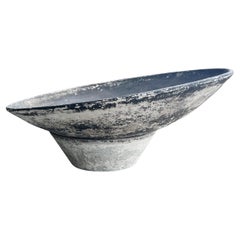
Large Adjustable Spindle Planter by Willy Guhl, Switzerland 1970s, Signed

Large Adjustable Spindle Planter by Willy Guhl, Switzerland 1970s, Signed

By Willy Guhl, Eternit

Located in Los Angeles, CA

A striking and large-scale adjustable tilted spindle planter designed by Swiss architect Willy Guhl for Eternit, Switzerland, circa 1978. This sculptural example exemplifies Guhl’s m...

Category

Vintage 1970s Swiss Modern Planters and Jardinieres

Materials

Concrete

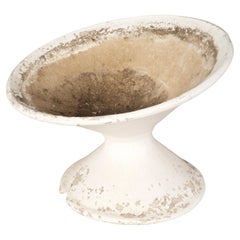
Willy Guhl for Eternit Large Sized Tilted Spindle Concrete Planter, circa 1968

Willy Guhl for Eternit Large Sized Tilted Spindle Concrete Planter, circa 1968

By Eternit, Willy Guhl

Located in Los Angeles, CA

A large sized (18" tall and 25" wide) tilted spindle concrete planter by Swiss architect Willy Guhl for Eternit, circa 1968, Switzerland. This special 'tilted' hourglass shaped concr...

Category

Vintage 1960s Swiss Modern Planters and Jardinieres

Materials

Concrete

You May Also Like

Italian Ceramic Vase by Marcello Fantoni, 1960s

Italian Ceramic Vase by Marcello Fantoni, 1960s

By Marcello Fantoni

Located in Phoenix, AZ

Marcello Fantoni glazed ceramic vessel, circa early 1960s. This fabulous example has hand painted female figures around the exterior and a speckled glaze on the inside.

Category

Vintage 1960s Italian Mid-Century Modern Vases

Materials

Ceramic

Tom Ferguson Ceramic Vase, United States, 1990's

Tom Ferguson Ceramic Vase, United States, 1990's

Located in San Juan Capistrano, CA

Tom Ferguson Ceramic Vase, United States, 1990's. Signed to the bottom.

Category

20th Century American Modern Vases

Materials

Ceramic

Italian Ceramic Vase by Marcello Fantoni

Italian Ceramic Vase by Marcello Fantoni

By Marcello Fantoni

Located in Asti, Piemonte

A ceramic vase designed and produced by Marcello Fantoni in 1983. Signed. Biography: Marcello Fantoni was born in Florence on October 1, 1915. Growing up, he became passionate about...

Category

Vintage 1980s Italian Modern Vases

Materials

Ceramic

Abstract Ceramic Studio Pottery Object by Gerhard Liebenthron, Germany, 1970s

Abstract Ceramic Studio Pottery Object by Gerhard Liebenthron, Germany, 1970s

By Gerhard Liebenthron

Located in Kirchlengern, DE

Article: Ceramic stoneware object Designer and producer: Gerhard Liebenthron Information: Gerhard Liebenthron, Bremen 1925-2005 Decade: 1970s This origin...

Category

Late 20th Century German Mid-Century Modern Vases

Materials

Ceramic, Pottery, Stoneware

Don Reitz Studio Pottery Sculpture Vessel

Don Reitz Studio Pottery Sculpture Vessel

By Don Reitz

Located in Las Vegas, NV

Mid-Century Don Reitz studio art pottery vessel. Circa late 1960s, measuring 23 inches tall x 20 inches wide. Weighs approximate 70lbs. Unsigned, as far as I can find, but unmistakab...

Category

Mid-20th Century American Mid-Century Modern Planters, Cachepots and Jar...

Materials

Pottery

Abstract Ceramic Studio Pottery Vase by Gerhard Liebenthron, Germany, 1980s

Abstract Ceramic Studio Pottery Vase by Gerhard Liebenthron, Germany, 1980s

By Gerhard Liebenthron

Located in Kirchlengern, DE

Article: Ceramic stoneware object Designer and producer: Gerhard Liebenthron Information: Gerhard Liebenthron, Bremen 1925 †2005 Decade: 1970s This original vintage Studio...

Category

Late 20th Century German Mid-Century Modern Vases

Materials

Ceramic, Pottery, Stoneware