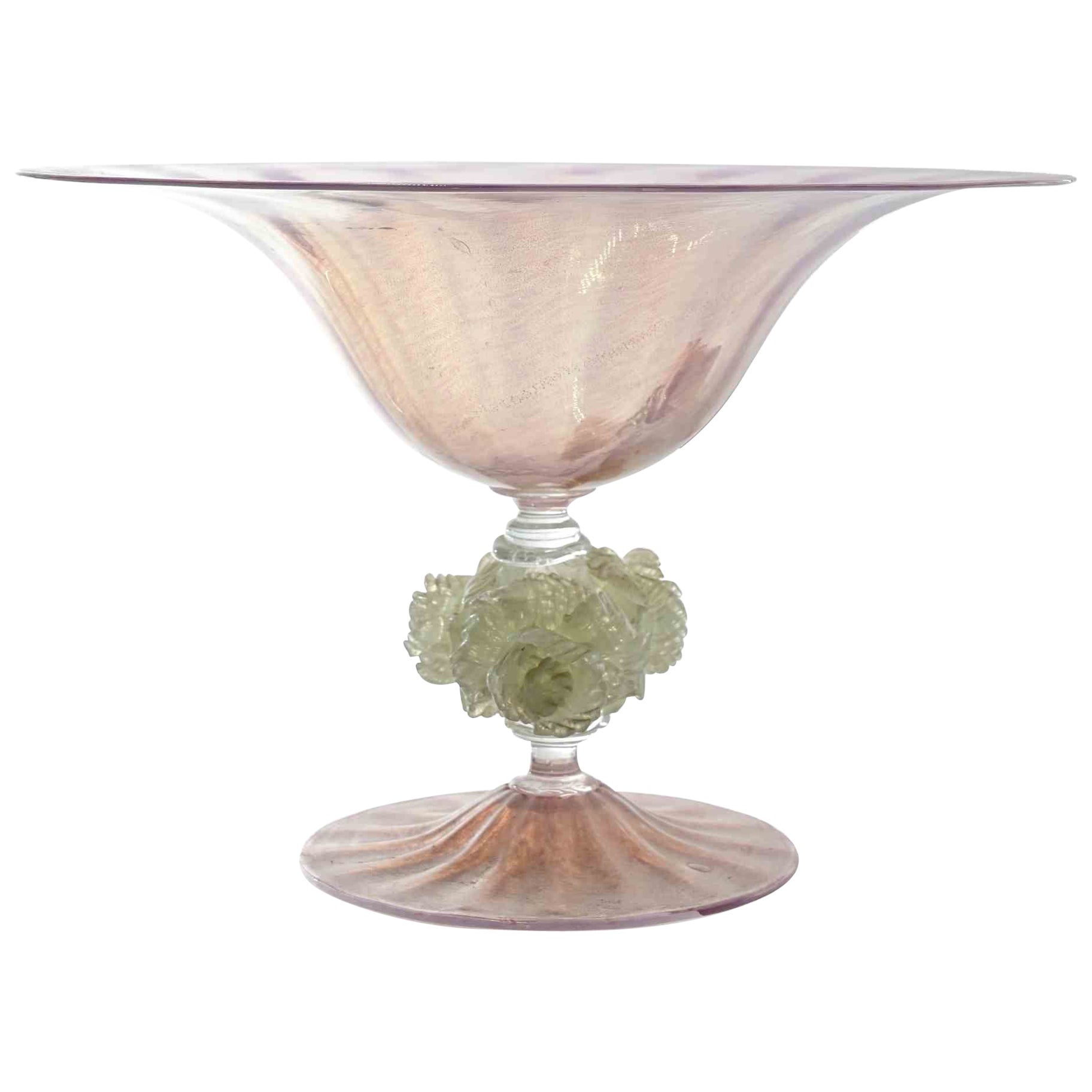
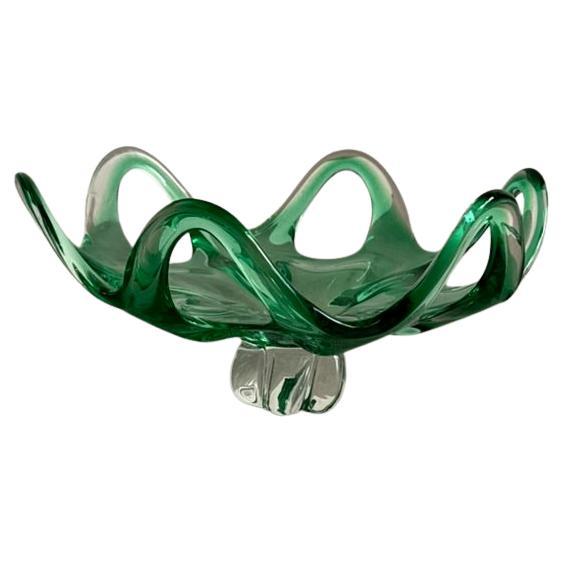
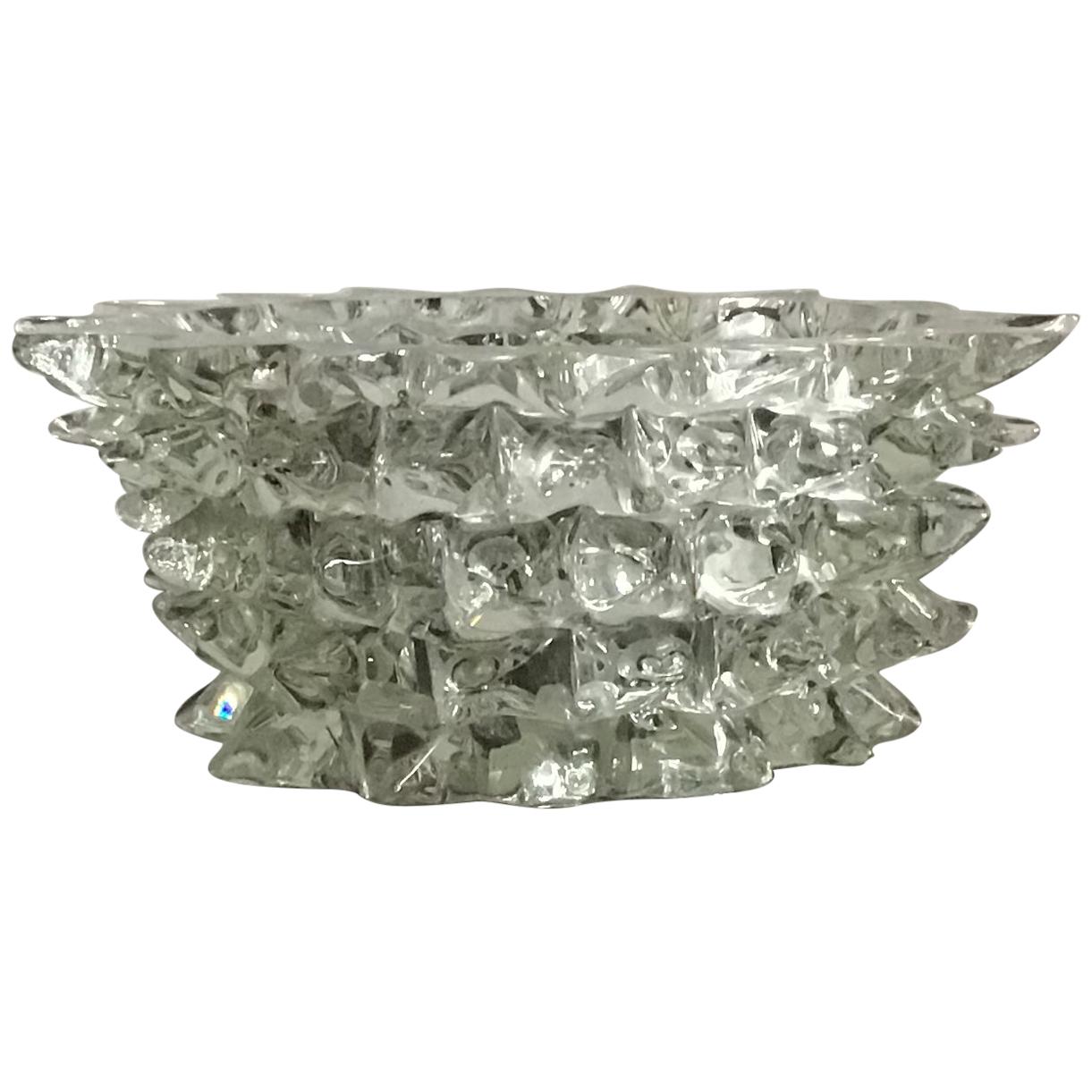
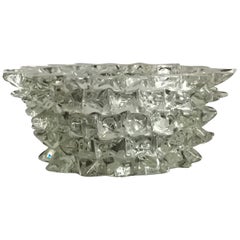
Barovier e Toso Murano Glass Rostrato Centerpiece, 1940, Italy
By Barovier&Toso
Located in Milano, IT
Barovier e Toso Murano glass Rostrato centerpiece, 1940, Italy.
Category
Vintage 1940s Italian Other Crystal Serveware
Materials
Murano Glass
Partnerships come and go within the community of glass-making artisans on the Venetian island of Murano, where business relationships seem as complex as the shifting alliances in the notoriously acrimonious Italian parliament. Formed in 1942 by members of families with centuries of experience in the craft, Barovier&Toso has proven to be one of the most enduring and prosperous Italian glass manufactories of recent decades. Under the nearly 50-year artistic directorship of cofounder Ercole Barovier (1889–1974), the company created buoyant traditional pieces such as chandeliers, sconces and other lighting fixtures, and it pioneered an array of innovative modernist glass designs with bold colors, patterns and surfaces.
The Barovier dynasty began in 1295, when Jacobello Barovier, mentioned in historical documents as a master glassblower, began pinching, cutting, blowing and twisting a molten mixture of sand and minerals into incandescent works of art. It remained entirely family-owned until the mid-20th century, when it merged with another glassworks to become Barovier&Toso.
To appeal to gentler, more conservative tastes, Barovier&Toso produced a range of lilting, sinuous lighting pieces that are often described as embodying “Liberty Style” — the Italian term for Art Nouveau, taken from the name of famed London department store Liberty & Co., which promoted 19th-century organic textile designs and Arts and Crafts-style furniture in the manner of William Morris. The hallmarks of the style in Barovier&Toso works are elements of glass in the shape of thick leaves, fronds and flower petals, deployed along with other naturalistic ornament in sconces, pendants and chandeliers.
Ercole Barovier began his personal aesthetic transition toward modernism in the 1930s with his Primavera series of vases and animal sculptures — idiosyncratic milky-white and clear glass filled with tiny bubbles and hairline interior fissures that he produced for Artisti Barovier, a firm headed by his father and uncle. Later, with Barovier&Toso, he would explore such novel styles as the mosaic-like Pezzato glass; fluid Spiral patterns; the pebbly textured Barbarico line and the complex, layered and highly colored abstractions of the Oriente series of vases and bowls.
Traditional or modern, Barovier&Toso — still under family control — has produced one of the finest and most diverse catalogues of Murano glass in the last 100 years.
Find antique Barovier&Toso chandeliers, serveware, decorative objects and more on 1stDibs.
Barovier e Toso Murano Glass Rostrato Centerpiece, 1940, Italy
By Barovier&Toso
Located in Milano, IT
Barovier e Toso Murano glass Rostrato centerpiece, 1940, Italy.
Murano Glass
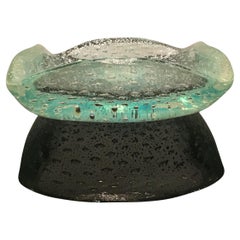
Venini Centerpiece Murano Glass, 1950, Italy
By Venini
Located in Milano, IT
Venini centerpiece Murano glass, 1950, Italy.
Murano Glass
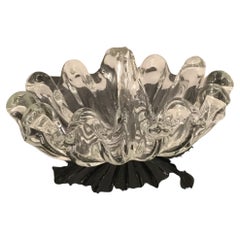
Barovier e Toso Centerpiece Murano Glass, 1940, Italy
By Barovier&Toso
Located in Milano, IT
Barovier e Toso.
Murano Glass
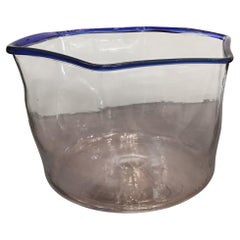
Venini Centerpiece Murano Glass, 1960, Italy
By Venini
Located in Milano, IT
Venini centerpiece murano glass, 1960, Italy.
Murano Glass
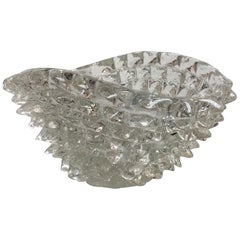
Barovier e Toso Centerpiece “Rostrato” Murano Glass, 1940, Italy
By Barovier&Toso
Located in Milano, IT
Barovier e Toso centerpiece “Rostrato” murano glass, 1940, Italy.
Murano Glass
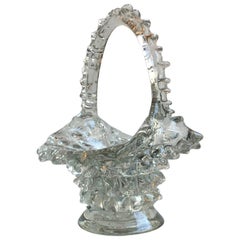
Barovier e Toso Centerpiece “Rostrato” Murano Glass, 1940, Italy
By Barovier&Toso
Located in Milano, IT
Barovier e Toso centerpiece “Rostrato“ Murano glass, 1940, Italy.
Murano Glass
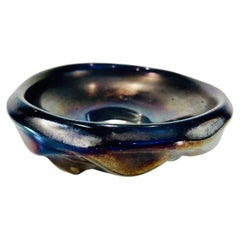
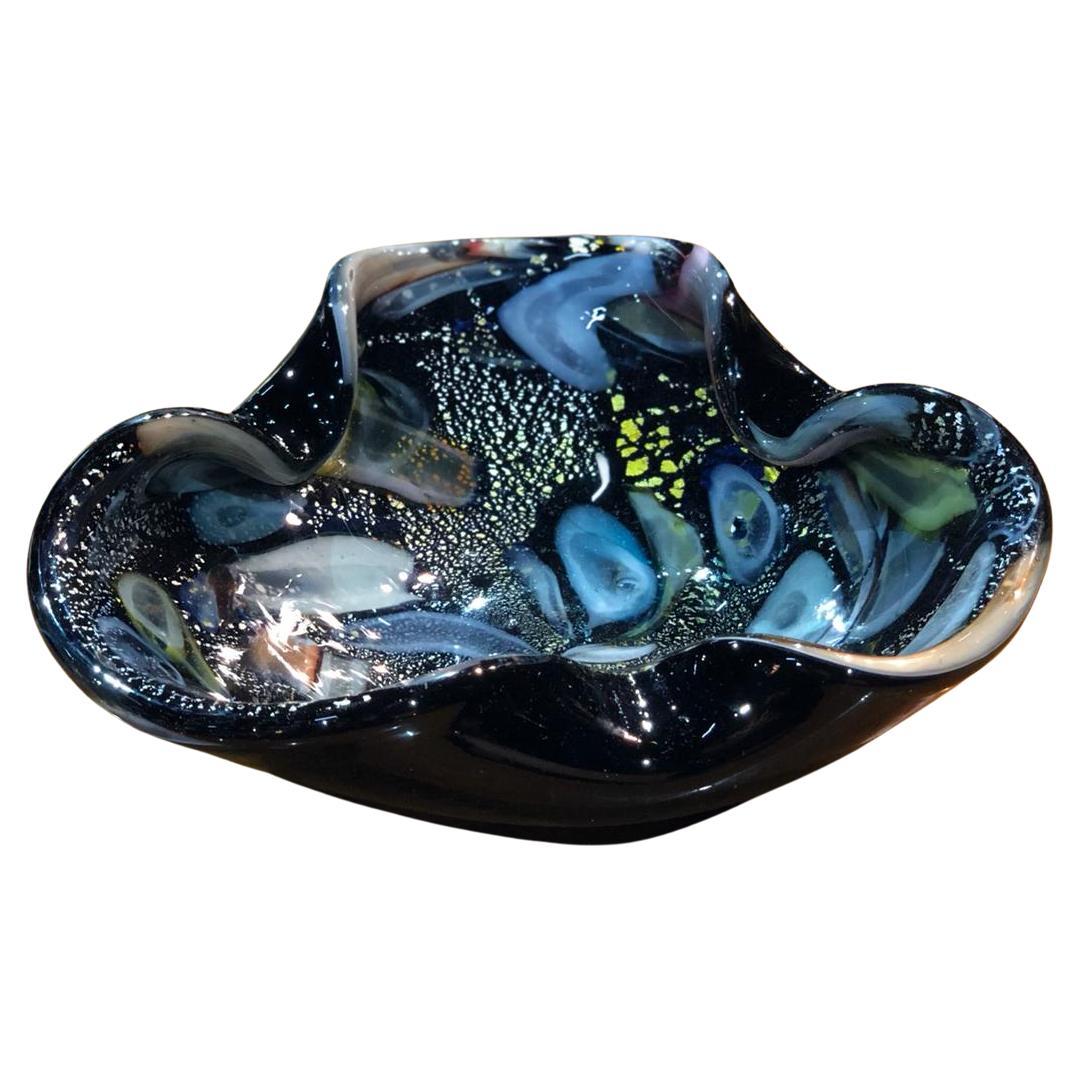
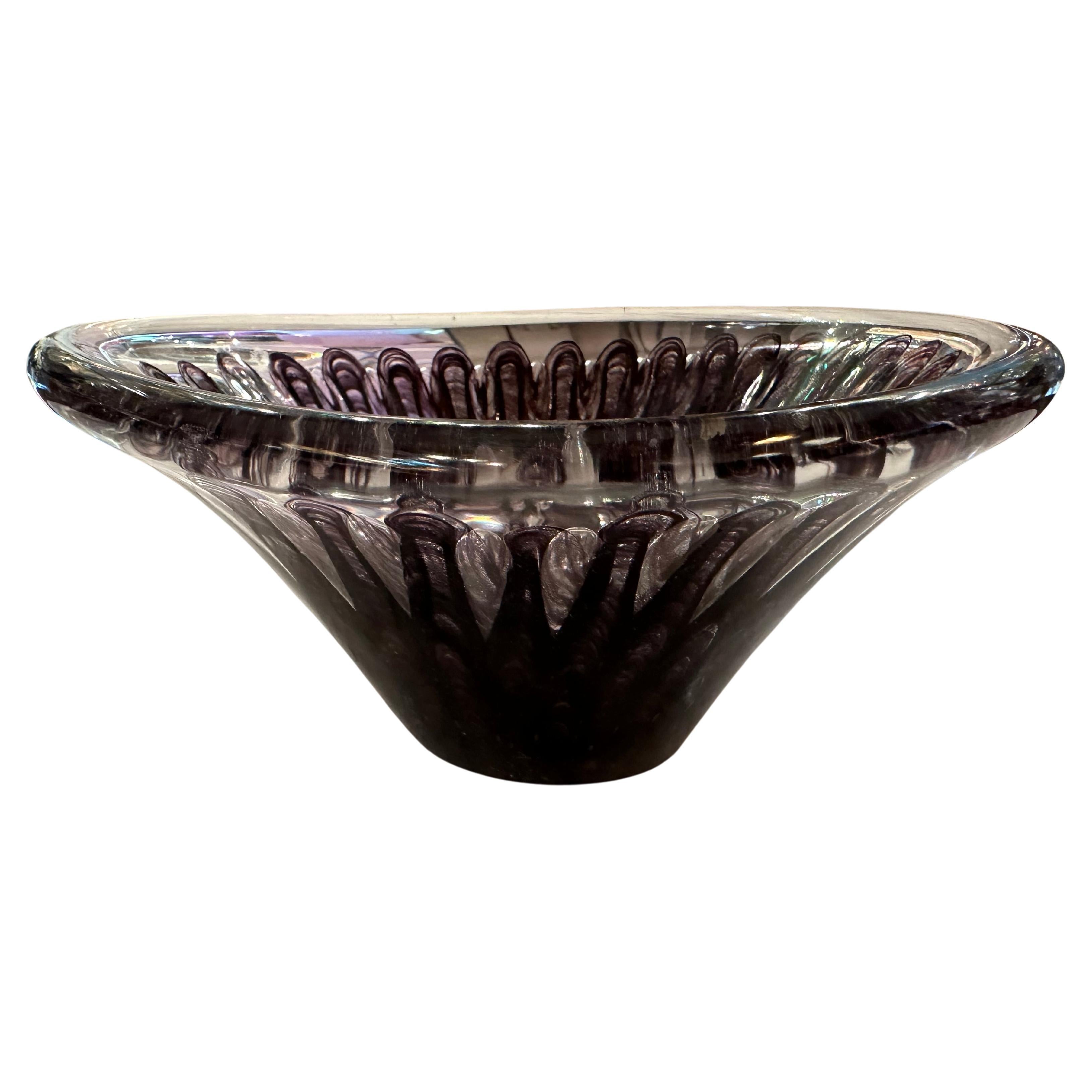
Center Piece in Murano glass attributed to Barovier&Toso 1950
By Barovier&Toso
Located in Rio De Janeiro, RJ
Incredible center piece in Murano glass black iridized attributed to Barovier&Toso circa 1950
Murano Glass
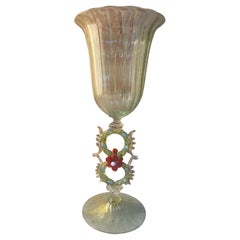
Italian Handcrafted Murano Glass 1970s
Located in Los Angeles, CA
Italian handcrafted chalice in blown Murano glass clear color, 1970s.
Murano Glass
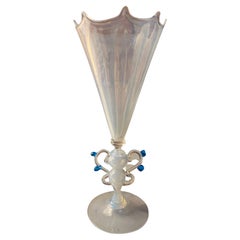
Vintage Italian Murano Handcrafted Glass, 1970s
Located in Los Angeles, CA
Vintage Italian Murano handcrafted glass 1970s.
Murano Glass
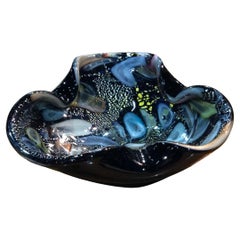
Murano 1930, Italian, Technical Avventurina
Located in Ciudad Autónoma Buenos Aires, C
Logistics and International Shipping We provide a comprehensive export service so that your only concern is enjoying your acquisition. • Door-to-Door Service: Pieces located in our Argentina galleries are shipped directly to your address via air freight. • Simplified Customs Management: We handle the processing of export permits and the payment of customs duties. You will receive your purchase without additional paperwork or surprise costs. • High-Security Packaging: Following FedEx international standards, each piece is protected in custom-made wooden crates, designed to withstand 1-meter impacts and ensure the integrity of the object during transit. • Note for shipments to the USA: To comply with shipping company regulations and ensure delivery at the destination, a valid tax ID (EIN, SSN, or ITIN) is required. • Domestic US Shipping: For those pieces available in our United States storage, logistics are managed through 1stdibs. Murano. With silver applications. We have specialized in the sale of Art Deco and Art Nouveau and Vintage styles since 1982. If you have any questions we are at your disposal. Pushing the button that reads 'View All From Seller'. And you can see more objects to the style for sale. Technical Avventurina : Avventurina is a Murano glass-making technique developed on Murano island in the 17th century. I was first mentioned in a document dating from 1614 as "a kind of stone with gilt stars inside", at which point it already mesmerized people with the unusual and attractive look. The technique owes its name to the fact that its discovery happened by chance thanks to a lucky coincidence, when a glass artisan is said to have accidentally dropped some metal shavings into the glass mixture. Italians say it happened "all'avventura", which in Italian means "by chance". The first documented recipe for the technique dates from 1644, when Murano master glassmaker Giovanni Darduin described how Avventurina glass should be created. The recipe involves adding various metal oxides such as copper and iron to the hot glass mixture, which will cause tiny particles of the metals to crystallize as the glass mixture cools off. Complicating the process, for such crystallization to occur the furnace had to get fully extinguished, and the metal particles would slowly separate from the glass base over a few days during the natural cooling of the glass. This was a very difficult process from a logistical perspective, since every time a glass furnace got extinguished it caused work to be paused, and re-igniting it was quite a big process, as it took time to fully heat it to the desired temperature. As industrial revolution set foot on Murano in the nineteenth century, the process got a remake. Large volumes of fine Avventurina paste were made and then skillfully stretched into glass canes, which were then re-melted for jewelry-making under a small flame, or for glass blowing. This Avventurina paste received worldwide acclaim and re-ignited the fame of Murano Glass workshops due to its use in Salviati mosaics...
Silver, Gold
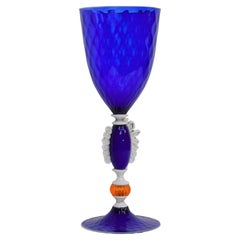
Murano Glass Globet, 1930s
Located in Palermo, PA
Murano glass globet, 1930s. Dimensions: H= 25 cm; D= 9 cm.
Glass
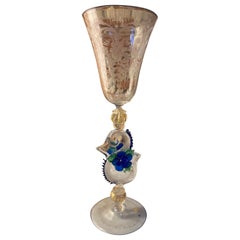
Vintage Italian Murano Handcrafted Glass, 1970s
Located in Los Angeles, CA
Vintage Italian Murano handcrafted glass 1970s.
Murano Glass