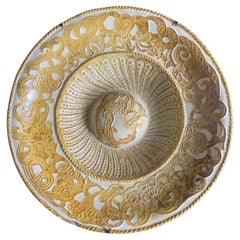
Large Hispano Moresque plate
Located in Bakewell, GB
Large Hispano Moresque plate 46cms diameter in excellent condition
Category
Antique Early 1600s Spanish Ceramics
Materials
Ceramic
Large Hispano Moresque plate
Located in Bakewell, GB
Large Hispano Moresque plate 46cms diameter in excellent condition
Ceramic
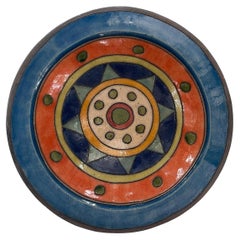
Midcentury Ceramic Plate
Located in New York, NY
A circa 1970's Italian col0r-glazed plate. Measurements: Diameter: 13" Depth: 2"
Ceramic
$282
H 9.65 in W 1.78 in D 9.65 in L 0.6 in
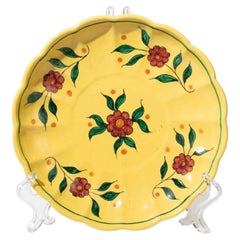
Vintage Decorative Plate Italian Manufacture, Mid 20th Century
Located in Roma, IT
A bright and decorative hand-painted Italian ceramic wall plate featuring a cheerful floral motif on a vibrant yellow ground. The design comprises stylised red flowers with green lea...
Ceramic
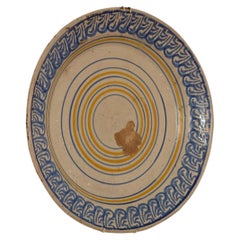
Italian Maiolica Plate. Italy, 1800s
Located in London, GB
A hand-painted Italian maiolica charger decorated with concentric blue and ochre bands, framed by a bold foliate border. The softly crackled glaze and visible signs of age, including...
Ceramic, Paint
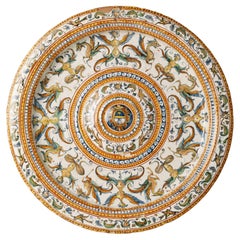
Italian Renaissance Plate, Patanazzi Workshop, Urbino, Circa 1580
By Patanazzi Workshop
Located in Milano, IT
Acquareccia plate Patanazzi workshop Urbino, last quarter of the 16th century It measures diameter 17.12 in; foot diameter 11.53 in; height 1.88 in (43.5 cm; 29.3 cm; 4.8 cm). Weight State of conservation: wear and a few small minimal detachments of enamel, chipping on the raised areas, peeling of enamel at the brim on the back. This large, shallow basin is equipped with a wide and convex well. It is umbonate with a contoured center. The brim, short and flat, is enclosed in a double rounded and barely raised edge. The basin has a flat base without rims; it has a slightly concave center in correspondence to the well. The shape takes inspiration from the basins associated with the metal forged amphora pourers that traditionally adorned the credenza. These were used from the Middle Ages to wash hands during banquets. Two or three people washed their hands in the same basin and it was considered an honor to wash one’s hands with an illustrious person. The decoration is arranged in concentric bands with, in the center of the umbo, an unidentified shield on a blue background: an oval banded in gold with a blue head, a gold star and a field with a burning pitcher. Rings of faux pods separate the center from a series of grotesque motifs of small birds and masks. These go around the basin and are, in fact, faithfully repeated on the brim. The main decoration develops inside the flounce of the basin, which sees alternating symmetrical figures of winged harpies and chimeras. The ornamentation, outlined in orange, green and blue, stands out against the white enamel background. This decorative style, defined since the Renaissance as “grottesche” or “raffaellesche”, refers to the decorations introduced after the discovery of the paintings of the Domus Aurea towards the end of the fifteenth century. The discovery of Nero's palace, buried inside Colle Oppio by damnatio memoriae, occurred by chance when a young Roman, in 1480, fell into a large crack which had opened in the ground on the hill, thus finding himself in a cave with walls covered with painted figures. The great artists present in the papal city, including Pinturicchio, Ghirlandaio, Raffaello, immediately visited these caves. The decorations found there soon became a decorative subject of immense success: the term grotesque , with the meaning of “unusual,” “caricatured,” or “monstrous,” was later commented by Vasari in 1550 as “una spezie di pittura licenziose e ridicole molto”( “a very licentious and ridiculous kind of painting”). The decorations “a grottesche” also widely circulated in ceramic factories, through the use of engravings, variously interpreted according to the creativity of the artists or the requests of the client. Our basin is reflected in similar artifacts produced at the end of the sixteenth century by the factories of the Urbino district. See the series of basins preserved in the main French museums, among which the closest in morphology is that of the Campana collection of the Louvre (Inv. OA1496); this however has a more complex figure decoration, while the decoration of our specimen is sober and with a watercolor style. The style, sure in its execution, approaches decorative results still close to the works produced around the middle of the sixteenth century by the Fontana workshop. The decoration is closely linked to their taste, which later finds its natural outlet, through the work of Antonio, also in the Patanazzi workshop. Studies show the contiguity between the two workshops due to the kinship and collaboration between the masters Orazio Fontana and Antonio Patanazzi, both trained in the workshop of Guido Fontana il Durantino. It is therefore almost natural that their works, often created according to similar typologies and under the aegis of the same commissions, are not always easily distinguishable, so much so that the presence of historiated or “grottesche” works by Orazio is documented and preserved in Antonio Patanazzi's workshop. Given that the studies have always emphasized the collaboration between several hands in the context of the shops, it is known that the most ancient “grottesche” works thus far known, can be dated from 1560, when the Fontana shop created the so-called Servizio Spagnolo (Spanish Service) and how, from that moment on, this ornamentation became one of the most requested by high-ranking clients. We remember the works created for the Granduchi di Toscana, when Flaminio Fontana along with his uncle Orazio supplied ceramics to Florence, and, later, other commissions of considerable importance: those for the service of the Duchi d’Este or for the Messina Farmacia of Roccavaldina, associated with the Patanazzi workshop when, now after 1580, Antonio Patanazzi began to sign his own work. Thus, in our basin, the presence of masks hanging from garlands, a theme of more ancient memory, is associated in the work with more advanced stylistic motifs, such as the hatching of the chimeras and harpies. These are found here on the front with the wings painted in two ornate ways. In addition, the theme of the birds on the edge completes the decoration along the thin brim and can be seen as representing an early style typical of the Urbino district during a period of activity and collaboration between the two workshops. Later, a more “doll-like” decorative choice, typical of the end of the century and the beginning of the seventeenth century, characterized the period of the Patanazzi workshop under the direction of Francesco. Bibliography: Philippe Morel, Il funzionamento simbolico e la critica delle grottesche nella seconda metà del Cinquecento, in: Marcello Fagiolo, (a cura di), Roma e...
Maiolica
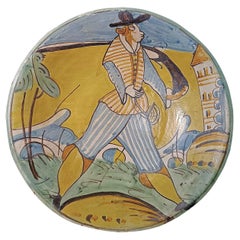
17th CENTURY MAJOLICA PLATE MONTELUPO
Located in Firenze, FI
Splendid polychrome majolica plate belonging to the Montelupo ceramic workshop. The enamel has also been applied to the rim, in an elegant aqua green, while the background is white d...
Maiolica
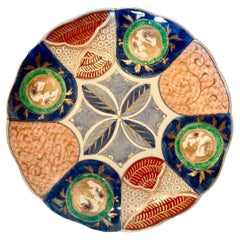
Excellent condition with wear consistent with age.
Located in Tampa, FL
A Japanese very nicely decorated Imari plate with beautiful green and gold accents. It looks like it’s never been used.
Porcelain
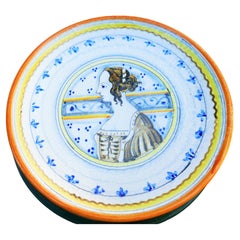
Eugenio Taccini Montelupo majolica plate
Located in Lugo, IT
Eugenio Taccini Montelupo majolica plate. Good condition. Thank you.
Maiolica
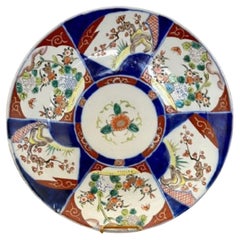
Quality antique Japanese Imari plate
Located in Ipswich, GB
Quality antique Japanese Imari plate having a quality Imari charger with a central floral panel blue and red outer panels decorated with flowers and birds hand painted in wonderful r...
Ceramic
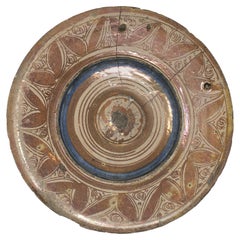
16th Century Spanish Valencian Manises Lusterware Ceramic Plate
Located in Marbella, ES
16th century Spanish Valencian Manises lusterware plate combining ceramics with metallic glaze. It has been repaired with iron grapples.
Iron
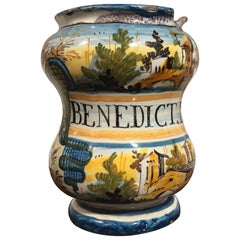
Italian Baroque Castelli Albarello, Hand-Crafted Ceramic, Circa 1700
Located in Stamford, CT
An Italian Baroque Castelli albarllo, also known as a pharmacy or drug jar. It held 'Benedict Laxat' listed as far back as Aristotle as a medication used in by midwives. Beautifully decorated with buildings in landscapes in the free, almost impressionistic style typical of Castelli Maiolica...
Ceramic
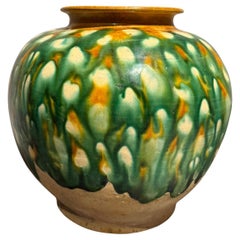
Chinese Tang Dynasty Style Sancai Glazed Ceramic Jar
Located in Stamford, CT
Chinese Tang Dynasty style Sancai glazed jar. This is a lovely example of Sancai glaze with the beautiful green, ocher and cream colors dripping down from the ocher rimand melding ov...
Ceramic, Earthenware
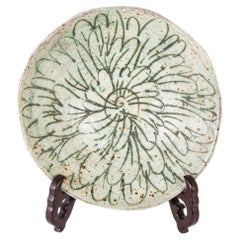
Glazed Ceramic Bowl by Makoto Yabe (b.1947-2005) 16.5 Inch Diameter
By Makoto Yabe
Located in Stamford, CT
A glazed ceramic bowl with incised decoration by Makoto Yabe (1947-2005). Beautiful cream glaze incised with abstract floral designs revealing green glaze underneath, with splatters ...
Ceramic
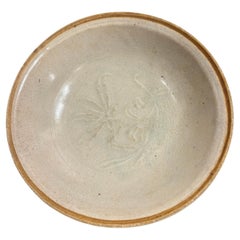
Song Dynasty Glazed Porcelain Ding Bowl with Carved Lotus
Located in Stamford, CT
A Chinese Song Dynasty carved lotus ding bowl, of gently rounded conical profile, resting on a short narrow foot and sweeping to an elegantly everted rim, glazed overall with a rich ...
Porcelain
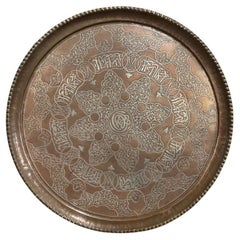
Moroccan Copper Charger Tray, Silver Inlay, Circa 1900, 27 Inches
Located in Stamford, CT
Moroccan copper charger with silver inlay, circa 1900. This large scale, heavy gauge copper tray with a raised scalloped 'pie crust' edge is a top quality example of this type. With ...
Silver, Copper
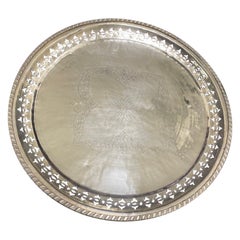
Chinese Export Brass Charger with Fretwork Border and Etched Decoration, Signed
Located in Stamford, CT
High quality Chinese Export brass tray or charger with incised decoration and openwork, or fretwork border. Heavy cast with a beautifully burnished surface. Circa 1900. Signed by mak...
Brass