Video Loading
Want more images or videos?
Request additional images or videos from the seller
1 of 22

Two Ancient Maiolica Pot Mustard Set, Milan, 1745-1788 Circa

$2,715.10
£2,005.94
€2,300VAT Included
CA$3,766.58
A$3,822.39
CHF 2,203.53
MX$46,282.51
NOK 25,576
SEK 25,849.55
DKK 17,537.86

About the Item

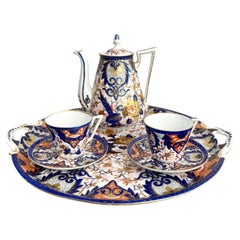
Two pot mustard set Felice Clerici or Pasquale Rubati Factory Milan, 1745-1788 Circa Majolica polychrome decorated "a piccolo fuoco" (third fire) It measures: 3.94 in in height x 7.36 x 6.06 in (10 cm x 18.7 x 15.4) It weighs: 0.51 lb (231 g) State of conservation: some chipping on the lid of one container and minor wear along the edges. This two pot mustard set consists of a small tray with a slightly concave mixtilinear rim and two oval-bodied containers. The two pots have ear-shaped handles and lids fitted with button grips. The decoration, in third fire polychromy, shows, in the center of the composition, a typical multi-levelled pagoda in blue with touches of red and yellow, which define the upper balcony and entrance archway. Upon manufacture, this style was referred to as "al casotto chinese (Chinese hut-style)," but it is commonly known today as "al carabiniere (carabiniere-style)" due to the coloration of the lid grips, which resemble the plumes on the hats of the carabinieri. The pagoda is accompanied by elements of oriental landscape such as the tall, pierced rock and stylized saplings which extend along the body to complete the decoration below the handles. On the containers, a river landscape, in which a small boat stands out, can be seen. On the tray the decoration is repeated on the brim and part of the well, showing, on the front, the two characters typical of this ornament (a Chinese dignitary welcoming a Westerner), with a pagoda in the center. This motif, referred to in Europe as "Imari trichromy," spread throughout the West via imported Chinese porcelain, which in turn reinterpreted Japanese models originally produced for the Chinese market and exported through the port of Imari. In the second half of the eighteenth century, this decorative repertoire entered the visual vocabulary of numerous European manufactories, sometimes enriched with the use of gold in place of yellow. In the inventories of the Clerici manufactory, this type of decoration is clearly identified as "alla chinese con casotto" ("Chinese-style with pavilion") (R. Ausenda, La maiolica a Milano nel Settecento, Florence 2025, p. 110). It does not appear to be recorded in the lists of the Rubati manufactory, although signed examples attributable to his production do exist, typically distinguishable by a more refined pictorial style (R. Ausenda, ed., Musei e Gallerie di Milano. Museum of Applied Arts. Ceramics, vol. II, Milan 2001, pp. 285-286, no. 306). Based on material, style, and technical characteristics, the work can be confidently attributed to one of the Milanese manufactories of Felice Clerici or Pasquale Rubati, active between 1745 and 1788. The attribution and dating are supported by comparison with a group of works consistent in form and decoration, published in the catalogue of the Museo d'Arti Applicate at the Castello Sforzesco in Milan (R. Ausenda, ed., Musei e Gallerie di Milano. Museum of Applied Arts. Ceramics, vol. II, Milan 2001, pp. 286-303, no. 307). The morphology of the two-barrel mustard pot is, however, present in both manufactures with different ornamentation: see a specimen in the Castello Sforzesco collections in Milan, with decoration "alla barbottine" equipped with a fruit-shaped grip and lids with cutouts for spoons, which are lacking in ours (R. Ausenda, ed., Musei e Gallerie di Milano. Museum of Applied Arts. Le ceramiche. T. II, Milan 2001, p. 378, n. 360). Maolica and porcelain production in the eighteenth century belonged mainly to the great royal families or in any case to the noble families who made the manufacture of ceramic works a source of prestige. In Milan, under Maria Teresa of Austria, the time period witnessed a real opening to new industrialists who, by virtue of the privatizations granted by the government, assumed a real business risk, giving life, albeit not without conflict, to flourishing factories and to production which was among the most elegant and most requested at the moment and which still today remains object of collection. Bibliography: R. Ausenda, a cura di, Musei e Gallerie di Milano. Museum of Applied Arts. Le ceramiche. T. II, Milan 2001, R. Ausenda, La maiolica a Milano nel Settecento, Florence 2025.
  • Creator:
  • Dimensions:
    Height: 3.94 in (10 cm)Width: 7.37 in (18.7 cm)Depth: 6.07 in (15.4 cm)
  • Style:
    Rococo (Of the Period)
  • Materials and Techniques:
  • Place of Origin:
  • Period:
  • Date of Manufacture:
    About 1745-1788
  • Condition:
    Wear consistent with age and use. Some chipping on the lid of one container and minor wear along the edges.
  • Seller Location:
    Milano, IT
  • Reference Number:
    1stDibs: LU4352246679922

More From This Seller

View All
Antique Maiolica Coffee Set by Pasquale Rubati, Milan, 1770-1780

Antique Maiolica Coffee Set by Pasquale Rubati, Milan, 1770-1780

By Pasquale Rubati

Located in Milano, IT

Coffee assortment with “barbotine” decoration Manufacture of Pasquale Rubati or Felice Clerici Milan, 1770- 1780 Maiolica polychrome decorated “a piccolo fuoco” (third fire). ...

Category

Antique 1770s Italian Rococo Ceramics

Materials

Maiolica

Three Dishes, Antonio Maria Coppellotti Factory, Lodi, Italy, Circa 1745

Three Dishes, Antonio Maria Coppellotti Factory, Lodi, Italy, Circa 1745

By Antonio Maria Coppellotti

Located in Milano, IT

Pair of round dishes and a small oval tray Antonio Maria Coppellotti factory Lodi, circa 1745 High fire polychrome majolica Dishes size: diameter 9.44 in, height 0.78 in (24 cm, 2 c...

Category

Antique 1740s Italian Rococo Delft and Faience

Materials

Maiolica

Antonio Ferretti Coffee Pot and Cups Set, Maiolica, Lodi, Circa 1765

Antonio Ferretti Coffee Pot and Cups Set, Maiolica, Lodi, Circa 1765

By Antonio Ferretti

Located in Milano, IT

A coffee pot and two cups with saucers Antonio Ferretti Manufacture Lodi, Circa 1765-1770 Maiolica polychrome decorated “a piccolo fuoco” (third fire). They measure: coffee pot: 9....

Category

Antique 1760s Italian Rococo Ceramics

Materials

Maiolica

Italian Maiolica Puerperal Cup by Antonio Ferretti, Circa 1770

Italian Maiolica Puerperal Cup by Antonio Ferretti, Circa 1770

By Antonio Ferretti

Located in Milano, IT

Maiolica puerperal cup Antonio Ferretti Manufacture Lodi, Circa 1770 - 1780 Maiolica polychrome decorated “a piccolo fuoco” (third fire). It measures: 4.3 x 6.8 x 5.3 in (11 x 17,5 x 13,5 cm) Weight: 0.78 lb (358 g) State of conservation: some closed pass-through fêlures on the cup, barely visible on the outside. Some use chips on the edge of the lid, two of which are more marked. From about the mid-sixteenth century, the puerperal soup tureen or puerperal cup became one of the most popular wedding gifts in central Italy. As an auspicious symbol, it replaced the birth table (“desco da parto”) which, on the occasion of high-ranking marriages, from the thirteenth century, had been painted by famous artists, especially in Tuscany. In France this same tureen is called "écuelle de mariée", as it is given to spouses as a sign of fertility. During the eighteenth century this custom spread even outside Italy to all social levels. Depending on availability and rank, it was made of different materials: precious metals, maiolica, porcelain, glass, pewter, etc. Beginning in the mid-twentieth century, the custom of this symbolic homage gradually disappeared, although famous designers such as Gio Ponti and Giuseppe Gariboldi, even as recently as the 1940s, revisited a model of a small puerperal soup bowl for the Ginori and, also in Italy in 1940, in a national competition for young potters, one of the themes of the test was indeed a modern model of a puerperal cup as an auspicious gift. This particular cup was also called a "service cup" or "puerperal vase" or "stuffed cup" - the windows were sealed with straw to prevent drafts of air for women in labor. In the eighteenth century the line of the puerpera cup was simplified, so much so that it took the form of a small tureen with two handles - the typical broth cup...

Category

Antique 1770s Italian Rococo Ceramics

Materials

Maiolica

Antique Maiolica Sick Cup by Pasquale Rubati, Milan, Circa 1770-1780

Antique Maiolica Sick Cup by Pasquale Rubati, Milan, Circa 1770-1780

By Pasquale Rubati

Located in Milano, IT

Sick cup Pasquale Rubati Manufacture Milan, Circa 1770 - 1780 Maiolica decorated in polychrome “a piccolo fuoco” (third fire) It measures: h 2.36 x 7.4 x 7.87 (h 6 x 19 x 20 cm) ...

Category

Antique 1770s Italian Rococo Ceramics

Materials

Maiolica

Two Small Italian Dishes Antonio Maria Coppellotti Manufacture, Lodi, Circa 1740

Two Small Italian Dishes Antonio Maria Coppellotti Manufacture, Lodi, Circa 1740

By Antonio Maria Coppellotti

Located in Milano, IT

Two small dishes Antonio Maria Coppellotti Manufacture Lodi, Circa 1740 High fire polychrome majolica They measure: diameter 7.08 in(18 cm) Weight: 0.37 lb (170 g) State of conservat...

Category

Antique 1740s Italian Baroque Ceramics

Materials

Maiolica

You May Also Like

20th Century Set of Ceramics by Lallier et Moustiers

20th Century Set of Ceramics by Lallier et Moustiers

By Lallier et Moustiers

Located in Sofia, BG

Set of four French beautiful hand-painted ceramic pieces by Lallier et Moustiers. Very good quality and vivid colors. France, circa 1990

Category

Mid-20th Century French Louis XV Serving Pieces

Materials

Ceramic

Early 20th Century French Hand Painted Faience Coffee Set from Blois

Early 20th Century French Hand Painted Faience Coffee Set from Blois

Located in Dallas, TX

Serve coffee or tea in this elegant faience coffee set. Crafted in Blois, France circa 1920, the set includes a large oval tray, two cups with saucers, a cream pitcher, a sugar bowl ...

Category

Early 20th Century French Delft and Faience

Materials

Faience

19th Century French Faience 8 Piece Hand-Painted Tea Service

19th Century French Faience 8 Piece Hand-Painted Tea Service

Located in Dallas, TX

19th century French faience 8 piece hand-painted tea service represents the remarkably unique and definitively French porcelains produced in the fabled region around Rouen! Hand-made...

Category

Antique Late 19th Century French French Provincial Tea Sets

Materials

Faience

Vintage Regency 19th Century Gien French Faience Earthenware Chocolate Set

Vintage Regency 19th Century Gien French Faience Earthenware Chocolate Set

Located in West Palm Beach, FL

A stunning vintage Regency Chocolate set. Made by the coveted Gien group and marked on the bottom. A charming hand painted set open deep rich colors. Acquired from a Palm Beach estat...

Category

Antique Late 19th Century French Regency Tea Sets

Materials

Earthenware

Quality 19th century porcelain coffee set

Quality 19th century porcelain coffee set

Located in Ipswich, GB

Quality 19th century porcelain coffee set, consisting of a large twin handled platter 38.5cm, two coffee cans with saucers and a coffee pot decorated in a imari pattern in stunning r...

Category

Antique 1860s Tea Sets

Materials

Porcelain