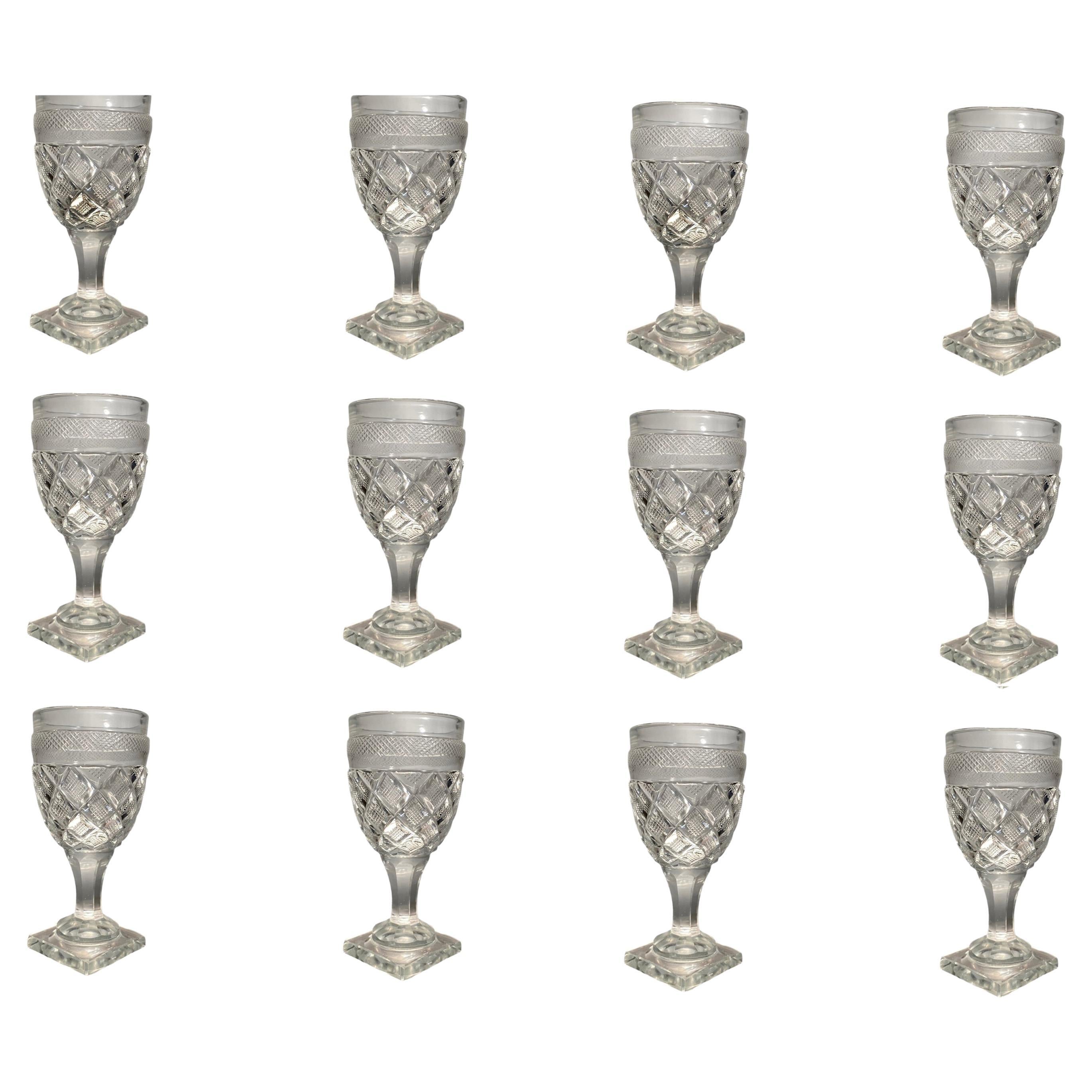
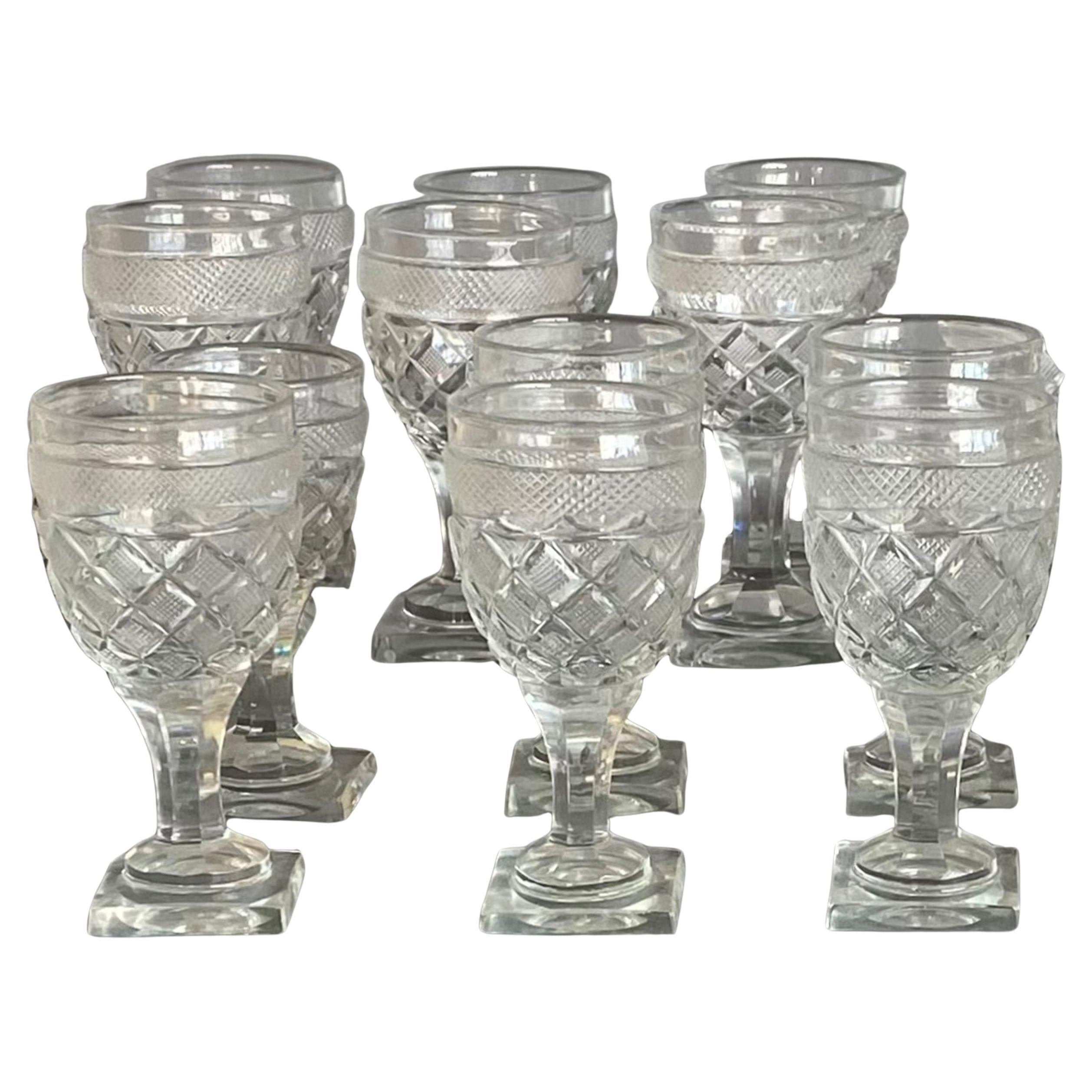
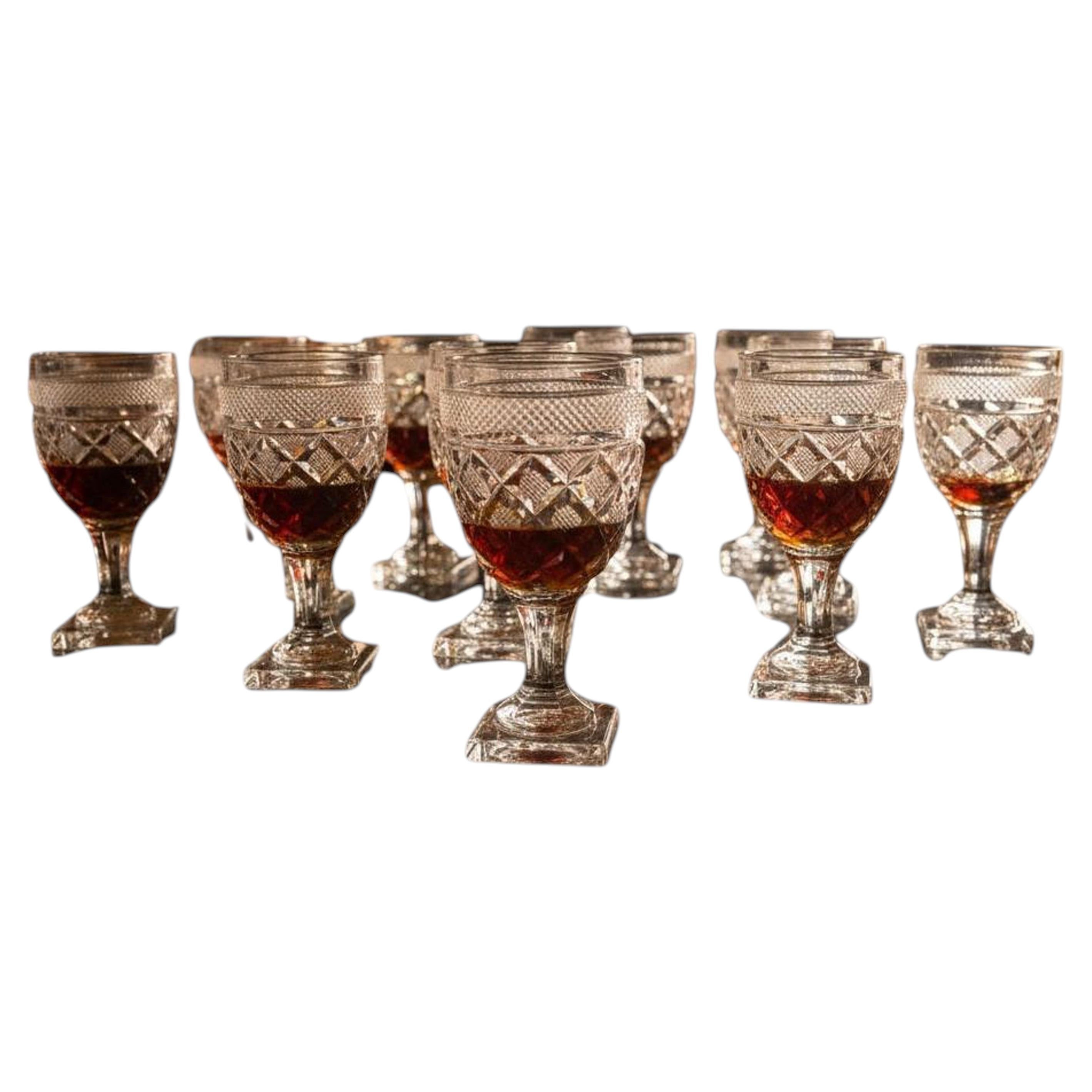
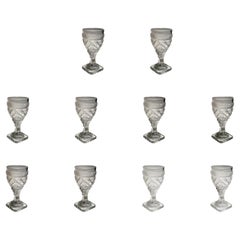
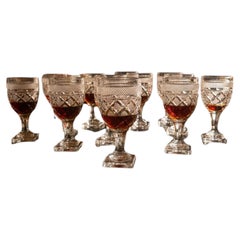
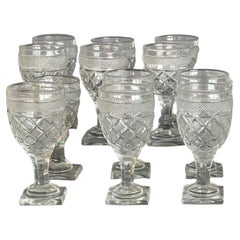
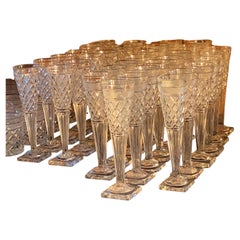
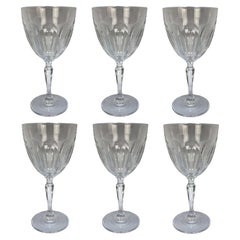
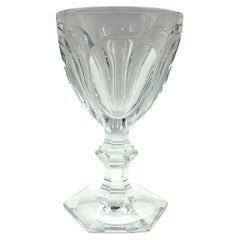
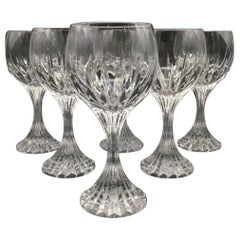
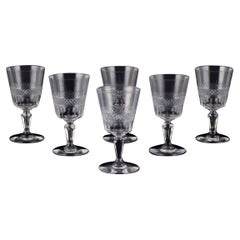
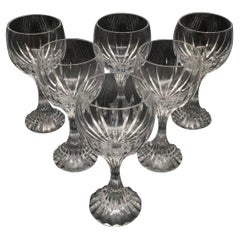
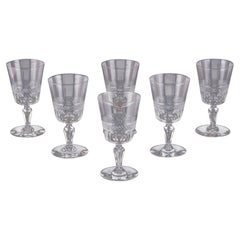
Important 12 glasses set of 1st Empire wine Cut-Glass goblets from Sainte Anne crystal factory in Voneche, 1800 - 1830 cca.
The set provenance:
Collection Baron Charles Jean Maurice Lemonnier (12 January 1860 – 11 September 1930) a Belgian liberal politician and mayor of the City of Brussels.
Vonèche (Sainte Anne crystal factory in Vonèche, active from 1778 to 1830).
1.The beginnings of the glassmaking adventure in Vonêche date back to the end of the Ancien Régime, when promoter Pierre-Nicolas Mathys hired master blower Gaspard Andrès to install a glass factory. It was created on August 4, 1778, by virtue of a grant granted by the Empress Marie-Thérèse. Production began on December 10, 1779. The premature death of the craftsman and the inexperience of his successors led to the closure of the company in 1793.
On March 10, 1802, Aimé-Gabriel d'Artigues, a wealthy Parisian industrialist, bought the glass factory and transformed it into a crystal factory. He renovated and enlarged the facilities, and made Vonêche the largest crystal factory in the French Empire. The proximity of vast sandy bottoms and important forests, as well as the significant financial participation of Artigues in the lead mines of Aix-la-Chapelle, contribute to making the place a production center with control over the components necessary for the manufacture of crystal. The splendor of the Empire and the economic growth of the upper middle class provided a large clientele eager to purchase luxury items.
In 1810, between 600 and 700 workers worked there. But the fall of Napoleon four years later led to a loss of outlets and a drastic reduction in personnel. Integrated into the new kingdom of the Netherlands, the crystal factory lost the substantial French market. It was at this time that Aimé-Gabriel d'Artigues bought the crystal works of Baccarat, in French Lorraine, and transferred his activities there. However, he retains ownership of the premises. In 1826, the chemist François Kemlin and the engineer Auguste Lelièvre, collaborators of Artigues, left the company to go and found the crystal works of Val-Saint-Lambert. Vonêche closed its doors definitively in 1830.
Today, the quality of Vonêche's productions is still unanimously recognized. There are crystal works by Vonêche at the Louvre, in New York or in Asia. Closer to home, some beautiful pieces are kept at the Museum of Decorative Arts in Namur.
2. Although works of crystal made during this period were rarely marked, there is no doubt, given its great quality, that this drageoir was made by the Cristallerie de Vonêche(link is external) in Beauraing, one of the most prestigious crystal factories in Europe in the early 19th century.
In 1802, the industrialist Aimé-Gabriel d’Artigues(link is external) took over the Verreries Sainte-Anne de Vonêche, which had been founded in 1778. With his degree in chemistry, d’Artigues had already been experimenting in the production of pure lead crystal and, aware of the importance of science and technology working together, he made every effort to perfect the manufacture of crystal through laboratory research. Vonêche rapidly became the most important glassworks in the French Empire, attracting numerous families specialized in crystal making from Alsace and Lorraine.
By 1806, the fame of Vonêche was undisputed. In preparation for the French Trade Fair (l’Exposition générale et publique des produits de l’industrie française), d’Artigues submitted samples of his crystal for examination by members of the Consultative Committee for the Arts and Manufacture of Namur. Members of the committee confirmed that the crystal and the work done to create it were of the greatest beauty. The engraving was perfect, whilst the prices of the company’s crystal appeared to be very reasonable.
A few years later, a report by J.-B.X. Wasseige, a deputy of the Fabriques et Manufactures de la Province de Namur, dated 25 February 1816, pointed out that this crystal works was without doubt one of the finest in Europe; not only could it supply crystal for the domestic market, but it could also make considerable exports abroad. Despite the region becoming part of the United Kingdom of the Netherlands in 1815, d’Artigues made sure that his company could continue to supply his French clients by acquiring the Verrerie de Baccarat in Lorraine, through which he could import his crystal of Vonêche into France.
3. The beginnings of the glassmaking adventure in Vonêche date back to the end of the Ancien Régime, when promoter Pierre-Nicolas Mathys hired master blower Gaspard Andrès to install a glassworks created on August 4, 1778 by virtue of a grant granted by the Empress Marie-Thérèse and whose production began on December 10, 1779. The premature death of Andrès and the inexperience of his successors led to the closure of the company in 1793. On March 10, 1802, Aimé-Gabriel d'Artigues, rich Parisian industrialist, buys the glass factory and transforms it into a crystal factory. He renovated and extended the facilities and made Vonêche the most important crystal factory in the entire French Empire! The proximity of vast sandy bottoms and important forests, as well as the significant participation of Artigues in the lead mines of Aix-la-Chapelle contribute to making Vonêche a production center with control over the components necessary for the manufacture of crystal. The splendor of the Empire and the economic rise of the upper middle class enabled the crystal factories to have a large clientele eager to purchase luxury items. In 1810, between 600 and 700 workers worked there, but the fall of Napoleon led to a loss of outlets and a drastic reduction in staff (400 workers in 1816). Integrated into the kingdom of the Netherlands, the crystal factory lost the important outlet of the French market. Aimé-Gabriel d'Artigues then bought the Baccarat crystal works in Lorraine and transferred his activities there. In 1826, the chemist François Kemlin and the engineer Auguste Lelièvre, employees of Aimé-Gabriel d'Artigues, left the company to go and found the crystal works of Val-Saint-Lambert in Seraing. The activities ceased definitively in Vonêche in 1830. The owner remained the only inhabitant of the place and resided in his very beautiful castle 1, built at the height of his glory.
In 1802, the old vonêchoise glassworks was developed by Aimé-Gabriel d’Artigues, from the glassworks that had existed there since 1778. Although it was a real success and had more than 650 workers, nothing remains of it today. Nevertheless, it is interesting to know that those who created the old vonêchoise glassworks were the ones who developed it in 1802, from the glassworks that had existed there since 1778, by Aimé-Gabriel d’Artigues. Although it was a real success and had more than 650 workers, nothing remains of it today. Nevertheless, it is interesting to know that those who created, in 1826, the famous Liège crystal factory of Val Saint-Lambert were none other than Kemlin and Lelièvre, former directors at Vonêche.