By Miles Mason Porcelain
Located in Downingtown, PA
Georgian Chinoiserie: A Pair of Miles Mason ‘Boy & Buffalo’ Plates
Attributed to Miles Mason, Staffordshire, England, Circa 1805
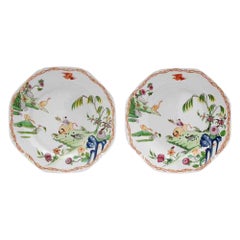
This beautiful and rare pair of English bone china plates represents a critical turning point in the history of British ceramics. Distinguished by their delicate, scalloped octagonal shape, the plates feature the celebrated "Boy and Buffalo" pattern—a quintessentially Chinoiserie motif that playfully reinterprets Chinese pastoral life for the European palate. The central scene is a vibrant polychrome landscape, where a boy perched atop a water buffalo is surrounded by fanciful rockwork and stylized botanical sprays. The palette is remarkably lush, utilizing high-quality enamels in leafy greens, deep blues, and the soft pinks and purples associated with the famille rose tradition.
The octagonal rims are framed by a fine band of painted orange ribbon and scrolling motifs, a direct stylistic quote from mid-18th-century Chinese export prototypes. These plates were not merely decorative whims; they were manufactured as high-quality "replacements" for aristocratic families whose original Chinese services had suffered the inevitable chips and breaks of decades of use. By matching the weight, translucency, and pattern of the 1760s originals, Mason ensured that a broken heirloom didn't mean the end of a coordinated dinner service.
Measurements & Condition
Diameter: 8 3/4 inches (22.2 cm)
Height: 1 1/4 inches (3.2 cm)
Material: Early English Bone China
Condition: Excellent antique condition. The polychrome enamels remain exceptionally vivid with minimal surface wear. The scalloped edges are well-preserved, and the porcelain body retains its characteristic translucency.
Provenance
Private Collection.
Historical Context: The Porcelain Wars
The early 19th century was the era of the "Porcelain Wars." When Chinese imports were disrupted in the 1790s, Miles Mason (1752–1822) pivoted from his role as a prominent London retailer to a manufacturer. Alongside rivals like Spode, he sought to perfect bone china—a material that combined the whiteness of Oriental porcelain with the durability required for British life.
The "Boy on a Buffalo" motif is a classic example of this cultural exchange. While the original Chinese design symbolized the harmony of nature and the simplicity of rural life, Mason’s version turned it into a luxury status symbol. As noted in Silk Roads, China Ships...
Category
Antique Early 19th Century English Georgian Porcelain