19th Century Oil Paintings of St. Francis Xavier & St. Carlo Borromeo
Located in Vancouver, British Columbia
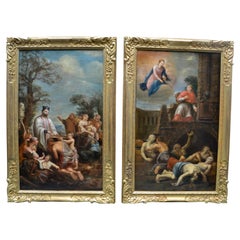
A beautifully executed and rare complementary pair of oil on canvas paintings depicting two of the moist famous and important counter reformation catholic saints St Francis Xavier and St Carlo Borromeo shown in scenes of what the respective saints are mostly famous for. St Francis Xavier for the conversion to Christianity of many S. E Asian countries notably India and St Carlo Borromeo shown asking the Virgin Mary to intercede for the cessation of the terrible plague of 1576. The paintings are presented in refreshed gilded carved wooden frames and are unsigned.
St. Francis Xavier was born in Spanish Navarre in 1506 and in 1528, he met St. Ignatius of Loyola. He became one of the seven in 1534 who founded the Society of Jesus (Jesuit Order). In 1536, he left the University of Paris and joined St. Ignatius in Venice. He was ordained in 1537, and in 1540 after the Society was recognized by the Pope, he journeyed to the Far East. Francis Xavier first evangelized the Portuguese colony of Goa in India, then Travancore, Ceylon, Malacca, and the surrounding islands. From there he journeyed to Japan, where he gave Christianity such deep roots that it survived centuries of violent persecution. He died on Sancian Island in 1552, while he was seeking to penetrate into the great forbidden land of China.
Despite language problems, lack of funds, resistance from the Europeans as well as the natives, he persevered. St. Francis converted more people in his life than anyone since the Apostle St. Paul. He baptized over 3 million people, converted the entire town of Goa in India, and he labored in India, Pakistan, Bangladesh, Sri Lanka, Malaysia, Indonesia, Singapore, and Japan. He was truly a missionary par excellence.
St Carlo Borromeo (1538-1584), was a Cardinal of the Holy Roman Catholic Church and Archbishop of Milan from 1565 to 1583. He was described in the decree for his canonization, as “a man, even while the world smiles on him with the utmost flattery, he lives crucified to the world, spiritually, trampling earthly things, seeking continuously the things of heaven, emulating the life of the Angels on earth, in his thoughts and actions.
The plague began in the month of August that year. Milan was celebrating joyfully the arrival of Don John of Austria, on his way to Flanders, where he had been appointed governor. The city authorities were abuzz with excitement in their desire to bestow the highest honours on the Spanish prince, but Charles, who had been Archbishop of the diocese for six years, was following with concern the news coming from Trento, Verona and Mantua, where the plague had begun claiming victims. The first cases exploded in Milan on August 11th, right at the moment when Don John of Austria arrived. The victor of Lepanto, followed by the governor, Antonio de Guzmán y Zuñiga, departed the city, while Carlo Borromeo, who was in Lodi for the Bishop’s funeral, returned in haste.
Confusion and fear reigned in Milan and the Archbishop dedicated himself completely to assisting the sick and ordering public and private prayers. Dom Prosper Guéranger sums up his infinite charity in this way: “In the absence of local authorities, he organized the health service, founded or renewed hospitals, sought money and provisions, decreed preventive measures. Most importantly though, he took steps to ensure spiritual help, assistance to the sick and the burial of the dead. Unafraid of being infected, he paid in person, by visiting hospitals, leading penitential processions, being everything to everyone, like a father and true shepherd”
St. Carlo was convinced that the epidemic was “a scourge sent by Heaven” as chastisement for the sins of the people and that recourse to spiritual measures was necessary to fight against it: prayer and penitence. He rebuked the civil authorities for having placed their trust in human measures rather than divine ones. “Hadn’t they prohibited all the pious gatherings and processions during the time of the Jubilee? For him, and he was convinced of it, these were the causes of the chastisement. The magistrates who governed the city continued to oppose public ceremonies, out of fear that the large gathering of people would spread contagion, but Charles “who was guided by the Divine Spirit” – recounts another biographer – convinced them by citing various examples, among which was the one regarding St. Gregory the Great who had halted the plague devastating Rome in 590.
While the pestilence spread, the Archbishop then ordered three general processions to take place in Milan on the 3rd, 5th and 6th of October, “to placate the wrath of God”. On the first day, the Saint, despite it not being the Lenten season, placed ashes on the heads of the thousands gathered, exhorting them to penitence. Once the ceremony was over, the procession went to the Basilica of St. Ambrose. Charles put himself at the head of the people, dressed in a hooded purple robe, barefoot, penitential cord at his neck and large cross in his hand.
The second procession led by the Cardinal headed towards the Basilica of San Lorenzo. The third day the procession from the Duomo headed for the Basilica of Santa Maria at San Celso. St. Carlo carried in his hands a relique of Our Lord’s Holy Nail, which had been given by the Emperor Theodosius to St. Ambrose in the 5th century.
The plague didn’t show any signs of waning and Milan appeared depopulated, as a third of its citizens had lost their lives and the others were in quarantine or didn’t dare leave their homes. The Archbishop ordered about twenty stone columns with a cross at the top to be erected in the main squares and city crossroads, allowing the inhabitants from every quarter to take part in the Masses and public prayers - from the windows of their homes. One of Milan’s protectors was St. Sebastian, the martyr the Romans had recourse to during the plague in 672. St. Charles suggested that the magistrates of Milan reconstruct the sanctuary dedicated to him, which was falling into ruins, and to celebrate a solemn feast in his honour for ten years. Finally in July 1577, the plague ceased and in September the founding stone was laid in the civic temple of St. Sebastian, where on January 20th every year, even today a Mass is offered to recall the end of the scourge.
St.Carlo Borromeo died on November 3rd 1584 and was buried in the Duomo of Milan. His heart was solemnly translated to Rome, in the Basilica of Saints Ambrose...
Category
Antique Late 19th Century French Baroque Paintings