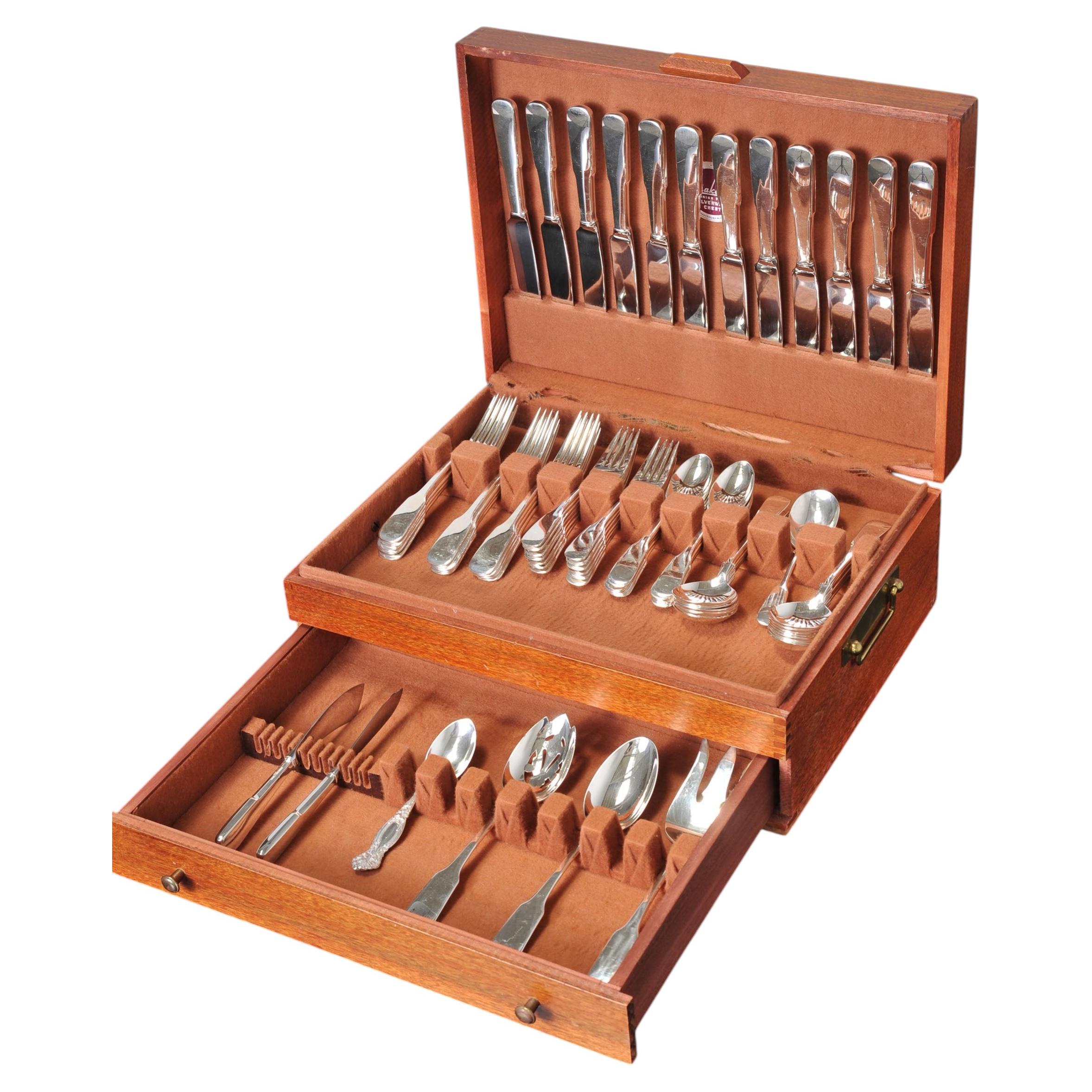
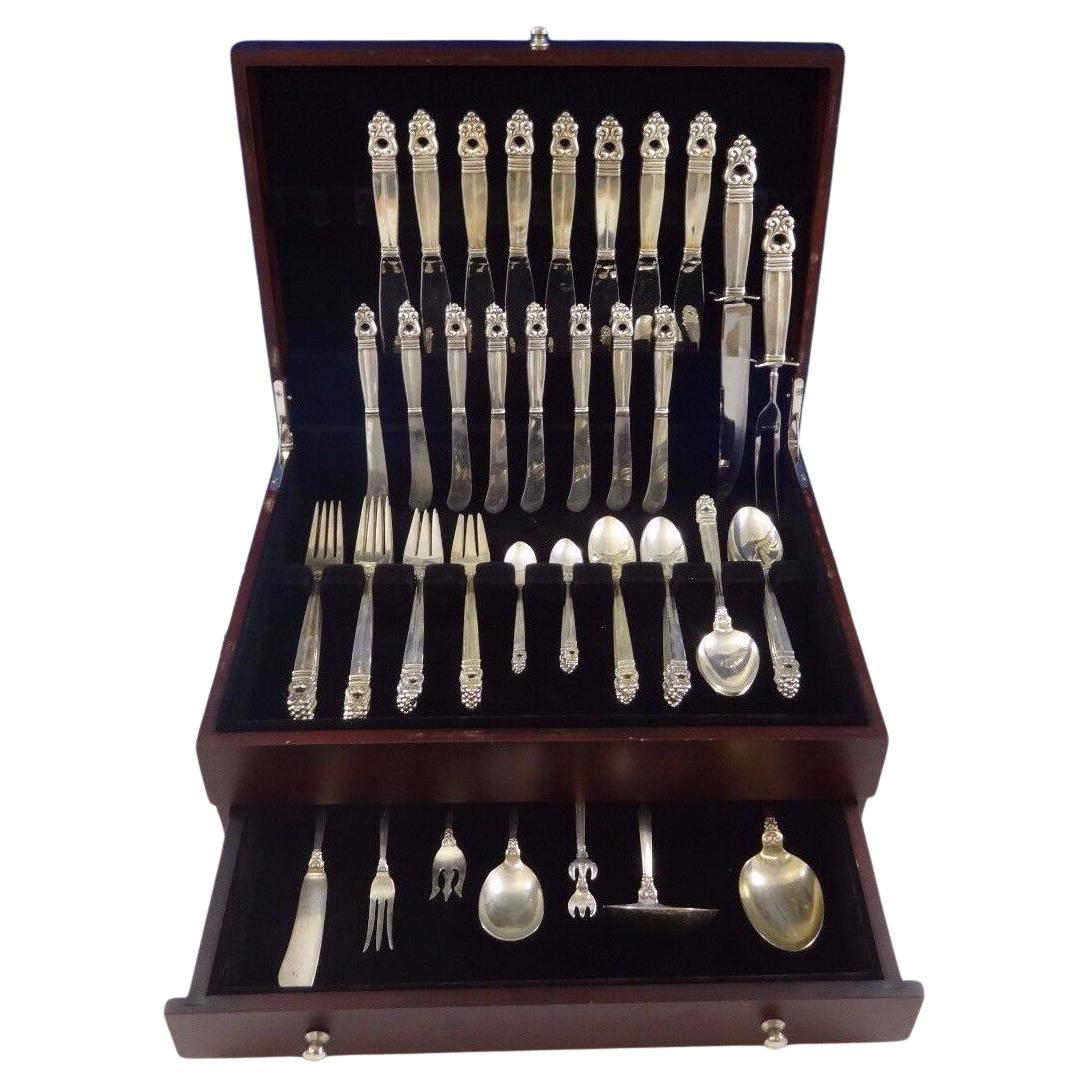
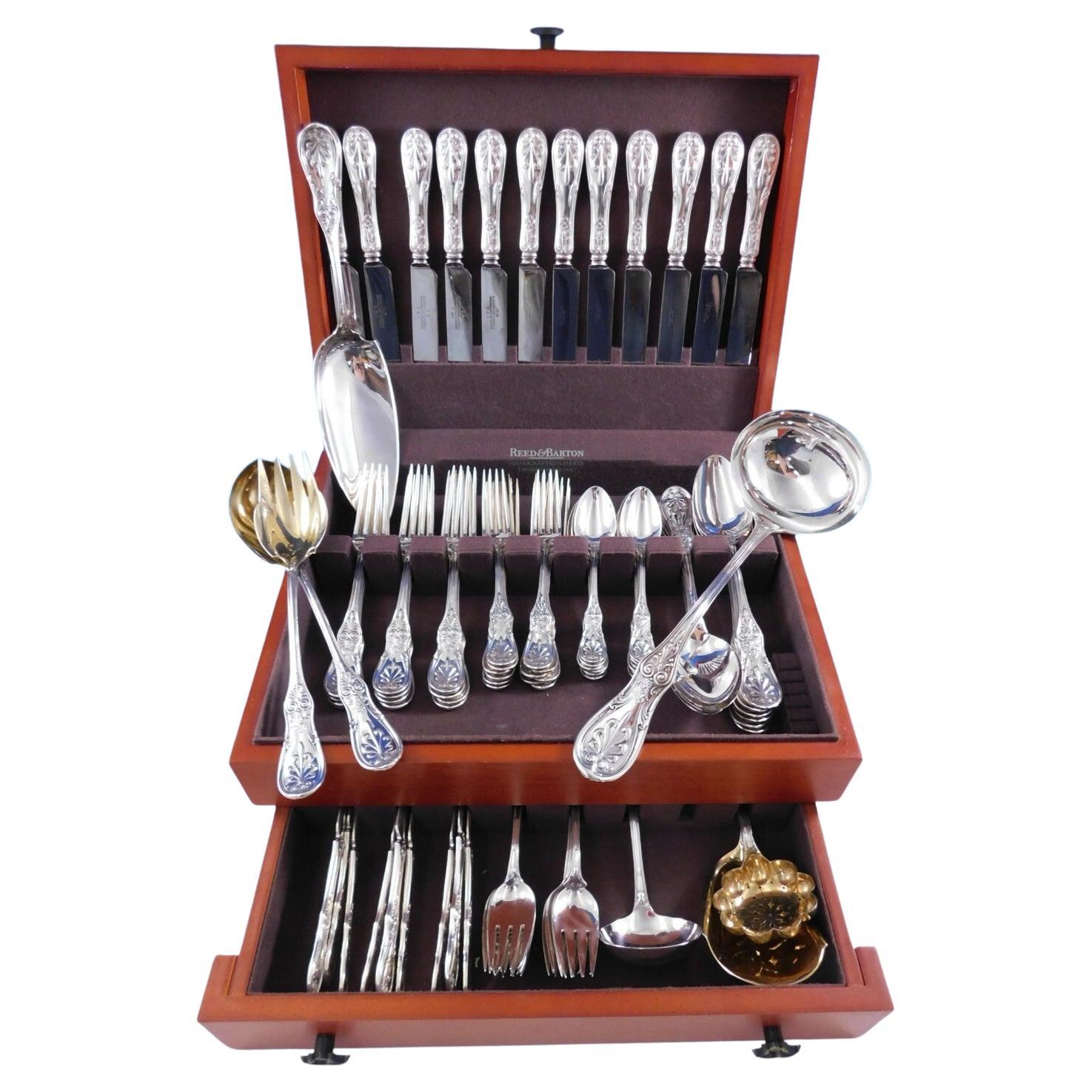
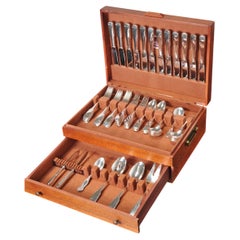
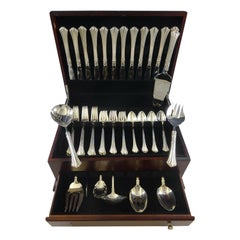
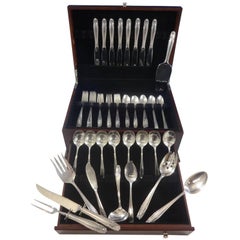
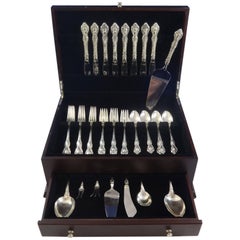
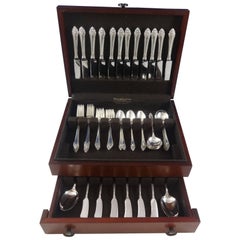
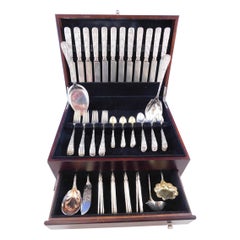
An exceptional and extremely rare set of a combination of silver and vermeil (gilded silver) flatware designed and crafted in St Petersburg Russia by Andrei Stepanovich Bragin dated 1847 and 1852. The set has 217 pieces in total consisting of 36 dinner silver forks, 36 silver soup spoons, 36 dinner knives ( silver handles with steel blades), 24 silver tea spoons, 24 dessert vermeil silver spoons, 24 dessert vermeil silver knives, 6 silver vermeil open salts, six corresponding vermeil silver salt spoons, a silver pierced ladle, 2 large silver serving spoons, a pair of silver tongs, a silver fish slice, a mustard vermeil silver spoon and a sugar vermeil silver sifter. The silver was assayed by D.Tverskoy and weighs 570 Troy Ounces in total. The majority of the pieces are dated and hallmarked with the name of the maker and the assayer.
Practically all the pieces in the set bear the crest and initials ( refer to photo gallery) of an aristocratic Russian family whose identity was first thought to have been the Sheremetevs but which has since been questioned through some gratuitous and generous correspondence with Mr Douglas Smith an awarding-winning American historian and author of four books on Russian Imperial History.
The subject of one of Mr Smiths most acclaimed and widely read books published in 2012 titled "The Former People : The Final Days of the Russian Aristocracy" is of particular relevance to this flatware. This was the first book to recount the history of the aristocracy caught up in the maelstrom of the Bolshevik Revolution and the creation of Stalin's Russia. It is filled with chilling tales of looted palaces burning estates, institutionalized terror inflicted with impunity on the aristocracy by marauding peasants and Red Army soldiers, of imprisonment, exile, and execution. Many aristocrats were killed in the process. Those lucky enough to escape were driven into exile taking with them whatever precious possessions they could. Most ended up boarding rescue ships on the Black Sea in Crimea disembarking in France notably the Cote D'Azur and Paris. To survive in their new homeland many had to sell some or all of the treasures that they managed to smuggle out of Russia. This flatware was very likely part of this unfortunate legacy.
The silver was acquired privately in Vancouver after filtering down from the estate of the Woodwards family likely that of "Chunky" Woodward, one of Western Canada’s last great renaissance men and owner of Woodward’s department store chain. Mr Woodward, who passed away in 1990, was also a renowned philanthropist and a collector of fine arts. Where and when Mr Woodward acquired the silver is a mystery but a sales receipt dated 12 December 1921 that accompanied ( refer to photo Gallery) the silver shows that it was originally retailed by a shop called “A La Veille Russie” 18 Faubourg St. Honore in Paris.
"A La Vieille Russie" which is still in business today on Fifth Ave in New York City, was founded by Jacob Zolotnitsky in Kiev in 1851. By the end of the nineteenth century the business had built a strong reputation in Imperial Russian circles trading in antique jewelry, snuff boxes, silver, and Russian and European porcelain.
Following the Russian Revolution and ensuing Bolshevik purge of the aristocracy, the business relocated from Kiev to Paris in 1920. where it quickly became an intellectual and sales hub for exiled Russian aristocracy and nobility. Among them were Grand Duchess Maria Pavlovna, Queen Marie of Romania, Grand Duchesses Xenia and Olga (sisters of Tsar Nicholas II), the Duke and Duchess of Windsor and King Farouk I of Egypt,
That this flatware ended up for sale at "A la Vielle Russie" in Paris in 1921 , a year after the shop opened for business, is therefore hardly surprising and follows the historical chronological order of the tumultuous times in Stalinist Russia.
All the experts contacted in Russia by Mr Smith in his effort to trace the origins of the silver including art historians, noble genealogists, museum curators and others, all agree that the flatware is extraordinary but what could not be ascertained is who commissioned it. Mr Douglas suggests that the Sheremetev family could have owned it but it was not made for them largely because when the silver was commissioned in the mid 19 Century there was only one Sheremetev , namely Count Dmitry Nikolaevich. As well, the coronet shown on the crest is typically associated with non-titled Russian nobility. Most of the Sheremetevs were titled and would have used a different more elaborate coronet that the one on the flatware. Mr Smith adds that it is more indicative of a bit lower down the noble rungs.
The timing of the sale of the silver also suggests that it was not the Sheremetevs who sold it to "A la Veille Russsie" in Paris as Count Alexander Dmitrievich Sheremetev and his wife fled to Finland in 1917 and didn't go to Paris till the late 1920s. A few other members of the family left via the Crimea in 1919 and moved to the south of France. It is conceivable that they could have visited Paris when the shop opened for business in 1920 before they moved on to Rome, but according to the descendants of the family contacted by Mr Smith, they left with only a few suitcases and none of them have ever seen the monogram on the silver before.. Finally, the Sheremetevs in exile bought more Russian treasures than they ever sold. Having fled with very little they never realized they would not be going back. While in the west, they tried to buy up art and antiques from Russia to replicate a bit of what they had lost. The only way to know who the silver was commissioned by is through the records from the silver master Andrei Bragin. This could take enormous research and equally enormous luck as they have most likely not survived.
Finally, one last intriguing factor relating to the provenance of the silver is that the 1921 sales receipt for the flatware lists a Monsieur Frick as the customer. Is it possible Monsieur Frick refers to Henry Clay Frick the American industrialist, financier and art patron and founder of the Frick Museum in New York. The mystery does not end here as Mr Frick died two years earlier than the date on the invoice but he left an endowment of trustees who carried on his collecting legacy after his passing.
The head archivst at the Frick Museum IN New Yourk City Ms Julie Ludwig wsa contacted On August 2023 in regrads the reference to a Monsieur Frick in the 1921 invouce. Ms Ludwig was unable to establish a connection between the silver and the Frick family. Ms Ludwig reiterates that Henry Clay Frick died in 1919, which makes it impossible for him to have purchased the silver personally. Also a review of a series of vouchers for bills paid by his estate in the early 1920s do not include A La Vieille Russie listed in the voucher index.
Ms Ludwig states that Frick’s widow, Adelaide H.C. Frick, and her daughter, Helen Clay Frick, both traveled to Europe in 1921, but they returned home in July, so she cold not place either of them in Paris in December. Neither was there any any record that Frick’s son, Childs Frick, was in Europe that year.
However the fact that the Frick's wife and daughter were in Paris earlier on the same year it was sold is encouraging as one could perhaps speculate that the silver was acquired by the Fricks but had a representative n Paris paying for it and claiming it on their behalf a few months later. The receipt does suggest this 3 rd party involvement.