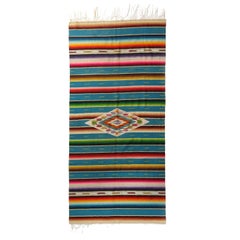
Vintage Mexican Serape from Mexico
Located in Sagaponack, NY
A finely crafted and vibrantly hued striped hand loomed wool serape from Saltillo, Mexico.
Category
Vintage 1920s Mexican Folk Art Quilts
Materials
Wool
Vintage Mexican Serape from Mexico
Located in Sagaponack, NY
A finely crafted and vibrantly hued striped hand loomed wool serape from Saltillo, Mexico.
Wool
$1,024Sale Price|20% Off
H 48 in W 22 in D 0.13 in
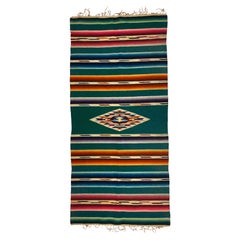
Vintage Mexican Saltillo Serape Rug, Handwoven Wool, Colorful Design
Located in Miami, FL
Vintage Mexican Saltillo Serape Blanket Rug Bright and beautiful reds, creams, blues, greens, orange and browns with geometric patterns. Very l...
Wool
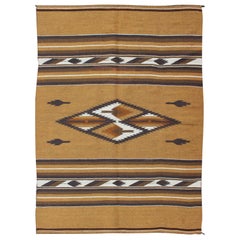
Mexican Serape design Flat weave 5'2 x 7'6
Located in Atlanta, GA
1930s Mexican Serape rug with geometric design in Marigold, brown, and ivory rug 1912-1511, country of origin / type: North America/ Mexico / Navajo style, circa 1930 Measures: 5'2...
Wool
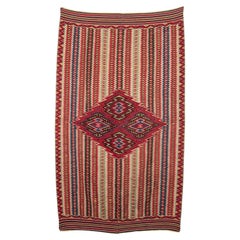
Saltillo Serape Mexican Blanket, 19th Century
Located in Istanbul, TR
A Saltillo serape is a type of Mexican blanket that originated in Saltillo, a city in the northern state of Coahuila. It is typically made of wool and features vibrant colors and intricate designs, often incorporating geometric shapes and floral motifs. The Saltillo serape is a popular item in Mexican culture...
Wool
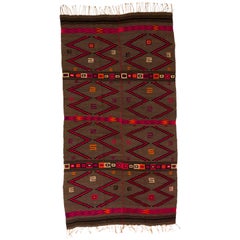
Hand Woven Mixtec Mexican Colourful Wool Serape Blanket
Located in New York, NY
Handwoven wool serape blanket from the highlands of Oaxaca, Mexico with traditional Mixtec symbols, circa 1950s.
Wool
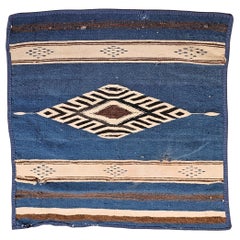
Vintage Mexican Saltillo Serape Rug, Hand-Woven Wool & Cotton, 1900s
Located in Barrington, IL
This vintage Mexican Saltillo Serape, woven in Coahuila, Northern Mexico, dates to the late 19th or early 20th century and showcases the exquisite craftsmanship of traditional Saltillo weaving. Made using flat-weave kilim techniques, the serape features the classic "royal blue" background, a signature element of these historic textiles. At the center of the blanket is a beautifully woven small lozenge medallion, rendered in warm ivory and brown tones, framed by delicate geometric patterns that enhance the overall composition. The design reflects the iconic Saltillo aesthetic, celebrated for its intricate detailing and bold yet harmonious color palettes. Woven with fine precision, this antique Saltillo kilim is as versatile as it is beautiful—perfect as a decorative wall tapestry, textile art piece, or a stunning addition to any Southwestern, bohemian, or heritage-inspired interior. Dimensions: 22” x 26” Date of Manufacture: 1st Quarter of the 1900s Place of Origin: Mexico Material: Wool on a cotton foundation Condition: Wear consistent with age and use The Persian Knot Gallery, SKU: 2257 Saltillo Rugs...
Wool, Cotton
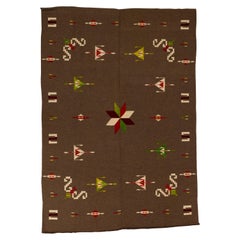
Antique Mexican Star Wool Serape Blanket
Located in New York, NY
Handwoven antique Mexican serape blanket with central star design and traditional Native symbols in natural pigment dyed wool on natural brown w...
Wool
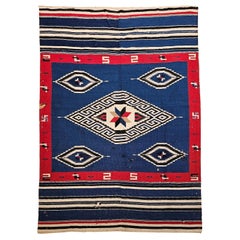
Vintage Mexican Saltillo Serape Kilim Rug, Handwoven Wool, Medallion Pattern
Located in Barrington, IL
A beautiful vintage Mexican Saltillo Serape kilim rug, handwoven in northern Mexico’s Coahuila region circa the late 19th to early 20th century. This exceptional textile features the classic Saltillo lozenge medallion design with four surrounding motifs, all set against a stunning French blue field accented by red, ivory, black, and tan. Woven with remarkable craftsmanship, the piece retains its original condition with gentle wear consistent with age, enhancing its authentic character. A versatile decorative textile, it is equally captivating as a floor covering or as a wall-mounted tapestry. Dimensions: 52” x 74” Date of Manufacture: 1st Quarter of the 1900s Place of Origin: Mexico Material: Wool on a cotton foundation Condition: Wear consistent with age and use The Persian Knot Gallery, SKU: 2260 Saltillo Rugs...
Wool, Cotton
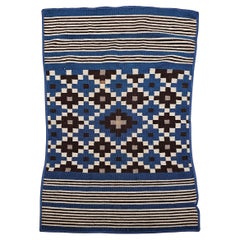
Antique Mexican Saltillo Serape, Handwoven Wool Kilim, Coahuila, 1900s
Located in Barrington, IL
This vintage Mexican Saltillo Serape, handwoven in Coahuila, Northern Mexico circa the late 19th to early 20th century, is a beautifully preserved example of traditional Saltillo textile artistry. Expertly crafted using flat-woven kilim techniques, this piece features the signature royal blue background, a hallmark of authentic Saltillo blankets. At the center lies a delicate lozenge-shaped medallion in ivory and brown, adding refined symmetry and cultural richness to the overall design. The fine weave and striking color contrast highlight the masterful skill of the artisan and the enduring appeal of this regional style. Whether displayed as wall art, used as a decorative tapestry, or incorporated into a curated interior, this antique Saltillo serape brings historic charm and artistic integrity to any space. Ideal for Southwestern, boho, rustic, or heritage-inspired interiors. Dimensions: 28” x 46” Date of Manufacture: 1st Quarter of the 1900s Place of Origin: Mexico Material: Wool on a cotton foundation Condition: Wear consistent with age and use The Persian Knot Gallery, SKU: 2258 Saltillo Rugs...
Wool, Cotton
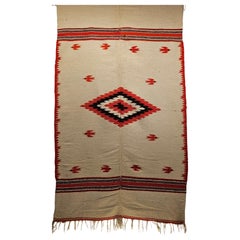
Vintage Serape Saltillo Kilim Rug, Handwoven Wool, Mid-20th Century, 4' x 6'
Located in Barrington, IL
Capture the beauty and tradition of Mexican textile art with this vintage Serape Saltillo kilim rug, handwoven in Mexico in the mid-20th century. This finely crafted piece features a soft cream or wheat-colored wool background, adorned with vibrant orange bird motifs that echo design influences found in both Navajo and Tibetan textiles. At the heart of the rug is a classic Saltillo lozenge medallion, delicately woven in shades of ivory, black, and orange, adding a bold focal point to the serene base. The bird designs in orange and blue bring movement and life to the piece, enhancing its visual depth and cultural richness. This flat-woven rug is a stunning example of Central and South American heritage—perfect for use as a decorative floor piece, wall hanging, or tapestry. Dimensions: 3’ 6” x 6’ 2” Date of Manufacture: Mid 20th Century Place of Origin: Mexico Material: Wool, cotton Condition: Wear consistent with age and use The Persian Knot Gallery, SKU: 1909 Saltillo Rugs, Mexican Saltillo, Serape Rugs...
Wool
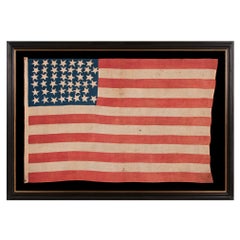
Homemade, Antique American Flag with Exceptional Folk Qualities, 1896-1908
Located in York County, PA
HOMEMADE, ANTIQUE AMERICAN FLAG WITH A TINY CANTON RESTING ON THE 6TH STRIPE AND AN EXTREMELY FOLKY PRESENTATION OF 45 STARS IN A “NOTCHED” PATTERN THAT MIGHT BE UNIQUE TO THIS EXAMP...
Cotton
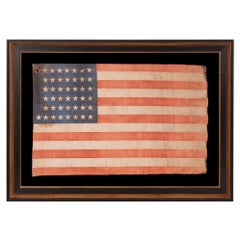
44 Star Antique American Parade Flag, Wyoming Statehood, ca 1890-1896
Located in York County, PA
44 STAR ANTIQUE AMERICAN PARADE FLAG WITH ENDEARING WEAR FROM LONG TERM USE AND WITH ITS STARS ARRANGED IN A NOTCHED PATTERN THAT LEAVES 4 SPACES OPEN FOR THE REMAINING WESTERN TERRI...
Cotton
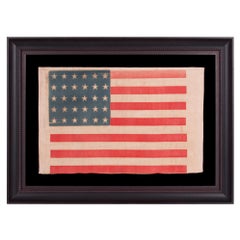
30 Star Antique American Parade Flag, Wisconsin Statehood, ca 1848-1850
Located in York County, PA
ANTIQUE AMERICAN PARADE FLAG WITH 30 STARS, THE ONLY KNOWN EXAMPLE IN THIS SIMPLE BUT EXTRAORDINARY STYLE, PRE-CIVIL WAR, OFFICIAL FOR JUST TWO YEARS, REFLECTS THE ADDITION OF WISCON...
Cotton
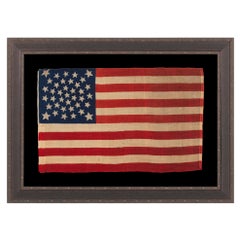
38 Star American Flag, Colorado Statehood, Made by Horstmann Brothers ca 1876
Located in York County, PA
38 STARS, COLORADO STATEHOOD, A SCARCE AND BEAUTIFUL ANTIQUE AMERICAN FLAG WITH A MEDALLION PATTERN AND 4 LARGE CORNER STARS, PRESS-DYED ON WOOL BUNTING, MADE BY HORSTMANN BROTHERS I...
Wool
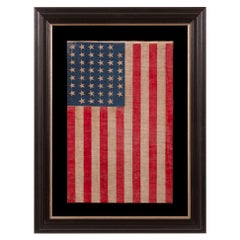
45 Stars Antique American Parade Flag, Utah Statehood, ca 1896-1908
Located in York County, PA
45 STAR ANTIQUE AMERICAN PARADE FLAG WITH ITS STARS ARRANGED IN A NOTCHED PATTERN, 1896-1908, UTAH STATEHOOD: 45 star American national flag, printed on coarse, glazed cotton. Evide...
Cotton
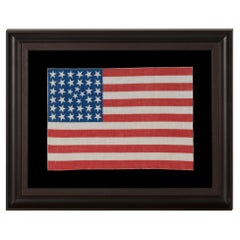
38 Star Antique American Parade Flag, Colorado Statehood, ca 1876-1889
Located in York County, PA
38 STARS IN AN EXTREMELY UNUSUAL CONFIGURATION THAT BEARS A CLUSTER OF 6 SMALL STARS WITHIN A LINEAL PATTERN OF LARGER STARS, 1876-1889, COLORADO STATEHOOD 38 star American national parade flag, printed on cotton. This is an extremely rare example of a lineal pattern flag with a wreath or cluster of smaller stars inserted in the center. A very small number of flags in this style are known to have survived, the colors of which are typically saturated and vibrant, like this example, in scarlet red and rich, royal blue. The particular wreath in the center of the configuration is really more of a pentagon with a single, center star. The reason for the choice of the design and 6 smaller stars seems a curious one on the surface, but its purpose was probably nothing more than to simply augment a 36 star print block to one with 38 stars. One may observe how 4 stars, that would have comprised the center of a 6 x 6 pattern, could have simply been removed and 6 smaller stars inserted in their place, in an artful fashion. At least two other similar 38-star patterns are known that incorporate 4 small stars intermingled between rows of what most certainly were two very similar 34-star flag print blocks originally. It was easier to modify these blocks rather than create brand new ones. In these particular instances, the results are rare, quirky configurations that are highly prized by collectors. Colorado became the 38th state on August 1st, 1876. This was the year of our nation’s 100-year anniversary of independence. Per the Third Flag Act of 1818, stars were not officially added until the 4th of July following a state's addition. For this reason, 37 was the official star count for the American flag in 1876. Flag-making was a competitive venture, however, and few flag-makers would have been continuing to produce 37 star flags when their competitors were making 38’s. It is for this reason that 38 and 13 stars (to represent the original 13 colonies) are more often seen at the Centennial International Exposition, the six-month long World’s Fair held in Philadelphia in honor of the event. Some flag-makers would have been adding a star for the 38th state even before it entered the Union, in the early part of 1876 or even prior. In fact, many makers of parade flags were actually producing 39 star flags, in hopeful anticipation of the addition of two more Western Territories instead of one. But the 39th state would not join the Union for another 13 years, when the Dakota Territory entered as two states on the same day. The 38 star flag became official on July 4th, 1877 and was generally used until the addition of the Dakotas in 1889. Provenance: Jeff R. Bridgman Antiques to the late collector Jim Ring...
Cotton