Located in York County, PA
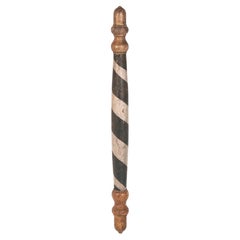
This delicate, New England barber pole has a round, double-tapered shaft with a swelled vase turning above and below, capped at each end with a elongated acorn finial. The center of the pole is painted black and white in the typical, swirling helix, with the remainder in gold.
Trade signs for barbering have existed since the middle ages. Many barbers doubled as surgeons and performed blood letting. Some prepared the deceased for viewings, as well as the living. Although black and white poles are rumored to be mortician’s poles among the collector community, very little information is available to substantiate that claim. I have never seen an image of a mortuary with such a pole, and little to no research exists to tie the black and white versions to barbers who offered the service. The red and white, present on most European poles, is said to reflect blood and bandages. In America, the colors are more often red, white, and blue, especially in later examples. This is rumored to represent veins and arteries, but more likely the blue fell into the color scheme as a nod to American patriotism.
Poles varied greatly, and it is unclear if a barber who offered a mix of services typically displayed more than one pole to do it. Although pairs of matching poles in two different colors are known to exist—for example, one with a red & white helix, and one black & white—these are far from the norm. With such a tiny population in any given town, and resources being what they were, it seems likely that in most cases a barber displayed only one. Because modern barber poles are sometimes black and white, though no services past shaves and hair cutting...
Category
American Antique Mid-19th Century Signs