Want more images or videos?
Request additional images or videos from the seller
1 of 8

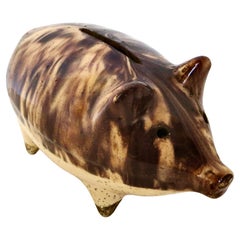
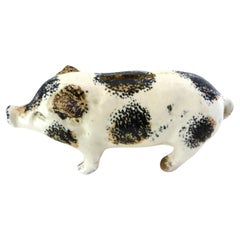
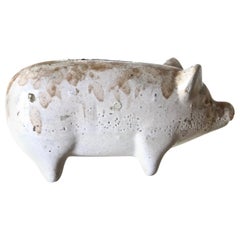
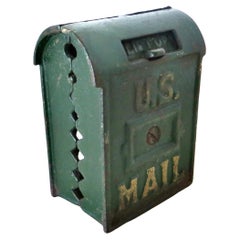
Early 20thC American Stoneware Razor Blade Disposal Piggy Bank Circa 1905

Price:$385

You May Also Like

More From This Seller

View All
Vintage Stoneware Larger Size Multi-Colored  Pig Bank (Still Bank) Austria C1890

Vintage Stoneware Larger Size Multi-Colored Pig Bank (Still Bank) Austria C1890

Located in Incline Village, NV

This bank was manufactured by HEPP "The Hole-Eyed Pottery Pig" company, the oldest Czechoslovakian/Austrian ceramic coin bank manufacturer, circa 1890. Their best customer was the Un...

Category

Antique 1890s Austrian Folk Art Toys

Materials

Stoneware

Multi Colored Brown & Beige 19thC Stoneware Large Size Pig Bank Austria Ca 1890

Multi Colored Brown & Beige 19thC Stoneware Large Size Pig Bank Austria Ca 1890

Located in Incline Village, NV

A marbleized brown with a beige hand painted underbelly dominates the color scheme to this excellent condition 19th century authentic stoneware Austrian still bank. This "piggy" bank...

Category

Antique 1890s Austrian Folk Art Toys

Materials

Stoneware

19th C. Stoneware Children's Savings Pig Bank. England, Circa 1880

19th C. Stoneware Children's Savings Pig Bank. England, Circa 1880

Located in Incline Village, NV

In the late 19th century the concept of thrift became a principle by which parents encouraged their children to safe money by putting their pennies into a "piggy bank", thus the proliferation of these items by pottery manufacturers, this particular example marked "SS" on the underneath indicating "A Smith Ltd.", Longton, England whose ceramic, china, and pottery business began in 1846 by Sampson Smith. Nicely molded and in excellent condition, this proverbial pig themed penny bank is painted overall white with a multiplicity of green "spatter" spots, the pig standing on all fours has a twisted tail in back. The original finish is beautifully glazed resulting in a lovely patina to this completely original bank with no restoration or touch up paint of any kind and all of it's original hand paint intact. Since these type of antique banks typically were made without a coin removal trap, the only way to extract the coins would have been the old "knife in the slot" method and retrieving the pennies one by one; or the more simpler method of smashing and breaking the bank, which is why locating these banks is very difficult, rendering a fine example particularly rare. This example is a wonderful addition to a collection of authentic still banks, folk art, or for those who accumulate pig items. This recently came from an estate collection of pig still banks. A similar example is referenced as #633 "Two Toned Pig" in Andy Moore's "The Penny Bank Book" written in 1984 when collecting pottery banks...

Category

Antique 1880s English Folk Art Toys
Materials

Stoneware

American Pottery Pig Bank, Circa 1880's

American Pottery Pig Bank, Circa 1880's

Located in Incline Village, NV

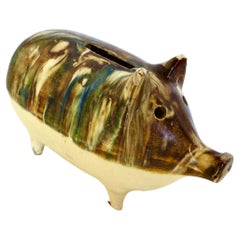
American pottery still bank in the shape of a pig, used for saving coins (usually pennies) to encourage children the importance of thrift. Pottery still banks are somewhat scarce since the typical way to remove coins was to smash the bank open, albeit, with this particular example, perhaps a knife was used for coin removal (note the wear to the coin slot---see images) or perhaps the additional wear is also from many coins having been deposited. The bank is in good all original condition , from an unknown potter (unmarked) circa 1880's, and probably a variant of #633 "Two Toned Pig" in Andy Moore's "The Penny Bank Book" written in 1984 when collecting pottery banks...

Category

Antique 1880s American Folk Art Toys

Materials

Pottery

Vintage Children's Toy Savings Bank "U.S. Mail". American, Circa 1920

Vintage Children's Toy Savings Bank "U.S. Mail". American, Circa 1920

By A.C. Williams Company

Located in Incline Village, NV

Children's Savings Coin Bank "U.S. Mail" bank , also known as a "still bank"; was American made, circa 1920. This is well made, sturdy, and all original. It is made of cast iron and hand painted in original green paint with gold highlighting. There is no repaint and no restoration. The coins were deposited through the "letter depository"; lift the lever and drop in a coin (see image). When the bank is full, coins are removed by undoing the original square nut in back and the screw in front. Cast into two parts and now separated, the coins are easily collected. Put back together again to insure parts don't go missing (which happened often) and original screw and nut are maintained. This bank was manufactured circa 1920 by the A.C. Williams Company, Chagrin Falls, Ohio. They made many cast iron toys, banks and other products during their time of operation until World War II. The "U.S. Mail" bank is referenced on page 102 #853 in "The Penny Bank Book" by Andy and Susan Moore...

Category

Early 20th Century American Folk Art Toys and Dolls

Materials

Iron

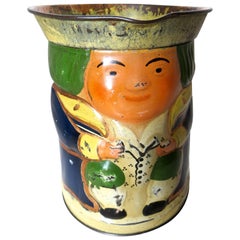
"Toby" Jug Still Bank and Biscuit Tin, circa 1910

"Toby" Jug Still Bank and Biscuit Tin, circa 1910

Located in Incline Village, NV

This is both a still bank and a biscuit tin. It would originally have been sold, filled with biscuits. After all of the cookies would have been consumed, the tin (rather than been thrown away) would have been used as a bank to save money. There is a slot for deposits at the back of the neck at the top (see image). Coins would have been removed by lifting or twisting the snug fitting lid. Toby is nicely hand-painted in pleasing colors of green, blue, gold, and white, with realistic flesh tones to the hands and face. The total height is 6 1/2" while the total width is 6" (includes handle). Diameter at the base is 5". This Toby figured tin was manufactured circa 1911 by the biscuit tin company of Hudson Scott located in Carlisle, England. It is marked at the bottom "Hudson Scott & Sons Ltd. Carlisle, England." It has crossover appeal into three categories of collectors. It would be a welcome addition to both the still bank collector and the biscuit tin collector...

Category

Vintage 1910s English Folk Art Toys

Materials

Tin