Want more images or videos?
Request additional images or videos from the seller
1 of 10

Antique Japanese Embroidered Apron (Mae-Kake)

$1,200
£904.32
€1,056.58
CA$1,702.89
A$1,707.83
CHF 990.78
MX$20,850.35
NOK 11,475.98
SEK 11,744.89
DKK 7,898.96

About the Item

Antique Japanese Embroidered Apron (Mae-Kake) This beautiful dark indigo cotton apron has tight sashiko embroidered stitching on both sides, on one side the hemp-leaf (asa no ha) pattern and on the other a geometric step pattern. The intricacy of the stitching and the precision of the design layout is an indication of the embroidery skills of the woman who made this apron. A fine piece of folk art from rural Japan. In very good condition. Width: 16 inches, Height: 27.5 inches Early 1900s.
  • Dimensions:
    Height: 27.5 in (69.85 cm)Width: 16 in (40.64 cm)Depth: 0.5 in (1.27 cm)
  • Style:
    Taisho (Of the Period)
  • Materials and Techniques:
    Cotton,Embroidered,Hand-Woven
  • Place of Origin:
  • Period:
  • Date of Manufacture:
    1900-1920
  • Condition:
    Wear consistent with age and use.
  • Seller Location:
    Point Richmond, CA
  • Reference Number:
    Seller: JR#11-081stDibs: LU1778245115852

More From This Seller

View All
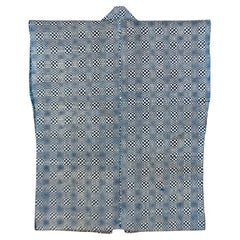
Antique Japanese Recycled Saki-Ori Farmer’s Vest

Antique Japanese Recycled Saki-Ori Farmer’s Vest

Located in Point Richmond, CA

Antique Japanese Recycled Saki-Ori Farmer’s Vest This late 19th C recycled farmer’s vest from northern Japan was strip woven from repurposed cotton scraps in a technique known as sa...

Category

Antique Late 19th Century Japanese Meiji Tribal Art

Materials

Cotton
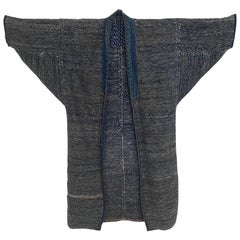
Saki-Ori Farmers Coat, Northern Japan, Meiji Period

Saki-Ori Farmers Coat, Northern Japan, Meiji Period

Located in Point Richmond, CA

Saki-ori farmers coat, Northern Japan, Meiji period A very heavy and substantial saki-ori coat, made of cotton with an indigo kasuri lapel. Several patches of hand sewn stitching ...

Category

20th Century Japanese Meiji Textiles

Materials

Cotton

Antique Japanese Stencil-Dyed Han-Juban

Antique Japanese Stencil-Dyed Han-Juban

Located in Point Richmond, CA

Antique Japanese Stencil-Dyed Han-Juban Han-juban are worn under kimono. This example, without its original cotton sleeves, displays a unique stencil-dyed pattern with indigo. A ve...

Category

Early 20th Century Japanese Taisho Tribal Art

Materials

Cotton

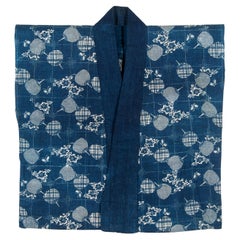
Antique Japanese Stencil-Dyed Han-Juban With Fan Motif

Antique Japanese Stencil-Dyed Han-Juban With Fan Motif

Located in Point Richmond, CA

Antique Japanese Stencil-Dyed Han-Juban With Fan Motif Han-juban are short, waist length garments that are worn under kimono. It’s not uncommon for older examples to be missing thei...

Category

Early 20th Century Japanese Taisho Tribal Art

Materials

Cotton

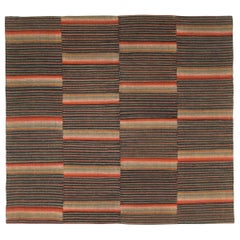
Early 20th Century Wool Apron 'Pangden, ' Western Tibet

Early 20th Century Wool Apron 'Pangden, ' Western Tibet

Located in Point Richmond, CA

Early 20th century wool apron (pangden), Western Tibet In original condition, four panels woven on a back-strap loom, stitched together and worn as an apron among the Tibetans of th...

Category

Early 20th Century Tibetan Tribal Textiles

Materials

Wool

You May Also Like

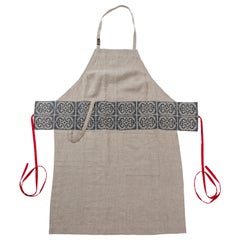
Hand embroidered linen apron from the SoShiro Ainu collection

Hand embroidered linen apron from the SoShiro Ainu collection

By SoShiro

Located in London, GB

This hand-embroidered linen apron from SoShiro’s Ainu collection, a collaboration between award-winning artist Toru Kaizawa and Shiro Muchiri, took design cues from leading chefs, resulting in the addition of clever loops and pockets. The apron, partly inspired by the structure of a kimono, is made of absorbent linen, with a 400-gram-per-square-meter thread count. The Blakiston’s fish owl eyes motif was designed by celebrated Ainu artist Mamoru Kaizawa. It is hand embroidered using 100% silk, and its placement is reminiscent of a kimono obi...

Category

2010s Japanese International Style Textiles

Materials

Linen, Natural Fiber

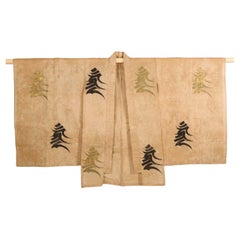
Antique Japanese Noh Outer Cloak Chōken with Stencil Decoration

Antique Japanese Noh Outer Cloak Chōken with Stencil Decoration

Located in Atlanta, GA

A large and striking Japanese outer cloak for Noh performance (known as Choken) circa 19th century (late Edo to early Meiji period). The robe was woven from a natural bast-fiber (kno...

Category

Antique 19th Century Japanese Edo Textiles

Materials

Natural Fiber

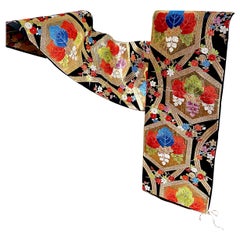
Vintage Japanese Obi Textile, Woven Floral Design, Silk, Circa 1970s

Vintage Japanese Obi Textile, Woven Floral Design, Silk, Circa 1970s

Located in Pasadena, CA

Superb example of a c. 1970s Obi. The obi is beautifully woven with multi-colored florals reserves and interlaced cherry blossoms. The reserves are delineated by woven metallic silve...

Category

Late 20th Century Japanese Other Textiles

Materials

Silk

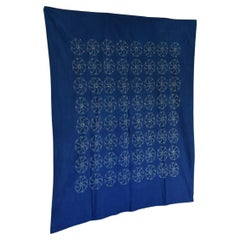
"SASHIKO" Japanese Vintage Quilt・Rag・Tapestry・Blanket / 1950s Wabi-Sabi BORO

"SASHIKO" Japanese Vintage Quilt・Rag・Tapestry・Blanket / 1950s Wabi-Sabi BORO

Located in 足利市, JP

A beautifully preserved, highly graphic example of mid-century Japanese textile art: an authentic 刺し子 (Sashiko) Hand-Stitched Multi-Purpose Cover / Quilt, dating to the Showa 30s per...

Category

Mid-20th Century Showa Textiles

Materials

Cotton

Japanese Silk Kimono Belt Fukuro-Obi 1970s /Table Runner

Japanese Silk Kimono Belt Fukuro-Obi 1970s /Table Runner

Located in Paris, FR

This is a Fukuro Obi made in Japan around 1970s. It is made with Silk and it is in good condition. Obi is a belt of varying size and shape worn with both traditional Japanese clothing like Kimono.Obi are categorised by their design, formality, material, and use, and can be made of a number of types of fabric, with heavy brocade weaves worn for formal occasions, and some lightweight silk obi worn for informal occasions. Fukuro obi are slightly less formal than maru obi...

Category

Late 20th Century Japanese Showa Antiquities

Materials

Silk