1 of 4

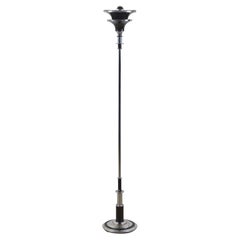
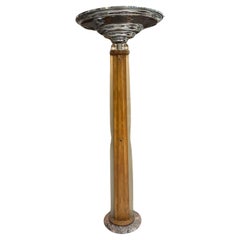
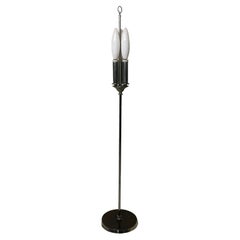
Art Deco Torchiere Attributed to Gilbert Rohde

$1,800List Price

You May Also Like

Art Deco Modern Age Tiered Aluminum Torchère, Style of Von Nesson Gilbert Rohde

Art Deco Modern Age Tiered Aluminum Torchère, Style of Von Nesson Gilbert Rohde

By Walter Von Nessen

Located in Port Jervis, NY

Elegant torch lamp with an ebony stained oak shaft and aluminum base, triple tiered shade. Rewired with a floor switch. Ring of Lucite between shaft and sha...

Category

Vintage 1930s American Art Deco Floor Lamps

Materials

Aluminum

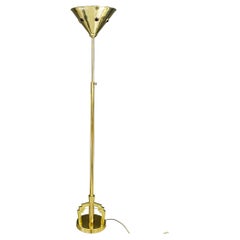
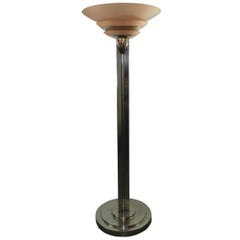
Art Deco Torchiere Floor Lamp

Art Deco Torchiere Floor Lamp

$2,500

H 62.75 in Dm 10.25 in

Art Deco Torchiere Floor Lamp

Located in Los Angeles, CA

Art Deco mixed metal floor lamp. This lamp features a spun aluminum top shade and a chrome plated stem and base. The lamp has alternating chrome and black enameled details. Dimensio...

Category

Mid-20th Century American Art Deco Floor Lamps

Materials

Metal, Chrome, Aluminum

Art Deco Floor lamp vienna around 1920s

Art Deco Floor lamp vienna around 1920s

$2,140

H 59.06 in Dm 13.98 in

Art Deco Floor lamp vienna around 1920s

Located in Wien, Au

Art Deco Floor lamp vienna around 1920s Polished and stove enameled Original red opaline glass stones Adjustable from Hight 150cm up to 185cm

Category

Vintage 1920s Austrian Art Deco Floor Lamps

Materials

Brass

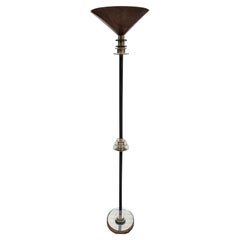
Art Deco Torchiere Floor Lamp with Stepped Mirror Design

Art Deco Torchiere Floor Lamp with Stepped Mirror Design

Located in Port Jervis, NY

Fabulous Art Deco torchiere floor lamp with a stepped mirror base and accent in the center. Brass shade and entire lamp in excellent vintage condition. ...

Category

Vintage 1960s French Art Deco Floor Lamps

Materials

Metal, Brass

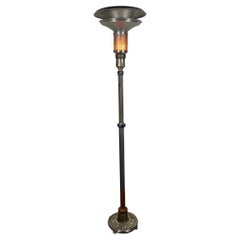
Unusual Aluminum , wood , mica Art Deco Torchere / floor lamp

Unusual Aluminum , wood , mica Art Deco Torchere / floor lamp

By Gilbert Rohde

Located in Buffalo, NY

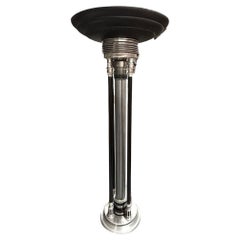
Unusual Aluminum , wood , mica Art Deco Torchere , floor lamp, adjustable height from 53" -68"... pierced detailing with mica cylinder.. Two - tier aluminum top with lid and (cand...

Category

Vintage 1930s American Art Deco Floor Lamps

Materials

Aluminum

Floor Lamp Art Deco 1920, France, Material, Wood

Floor Lamp Art Deco 1920, France, Material, Wood

Located in Ciudad Autónoma Buenos Aires, C

Logistics and International Shipping We provide a comprehensive export service so that your only concern is enjoying your acquisition. • Door-to-Door Service: Pieces located in our A...

Category

Vintage 1920s French Art Deco Floor Lamps

Materials

Alabaster

Jean Perzel French Art Deco Very Rare Floor Lamp, circa 1932

Jean Perzel French Art Deco Very Rare Floor Lamp, circa 1932

$26,651Sale Price|20% Off

H 74.81 in Dm 23.63 in

Jean Perzel French Art Deco Very Rare Floor Lamp, circa 1932

By Atelier Jean Perzel

Located in Saint-Ouen, FR

Jean Perzel, rare floor lamp, model 32, in nickel-plated bronze and salmon-pink crystal. Very rare, only a few collectors and the Musée d'Art Moderne de la Ville de Paris own this mo...

Category

Vintage 1930s French Art Deco Floor Lamps

Materials

Crystal, Bronze

Large 6-Foot Art Deco Revival Machine Age Torchiere Floor Lamp

Large 6-Foot Art Deco Revival Machine Age Torchiere Floor Lamp

$3,025Sale Price|44% Off

H 75 in W 31 in D 31 in

Large 6-Foot Art Deco Revival Machine Age Torchiere Floor Lamp

Located in Van Nuys, CA

Renowned artist Rick Ramirez fashioned distinctive, towering floor lamps in the Art Deco style, each a singular creation. His hallmark aesthetic seamlessl...

Category

Vintage 1980s American Floor Lamps

Materials

Steel, Chrome

Art Deco floor lamp by Jules Cayette and Schneider

Art Deco floor lamp by Jules Cayette and Schneider

By Jules Cayette, Charles Schneider

Located in NANTES, FR

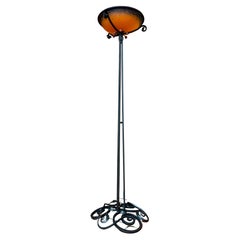
Art Deco floor lamp circa 1925. Wrought iron base by Jules Cayette. Glassware by Charles Schneider. 1 basin of 40 cm in diameter and 6 blown glass balls. In perfect condition, electrified, 3 lights. Height: 167.5 cm Base diameter: 49 cm Basin diameter: 40 cm Weight: 16 Kg Édouard Élie Jules Cayette, born on May 27, 1882 in Paris and died on January 2, 1953 in Nancy, was a French ironworker, bronze worker, cabinetmaker, sculptor and interior decorator, representative of the Art Nouveau movement, then of that of Art Deco. In 1896, he enrolled for the first time at the municipal and regional school of fine arts in Nancy. He left the school in 1899 and entered as an apprentice with Férez, a wood sculptor and carpenter from Nancy. In 1900, he re-enrolled at the Beaux-Arts in Nancy, while continuing his apprenticeship with Schwartz. He left the school for good in 1902. During this apprenticeship, he received instruction from Victor Prouvé and Eugène Vallin. His classmates were Auguste Vallin, Joseph Mougin and Pierre Mougin. In 1904, he joined Jacques Gruber as a collaborator, where he perfected his style. He modeled many compositions and made sculptures in place of the master as far as furniture was concerned. The workshop then adjoined that of Vallin, hence the latter's definite influence on Cayette's early works. In 1910, Jules Cayette set up his own business and officially began his activity on August 1st. From 1912, he exhibited regularly at the Société lorraine des amis des arts. It was at this time that he met his main patron, Saint-Just Péquart (1881-1944). He set up his first workshop on rue Collinet de La Salle in Nancy in 1913, the date of his first mention in the Meurthe-et-Moselle commercial directory. He married Marie Lucie Berche (1893-1933) on May 11, 1918. In 1919, he moved and set up his workshop at 63, rue des Jardiniers (which would be supplemented by the one on rue du Montet, currently avenue du Général Leclerc, bought from the widow Guth). The 1920s were the glory years of the workshops, which employed a dozen workers. The productions were very varied: from bronze ashtrays to light fixtures — always with Daum glassware...

Category

Vintage 1920s French Art Deco Floor Lamps

Materials

Wrought Iron

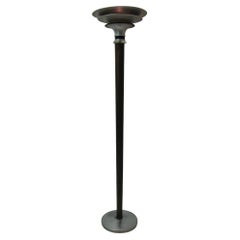
Floor Lamp Art Deco 1930, France, Materials, Chrome and Wood

Floor Lamp Art Deco 1930, France, Materials, Chrome and Wood

Located in Ciudad Autónoma Buenos Aires, C

Logistics and International Shipping We provide a comprehensive export service so that your only concern is enjoying your acquisition. • Door-to-Door Service: Pieces located in our Argentina galleries are shipped directly to your address via air freight. • Simplified Customs Management: We handle the processing of export permits and the payment of customs duties. You will receive your purchase without additional paperwork or surprise costs. • High-Security Packaging: Following FedEx international standards, each piece is protected in custom-made wooden crates, designed to withstand 1-meter impacts and ensure the integrity of the object during transit. • Note for shipments to the USA: To comply with shipping company regulations and ensure delivery at the destination, a valid tax ID (EIN, SSN, or ITIN) is required. • Domestic US Shipping: For those pieces available in our United States storage, logistics are managed through 1stdibs. Personalized Restorations Our team of expert artisans offers restoration services tailored to your aesthetic preferences and design needs: • Cabinetry and Polishing: We perform polishing work on woods, allowing for transitions from light to dark tones (including deep black finishes). • Upholstery: We reupholster chairs and armchairs with fabrics or leathers of your choice, guaranteeing a high-quality finish. • Lighting: We adapt ceiling lamps by shortening smooth rods to adjust them to the height of your rooms. • Metal Treatment: * Restoration of chromed or silver-plated bronze pieces to their original state. o Chroming or silver-plating services for bronze objects. Personalized Quotes: We would be delighted to advise you and provide a quote for any intervention according to your personal taste. Floor lamp Art Deco Materials: chrome and wood France 1930 You want to live in the golden years, those are the floor lamps that your project needs. We have specialized in the sale of Art Deco and Art Nouveau styles since 1982. Pushing the button that reads 'View All From Seller'. And you can see more objects to the style for sale. Why are there so many antiques in Argentina. In the 1880 – 1940 there was a grate wave of immigration encouraged by the periods of war that were taking place. 1st World War took place between 1914 and 1918 2nd World War took place between 1939 and 1945 The immigrants options were New York or Buenos Aires. Tickets were cheap and in Buenos Aires they were welcomed with open arms, as it was a country where everything was still to be done. Argentina was the country of new opportunities, labour was needed and religious freedom was assured, in many cases the of the family travel first until they were settled and then the rest of the family members join them. In the immigrant museum “Ellis Island Immigrant Building” in New York you can se the promotional posters of the boats that would take them to a new life. Between the years 1895 and 1896, Argentina had the highest DGP (gross domestic product) per capita in the world according to the Maddison Historical Statistics index, this situation arose due to the large amount of food being exported to European countries, which were at war. The Argentinean ships left the port of Buenos Aires with food, but they returned with furniture, clothes and construction elements, (it´s common to see this the old buildings of the historic neighbourhood of San Telmo, the beams with the inscription “Made in England)”, as well as many markets that were built in Buenos Aires, such us the San Telmo Market, whose structure was brought by ship and afterwards assembled in 900 Defensa Street. With the great influence of European immigrants living in the country, the children of the upper classes travelled to study in France, resulting in the inauguration of “La Maison Argentinienne”, on 27th of June 1928, in the international city of Paris, which hosted many Argentinians that were studying in Frace. It´s the fourth house to be built after France, Canada and Belgium, being the first Spanish-speaking one. Still in place today (17 Bd Jourdan, 75014, Paris, France). Many of the children of these wealthy families who attended international art exhibitions, museums and art courses abroad, took a keen interest in the European style. This is why Buenos Aires was at the time referred as “The Paris of South America”. Between the years 1890 and 1920 more than a hundred Palaces were built on Alvear Avenue the most exclusive avenue in Buenos Aires. Today some of these palaces have been transformed into museums, hotels and embassies. In the year 1936, the Kavanagh building was inaugurated, it was the tallest reinforced concrete building in South America. During 1994 the American Society of Civil Engineers distinguished it as an “international engineering milestone”, and it´s now considered a World Heritage of Modern Architecture. At the time was common to hire foreign architects such as Le Corbusier, who visited Buenos Aires/Argentina in 1929 and in 1948 he drew up the blueprints for a house built in La Plata City (which was declared a World Heritage Site). In 1947, the Hungarian architect Marcelo Breuer designed “Parador Ariston” in the seaside city of Mar del Plata. After an Argentinean student at Harvard University convinced him to come to Argentina. He worked on an urban development project in the Casa Amarilla, area of La Boca. The Ukrainian architect, Vladimiro Acosta, arrives in Argentina in 1928 and worked as an architect until que moved to Brazil. Antonio Bonet, a Spanish architect who worked with Le Corbusier in Paris, arrives in Argentina in 1937, where he carried out several architectural works and in 1938 designs the well-known BFK chair...

Category

Vintage 1930s French Art Deco Floor Lamps
Materials

Chrome