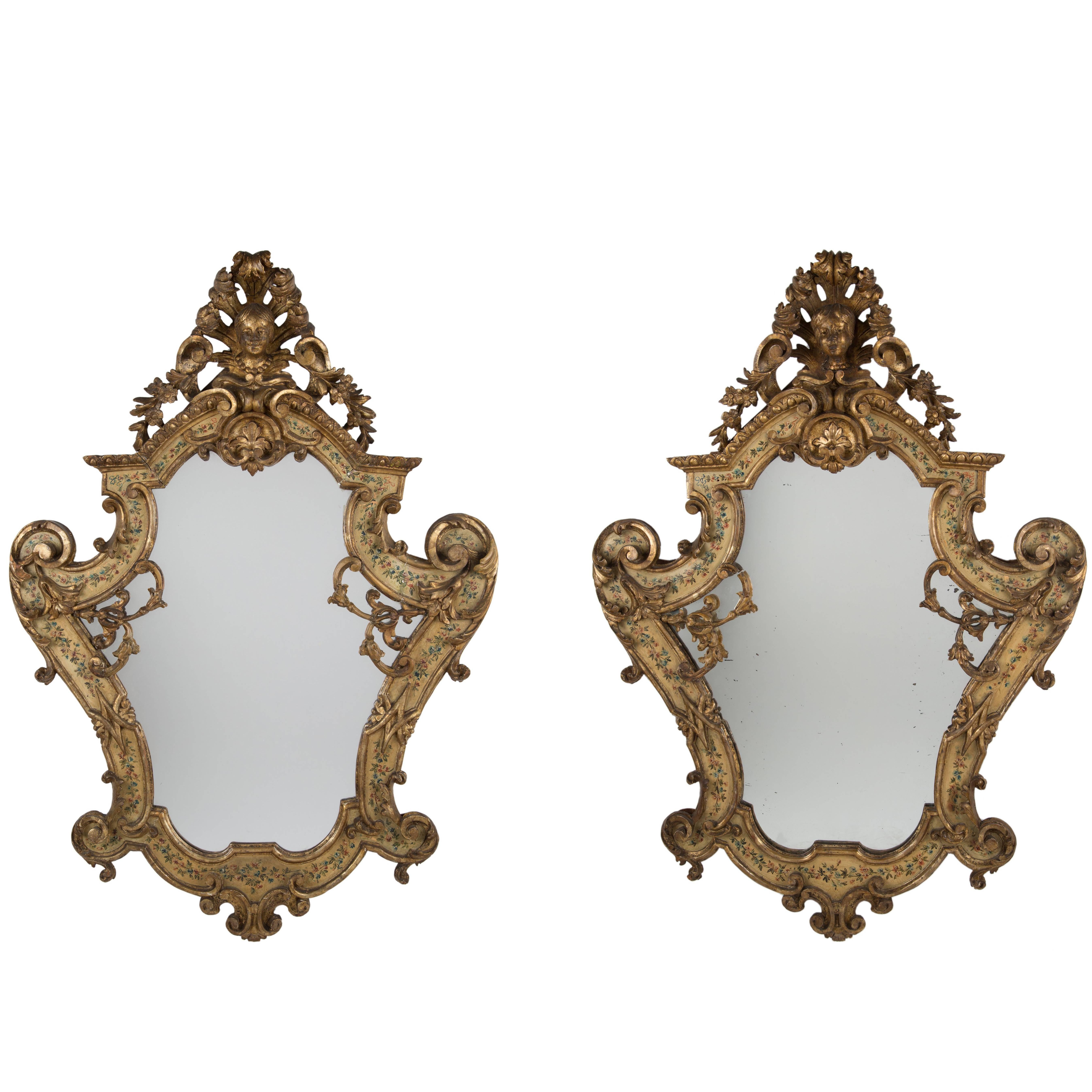
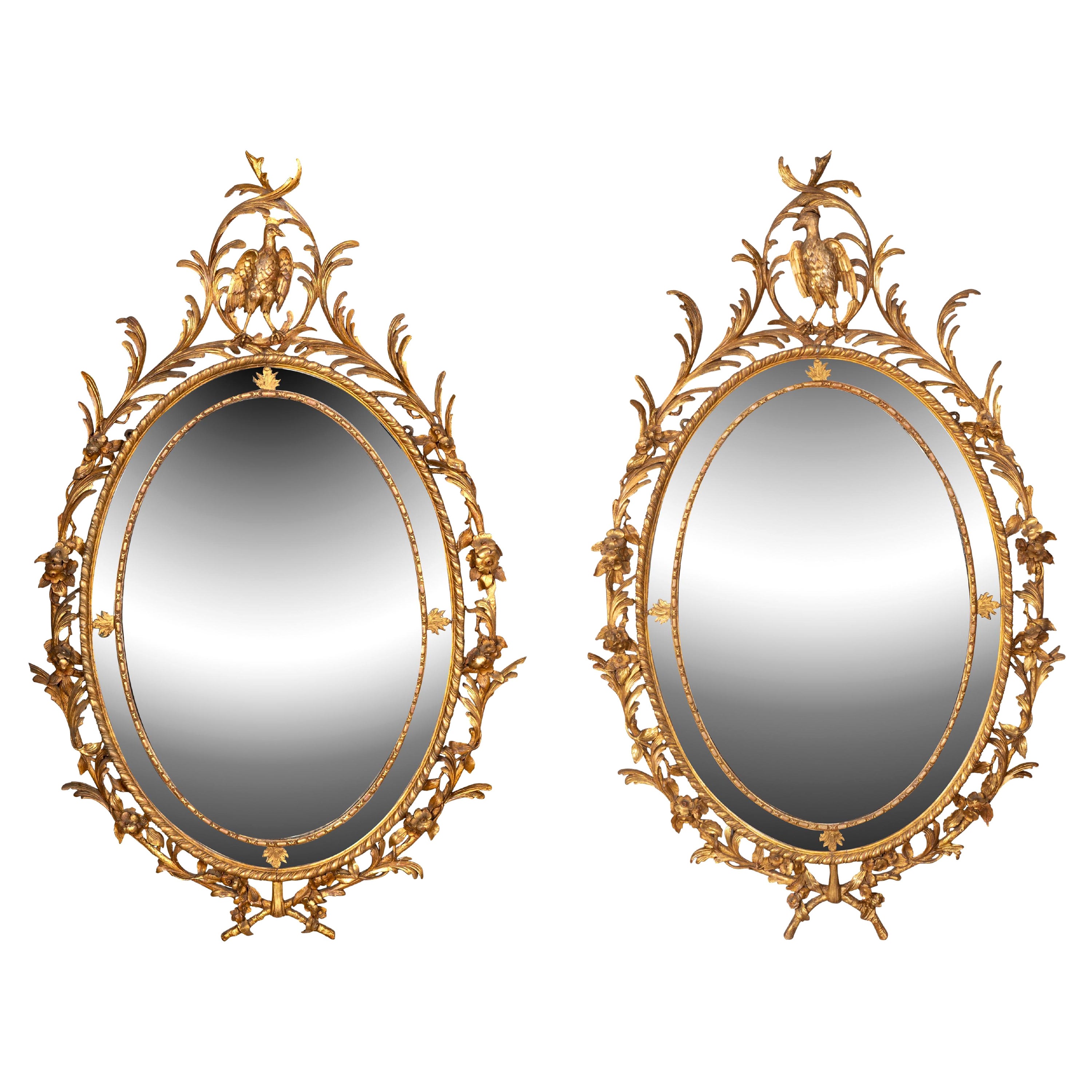
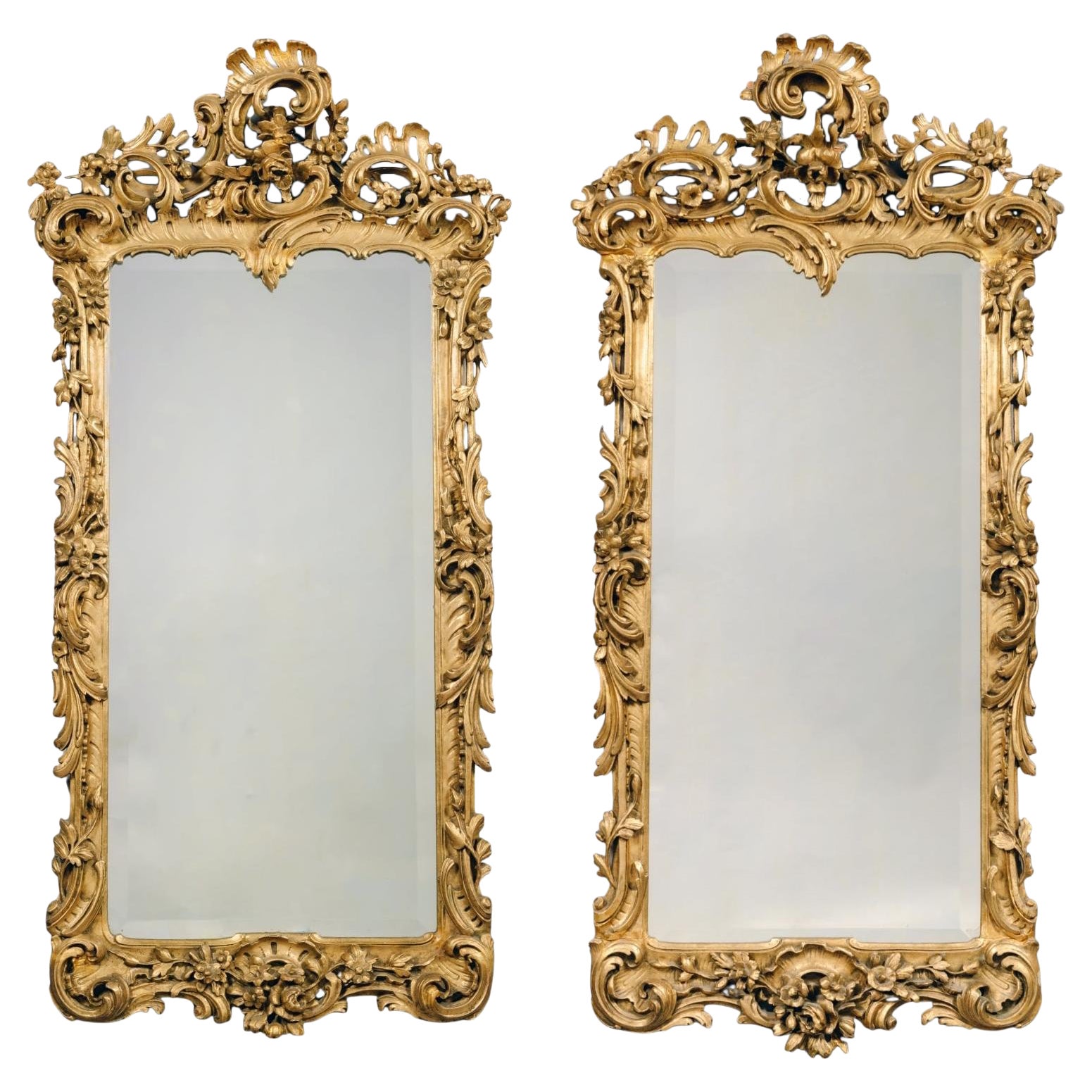
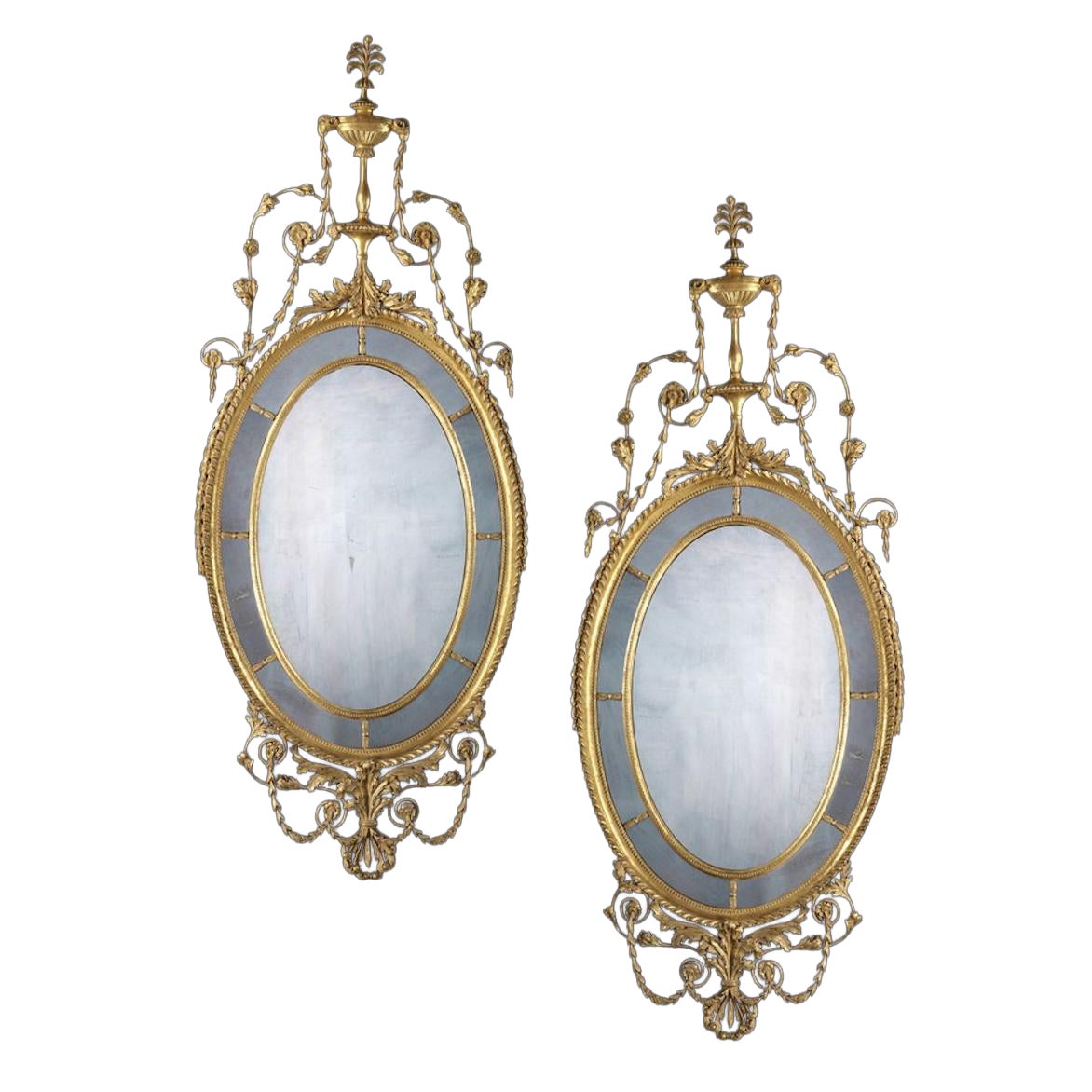
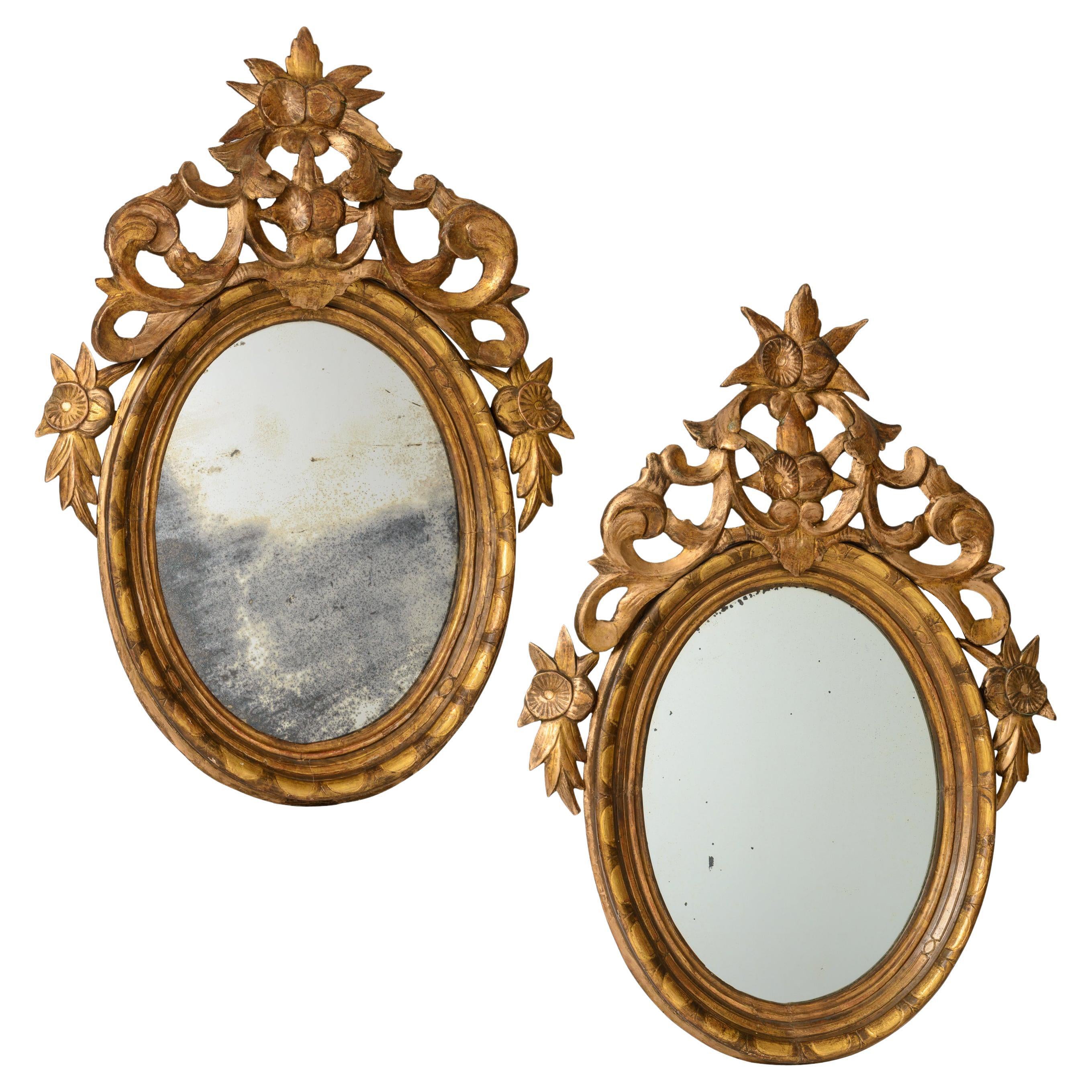
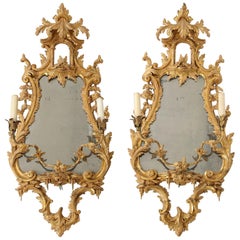
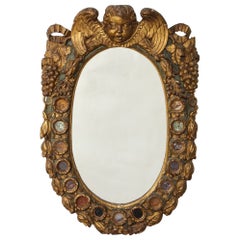
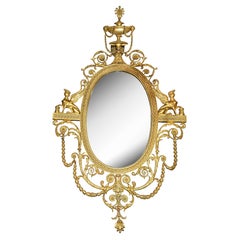
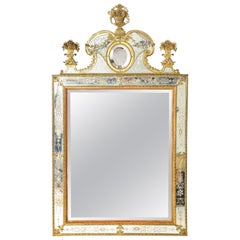
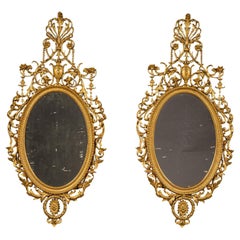
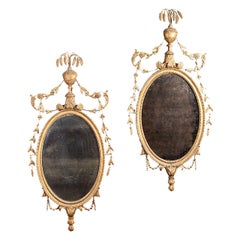
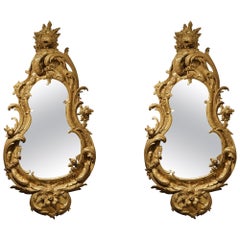
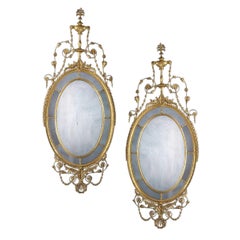
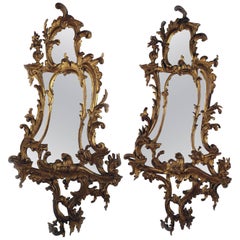
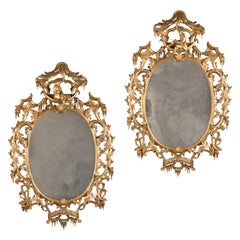
A fantastic and extremely rare pair of George III period gilt Carton-Pierre and giltwood oval mirrors in the manner of John Linnell. Each mirror is gorgeously hand carved with meticulous detail and fine craftsmanship. The giltwood borders are designed with foliate crests above female masks, with aprons centered by a standing or recumbent left facing lamb. It is extremely rare to find a pair of mirrors of this date and in such amazing untouched condition, the mirror panels are most probably original and date to the late 1700s.
Provenance: Jeremy, Ltd., London
England, circa 1770
Carton-pierre, literal translation from the French - cardboard stone, was developed in the 18th century specifically to imitate wood and stone. The Formula typically included flour, chalk, sawdust, sand and plaster and bound with wax, resin, animal glues or gum arabic. The material could be moulded, bent and otherwise formed into the desired design. Preeminent makers like Gillows and John Linnell began using carton pierre in the late 1760s. The new material allowed for lacey decorative spandrels and festoons that could be made into nearly any length or shape required. These elements and the particular foliate umbrella canopy on this pair of mirrors relates to designs of William and John Linnell. The most famous example of this crest element is on the mirror supplied by Linnell to the 4th Duke of Beaufort for the State Bedroom at Badminton House, sold from the Doris Duke Collection, Christie's New York, 3-5 June 2004, lot 442.
Linnell studied Rococo design, particularly by French exponents of the style, at St. Martin’s Lane Academy, founded by William Hogarth in 1735 (ed. G. Beard & C. Gilbert, Dictionary of English Furniture Makers 1660-1840, Leeds, 1986, p. 543). From an early age, he was inspired by the ‘antique’ taste promoted by the fashionable architect Robert Adam (1728-1792), with whom John Linnell and his father William worked on early commissions, including for the 6th Earl of Coventry at Croome Court, Worcestershire and Coventry House, Piccadilly from 1751-1763, and for Nathaniel Curzon, 1st Baron Scarsdale at Kedleston Hall, Derbyshire and London from 1759 (ibid., p. 547; H. Hayward, P. Kirkham, William and John Linnell, London, 1980, pp. 108-113).