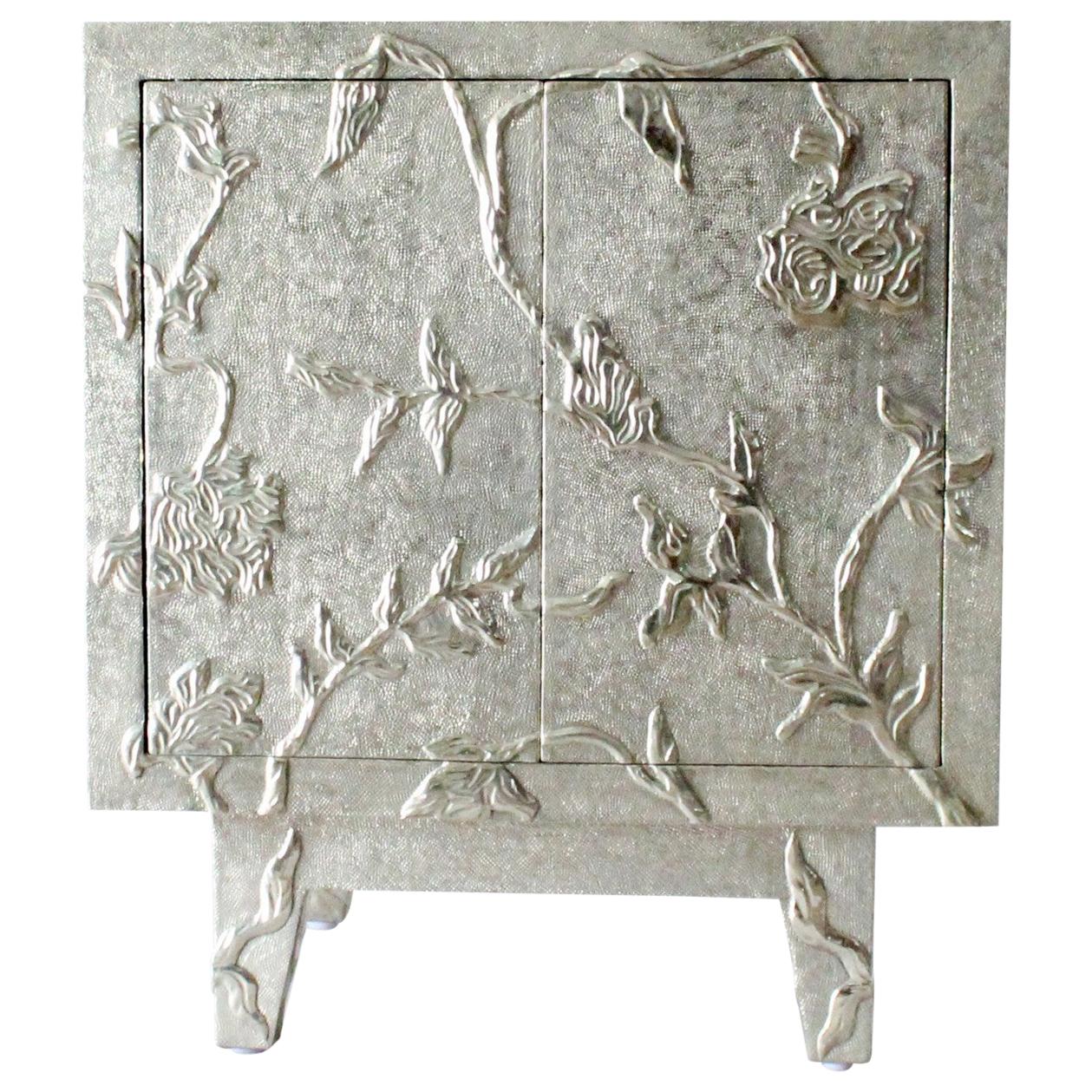
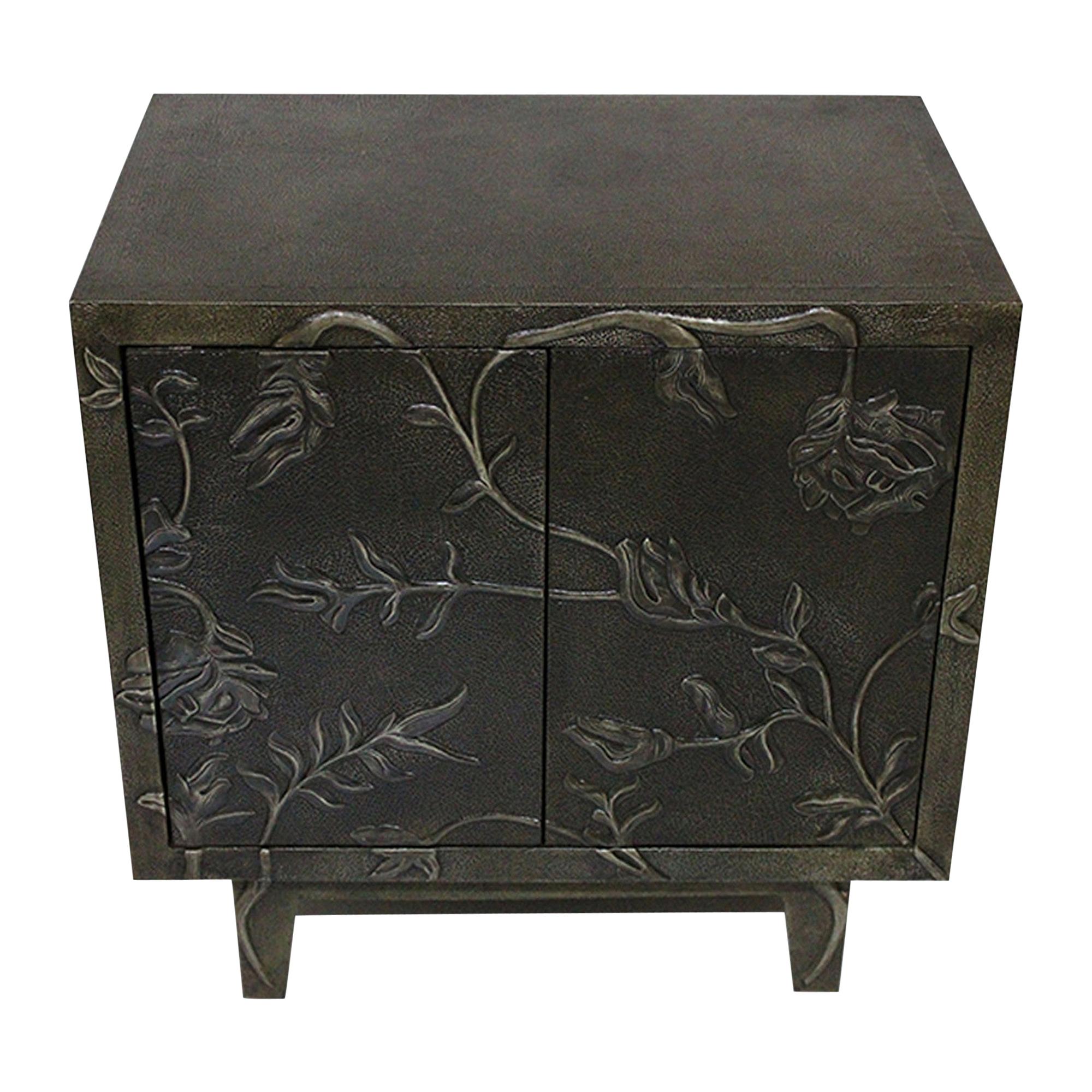
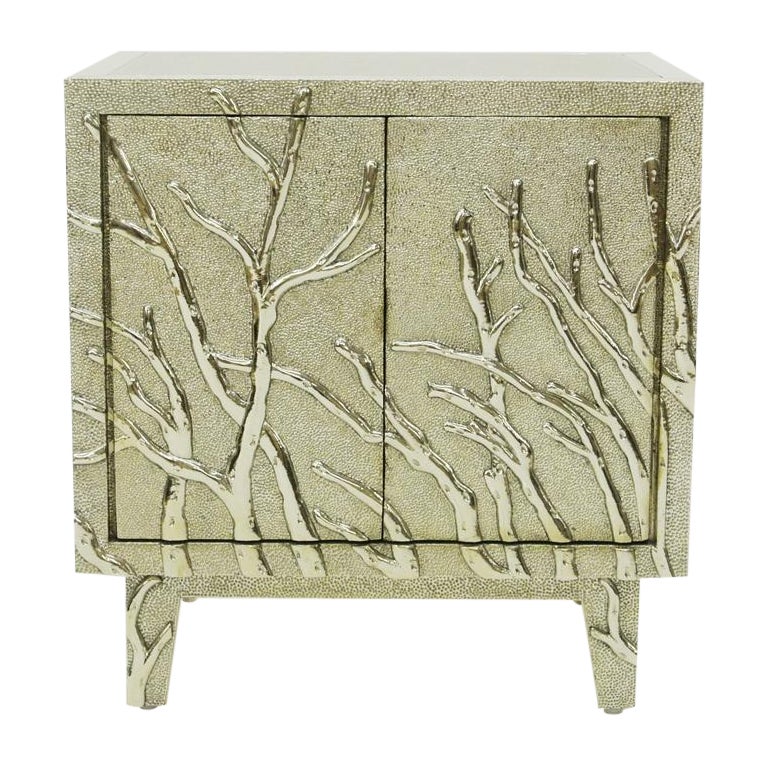
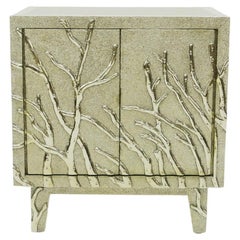
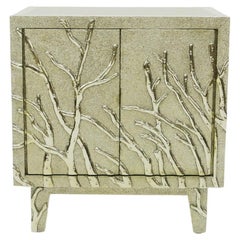
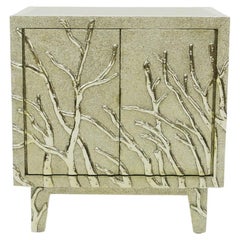
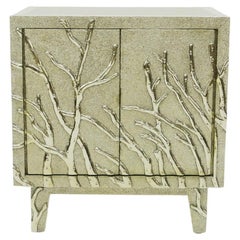
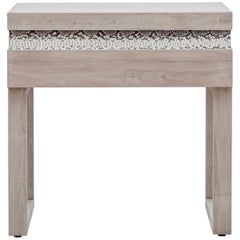
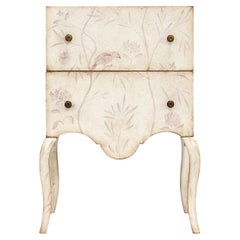
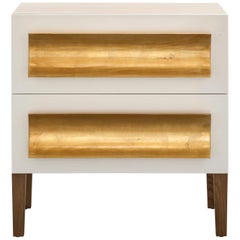
A metal-clad nightstand is clad in hand-applied White Bronze over a wood substrate, with twig-relief surface texture. The piece renders the organic form of gathered twigs in hand-worked White Bronze sheet metal. Works equally as nightstand, bedside table, side table, or accent table. The twig pattern is formed by hand before the metal is applied, creating a low-relief surface that reads as natural and structural at once. The form integrates naturally into Art Deco, Hollywood Regency, and Contemporary interiors.
The twig-relief surface reads as organic texture against the warm White Bronze ground. In directional light, the raised branches cast thin shadow lines across the metal surface, giving the piece a layered quality — the smooth ground visible between the relief elements. The White Bronze develops a warm, living tone over time.
The Twig Nightstand is constructed on a wood substrate. Sheets of White Bronze are hand-formed with a twig-relief pattern, then applied to all exterior surfaces and secured with flush-set nails. The surface is hand-finished to bring out the warmth and texture of the White Bronze.
Measuring 24"×18"×28"H. Available in White Bronze finish. Made entirely to order by artisan workshops in Rajasthan.
Designed for the Stephanie Odegard Collection. The Twig Nightstand uses the organic language of branch and twig as the organizing motif for a bedside cabinet, realized in hand-applied White Bronze cladding. Produced in Rajasthan.
Customization is at the heart of what we do. Custom sizes, finishes, and bespoke designs are available upon request. Whether you are working from a sketch, technical drawing, reference image, or an initial concept, our team would be delighted to collaborate with you and help bring your vision to life.
Made to order, each piece may show slight variations that are a natural result of handmade metal-clad production. The White Bronze surface will gradually mellow in tone over time, which is part of the material's natural character.
The images shown in this listing may be photographed in different lighting conditions or may include 3D illustrations created to represent the available finishes. We warmly encourage customers to request an individual sample or a complete sample set of all twelve finishes to experience the surface, tone, and character firsthand.
Please note that moisture in the air, seasonal climate shifts, and the natural movement of wood over time may cause the metal surface to develop slight wrinkles or occasional bubbling. We use well-seasoned reclaimed teak and high quality engineered wood wherever technically possible to minimise these natural effects, but complete stability of metal cannot be guaranteed.
All smooth finishes will show subtle tool marks. These are not defects but a natural and unavoidable result of hand-working and hand-polishing metal sheets. Our hammered finishes are recommended where a more textured, forgiving surface is preferred.
None of our metal-clad pieces are sealed with a permanent protective coating. This allows the metal to age naturally and beautifully over time. We polish every piece carefully before packing. A clear PU coat can be applied on request.
The antiqued white bronze finish will react with natural elements the fastest in the beginning, but it too will stop reacting and settle into a stable state like copper after 6 to 12 months. Since it is already antiqued and looks intentionally tarnished, this early reaction does not change the overall appearance. In that way, this surface is the most forgiving.
The antiqued white bronze finish is done by applying an acidic chemical over the white bronze to recreate a natural patination. Like the aging of silver, copper, or brass, the final result and colour uniformity cannot be guaranteed. The goal of this finish is to achieve rainbow-like tones with dull, shiny, cloudy, and lightly streaked patches to give an illusion of antiquing.
As a default practice, we offer a protective wipe-on PU coat only on this finish. If a designer prefers the natural, uncoated aging, we can leave it untreated just like the other finishes. A PU coat helps keep the surface looking the same as when shipped, but it does not create a fully uniform patina; natural variation will always remain part of this finish.