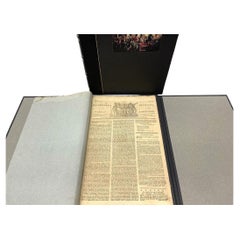
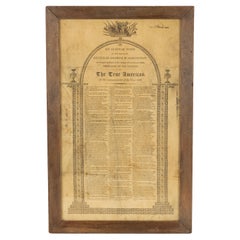
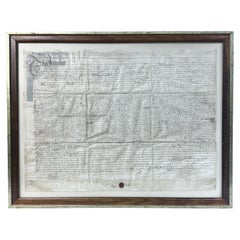
Presented here is a rare printed Postscript to The Massachusetts Spy, or Thomas’s Boston Journal, issued in Boston on May 5, 1774. Founded by Isaiah Thomas and Zechariah Fowle in 1770, The Massachusetts Spy was one of the most influential newspapers of the American Revolution, serving as a principal vehicle for the circulation of Patriot ideas and political intelligence throughout the colonies. This May 5th issue, published less than five months after the Boston Tea Party and only weeks before Parliament enacted the Intolerable Acts, offers an extraordinary record of how news from London was gathered, disseminated, and interpreted in colonial America. It presents a collection of British reports, parliamentary proceedings, royal pronouncements, and British commentary concerning the colonial unrest in Massachusetts, with significant focus on the Boston Tea Party. For readers in Massachusetts, these reports provided critical insight into how their actions were being discussed in London and what measures Parliament and the Crown were considering in response.
The Postscript opens under the striking heading “Interesting Intelligence,” announcing the arrival of “The Ship Minerva, Capt. Callahan, arrived here last Sunday in 6 Weeks from London, by whom we have Papers to the 15th of March, from which we have extracted the following INTERESTING INTELLIGENCE.” At the time, colonial newspapers frequently republished articles from London newspapers and official government reports in order to inform American readers of political developments unfolding in Britain. This issue is an exceptional example of that practice, as the reports in this issue reveal mounting British determination to suppress resistance in America.
One dispatch dated March 5 reports that Britain was “getting ready several Ships of War for Sea” and that “Some say it is to reduce the mutinous spirit of the Americans.” A subsequent report of March 10 declared that “the most vigorous Measures are resolved to be taken with the turbulent and refractory Colonies,” including the dispatch of “Four Regiments of Foot” to Boston and “six Men of War” to block the harbor. The article further notes the widespread rumor that Boston would lose its charter and be transformed into “a King’s Government.”
In a passage dated March 11, a British author offers a more ominous response to colonial resistance: “If the spirited measures at present talked of should take place respecting the Americans, the next cargo of a certain commodity may be called gun-powder tea, and they must take it with a little smack of British spirit.” This commentary illustrates the growing inevitability of confrontation, from the viewport of Britain subjects.
Other reports address the increasingly contentious question of colonial representation and governance. One article insists that Americans have “no reason to complain of want of Representation in the Senate,” arguing that members of Parliament were “more zealous for the interests of America than Great-Britian.” Yet the same report acknowledges the intensity of official concern by noting that ministerial councils had been meeting nightly, “assisted in their Deliberations by the Crown Lawyers, on American Affairs.” The gravity of the crisis is underscored by a March 12 warning that “There never was, perhaps, since the Revolution, so important a crisis in the constitution of this country as the present state of American affairs,” concluding with the dramatic declaration that “no less than the FATE OF A GREAT EMPIRE, trembles on the decision.”
This issue is equally significant for its publication of King George III’s formal message to the House of Commons, concerning the destruction of the tea in Boston Harbor. The king characterizes the event as “violent and outrageous” and urges Parliament to “not only enable his Majesty effectually to take such measures as may be most likely to put an immediate stop to the present disorders, but will also take into their most serious consideration what further regulations and permanent provisions may be necessary to be established, for better securing the execution of laws, and the just dependence on the Colonies upon the Crown and Parliament of Great-Britian.” By reprinting this royal statement in a Boston newspaper, the Massachusetts Spy publishers gave colonial readers direct access to the specific language and intentions of the British government, at a consequential turning point in their relationship.
Further reports the third column summarize proceedings before the House of Commons and testimony concerning the Boston Tea Party itself. Included are accounts from colonial governors, discussions regarding the whereabouts of the other tea shipments sent to other American colonies, and details of Governor Thomas Hutchinson’s response to the crisis. Particularly noteworthy is the eyewitness statement attributed to “Mr. Rotch, the owner of Capt. Hall’s vessel,” who described how “a number of men, disguised, boarded the vessels containing the Tea, and, as it said, threw the whole into sea.”
Beyond its specific contents, this issue is an important example of the role of newspapers in shaping revolutionary America. By collecting, reprinting, and circulating British reports, The Massachusetts Spy enabled colonial readers to monitor official attitudes in London and assess the likely consequences of resistance. The newspaper functioned as a source of local news and also as a crucial vehicle for political intelligence.
Founded on July 17, 1770, by Isaiah Thomas and Zechariah Fowle, The Massachusetts Spy quickly emerged as one of the most influential newspapers of the Revolutionary era. Although it initially professed to be “open to all parties, but influenced by none,” the paper increasingly aligned itself with the Patriot cause and became closely associated with the activities of the Sons of Liberty. Governor Thomas Hutchinson even attempted to prosecute Isaiah Thomas in 1771 for his allegiance to the patriot cause. The printer ultimately fled Boston to avoid arrest, relocating his press to Worcester. His first publication in Worcester was on May 3, 1775, wherein he published his eyewitness coverage of the Battles of Lexington and Concord, often regarded as the first example of American war correspondence. Thomas became one of the foremost printers and publishers in the United States and, in 1812, founded the American Antiquarian Society.
CONDITION:
Near fine condition. "Postscript to The Massachusetts Spy, or Thomas’s Boston Journal." [Boston]: May 5, 1774. 4to. Scattered minor spotting and a few small holes. Light fold lines, from past storage. Small tears in margin, since stabilized. 2pp. Dimensions: 15 3/8” H x 9 ¼” W.
Archivally framed in a custom-built black and gold wooden frame, with acid-free mats, and UV glass. Framed Dimensions: 24" H x 18 1/2" W x 1 1/4" D.
Accompanied by our company’s letter of authenticity.