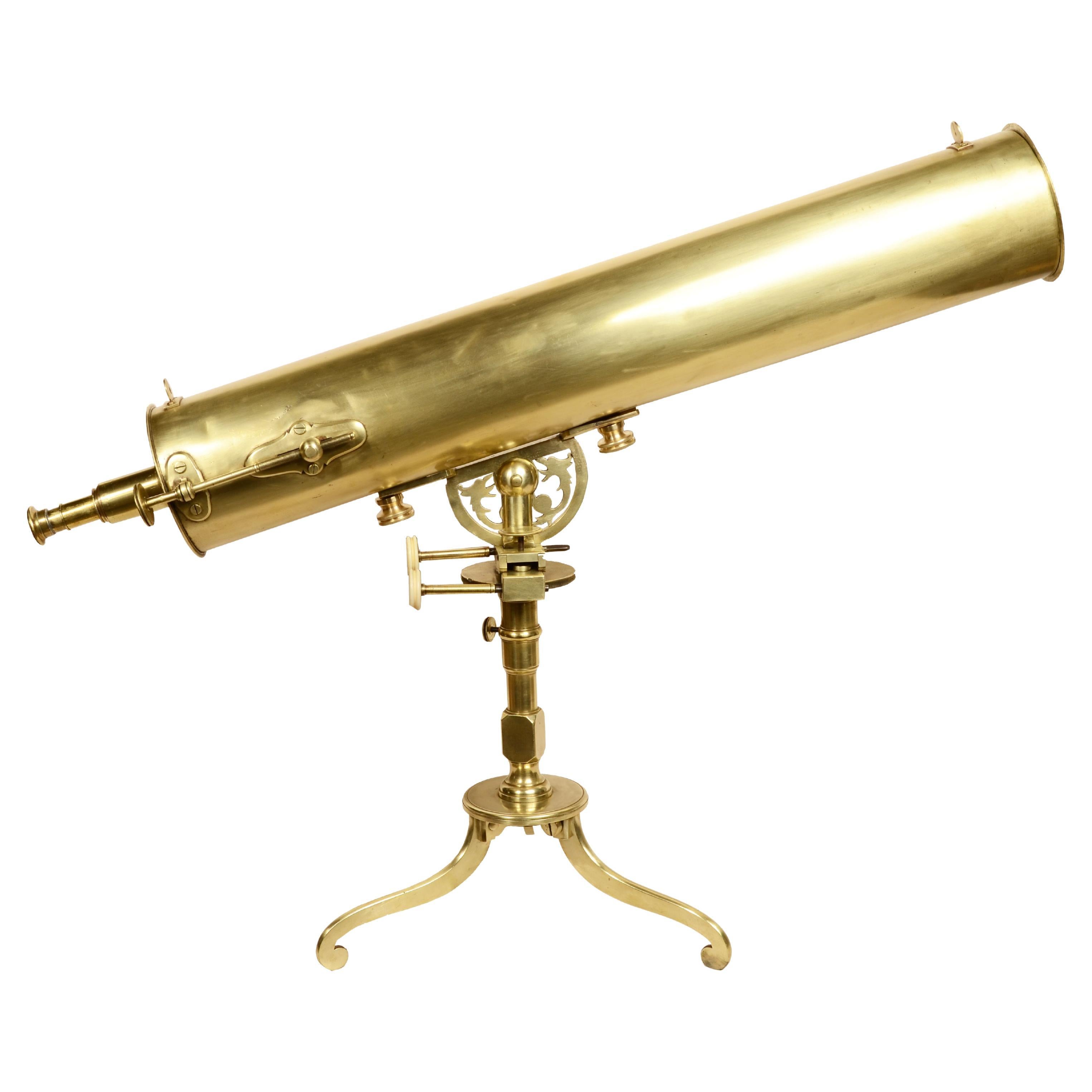
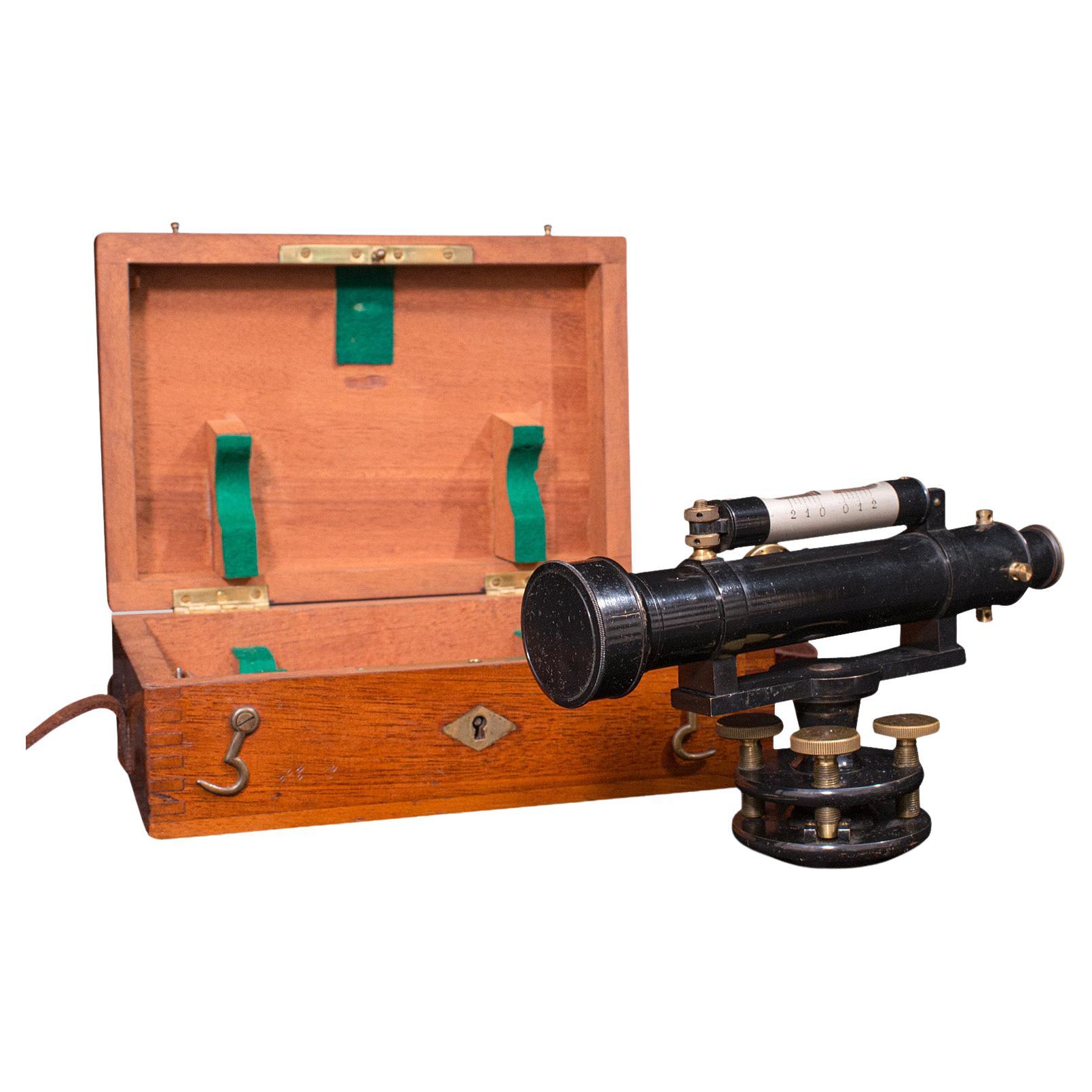
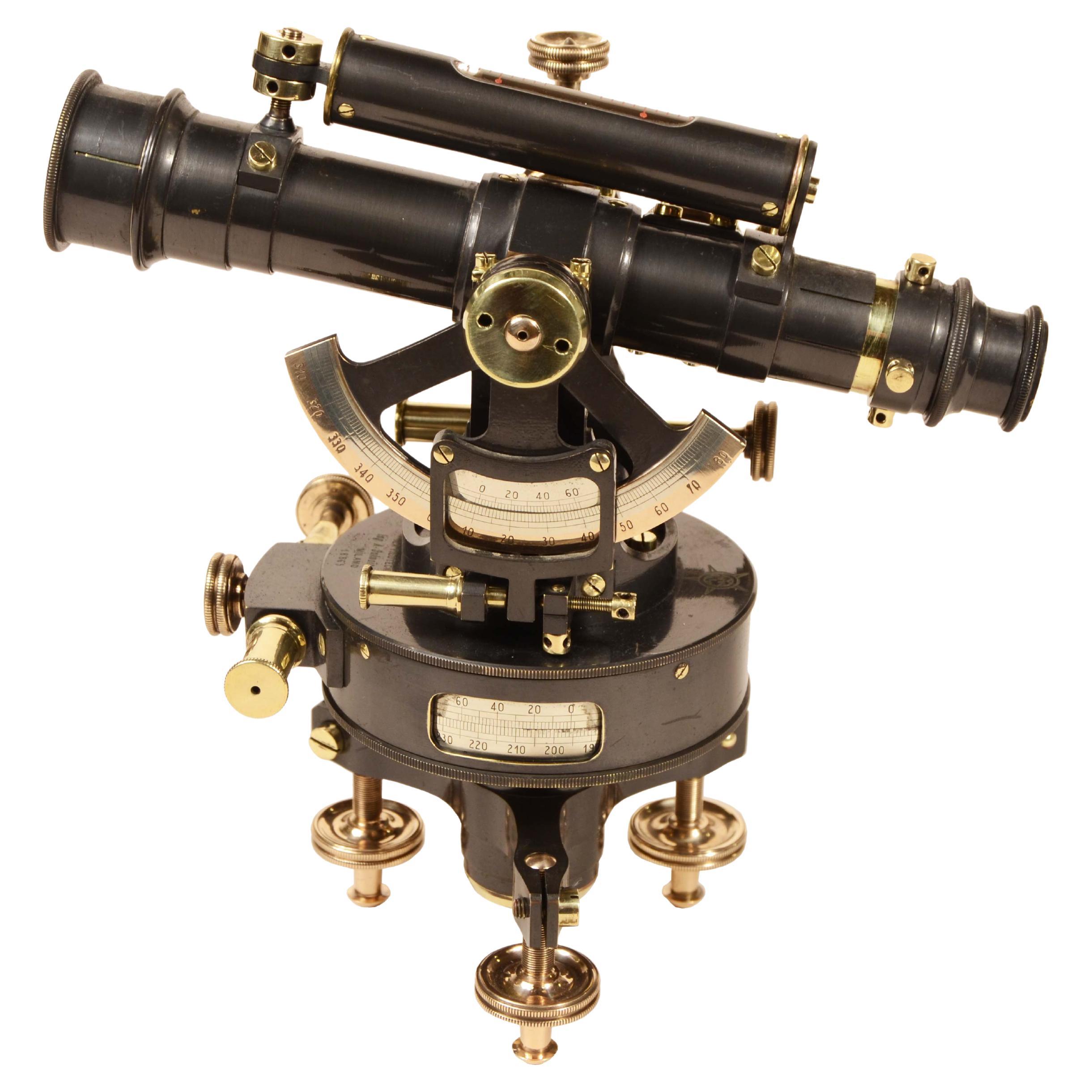
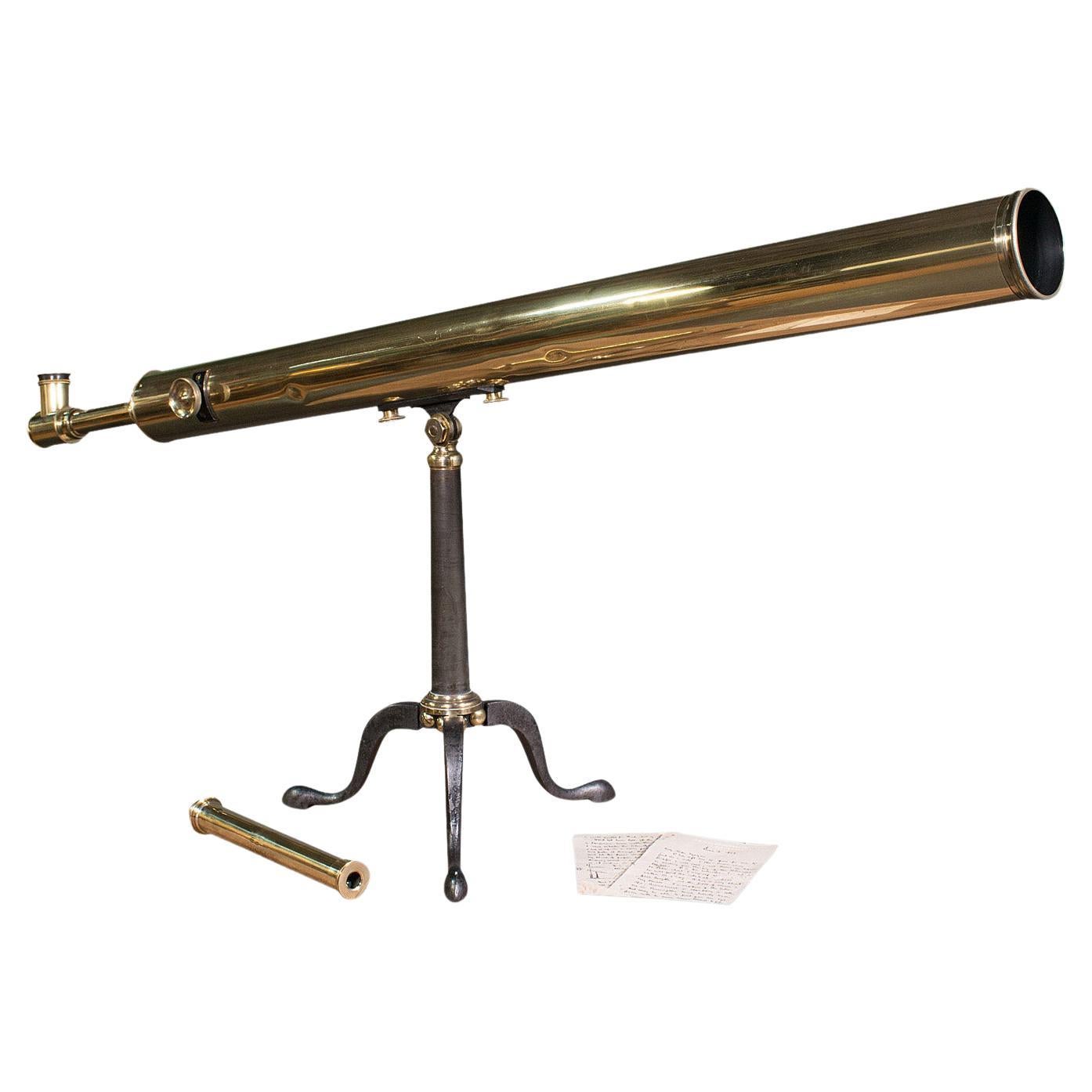
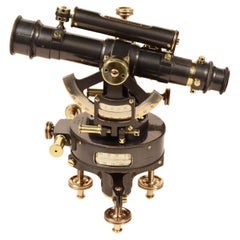
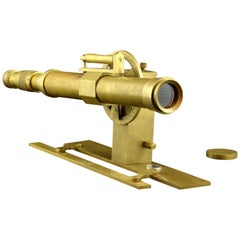
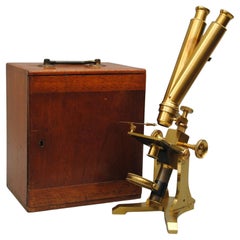
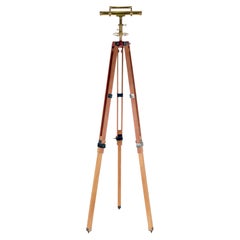
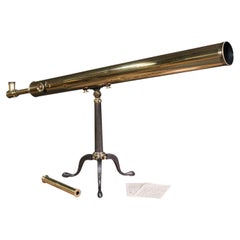
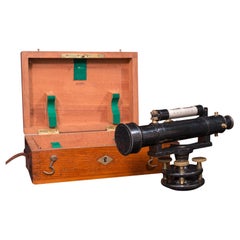
8511 Ing. A. Salmoiraghi, Milan; Centesimal brass theodolite No. 7886, from the late 19th century.
It is a scientific instrument used in terrestrial observations to measure horizontal and vertical angles. The instrument consists of a three-legged base with adjustment screws, a telescope, a vertical circle and a graduated horizontal circle, four microscopes for reading the circles, and a dual spirit level. Dimensions: height 36 cm, telescopic length 38.5 cm, base width 20 cm.
The Salmoiraghi company was founded in Milan in 1865 by Ignazio Porro (1801–1875) under the name Filotecnica, a training workshop specializing in the manufacture of surveying instruments. Porro was a skilled builder and inventor, so much so that he was sometimes ahead of his time: just consider his invention of the anallactic telescope, that is, a system of lenses with a variable focal length (now known as a zoom); or one might recall the “Porro prism,” an arrangement of prisms used to straighten images in telescopes and binoculars. After staying and working in various locations in Piedmont, Paris and Florence, Porro settled in Milan and began teaching at the Politecnico. Here he has as a pupil the young Angelo Salmoiraghi, and it will be him a few years later who will transform the company into an industry, while also maintaining the initial teaching vocation. In fact, in 1871 Salmoiraghi became a partner in Porro, and in 1877 he bought the factory, expanding it: by 1890, about 150 workers were working there and the factory covered an area of 1,500 square meters. From 1906 until the outbreak of World War I, the company was known as Filotecnica Salmoiraghi and expanded its product range: in addition to surveying instruments, it produced mathematical instruments, as well as tools for drafting, astronomy, meteorology, and navigation, with its catalog featuring more than 300 items; The instruments produced were of excellent quality and garnered numerous accolades at world’s fairs. During World War II, the company was targeted as a wartime objective and its factories were bombed, but at the end of the conflict, the company managed to recover immediately; In the 1970s, it was acquired by Dollond & Aitchison, along with Viganò, an optics company that had long been a competitor of Salmoiraghi. The Salmoiragh & Viganò company still exists today and became “Italian” again in 2000.
Surveying studies the instruments, surveying techniques, calculations, and drawings needed to graphically represent a portion of the Earth’s physical surface to scale on a map, highlighting the details it contains, such as roads, rivers, buildings, crops… Surveying is one of the oldest sciences. The Egyptians surveyed the land along the Nile to re-establish its boundaries after the river's periodic flooding. The Greeks, and especially the Romans, used topographic methods that were already highly precise; teams of surveyors (the gromatici), traveling with the Roman legions, marked out boundaries and divided the conquered lands into regular plots, which were then described and depicted on copper plates. Among the Arabs, topography was used to create maps and to measure agricultural land and plots for cadastral purposes.