By Pierre de Baillou
Located in Milano, IT
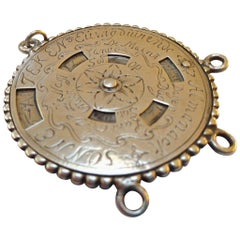
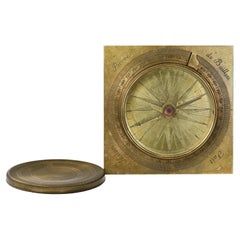
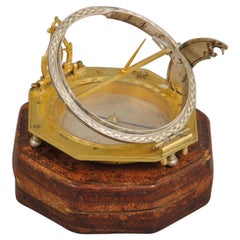
Compass
Pierre de Baillou
Milan, first quarter of the 18th century
Brass, steel and glass
It measures 3.81 in x 3.81 x 0.59 (9.7 cm x 9.7 x 1.5)
It weights 0.57 lb (259 g)
State of conservation: some signs of use and some slight scratches on both the metal and the glass.
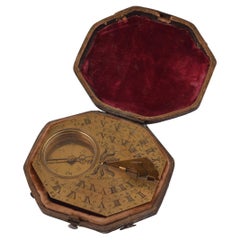
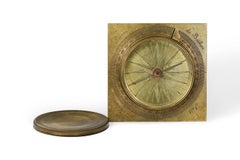
The whole instrument is made of brass, apart from the glass cover and the magnetic steel needle.
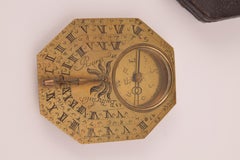
The cup of the compass has a lid and is attached to a square plate; inside the wind rose is engraved and the cardinal points are marked.
The square plate is graduated 0 ° / 360 ° around the compass and is divided into four vertices, bearing the inscription:
Pierre
de Baillou
Fait
à Milan
A shaped radial hand, which pivots between the cup and the plate, acts as a movable indicator.
Nothing is known of the biography and activity of Pierre de Baillou.
The fact that he signed a scientific instrument, defining it "made in Milan", allows us to hypothesize with some certainty that he was related to François de Baillou (Milan, 1700-1774), a Milanese optician and one of the most famous manufacturers of telescopes and microscopes of his time. Descending from a French family who had settled in Milan, François was nominated Royal Optician by Empress Maria Theresa in 1750.
Pierre was probably his relative - perhaps his father - and may have started his business as a manufacturer of scientific instruments in Milan. This was then continued by François.
A compass of proportions signed by Pierre is present in the collections of the Civic Collections of Applied Art of the Castello Sforzesco (Tullio Tomba, La collezione Scientifica delle civiche raccolte del Castello Sforzesco, in Rassegna di Studi e di Notizie, 1973, p. 114).
A brass sundial from the first quarter of the 18th century signed Pierre Baillou Fait à Milan is kept at the Poldi Pezzoli museum in Milan (inv. 4141).
Anthony John...
Category
Italian Other Antique Early 18th Century Scientific Instruments