Main Hall Carpet
Ningxia
North Central China
First Half of the 18th century
Measures: 12'8" x 13'4" - 386 x 406 cm
Structural Analysis
Warp: cotton, white, natural, Z-4-S, hand-spun, very irregular in both individual strands and overall
Weft: cotton, white, natural, Z-4-S, hand-spun, winder plied, thick and very soft, two shoots equally wavy, alternating, P.6 wool, Z-2.3.4-S
Knot: Pl/0°/horizontal 6 x vertical 5 = 30 per square inch
Sides: 2 cords each of 2 body warps, weft wrapped figure-8 style
Ends: n.o.
Wefts/Knots: 2 or 2+/1, thin knotting yarn, knot lines very irregular on verso
[n.b. check for T knots along edges]
Description and remarks
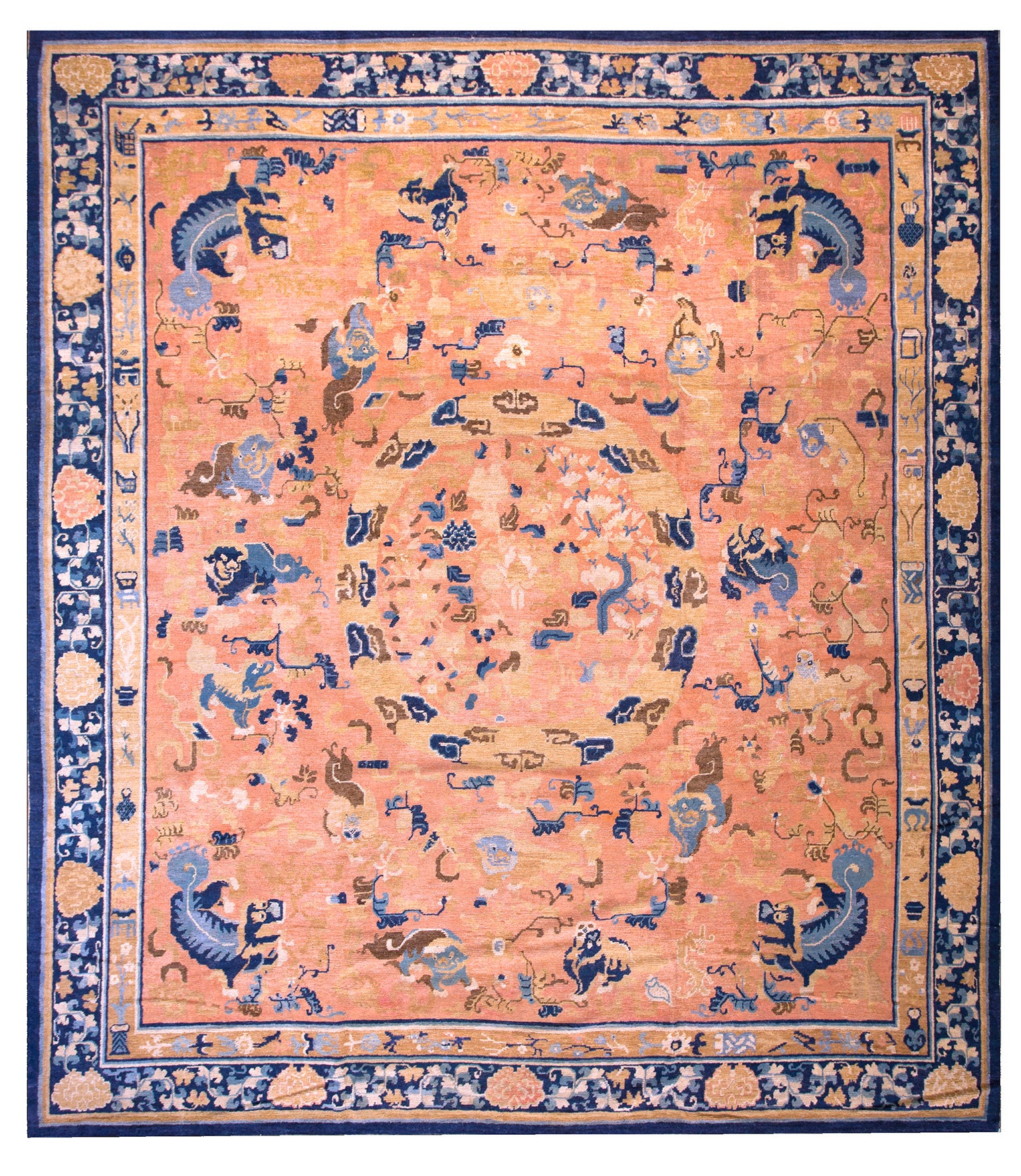
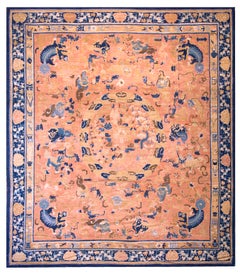
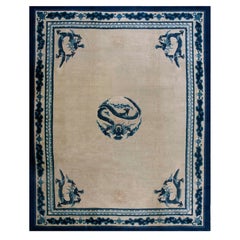
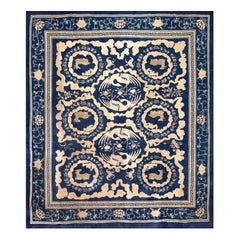
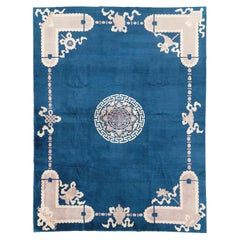
The corners of this now salmon (once red) ground square main hall carpet are marked by four, gigantic dark and middle blue lion dogs (over five feet long!). Two more dogs comprise a central roundel within a thick, polychrome cloud wreath. The rest of the field ornamentation consists of eight, large complete lotus palmettes, four additional fractional ones behind the corner dogs, and vigorous connecting vines and leaves, the latter primarily in dark blue. The two central dogs play with a brocade ball. There are, then, a total of six lion dogs.
[The dark blue main border…]
The four huge lion dogs are probably the largest on any surviving Ningxia carpet and are very finely detailed, with elements retained from much earlier prototypes. Each dog has a broad, leonine mane developing into an overpelt edged with split curls and a powder puff tail. There is a strong ivory backbone line from the neck to a volute in the tail. This line appears on the more dragon-like lion dogs in the well-preserved, magnificent Peking imperial late sixteenth-century carpet (7.85 m x 8.15 m), still in the Forbidden City [Carpets in the Collection of the Palace Museum, pp.XXX, ill.XXX]. The flaming joints on the latter dogs, a qilin feature, are also present in various later Ningxia carpet dogs, our 21376 among them, although here the front flames are reduced to small ivory veins or branches. In later rugs, or those with smaller dogs, the flames disappear entirely or are converted to limb contour outlines.
The dogs' faces and snouts are flat, but there are indications of teeth, even though the jaws are closed. The dogs are not barking nor do they hold in their mouths ribbons attached to brocade balls. There eyes are beady and lack eyelashes. They do not obviously protrude? as in certain other period examples [eg. Franses, pls.6,7,9]. While certain imperial dogs might be mistaken for dragons, these dogs are purely canine. Their ears are pointed and relatively short, and they lack the cloud-like involutions of the Beijing piece, cited above. Their manes are intended to be curly with scalloped outer edges, but lack internal detailing. Overall, the animals are fiercely playful, but not roly-poly pets. The dogs are grinning, not yapping.
The lion dogs of the central roundel are smaller and more schematic in design, partially because of the fading of the yellow to a buff-tan. Hence, details have been lost.
A published example with relatively larger corner dogs is the qilin and four dog rug [Franses, pl.6], 4.8 x 6.6, dated to the second half of the 17th century. The dogs here are more slender in body and each holds in its mouth ribbons connected to a brocade ball as in earlier imperial pieces. Their overpelts are far more simplified and schematic. The tails are very short with a distinct spiral. The selective fading has deprived us of many originally striking details in this small rug. Overall, the four corner dogs are proportionally smaller.
There are several idiosyncrasies in the large dogs of 21376. There is a dark blue and ivory speckled underside? to each dog and a similar area around the ivory tail volute. The feet of our dogs end in white puffs instead of detailed paws. The long, outstretched nearside back legs resemble those of [Franses, pl.6]. Our dogs have a dark blue hump in their lower backs. In some imperial pieces [eg. Franses, pp.24, 26-27], the hump is actually the top of the back offside leg and has flaming joint details. The effect has been converted into a convexity along the spine in 21376 instead of being off to one side. There are no flames issuing from the hidden joint.
The dark blue main border displays cartouches with various unrepeating antiques and precious objects: a fish, a square knot, scrolls, etc. Butterflies and small fruits* or paeonies with short, thin tendrils fill the interstices. The cartouches turn neatly at the corners. There is a "T" fret inner border with all four corners identically shaped, and a plain, dark blue outer band. The border is quite rare, appearing in smaller form on a daybed format rug, Sotheby's, New York, 7.4.99, lot 80, 5.5 x 8.3. Between the cartouches were stencil type lotuses with "M"-style tendrils.t. The rug was attributed, rather conservatively, to the mid-19th century. Given the close similarity of the borders, the rugs cannot have been made much apart chronologically and perhaps in the same workshop.
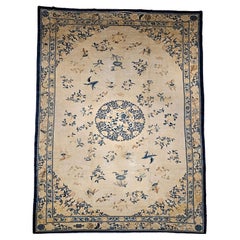
Antique Chinese - Ningxia Chinese Brown 1730s Rug, Circa Date: 1730s. This exceptional example of Chinese weaving originates from the Ningxia region, renowned for producing some of the most sophisticated antique rugs during the Qing Dynasty. Its square format and powerful iconography suggest a commission of considerable importance, likely intended for a high-ranking official or palace setting.
The palette is dramatically rendered, utilizing a rich, warm apricot field that reads as a sophisticated brown earth tone color. This field provides a stunning contrast to the deep indigo and vibrant aqua blues used for the primary mythological creatures and the multiple, complex borders. The meticulous use of natural dyes has ensured the longevity and remarkable clarity of these hues over centuries.
The central composition features two highly stylized, confronting dragons or Foo Dogs, swirling amidst stylized clouds and water elements, all contained within a large circular medallion. While the primary focus is on these powerful zoomorphic figures, the secondary elements incorporate delicate scrolling vines and subtle floral rugs motifs, balancing the intensity of the central design with traditional Chinese symbolism.
Measuring approximately square, this piece functions perfectly as a distinctive feature among room size rugs, offering a rare glimpse into 18th-century imperial aesthetics. The preservation of the fine wool pile and the remarkable clarity of the design confirm its status as a highly collectible textile, representing the zenith of Ningxia's artistic output.