Want more images or videos?
Request additional images or videos from the seller
1 of 13

Gerrit Thomas Rietveld Black Red And Blue Armchair For Cassina

$10,542.42per item
£7,814.75per item
€10,898.55per itemVAT Included
CA$14,705.15per item
A$14,957.82per item
CHF 8,584.26per item
MX$179,810.57per item
NOK 100,135.10per item
SEK 101,077.78per item
DKK 68,400.08per item
Quantity

About the Item

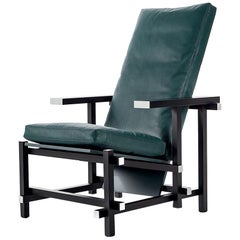
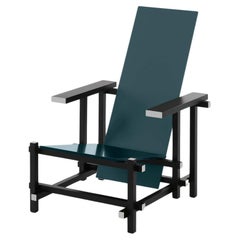
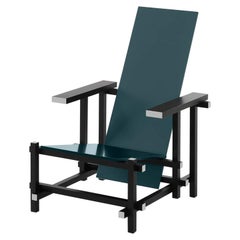
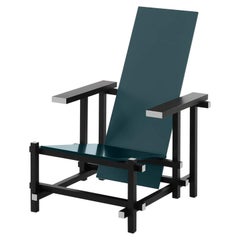
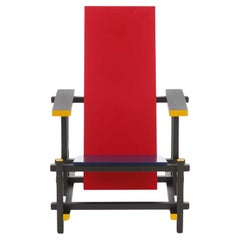
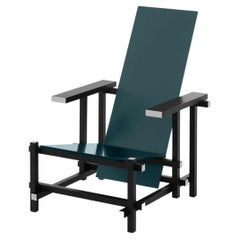
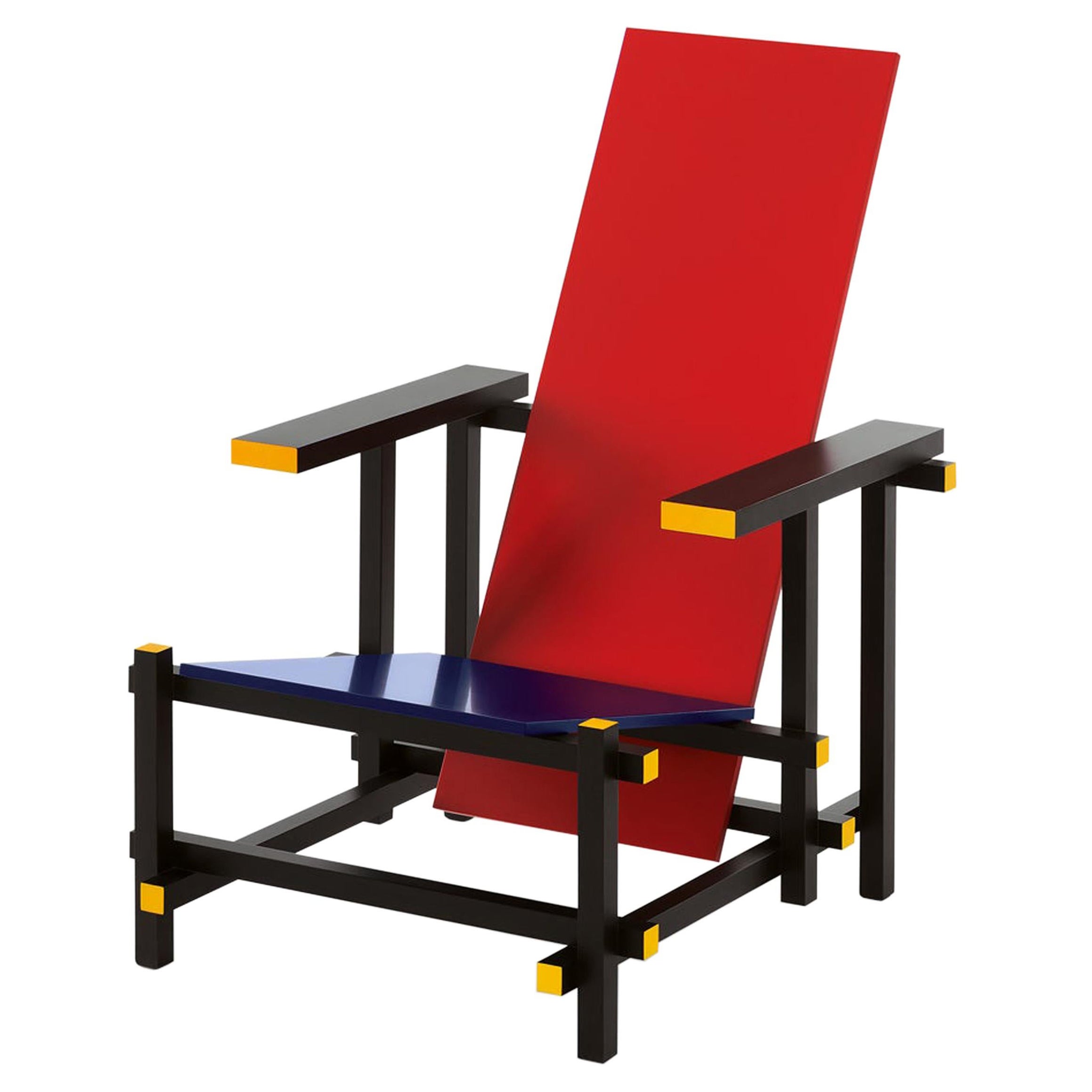
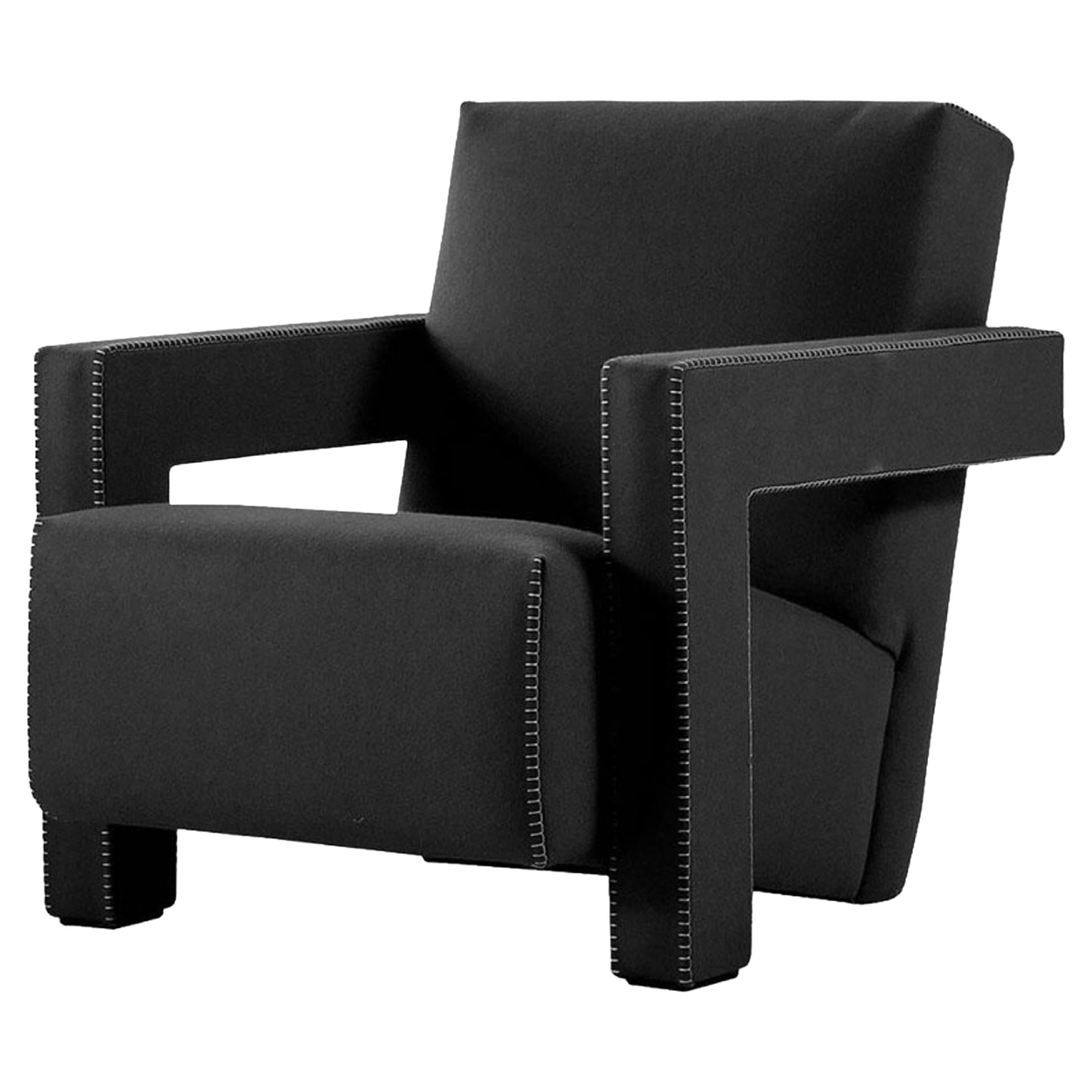
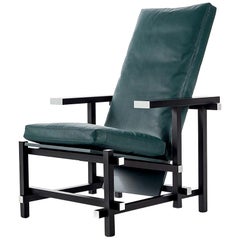
Gerrit Thomas Rietveld Black Red And Blue Armchair For Cassina A variation of the iconic 1918 chair by G. T. Rietveld, the Black Red and Blue wood armchair grew out of the Dutch master’s unflagging exploration and the clear evolution of the archetypal model with a view to the exploration of color. Lounge chair withframe in black-stained beechwood with white contrasting parts. Seat and back in green lacquered multiplywood. The armchair can have a single seat and backrest cushion in fabric or leather. This chair, produced for the school teacher Wicher Zeilmaker, is one of the numerous versions of the iconic model designed in 1918. After analysing the original pieces, it was discovered that the first was completely produced in unpainted wood. In the following years Rietveld proposed various examples, monochrome or painted with other colours, depending on the clients necessities and the interiors that the chair would furnish. The first owners kept the chair in their homes as if it were an abstract sculpture but in some cases it was used as a proper chair, with cushions to make it more comfortable Structure · In black-stained beechwood with white contrasting parts. Seat and back · On green lacquered multiplywood. The armchair can have a single seat and backrest cushion in fabric or leather One of the versions of the iconic model dated 1918. The structure is in black-stained beechwood with white contrasting parts. Seat and back in green lacquered multiplywood. The armchair can have a single seat and backrest cushion in fabric or leather. The Black Red and Blue (Zeilmaker version) born from Rietveld’s chromatic experimentation While researching the origins of the Red and Blue model in collaboration with the Rietveld heirs, it emerged that the key idea of the first prototypes was based on the concept of spatial organisation expressed through the monochrome tones of its elements. The first version was in fact produced in 1918 in completely unpainted wood. In the following years Rietveld proposed various examples, either monochrome or painted in different colours, depending on the requirements of his customers and the interiors for which the chairs were intended. As such, it comes as no surprise to find this 1920s version, presented as part of Cassina’s MutAzioni selection, created for the school teacher Wicher Zeilmaker with a black frame with white ends and a dark green painted seat and backrest. It was Rietveld’s ever-increasing involvement in the De Stijl movement that led him to also use primary colours on this model in 1923, and as such the chair became a veritable manifesto for the emerging neoplastic movement. Initially dubbed Slat chair, Rietveld only gave it the name Red and Blue in the 1950s following its chromatic evolution. The various owners of the different examples used the chair as an abstract- realist sculpture in their interiors and, in some cases, as a simple tool for sitting on, adding cushions to make it more comfortable, just like Cassina offers for the Black Red and Blue today. Important information regarding images of products: Please note that some of the images show other colors and variations of the model, these images are only to present interior design proposals. The item that is selling is on the first image. Important information regarding color(s) of products: Actual colors may vary. This is due to the fact that every computer monitor, laptop, tablet and phone screen has a different capability to display colors and that everyone sees these colors differently. We try to edit our photos to show all of our products as life-like as possible, but please understand the actual color may vary slightly from your monitor. About the Designer: Gerrit Thomas Rietveld, born in Utrecht on 24 June 1888, seems possessed of two personalities, each so distinct that one might take his work to be that of more than one artist. The first personality is that seen in the craftsman cabinet-maker working in a primordial idiom, re-inventing chairs and other furniture as if no one had ever built them before him and following a structural code all of his own; the second is that of the architect working with elegant formulas, determined to drive home the rationalist and neoplastic message in the context of European architecture. The two activities alternate, overlap, and fuse in a perfect osmosis unfolding then into a logical sequence. In 1918 Rietveld joined the “De Stijl” movement which had sprung up around the review of that name founded the year before by Theo van Doesburg. The group assimilated and translated into ideology certain laws on the dynamic breakdown of compositions (carrying them to an extreme) that had already been expressed in painting by the cubists: the “De Stijl” artists also carefully studied the architectonic lesson taught by the great Frank Lloyd Wright, whose influence was widely felt in Europe at that time.Collaborating first with Robert van’t Hoff and Vilmos Huszar, then with Theo van Doesburg and Cornelius van Eesteren, Rietveld soon became one of the most distinguished interpreters of the neoplastic message.Among his most important works are:the Schröder house at Utrecht (1924); the “Row Houses” at Utrecht (1931-34); the Dutch pavilion at the Venice Biennial (1954); the sculpture pavilion in the Rijksmuseum Kröller-Müller at Otterloo and the Van Gogh Museum in Amsterdam (1955). Out of his equally important furniture, Cassina has chosen for its own production: the “Red and Blue” (1918), the “Zig-Zag” (1934), the “Schröder 1” (1923), the “Utrecht” (1935) About Manufacture: Established in 1927 by Cesare and Umberto Cassina in Meda, Italy, Cassina launched industrial design in Italy in the 1950s, based on a totally innovative approach that marked the transition from artisan production to mass production. With a mindset focused on research and innovation, Cassina combines technology and long-standing artisan craftsmanship. Memory, research, innovation. Cassina blends traditional skills and superior productivity, meticulous attention to detail and passion, uniqueness and experimentation, wellbeing and sustainability. Today, the company continues to address new lifestyles with the creation of complete, harmonious interior decor solutions that embody the best contemporary design for all areas of the home.
  • Dimensions:
    Height: 34.65 in (88 cm)Width: 17.33 in (44 cm)Depth: 32.68 in (83 cm)Seat Height: 13 in (33 cm)
  • Style:
    Mid-Century Modern (In the Style Of)
  • Materials and Techniques:
  • Place of Origin:
  • Period:
  • Date of Manufacture:
    Contemporary
  • Production Type:
    New & Custom(Current Production)
  • Estimated Production Time:
    14-15 weeks
  • Condition:
  • Seller Location:
    Barcelona, ES
  • Reference Number:
    1stDibs: LU1427243174392

More From This Seller

View All
Gerrit Rietveld Zeilmaker Version of Black Red and Blue Chair by Cassina

Gerrit Rietveld Zeilmaker Version of Black Red and Blue Chair by Cassina

By Gerrit Rietveld, Cassina

Located in Barcelona, Barcelona

Chair designed by Gerrit Rietveld in 1920. Relaunched in 2015. Manufactured by Cassina in Italy. One of the versions of the iconic model dated 1918. The structure is in black-stained beechwood with white contrasting parts. Seat and back in green lacquered multiplywood. The armchair can have a single seat and backrest cushion in fabric or leather. The black red and blue (Zeilmaker version) born from Rietveld’s chromatic experimentation While researching the origins of the red and blue model in collaboration with the Rietveld heirs, it emerged that the key idea of the first prototypes was based on the concept of spatial organization expressed through the monochrome tones of its elements. The first version was in fact produced in 1918 in completely unpainted wood.   In the following years Rietveld proposed various examples, either monochrome or painted in different colors, depending on the requirements of his customers and the interiors for which the chairs were intended. As such, it comes as no surprise to find this 1920s version, presented as part of Cassina’s MutAzioni selection, created for the school teacher Wicher Zeilmaker with a black frame with white ends and a dark green painted seat and backrest.  It was Rietveld’s ever-increasing involvement in the De Stijl movement that led him to also use primary colors on this model in 1923, and as such the chair became a veritable manifesto for the emerging neoplastic movement. Initially dubbed slat chair, Rietveld only gave it the name red and blue in the 1950s following its chromatic evolution. The various owners of the different examples used the chair as an abstract-realist sculpture in their interiors and, in some cases, as a simple tool for sitting on, adding cushions to make it more comfortable, just like Cassina offers for the black red and blue today. Important information regarding images of products: Please note that some of the images show other colors and variations of the model, these images are only to present interior design proposals. The item that is selling is on the first image. Important information regarding color(s) of products: Actual colors may vary. This is due to the fact that every computer monitor, laptop, tablet and phone screen has a different capability to display colors and that everyone sees these colors differently. We try to edit our photos to show all of our products as life-like as possible, but please understand the actual color may vary slightly from your monitor About the designer: Gerrit Thomas Rietveld, born in Utrecht on 24 June 1888, seems possessed of two personalities, each so distinct that one might take his work to be that of more than one artist. The first personality is that seen in the craftsman cabinet-maker working in a primordial idiom, re-inventing chairs and other furniture as if no one had ever built them before him and following a structural code all of his own; the second is that of the architect working with elegant formulas, determined to drive home the rationalist and neoplastic message in the context of European architecture. The two activities alternate, overlap, and fuse in a perfect osmosis unfolding then into a logical sequence. In 1918 Rietveld joined the “De Stijl” movement which had sprung up around the review of that name founded the year before by Theo van Doesburg. The group assimilated and translated into ideology certain laws on the dynamic breakdown of compositions (carrying them to an extreme) that had already been expressed in painting by the cubists: the “De Stijl” artists also carefully studied the architectonic lesson taught by the great Frank Lloyd Wright, whose influence was widely felt in Europe at that time. Collaborating first with Robert van’t Hoff and Vilmos Huszar...

Category

2010s Italian Mid-Century Modern Armchairs

Materials

Leather, Wood

Gerrit Rietveld Zeilmaker Version of Black Red and Blue Chair by Cassina

Gerrit Rietveld Zeilmaker Version of Black Red and Blue Chair by Cassina

By Gerrit Rietveld, Cassina

Located in Barcelona, Barcelona

Chair designed by Gerrit Rietveld in 1920. Relaunched in 2015. Manufactured by Cassina in Italy. One of the versions of the iconic model dated 1918. The structure is in black-stained beechwood with white contrasting parts. Seat and back in green lacquered multiplywood. The armchair can have a single seat and backrest cushion in fabric or leather. The black red and blue (Zeilmaker version) born from Rietveld’s chromatic experimentation While researching the origins of the red and blue model in collaboration with the Rietveld heirs, it emerged that the key idea of the first prototypes was based on the concept of spatial organization expressed through the monochrome tones of its elements. The first version was in fact produced in 1918 in completely unpainted wood.   In the following years Rietveld proposed various examples, either monochrome or painted in different colors, depending on the requirements of his customers and the interiors for which the chairs were intended. As such, it comes as no surprise to find this 1920s version, presented as part of Cassina’s MutAzioni selection, created for the school teacher Wicher Zeilmaker with a black frame with white ends and a dark green painted seat and backrest.  It was Rietveld’s ever-increasing involvement in the De Stijl movement that led him to also use primary colors on this model in 1923, and as such the chair became a veritable manifesto for the emerging neoplastic movement. Initially dubbed slat chair, Rietveld only gave it the name red and blue in the 1950s following its chromatic evolution. The various owners of the different examples used the chair as an abstract-realist sculpture in their interiors and, in some cases, as a simple tool for sitting on, adding cushions to make it more comfortable, just like Cassina offers for the black red and blue today. Production delay: 8-9 weeks Important information regarding images of products: Please note that some of the images show other colors and variations of the model, these images are only to present interior design proposals. The item that is selling is on the first image. Important information regarding color(s) of products: Actual colors may vary. This is due to the fact that every computer monitor, laptop, tablet and phone screen has a different capability to display colors and that everyone sees these colors differently. We try to edit our photos to show all of our products as life-like as possible, but please understand the actual color may vary slightly from your monitor About the designer: Gerrit Thomas Rietveld, born in Utrecht on 24 June 1888, seems possessed of two personalities, each so distinct that one might take his work to be that of more than one artist. The first personality is that seen in the craftsman cabinet-maker working in a primordial idiom, re-inventing chairs and other furniture as if no one had ever built them before him and following a structural code all of his own; the second is that of the architect working with elegant formulas, determined to drive home the rationalist and neoplastic message in the context of European architecture. The two activities alternate, overlap, and fuse in a perfect osmosis unfolding then into a logical sequence. In 1918 Rietveld joined the “De Stijl” movement which had sprung up around the review of that name founded the year before by Theo van Doesburg. The group assimilated and translated into ideology certain laws on the dynamic breakdown of compositions (carrying them to an extreme) that had already been expressed in painting by the cubists: the “De Stijl” artists also carefully studied the architectonic lesson taught by the great Frank Lloyd Wright, whose influence was widely felt in Europe at that time. Collaborating first with Robert van’t Hoff and Vilmos Huszar, then with Theo van Doesburg and Cornelius van Eesteren, Rietveld soon became one of the most distinguished interpreters of the neoplastic message. Among his most important works are: the Schröder house at Utrecht (1924); the “Row Houses” at Utrecht (1931-1934); the Dutch pavilion at the Venice Biennial (1954); the sculpture pavilion in the Rijksmuseum Kröller-Müller at Otterloo and the Van Gogh Museum in Amsterdam (1955). Out of his equally important furniture, Cassina has chosen for its own production: the “Red and Blue” (1918), the “Zig-Zag” (1934), the “Schröder 1...

Category

2010s Italian Mid-Century Modern Armchairs

Materials

Leather, Wood

Gerrit Thomas Rietveld Black Red And Blue Armchair For Cassina

Gerrit Thomas Rietveld Black Red And Blue Armchair For Cassina

Located in Barcelona, Barcelona

Gerrit Thomas Rietveld Black Red And Blue Armchair For Cassina A variation of the iconic 1918 chair by G. T. Rietveld, the Black Red and Blue wood armchair grew out of the Dutch mas...

Category

2010s Italian Mid-Century Modern Armchairs

Materials

Lacquer

Gerrit Rietveld Zeilmaker Version of Black Red and Blue Chair by Cassina

Gerrit Rietveld Zeilmaker Version of Black Red and Blue Chair by Cassina

By Gerrit Rietveld, Cassina

Located in Barcelona, Barcelona

Chair designed by Gerrit Rietveld in 1920. Relaunched in 2015. Manufactured by Cassina in Italy. One of the versions of the iconic model dated 1918. The structure is in black-staine...

Category

2010s Italian Mid-Century Modern Armchairs

Materials

Leather, Wood

Gerrit Rietveld Zeilmaker Version of Black Red and Blue Chair by Cassina

Gerrit Rietveld Zeilmaker Version of Black Red and Blue Chair by Cassina

By Cassina, Gerrit Rietveld

Located in Barcelona, Barcelona

Chair designed by Gerrit Rietveld in 1920. Relaunched in 2015. Manufactured by Cassina in Italy. One of the versions of the iconic model dated 1918. The structure is in black-stained beechwood with white contrasting parts. Seat and back in green lacquered multiplywood. The black red and blue (Zeilmaker version) born from Rietveld’s chromatic experimentation While researching the origins of the red and blue model in collaboration with the Rietveld heirs, it emerged that the key idea of the first prototypes was based on the concept of spatial organization expressed through the monochrome tones of its elements. The first version was in fact produced in 1918 in completely unpainted wood.   In the following years Rietveld proposed various examples, either monochrome or painted in different colors, depending on the requirements of his customers and the interiors for which the chairs were intended. As such, it comes as no surprise to find this 1920s version, presented as part of Cassina’s MutAzioni selection, created for the school teacher Wicher Zeilmaker with a black frame with white ends and a dark green painted seat and backrest.  It was Rietveld’s ever-increasing involvement in the De Stijl movement that led him to also use primary colors on this model in 1923, and as such the chair became a veritable manifesto for the emerging neoplastic movement. Initially dubbed slat chair, Rietveld only gave it the name red and blue in the 1950s following its chromatic evolution. The various owners of the different examples used the chair as an abstract-realist sculpture in their interiors and, in some cases, as a simple tool for sitting on, adding cushions to make it more comfortable, just like Cassina offers for the black red and blue today. Important information regarding images of products: Please note that some of the images show other colors and variations of the model, these images are only to present interior design proposals. The item that is selling is on the first image. Important information regarding color(s) of products: Actual colors may vary. This is due to the fact that every computer monitor, laptop, tablet and phone screen has a different capability to display colors and that everyone sees these colors differently. We try to edit our photos to show all of our products as life-like as possible, but please understand the actual color may vary slightly from your monitor About the designer: Gerrit Thomas Rietveld, born in Utrecht on 24 June 1888, seems possessed of two personalities, each so distinct that one might take his work to be that of more than one artist. The first personality is that seen in the craftsman cabinet-maker working in a primordial idiom, re-inventing chairs and other furniture as if no one had ever built them before him and following a structural code all of his own; the second is that of the architect working with elegant formulas, determined to drive home the rationalist and neoplastic message in the context of European architecture. The two activities alternate, overlap, and fuse in a perfect osmosis unfolding then into a logical sequence. In 1918 Rietveld joined the “De Stijl” movement which had sprung up around the review of that name founded the year before by Theo van Doesburg. The group assimilated and translated into ideology certain laws on the dynamic breakdown of compositions (carrying them to an extreme) that had already been expressed in painting by the cubists: the “De Stijl” artists also carefully studied the architectonic lesson taught by the great Frank Lloyd Wright, whose influence was widely felt in Europe at that time. Collaborating first with Robert van’t Hoff and Vilmos Huszar, then with Theo van Doesburg and Cornelius van Eesteren, Rietveld soon became one of the most distinguished interpreters of the neoplastic message. Among his most important works are: the Schröder house at Utrecht (1924); the “Row Houses” at Utrecht (1931-1934); the Dutch pavilion at the Venice Biennial (1954); the sculpture pavilion in the Rijksmuseum Kröller-Müller at Otterloo and the Van Gogh Museum in Amsterdam (1955). Out of his equally important furniture, Cassina has chosen for its own production: the “Red and Blue” (1918), the “Zig-Zag” (1934), the “Schröder 1...

Category

2010s Italian Mid-Century Modern Armchairs

Materials

Leather, Wood

Gerrit Thomas Rietveld Red And Blue Armchair For Cassina

Gerrit Thomas Rietveld Red And Blue Armchair For Cassina

Located in Barcelona, Barcelona

Gerrit Thomas Rietveld Red And Blue Armchair For Cassina Designed by Rietveld in 1918, Red & Blue is a design armchair in the guise of a Rationalist geometric sculpture. A genuine m...

Category

2010s Italian Mid-Century Modern Armchairs

Materials

Beech

You May Also Like

Gerrit Rietveld Zeilmaker Version of Black Red and Blue for Cassina, Italy new

Gerrit Rietveld Zeilmaker Version of Black Red and Blue for Cassina, Italy new

By Gerrit Rietveld, Cassina

Located in Berlin, DE

Prices vary dependent on the size/model and material of the product. Chair designed by Gerrit Rietveld in 1920. Relaunched in 2015. Manufactured by Cassina in Italy. One of the versi...

Category

21st Century and Contemporary Italian Chairs

Materials

Wood, Leather

Gerrit Thomas Rietveld "Utrecht" Armchair for Cassina, 1935

Gerrit Thomas Rietveld "Utrecht" Armchair for Cassina, 1935

By Cassina, Gerrit Rietveld

Located in Lonigo, Veneto

Gerrit Thomas Rietveld "Utrecht" armchairs for Cassina, wool and steel, Netherlands, 1935. The designer came up with the idea of the “Utrecht” armchair in 1935 while working for t...

Category

Vintage 1980s Dutch Mid-Century Modern Armchairs

Materials

Wool

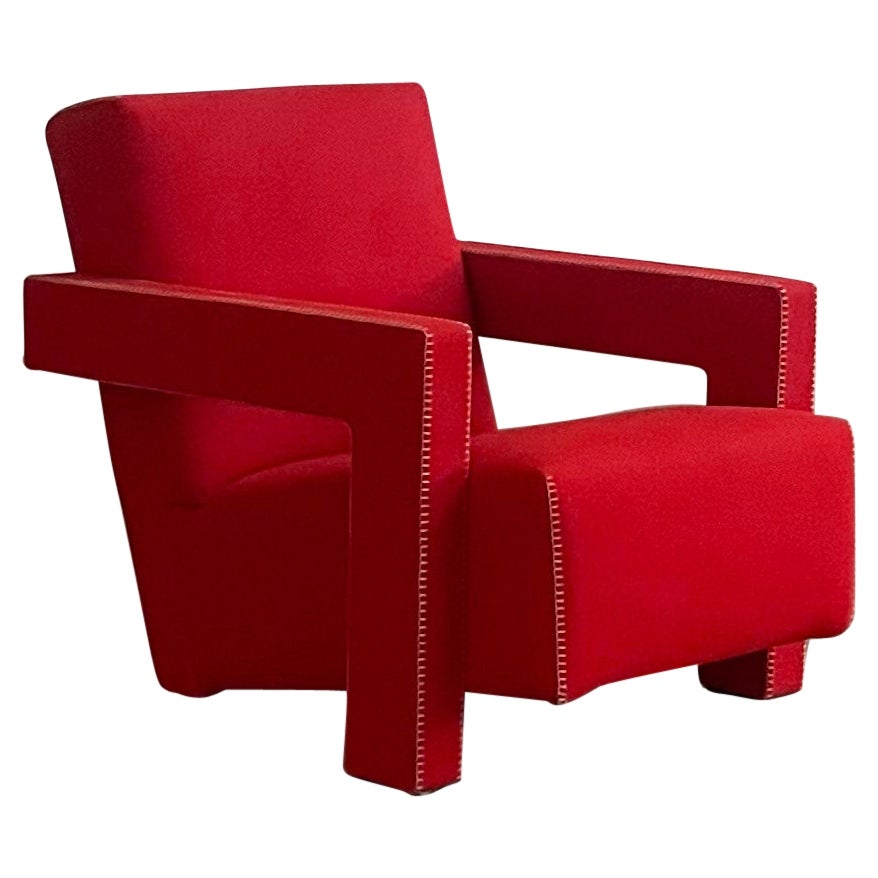
Gerrit Rietveld Utrecht Armchair by Cassina, Mid-Century Modern Available Now

Gerrit Rietveld Utrecht Armchair by Cassina, Mid-Century Modern Available Now

By Cassina, Gerrit Rietveld

Located in Barcelona, ES

Armchair designed by Gerrit Thomas Rietveld in 1935. Relaunched in 2015. Manufactured by Cassina in Italy. Materials: Fabric Dimensions: D 85 cm x W 64 cm x H 60 cm (SH 37 cm) A...

Category

2010s Italian Mid-Century Modern Armchairs

Materials

Fabric

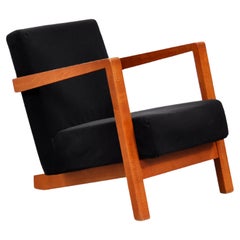
1950s Dutch Modernist Low-Profile Armchair in Black Upholstery

1950s Dutch Modernist Low-Profile Armchair in Black Upholstery

By Gerrit Rietveld

Located in Antwerp, Antwerp

A striking example of Dutch modernist design, this low-profile armchair from the 1950s reflects the architectural precision and geometric rigor characteristic similar to Gerrit Rietv...

Category

Vintage 1950s Dutch Mid-Century Modern Lounge Chairs

Materials

Cotton, Wood

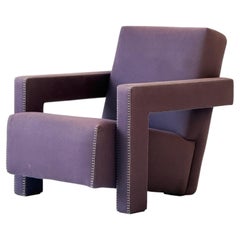
Utrecht Lounge Chair by Gerrit Rietveld for Cassina

Utrecht Lounge Chair by Gerrit Rietveld for Cassina

By Cassina, Gerrit Rietveld

Located in Chicago, IL

c. 1980s. Italy. Purple wool upholstery with blanket stitch.

Category

Vintage 1980s Italian Mid-Century Modern Lounge Chairs

Materials

Upholstery

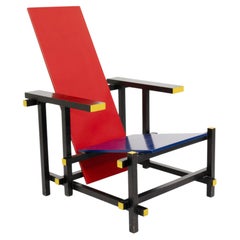
Red And Blue Chair By Gerrit Rietveld For Cassina

Red And Blue Chair By Gerrit Rietveld For Cassina

By Cassina

Located in Keego Harbor, MI

The Red and Blue Chair by Gerrit Rietveld for Cassina is one of the most iconic expressions of early modern design. Originally conceived in 1918 and later refined with its now signat...

Category

Late 20th Century Italian Modern Chairs

Materials

Beech