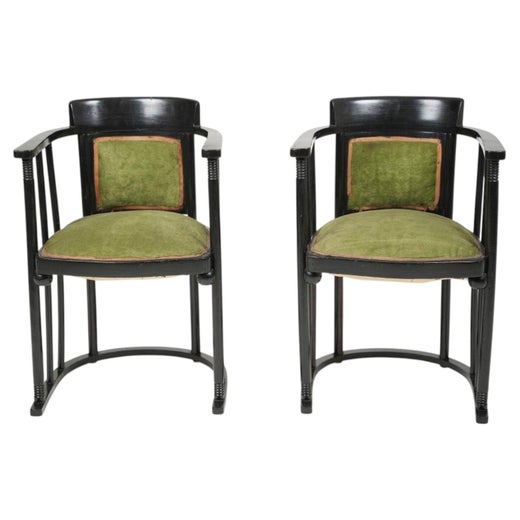
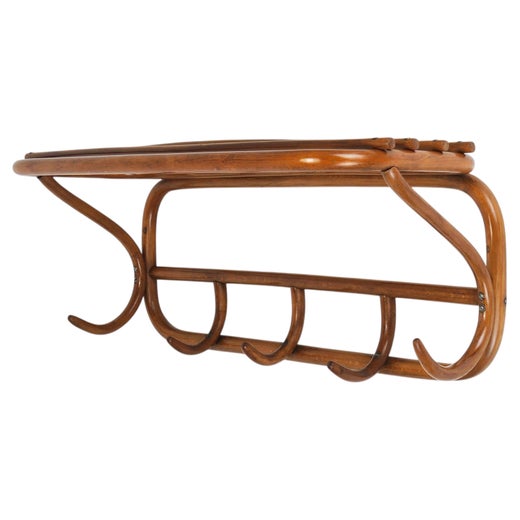
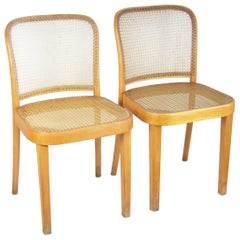
Two Chairs Thonet 811, Josef Hoffmann
By Josef Hoffmann, Thonet
Located in Praha, CZ
Original state with a pleasant patine of age, perfectly cleaned and re-polished.
Category
Mid-20th Century Czech Mid-Century Modern Chairs
Materials
Bentwood
The Austrian architect Josef Hoffmann was a central figure in the evolution of modern design, and a leader in an aesthetic movement born in Europe in the late 19th century that rejected florid, extravagant ornamentation in favor of a new emphasis on simplicity of line.
As a founder of the Vienna Secession — a union of artists and designers determined to upend Austria’s artistic conservatism — and later, a founder of the turn-of-the-century Wiener Werkstätte (in English: the Viennese Workshops), a design cooperative that produced superbly crafted furniture and housewares, Hoffmann was a pioneering practitioner of what would become a fundamental principle of modernism: that good design is a way of life.
Hoffmann came of age amidst a shift in the culture of the applied arts, as a conservative order that looked only to the past for inspiration was pushed aside. But what, exactly, would replace that order was in question — and Hoffmann’s career embodies the developing patterns of design’s new spirit. His architectural work reflects his time as a student of the Vienna architect Otto Wagner, who disdained excessive decoration and employed new materials such as steel girders and reinforced concrete to create buildings with airy, open interiors full of light.
As a designer of furniture and interiors, Hoffmann was consistently open-minded about the aesthetics he explored. He was an early adherent of the flowing, organic forms of the Art Nouveau design movement that began to flourish in the late 1880s — but by the opening of the Wiener Werkstätte in 1903, Hoffmann’s designs embraced the beauty of geometry in pieces that feature grids and angular forms.
Hoffmann’s greatest works reflect his ability to combine seemingly conflicting design visions into coherent wholes. His architectural masterpiece, the Stoclet Palace in Brussels, has an exterior that groups together simple geometric forms and spacious interiors marked by subtly naturalistic design details that lend rooms an air of charm and geniality.
Hoffmann’s signature furniture design is an adjustable lounge chair — the Sitzmaschine (1905) — that marries a curving frame with square and rectangular back- and side rests. This piece, like so many others by Hoffmann, reflects a groundbreaking, forward-thinking appreciation for the union of different looks and sources that marks the best of interior design in our own day. Moreover, items offered on 1stDibs — which range from enameled silver jewelry, to silver flower vase baskets and other decorative objects, to sofas, lighting pendants and sconces — testify to the astonishing breadth of Hoffman’s creative pursuits. He was truly a giant of design.
For more than 180 years, Thonet — or Gebrüder Thonet — has produced elegant and durable tables and cabinets as well as chairs, stools and other seating that wholly blur the lines between art and design. Widely known as a trailblazer in the use of bentwood in furniture, the European manufacturer has reimagined the places in which we gather.
Noted for his skill in parquetry, German-Austrian company founder Michael Thonet received an invitation from Austrian Chancellor Prince Metternich to contribute Neo-Rococo interiors to the Liechtenstein City Palace in Vienna. The Boppard-born Thonet had honed his carpentry skills in his father’s workshop, where he carried out experiments with plywood and modified the Biedermeier chairs that populated the studio.
Thonet’s work for the chancellor raised his profile, and the cabinetmaker gained international recognition, including at London’s Great Exhibition of 1851, which featured works created by members of the Arts and Crafts movement as well as industrial products of the day. Thonet showed a range of furniture at the fair and won the bronze medal for his bentwood chairs. He incorporated his family’s company, the Thonet Brothers, with his sons in 1853.
Bentwood furniture dates as far back as the Middle Ages, but it is the 19th-century cabinetmaker Thonet who is most often associated with this now-classic technique. Thonet in 1856 patented a method for bending solid wood through the use of steam, and from there, the bentwood look skyrocketed to furniture fame. The works of renowned mid-century modern designers such as Alvar Aalto, Arne Jacobsen, and Charles and Ray Eames that put this technological advancement to use would not be as extensive or celebrated were it not for the efforts of the pioneering Thonet.
Considered the world’s oldest mass-produced chair, Michael Thonet’s ubiquitous Chair No. 14 demonstrated that his patented bentwood technology made it possible to efficiently produce furniture on an industrial scale. Now known as the 214, it won the German Sustainability Award Design for 2021, a recognition of the company’s commitment to environmentally responsible production.
Often called the Coffee House chair — the company’s first substantial order was for a Viennese coffeehouse — the No. 14 remains an icon. Thonet originally designed the chair in 1859, and it is considered the starting point for modern furniture.
The bentwood process opened doors — there were investments in machinery and new industrial processes, and the business began mass-producing furniture. By the end of the 1850s, there were additional Thonet workshops in Eastern Europe and hundreds of employees. Michael Thonet’s reputation attracted the attention of notable architects including Otto Wagner, Marcel Breuer and Ludwig Mies van der Rohe.
The No. 14 was followed by the No. 18, or the Bistro chair, in 1867, and the 209, or the Architect’s chair, of which Le Corbusier was a fan. (The influential Swiss-French architect and designer used Thonet furniture in his Pavillon de l’Esprit Nouveau at the 1925 International Exposition of Decorative Arts in Paris.)
Thonet’s chair designs also appeared in artwork by Toulouse-Lautrec, John Sloan and Henri Matisse in his Interior with a Violin Case. The noteworthy Thonet rocking chair remains a marvel of construction — in the middle of the 19th century, Michael produced a series of rockers in which the different curved parts were integrated into fluid, sinuous wholes. Thanks to Thonet, the humble rocker acquired something unexpected: style. It was captured in the paintings of Pablo Picasso, Pierre-Auguste Renoir and James Tissot.
Thonet is currently split into global divisions. Thonet Industries U.S.A. was acquired in 1987 by Shelby Williams and joined the CF Group in 1999, while the Thonet brand in Germany is owned by Thonet GmbH.
Find a collection of antique Thonet furniture on 1stDibs.
Two Chairs Thonet 811, Josef Hoffmann
By Josef Hoffmann, Thonet
Located in Praha, CZ
Original state with a pleasant patine of age, perfectly cleaned and re-polished.
Bentwood
$2,200 / set
H 32 in W 20.75 in D 17 in
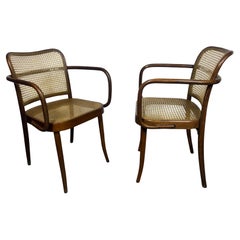
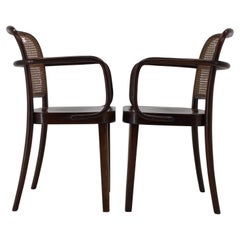
Pair Josef Hoffmann Prague 811 Bentwood Cane Armchairs /Thonet Czech
By Thonet, Josef Hoffmann
Located in Buffalo, NY
A beautifully preserved antique bentwood armchair designed by Josef Hoffmann, the seminal Viennese architect and co-founder of the Wiener Werkstätte. This is the iconic Model 811, kn...
Cane, Bentwood
$2,013 / item
H 32.68 in W 20.87 in D 19.69 in
1920s Josef Hoffmann Bentwood Chairs, No. 811 for Thonet, Czechoslovakia
By Josef Hoffmann
Located in Praha, CZ
- Carefully refurbished and finished by shellac - seat cane strings in good condition - backrest cane strings with minor damage
Bentwood
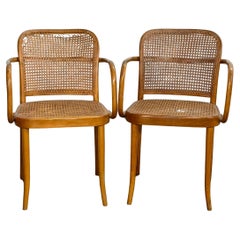
Pair of Stendig Prague Armchairs by Josef Hoffman
By Josef Hoffmann, Stendig Co., Thonet
Located in Brooklyn, NY
Classic and iconic Prague armchairs designed by Josef Hoffmann for Thonet. Imported from Czechoslovakia by Stendig in the 1960s. Wood in good shape. Original cane needs to be redone ...
Cane, Bentwood
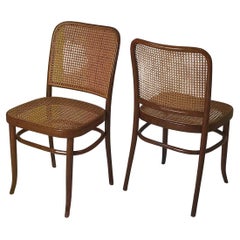
Set Of Two Josef Hoffmann Prague 811 Chair 1950s
By Josef Hoffmann
Located in Čelinac, BA
Josef Hoffmann Chairs Prague 811 Slovenia 1950s
Cane, Wood
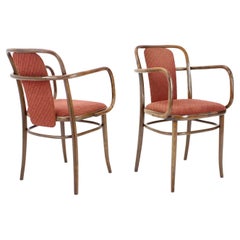
Set of Two Bentwood Chairs, Ton 1989
By Thonet
Located in Praha, CZ
- made in Czechoslovakia - made of wood, fabric - the fabric has some signs of use - good, original condition. - seat height 47 cm.
Fabric, Wood
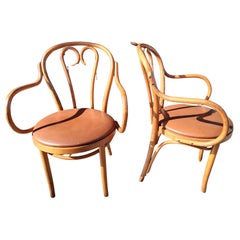
$767Sale Price / set|20% Off
H 34.75 in W 23.5 in D 23 in
Pair of Thonet Style Bentwood Armchairs, C1960
By Thonet
Located in Port Jervis, NY
Fabulous pair of hard to find bentwood armchairs in the style of Thonet. In very good vintage condition with minimal wear. Have other sets that can be combined but these are the only...
Beech
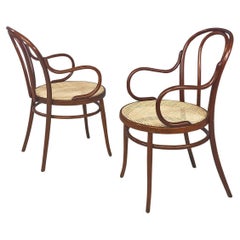
$1,429 / set
H 38.19 in W 21.66 in D 25.6 in
Italian mid-century big beech wood and Vienna straw Thonet chairs, 1950s
By Thonet
Located in MIlano, IT
Italian mid-century big beech wood and Vienna straw Thonet chairs, 1950s. Large chairs or armchairs with armrests in Thonet style, with Vienna straw seat and curved armrests and with...
Straw, Beech
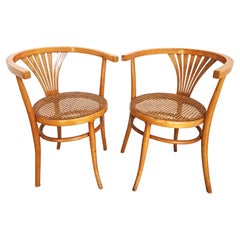
$2,620 / set
H 28.75 in W 22.05 in D 21.66 in
Pair of Antique Armchairs Model B28 by Thonet, bentwood and cane, Austria 1920s
By Thonet
Located in Beograd, RS
In this listing you will find an elegant pair of Thonet B28 armchairs, estimated to date from the 1920s. These chairs beautifully demonstrate Thonet’s mastery of bentwood constructio...
Cane, Bentwood
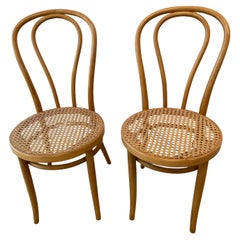
$714Sale Price|20% Off
H 35.83 in W 17.33 in D 20.48 in
Set of Two Thonet No. 18 Bentwood Chairs by ZPM Radomsko, Poland, 1960s
By ZPM Radomsko, Michael Thonet
Located in Rødekro, DK
This elegant set of two bentwood chairs is based on the iconic Model No. 18, originally designed circa 1875 by the renowned Thonet workshop founded by Michael Thonet. Model No. 18 b...
Beech, Bentwood