Want more images or videos?
Request additional images or videos from the seller
1 of 10

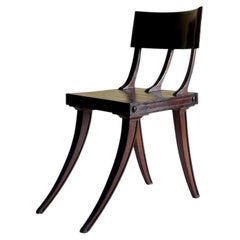
Klismos Chair

$55,000
£41,692.12
€48,624.17
CA$78,940.11
A$79,586.88
CHF 45,317.75
MX$967,411.96
NOK 534,954.17
SEK 533,418.44
DKK 363,459.95

About the Item

In general, wealthy families in and around Boston in the early years of the nineteenth century chose homes, paintings, furniture, silver, glass, and other decorative accessories that were distinguished, yet unpretentious, elegant, yet chaste, fashionable, yet not avant garde. Unlike the artistic production of New York and Philadelphia, where showiness and extravagance were encouraged, the furniture of Boston and its environs tended to be restrained and tasteful, consisting of a limited but aesthetically pleasing vocabulary of form and ornament. One of the signature forms of furniture of the Neo-Classical period in the United States is the klismos chair as interpreted by a group of Boston cabinetmakers in the period beginning about 1820 (see Page Talbott, “Seating Furniture in Boston, 1810-1835,” in The Magazine Antiques CXXXIX [May 1991], pp. 966ff.). These chairs are usually characterized by sabre legs at the front and back and curved crest rails typically enriched with flaming mahogany veneers, their ends often punctuated by stylized leaves, anthemia, or scrolls, and center splats decorated with leaves, drapery, lyres, etc. Just as it is easy to identify a New York or Philadelphia side, or dining, chair of the period, so Boston chairs have a certain “look” that sets them apart from chairs from all other cabinetmaking centers in this period. This chair is one of an extremely small number of Boston chairs that is labeled or stamped by its maker or retailer. On the underside of the original slip seat, which retains not only all of its original horsehair stuffing but also its original red gauffraged velvet showcover, is the label of William Hancock, who describes himself as an “UPHOLSTERER,” but also notes that he “keeps constantly on hand, an extensive assortment of Furniture,” the forms of which he then lists and, further, offers “Furniture made to order, equal to any manufactured in the city.” It is thus impossible to determine at this time whether Hancock’s role in the present chair was merely that of upholsterer, whether this was one of the “chairs” offered in his “Furniture Warehouse,” or whether it was indeed “made to order.” Under any circumstances, it is a chair of exceptional quality that also has the added distinction of retaining its original wax finish, its original label, and its original underupholstery and show fabric. Hancock's firm spent its first six years, 1819 to 1825, on Orange Street and then moved to Market Street (later Cornhill), where the firm would see its most successful years. Originally located at numbers 39 and 41 Market Street, by 1829 the firm had expanded to include numbers 37 to 53. In 1836, Hancock went into business with Holden and Adams, with whom he worked until 1837. While Hancock is listed in the business directories of Boston until 1849, little is known about his career after the dissolution of Hancock, Holden, and Adams. Thus, the addresses of 39, 41, 45, and 49 Market Street on the label of this chair indicate a date for it after 1829. Indeed, although this chair follows a very familiar Boston type, Hancock was clearly using Thomas King’s The Modern Style of Cabinet Work Exemplified, which was published in that same year, and which is known to have been owned in Eastern Massachusetts very shortly thereafter. The proportion and stance of the chair would seem to be derived from plate 15, the treatment of the front and back legs was likely taken from plate 16 which shows a group of “parlour chairs,” and plate 21 probably served as the model for the acanthus leaves that gracefully wrap around the corners of the crest rail. The chair retains its original stuffing and gauffraged red velvet or mohair show cover, the latter of which is, probably not coincidentally, very close to those on a set of Boston side chairs, possibly from the same shop, that belong to the Plymouth Antiquarian Society, Plymouth, Massachusetts, and are currently on loan to Shirley Place an historic house in Roxbury, Massachusetts.
  • Creator:
    William Hancock (Retailer)
  • Dimensions:
    Height: 34.5 in (87.63 cm)Width: 19.07 in (48.44 cm)Depth: 23 in (58.42 cm)
  • Style:
    Neoclassical (Of the Period)
  • Materials and Techniques:
  • Place of Origin:
  • Period:
  • Date of Manufacture:
    1829
  • Condition:
    Repaired: The show cover has been cleaned, modestly repaired, and sewn to a cotton backing to stabilize and preserve it. Excellent. The chair has been very lightly cleaned and waxed. The slip seat, stuffing, and show cover are all original to the chair.
  • Seller Location:
    New York, NY
  • Reference Number:
    Seller: FAPG 18824D.0011stDibs: LU903248566142

More From This Seller

View All
Pair Side Chairs with Lyre Back

Pair Side Chairs with Lyre Back

Located in New York, NY

“I know of no other chair like the single [sic] ‘lyre back’ one. . . . I certainly recognize it as a Boston chair considering all the individual elements, but the combination is particularly elegant.” So wrote noted scholar of Boston furniture Page Talbott when a set of four chairs of this design originally surfaced in the 1980s. Although the existence of four chairs in a specific pattern might imply that the chairs were originally part of a larger set, no additional chairs of this form have appeared in the intervening years. The lyre became a popular motif during the Neo-Classical period, and is frequently encountered as the back splat of klismos chairs, in no example more familiar than in a group of Duncan Phyfe chairs...

Category

Antique 1820s American Neoclassical Chairs

Materials

Mahogany

Small Settee in the Neoclassical Taste

Small Settee in the Neoclassical Taste

Located in New York, NY

Small Settee in the neoclassical taste Boston, Massachusetts (active 1804–17), about 1810 Mahogany (secondary woods: ash) Measures: 35 1/8 in. high, 59 3/4 in. long, 19 1/8 in. deep Although the diminutive scale of this settee places it in a unique category, the piece itself partakes of a vocabulary that is common in Boston furniture of the Late Federal period. Its sabre legs, for example, as seen straight on from the left and right ends, are closely related to the legs, as seen from the front, on a group of chairs of undisputed Boston origin, including a spectacular armchair with scrolled arms (see Stuart P. Feld, Boston in the Age of Neo-Classicism, 1810–1840, exhib. cat. [New York: Hirschl & Adler Galleries, 1999], p. 37 no. 6 illus. in color), as well as a number of side chairs, including a set made for Nathan Appleton (see Page Talbott, “Boston Empire Furniture, Part I,” The Magazine Antiques, CVII [May 1975], p. 887 fig. 12). In all, the legs are ornamented with two bold, somewhat flattened reeds set between corner beads, a pattern which is repeated here on the front and end seat rails as well. The superb quality of the piece is further demonstrated in the finely drawn profile of the arms, as well as the delicately bulbous surface of the fronts of the arms and legs. As in the best of the related chairs, the sabre legs end in delicately carved paw feet. The added refinement of the beautifully carved rosettes at both the fronts and backs of the arms suggests that the piece may have been designed to be used in the round. Stylistically harmonious with these pieces is also a group of larger sofas with frontally set sabre legs and scrolled arms (see Page Talbott, “Seating Furniture in Boston, 1810–1835,” The Magazine Antiques, CXXXIX [May 1991], p. 963 pl. 11) that represent an indigenously Boston form. Although none of the furniture in this group has been effectively attributed, they can certainly be related to various Boston card tables...

Category

Antique Early 19th Century American Neoclassical Settees

Materials

Wood

Pier Table

Pier Table

Located in New York, NY

One of the signature forms of the Neo-Classical period, the pier (or console) table received its name from its typical use against the wall, or pier, between two windows. Pier tables...

Category

Antique 1810s American Neoclassical Tables

Materials

Marble, Brass, Bronze, Lead

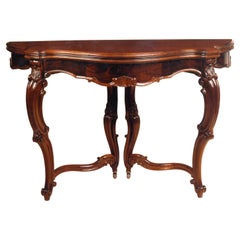
Card Table in the Rococo Taste

Card Table in the Rococo Taste

By Charles A. Baudoine

Located in New York, NY

RECORDED: cf. Anna Tobin D’Ambrosio, ed., Masterpieces of American Furniture from the Munson-Williams-Proctor Institute (Syracuse University Press, Utica, New York, 1999), pp. 85, 86, 87 illus. the Munson-Williams-Proctor tables // cf. The Metropolitan Museum of Art, New York, 19th Century America–Furniture and Other Decorative Arts (1970), exhib. cat., [n.p.] no.133 This table is identical to a pair of card tables bearing the stenciled label of Charles A. Baudouine of 335 Broadway, New York, which were acquired by James and Helen Munson Williams of Utica, New York, in May 1852 for their home, Fountain Elms, which is where they remain today as part of the Munson-Williams-Proctor Art Institute collection. The Williams tables were billed as “1 Rosewood Multiform Table” at $160 for the pair, and they were indeed “multiform” in that they could be used separately and folded as a pair of console tables, opened as a pair of card tables, or joined together as a center table. The present table varies essentially in the fact that it does not include the mechanism that would have allowed it to be attached to another to form a center table. Of French descent, Baudouine was born in New York in 1808. He made his debut as a cabinetmaker in the New York directory of 1829/30, where he is listed at 508 Pearl Street. By 1839/40 he relocated to Broadway, where he remained in business at various addresses until about 1854. A sense of the scale of Baudouine’s operation is given by German immigrant cabinetmaker Ernest Hagen...

Category

Antique Mid-19th Century North American Rococo Revival Card Tables and T...

Materials

Wood, Rosewood

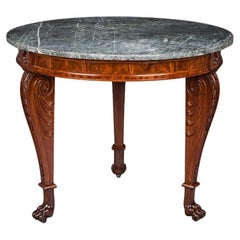
Center Table with Scroll Legs, Paw Feet and Marble Tops

Center Table with Scroll Legs, Paw Feet and Marble Tops

By Thomas Seymour

Located in New York, NY

Center Table, about 1818–20 Attributed to Thomas Seymour (1771–1848), working either for James Barker or for Isaac Vose & Son, with Thomas Wightman (1759...

Category

Antique 1810s American American Classical Center Tables

Materials

Wood, Mahogany

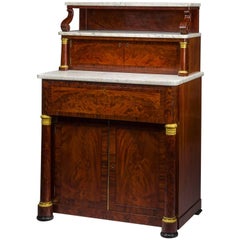
Butler's Desk and Etagére, New York, Possibly Duncan Phyfe

Butler's Desk and Etagére, New York, Possibly Duncan Phyfe

By Duncan Phyfe

Located in New York, NY

Butler’s Desk and Etagére, circa 1825 New York, possibly by Duncan Phyfe Mahogany (secondary woods: mahogany, pine, poplar), with ormolu mounts, marble,...

Category

Antique 1820s American Neoclassical Cabinets

Materials

Mahogany

You May Also Like

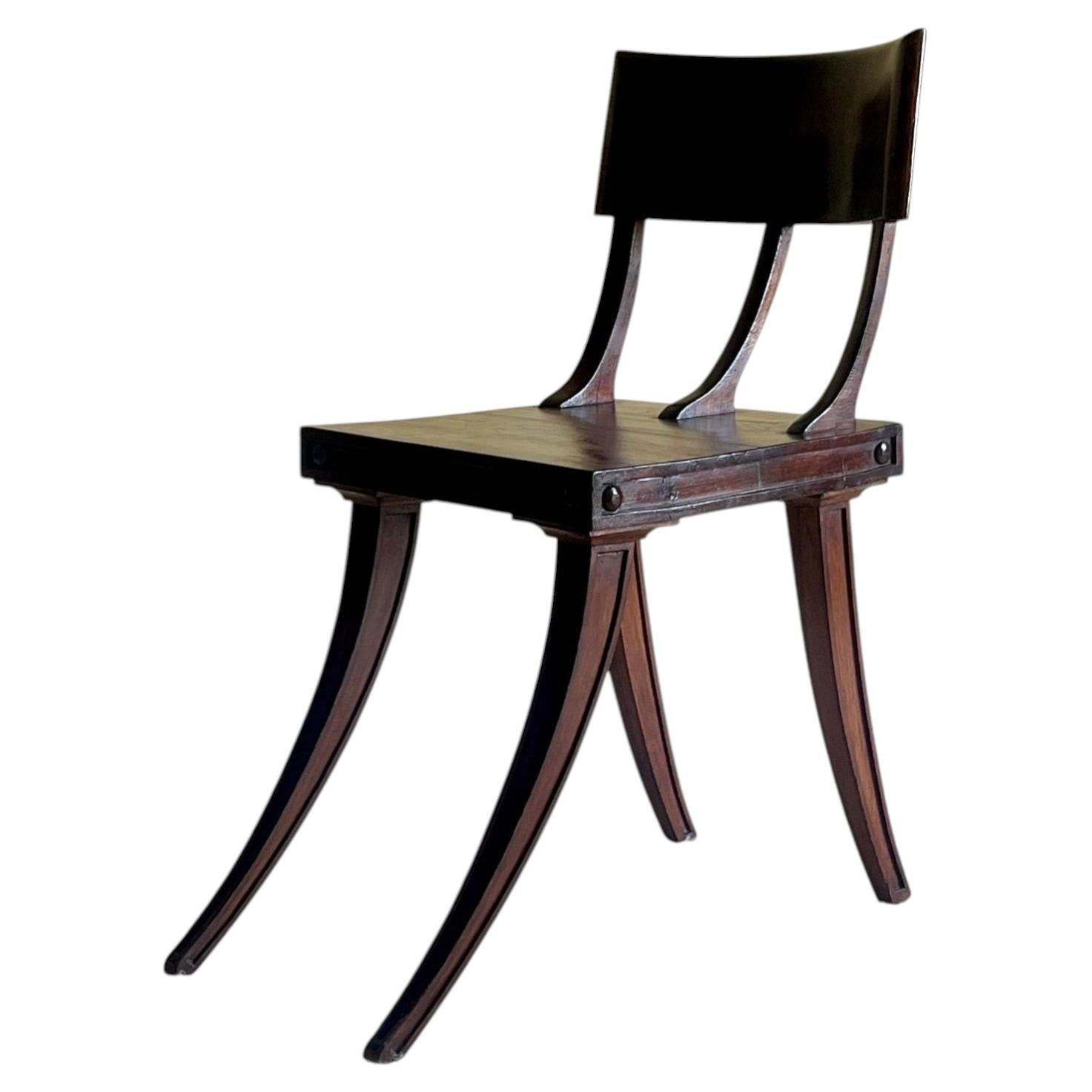
" Klismos" chair, 19th century

" Klismos" chair, 19th century

Located in Paris, Ile-de-France

"Klismos" chair Stained walnut Of unusual design, the chair has a curved back attached to the seat by a triple support, Square seat, saber feet. Northern Europe, probably Denmark. ...

Category

Antique 19th Century Danish Neoclassical Chairs

Materials

Wood, Walnut

Early Victorian Side Chair

Early Victorian Side Chair

Located in Savannah, GA

An early Victorian mahogany side chair in green velvet tufted upholstery, 1840s. 18 ½ inches wide by 25 inches deep by 36 inches tall

Category

Antique 1840s Early Victorian Side Chairs

Materials

Velvet, Mahogany

19th century desk chair

19th century desk chair

Located in Hronská Breznica, Banskobystrický kraj

19th century desk chair in original vintage condition.

Category

Antique 19th Century Slovak Neoclassical Chairs

Materials

Fabric, Wood

20th Century Neoclassical Style Light-Palisander Chair

20th Century Neoclassical Style Light-Palisander Chair

Located in Berlin, DE

Very elegant chair in Classicist Style. solid beechwood. Classical upholstery. Backrest black decorated. (C-Sam-6)

Category

20th Century Chairs

Materials

Wood, Beech, Palisander

Custom Sheildback Occassional Chair

Custom Sheildback Occassional Chair

Located in Asheville, NC

Fruitwood Shieldback chair with delicate feather and ribboning elegant diamond slant legs with olive pouf fabric.

Category

20th Century American Side Chairs

Materials

Fruitwood