Want more images or videos?
Request additional images or videos from the seller
1 of 10

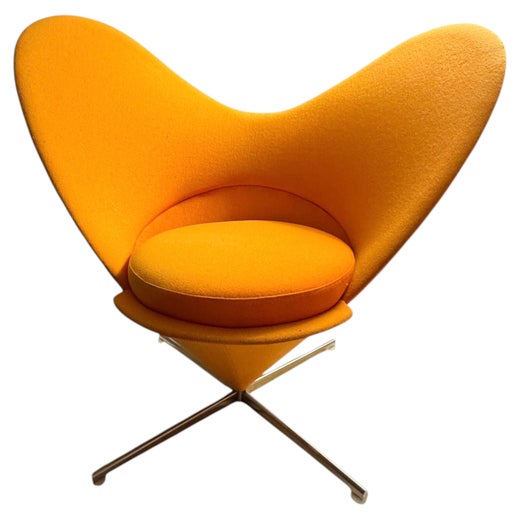
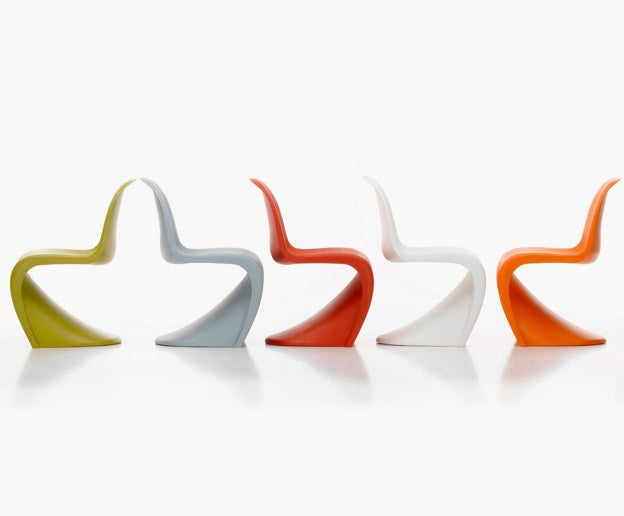
Verner Panton Set of Four Orange Panton Chairs by Herman Miller 1970s

$6,520.44List Priceper set

You May Also Like

More From This Seller

View All
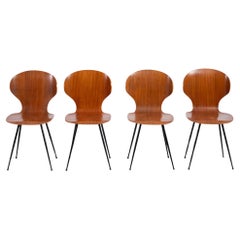
Carlo Ratti Set of Four Lulli Dining Chairs in Steel and Wood by ILC 1950s Italy

Carlo Ratti Set of Four Lulli Dining Chairs in Steel and Wood by ILC 1950s Italy

By Carlo Ratti

Located in Cascina, Pisa

The set of four Lulli dining chairs, designed by Carlo Ratti for ILC Lissone in the 1950s, features black painted steel legs combined with a curved and shaped veneered wood seat and ...

Category

Vintage 1950s Italian Mid-Century Modern Chairs

Materials

Steel

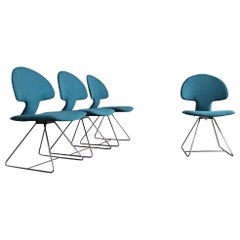
Vittorio Introini Set of Four Longobarda Dining Chairs by Saporiti 1960s Italy

Vittorio Introini Set of Four Longobarda Dining Chairs by Saporiti 1960s Italy

By Vittorio Introini, Saporiti

Located in Cascina, Pisa

Set of four Longobarda chairs with chromed metal legs, seat, and back upholstered with blue shade fabric. The Longobarda chair was designed by Vittorio Introini and manufactured by ...

Category

Vintage 1960s Italian Mid-Century Modern Chairs

Materials

Metal

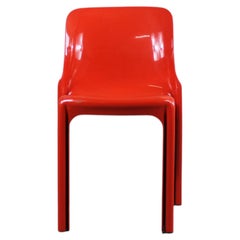
Vico Magistretti Set of Four Red Selene Chairs by Artemide 1970s

Vico Magistretti Set of Four Red Selene Chairs by Artemide 1970s

By Vico Magistretti, Artemide

Located in Cascina, Pisa

A set of two Selene stackable chairs in red resin reinforced with fiberglass, designed by Vico Magistretti in 1967 and produced by Artemide Milano in the 1970s. The Selene chair was designed in 1967 by Magistretti to be produced in a plastic material, as he affirmed: "The seat and the back are simple curved surfaces. For me, the legs represented the real image of the piece, with as small a volume as that of any common wooden chair. I solved it by exploiting the molding of a plastic material formed by a simple 3-millimeter-thick sheet with a simple but very resistant "S" cross-section which inter-related the object with ordinary chairs without however the elephant legs so untypical of chairs. It was fun working with the model maker on the wood model." When produced in series, "a unit comes out of the machine every five minutes": Selene is the fruit of a single compression molding process on a pre-impregnated sheet (Ottagono 15 / 1969). Magistretti solves the problem of leg resistance by adopting an "S-shaped" configuration that confers resistance to a sheet only 3 millimeters thick. The formal and structural solution had already been previously adopted for the Chimera lamp...

Category

Vintage 1970s Italian Mid-Century Modern Chairs

Materials

Plastic, Rubber

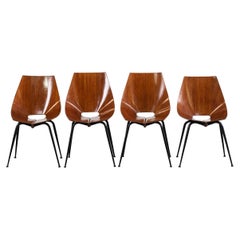
Carlo Ratti Set of Four Chairs in Plywood by Società Compensati Curvi 1950s

Carlo Ratti Set of Four Chairs in Plywood by Società Compensati Curvi 1950s

By Società Compensati Curvati, Carlo Ratti

Located in Cascina, Pisa

Set of four dining chairs with a frame in black lacquered metal and seat in curved plywood, attributed to Carlo Ratti and produced by Società Compensati Curvati in the 1950s. In Italy, at the beginning of the XX century, industries of curved solid wood arose under license of Michael Thonet, and through the International Exhibitions the processing of curved wood became more and more widespread. The Expo of the first decade was also attended by the wood manufacturers of Monza, while in 1905 Otto Helzer, in Switzerland, patented wooden structures in curved laminated, whose strength was equivalent to those in steel. The Ratti brothers of Monza took their cue from the solid wood laminate to create furniture that, instead of wooden elements, used sheets of wood. The brothers Ratti, Carlo and Mario, also began to follow the young artistic avant-gardes (cubism, futurism and abstractionism). The mastery of wooden sculpture influenced Carlo in the design and realization of furniture of fine neo-plastic artistic workmanship and decò, receiving honors from the Prince of Piedmont Umberto di Savoia. In 1919, in Milan, the first Lombard Exhibition of Decorative Arts was set up (later to become the Triennale) and the Ratti brothers exhibited their furniture in solid wood but also in curved panel with a new system of curvature, the one in Telo. The canvas system was developed by the Ratti brothers with the help of a friend, Cesare Cantù. They developed an elastomer bag in which the mould was inserted with the panel to be bent and, closing it with clamps, the air inside was removed, thus making the panel adhere to the mould. Carlo and Mario found in the Telo system a means by which they could make objects and furniture in the three spatial directions with large surface curvatures, without limits of thickness and minimum radii of curvature. In 1921 in Stuttgart the first Salone del Mobile was inaugurated and the Fratelli Ratti of Monza made itself known internationally by presenting solid wood furniture and also furniture in load-bearing plywood, flanked by furniture with framed and interchangeable covers. The Expo became meeting places to verify and present the novelties in the furniture and industrialization sector and, with the development of Industrial Design, the first architects joined in the design of the furniture industries. The Ratti Brothers, in the various international and national exhibitions, also presented incredible objects in their realization with the system in Telo. After 1930 Carlo and Mario produced many containers for radio and folding chairs for cinema but in 1939 they divided and in Monza Mario remained who, with his sons Antonio and Angela, formed the Società Compensati Curvi...

Category

Vintage 1950s Italian Mid-Century Modern Dining Room Chairs
Materials

Metal

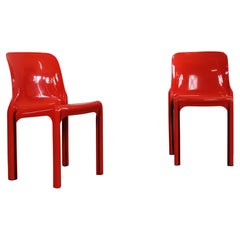
Vico Magistretti Set of Two Red Selene Chairs by Artemide 1970s

Vico Magistretti Set of Two Red Selene Chairs by Artemide 1970s

By Artemide, Vico Magistretti

Located in Cascina, Pisa

A set of two Selene stackable chairs in red resin reinforced with fiberglass, designed by Vico Magistretti in 1967 and produced by Artemide Milano in the 1970s. The Selene chair was designed in 1967 by Magistretti to be produced in a plastic material, as he affirmed: "The seat and the back are simple curved surfaces. For me, the legs represented the real image of the piece, with as small a volume as that of any common wooden chair. I solved it by exploiting the molding of a plastic material formed by a simple 3-millimeter-thick sheet with a simple but very resistant "S" cross-section which inter-related the object with ordinary chairs without however the elephant legs so untypical of chairs. It was fun working with the model maker on the wood model." When produced in series, "a unit comes out of the machine every five minutes": Selene is the fruit of a single compression molding process on a pre-impregnated sheet (Ottagono 15 / 1969). Magistretti solves the problem of leg resistance by adopting an "S-shaped" configuration that confers resistance to a sheet only 3 millimeters thick. The formal and structural solution had already been previously adopted for the Chimera lamp (a self-supporting methacrylate sheet) and in developing the legs of the Demetrio table...

Category

Vintage 1970s Italian Mid-Century Modern Chairs

Materials

Plastic, Rubber

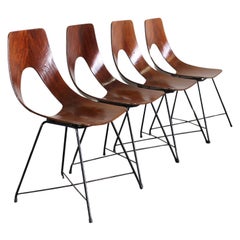
Augusto Bozzi Set of Four Ariston Chairs in Plywood and Metal by Saporiti 1950s

Augusto Bozzi Set of Four Ariston Chairs in Plywood and Metal by Saporiti 1950s

By Fratelli Saporiti, Augusto Bozzi

Located in Cascina, Pisa

Set of four dining chairs model Ariston with structure in curved plywood and black lacquered metal legs. The Ariston chair was designed by Augusto Bozzi and manufactured by Saporiti...

Category

Vintage 1950s Italian Mid-Century Modern Chairs

Materials

Metal