Want more images or videos?
Request additional images or videos from the seller
1 of 11

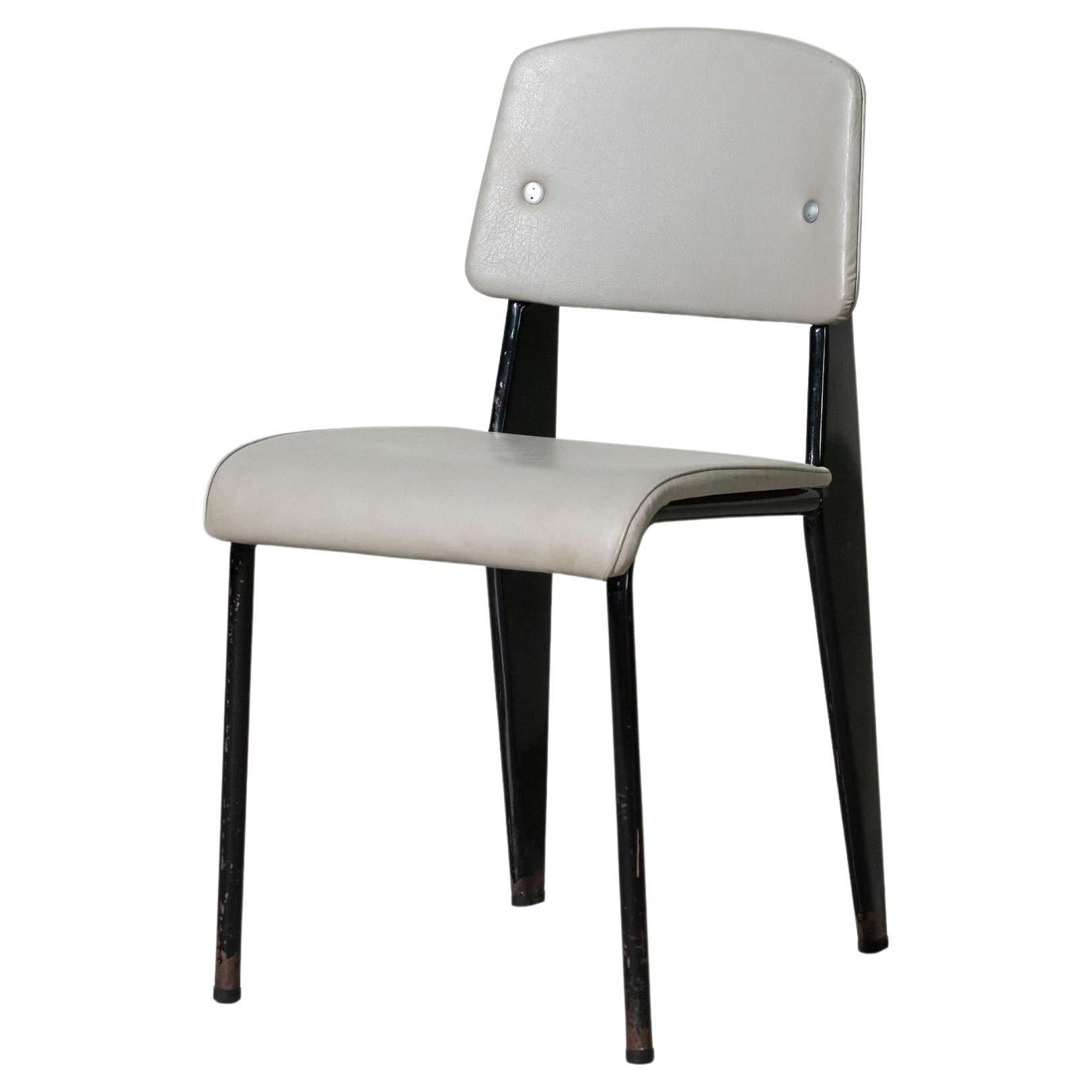
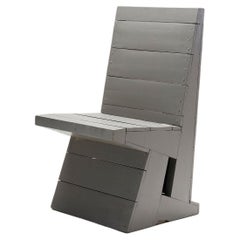
Dom Hans van der Laan High Chair in Grey Lacquered Pine with Metal Nails

$9,800
£7,325.40
€8,547.72
CA$13,761.19
A$13,998.04
CHF 7,993.08
MX$169,313.99
NOK 93,203.52
SEK 94,631.58
DKK 63,900.47

About the Item

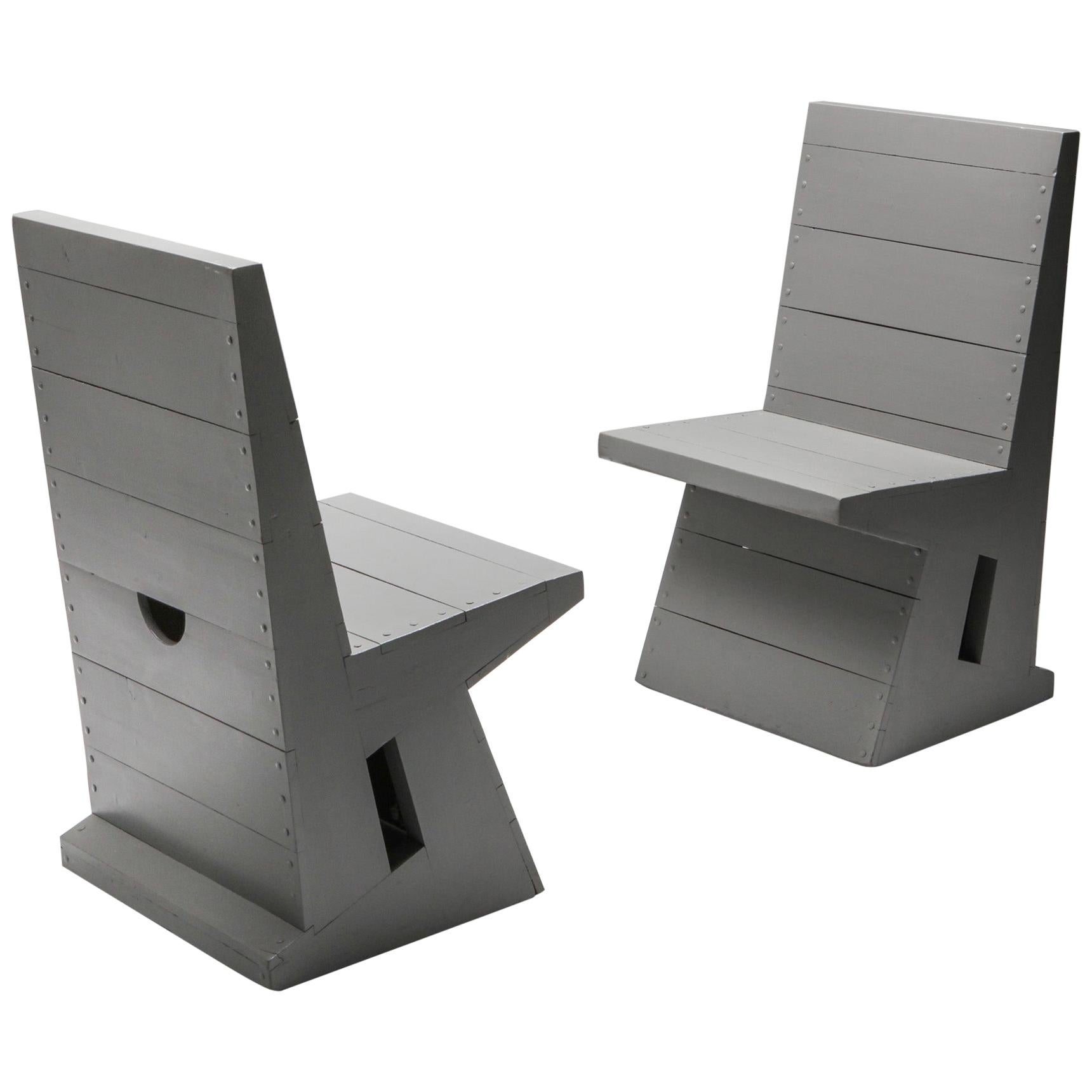
Dom Hans van der Laan, high chair, lacquered pine, steel, the Netherlands, 1960s Designed by Dutch Benedictine monk and architect Dom Hans van der Laan, this high chair was initially conceived for the Abbey Church of St. Benedictusberg near the Dutch town of Vaals. Aligned with his theoretical pursuits, he valued both the design of individual objects and architecture equally. His approach centers on perceiving liturgy as a transformative process, elevating ordinary actions to a sacred realm. With its restrained character and ascetic formal language, the furniture and liturgical items seamlessly integrate into the comprehensive design of the buildings. Since the 1940s, van der Laan has been meticulously crafting liturgical objects for churches, consistently adhering to the principles of the plastic number. Each piece of furniture is not only intricately sketched and designed but is also assigned a specific place within the interior. The furniture is crafted based on a foundational system first implemented by him in Vaals in the onset of the 1960s. Each furniture piece is centered around a common U-profile, extending in various directions. A cabinet adopts a horizontal U-profile, extending upward, while benches, tables and stools feature a vertical U-profile elongated lengthwise. Other tables and chairs consist of extruded compositions of U-profiles. The outer edges of the foundation exhibit straight corners, whereas the inner edges are added with beveled contours. All the furniture is constructed from wooden planks, primarily pine, fastened using hinge nails thoughtfully placed following the 'extrusion' pattern. When viewed from the side, the ending of the planks and the foundational wood to which they are affixed are both visible. The furniture is predominantly painted in an array of earthy tones like brown and grey, with the occasional use of maroon and blue. Biography In 1904, Hans van der Laan was born into a family of architects in Leiden. His father and brothers, Jan and Nico, were also architects. Between 1923 and 1926, he pursued his architectural studies in Delft under the guidance of M.J. Granpré Molière (1883-1972), a leading figure among Dutch Catholic architects of that era. However, van der Laan discontinued his work in Delft within a few years, dissatisfied with the lack of fulfillment in his quest for the 'essence of architecture.'. In 1926, he sought a deeper spiritual connection and chose to become a monk at St. Paul's Abbey in Oosterhout. In 1934, he was ordained as a priest and became increasingly immersed in the realms of liturgical design and architecture. After the Second World War came to an end, Hans van der Laan, accompanied by his brother Nico, was enlisted to lead and guide the reconstruction in Catholic architecture. In 's-Hertogenbosch, he directed the Ecclesiastical Architecture course, specifically dedicated to the construction of churches. This initiative laid the foundation for the 'Bossche School,' where van der Laan played a crucial role as the primary architect and theoretician. Under his leadership, the primary focus was placed on the fundamental essence of all architecture: Well-proportioned and human-scale dimensions. In the realm of 20th-century architectural history, the monk-architect held a distinctive position. Amidst the conflict between traditionalists and modernists in The Netherlands, van der Laan formulated his unique perspectives and formal language. His buildings and writings alike reflect a dedicated exploration of the laws of architecture and the connection between humanity and nature. The legacy left by the architect comprises a modest yet significant collection, encompassing seven buildings, including several monasteries, a chapel, and a church library. As a theorist, van der Laan dedicated a significant portion of his life to contemplating form, proportion, and the human experience within architectural spaces. His focus centered on exploring the essence of architecture, leading him to formulate a comprehensive theory involving space, shape, and size. Central to his ideas was the plastic number, a three-dimensional extension of the golden ratio. This numerical concept sheds light on the proportional relationship between the thickness, length, and width of architectural elements. Apart from architectural creations, van der Laan applied the principles of the plastic number to design liturgical items, notebooks, uniforms, and furniture, resulting in a subtly impactful body of work. Dom Hans van der Laan, a Dutch Benedictine monk and architect, played a pivotal role as a key figure in the Bossche School. Renowned for his influential theories on numerical proportions in architecture, his ideas continue to be explored and shared. On August 19, 1991, Hans van der Laan passed away at the St. Benedictusberg Abbey near Vaals.
  • Dimensions:
    Height: 37.6 in (95.5 cm)Width: 21.26 in (54 cm)Depth: 21.46 in (54.5 cm)Seat Height: 18.31 in (46.5 cm)
  • Style:
    Mid-Century Modern (Of the Period)
  • Materials and Techniques:
  • Place of Origin:
  • Period:
  • Date of Manufacture:
    1960s
  • Condition:
    Wear consistent with age and use. Every item Morentz offers is checked by our team of 30 craftspeople in our in-house workshop. Special restoration or reupholstery requests can be done. Check ‘About the item’ or ask our design specialists for detailed information on the condition.
  • Seller Location:
    Waalwijk, NL
  • Reference Number:
    Seller: 450157081stDibs: LU933149399612

More From This Seller

View All
Robert Haussmann for De Sede Lounge Chair in Grey Fabric and Steel

Robert Haussmann for De Sede Lounge Chair in Grey Fabric and Steel

By Robert Haussmann, De Sede

Located in Waalwijk, NL

Robert Hausmann for De Sede, lounge chair, fabric, chrome-plated steel, Switzerland, 1954 This comfortable armchair is designed with a chromed steel frame that functions as a basket...

Category

Vintage 1950s Swiss Mid-Century Modern Lounge Chairs

Materials

Steel, Chrome

Danish Highback Lounge Chair in Grey Upholstery and Teak

Danish Highback Lounge Chair in Grey Upholstery and Teak

Located in Waalwijk, NL

High back lounge chair, grey fabric upholstery, teak, Denmark, 1960s Danish high back lounge chair in grey fabric upholstery. This comfortable chair features clean lines and comfort...

Category

Vintage 1960s Danish Scandinavian Modern Lounge Chairs

Materials

Fabric, Teak

Jan de Jong Minimalist Prayer Stools in Grey Lacquered Pine

Jan de Jong Minimalist Prayer Stools in Grey Lacquered Pine

Located in Waalwijk, NL

Jan de Jong, prayer stools, lacquered pine, metal, the Netherlands, 1964 These prayer stools were originally intended for the Sint-Willibrordus church in Almelo, the Netherlands, in...

Category

Vintage 1960s Dutch Mid-Century Modern Stools

Materials

Metal

Gianfranco Frattini for Cassina Lounge Chair in Grey Wool and Walnut

Gianfranco Frattini for Cassina Lounge Chair in Grey Wool and Walnut

By Cassina, Gianfranco Frattini

Located in Waalwijk, NL

Gianfranco Frattini for Cassina, lounge chair, model '877', wool, walnut, Italy, 1959 This grand lounge chair is based on a solid construction, featuring strict lines and angular sh...

Category

Vintage 1950s Italian Mid-Century Modern Lounge Chairs

Materials

Wool, Walnut

Modernist Dining Chair in Wood and Metal

Modernist Dining Chair in Wood and Metal

Located in Waalwijk, NL

Dining chair, beech, coated steel, Europe, 1980s The design of this 1980s chair avoids sharp edges or overly angular forms, leaning instead into cylindrical legs and rounded corners...

Category

Vintage 1980s European Mid-Century Modern Chairs

Materials

Steel

1970s Sturdy Dining Chair in Black Leather & Wood with Architectural Design

1970s Sturdy Dining Chair in Black Leather & Wood with Architectural Design

Located in Waalwijk, NL

Dining chair, leather, beech, Europe, 1970s This design shows a sturdy construction, featuring durable black leather upholstery complemented by a robust wooden framework. The archit...

Category

Vintage 1970s European Mid-Century Modern Dining Room Chairs

Materials

Leather, Beech

You May Also Like

Chair by Dom Hans van der Laan, Netherlands, 1960s

Chair by Dom Hans van der Laan, Netherlands, 1960s

By Dom Hans van der Laan

Located in Utrecht, NL

This chair was originally designed by the Dutch Benedictine monk and architect, Dom Hans van der Laan for the Abbey Church of St. Benedictusberg located near the Dutch town of Vaals. This easy chair is in an untouched condition. It was made of pinewood and feature copper nails, giving this piece an understated, rustic look. The chair was entirely painted grey, including the nails. The main focus of van der Laan’s design was functionality and rationality, which is reflected in the openings on the sides and on the back that serves the purpose of joining multiple pieces together. This chair is a beautiful piece of Dutch design history. Although Dom van der Laan left a small body of work behind, his legacy is highly regarded in the world of architecture. The St. Benedictusberg Abbey in Vaals and its interior quickly became his masterpiece at the age of 53. Condition: In good vintage condition. Wear consistent with age and use. Item has some small marks and scratches. Dimensions: 21.2 in W x 20.8 in D x 37.4 in H 54 cm W x 53 cm D x 95 cm H About the designer: Dom Hans van der Laan (1904-1991) was the ninth of the eleven recorded children of Leiden architect Leo van der...

Category

Vintage 1960s Dutch Mid-Century Modern Chairs

Materials

Pine

Bossche School Chair by Dom Hans van der Laan

Bossche School Chair by Dom Hans van der Laan

By Dom Hans van der Laan

Located in Antwerp, BE

Dom Hans van der Laan, Bossche school, Netherlands, 1960s. The chair was designed by the Dutch Benedictine monk and architect, Dom Hans van der Laan ...

Category

Vintage 1940s Belgian Mid-Century Modern Chairs

Materials

Pine

Simplex Chair in Cement Grey Stained Beech Wood by Oscar Tusquets

Simplex Chair in Cement Grey Stained Beech Wood by Oscar Tusquets

Located in Geneve, CH

Simplex Chair in Cement Grey Stained Beech Wood by Oscar Tusquets Dimensions: D 46 x W 52 x H 73 cm. SH: 46 cm. Materials: Beech, beech plywood, steel, and plastic. Optionally, an e...

Category

2010s Spanish Modern Chairs

Materials

Steel

Italian modern Chair in gray metal, black rubber and wood, 1980s

Italian modern Chair in gray metal, black rubber and wood, 1980s

Located in MIlano, IT

Italian modern Chair in gray metal, black rubber and wood, 1980s Chair with gray painted tubular metal structure. The rectangular seat is in black curved wood and the cylindrical bac...

Category

Vintage 1980s Italian Modern Chairs

Materials

Metal

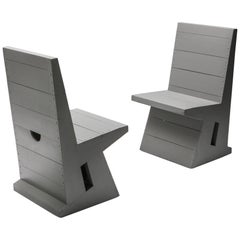
Two Chairs by Dom Hans van der Laan, The Netherlands 1960s

Two Chairs by Dom Hans van der Laan, The Netherlands 1960s

By Dom Hans van der Laan

Located in Utrecht, NL

This set of chairs was originally designed by the Dutch Benedictine monk and architect, Dom Hans van der Laan for the Abbey Church of St. Benedictusberg located near the Dutch town of Vaals. These easy chairs are in an untouched condition. They are made of pine wood and feature copper nails, giving these pieces an understated, rustic look. The pair is entirely painted grey, including the nails. This specific colour was carefully selected by Whim van Hoof to resemble the original shade as closely as possible. The main focus of van der Laan’s design was functionality and rationality, which is reflected in the openings on the sides and on the backs serve the purpose of joining multiple pieces together, and lifting them. Van der Laan was a leading figure in the traditionalist movement, the Bossche School, that held these values as well. These characteristics make these chairs charming, while also being beautiful pieces of Dutch design history. Although Dom Hans van der Laan left a small body of work behind, his legacy is highly regarded in the world of architecture. The St. Benedictusberg Abbey in Vaals and its interior quickly became his masterpiece at the age of 53. This model is still found in the Dutch church named Sint Willibrorduskerk in Almelo, for which it was possibly designed for in 1964. Condition: In good vintage condition. Wear consistent with age and use. Some small marks and scratches. Dimensions: 25.59 in W, 26.77 in D, 35.43 in H; Seat Height 15.94 in 65 cm W, 68 cm D, 90 cm H; Seat Height 40.5 cm About the designer: Dom Hans van der Laan (1904-1991) was the ninth of the eleven recorded children of Leiden architect Leo van der...

Category

Mid-20th Century Dutch Mid-Century Modern Chairs

Materials

Wood