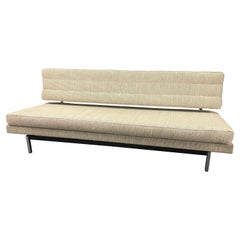
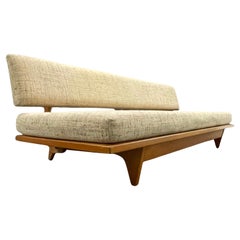
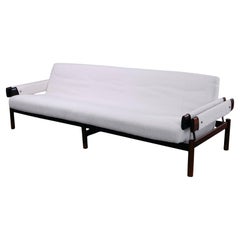
This is a very important piece of design history, and to understand why - it is all in the details, so to anyone interested in modern art and interior design, please keep reading.
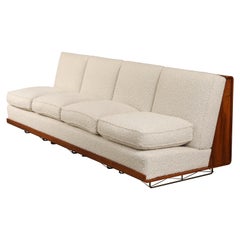
Vladimir Kagan’s 'Roll Back Day Bed' (model #6718) was originally conceived as a one-off design for a client in the 1950s. Valdimir Kagan selected Rosewood and Lucite, materials he had just started experimenting with at that time, blended it into a futuristic frame with a brass-capped cylindrical adjustable back cushion that can transform the sofa into a daybed and even into a double sided gallery seating system. All on top of Lucite legs giving the appearance the sofa is floating above ground.
By all accounts - Vladimir Kagan advertisements, catalogues, the design community and even the team at Vladimir Kagan Designs had it documented that the design (model 6718 Roll Back Day Bed) was first put into production in 1967, however this one - this exact sofa in the photos and listed for sale, IS THE ONE that he created in the 1950s for a special one-off client. And it was later, in 1967 that he decided to bring the design into production, all based on this concept model which we have listed for sale.
This is all documented with the Vladimir Kagan archives under registry 25073. They were thrilled to have found this surviving example and have added it into their archives, knowledge-base and timelines. They wrote:
"We conducted a detailed review of the Kagan Archive, and we were puzzled to find that Vladimir consistently dated the release of the Roll Back Day Bed to 1967. Also based on Vladimir’s accounts, Hugo Dreyfuss retired in 1960, ending their partnership. This would mean that your example pre-dates the “earliest production date” we have on record for the Roll Back Day Bed or Roll Back Sofa.
It was not uncommon for Vladimir to develop a unique design for a custom client request, and then later rework the concept into a variation that would be sold on a made-to-order basis within his standard collection.
Although no documentation survives to confirm this, our designer has suggested that your piece would most likely be an early iteration of the Roll Back Day Bed produced under similar circumstances, which displays subtle differences from the version of the Day Bed later released in 1967.
One such visual difference is the back bolster, which is much larger in proportion and rests on the seat in a unique way compared to later examples. We have seen similar details to these in other early versions of the design, though never also with an accompanying Kagan-Dreyfuss stamp.
Thank you so much for sharing this interesting piece with us! It’s always such a treat to find fragments that expand our understanding of Vladi’s early years."
In addition, they provided us with a certificate and a plaque bearing the registry number along with a letter that provides further details about this daybed / sofa (see photos).
Beyond its rarity, place in history and provenance, this example features several desirable characteristics not commonly found on later production versions of the Roll Back Day Bed sofa. Most notably, the daybed offers three adjustable back positions, allowing the roll bolster to be set for a deep lounge configuration which is deep enough to use as a daybed, a standard sofa depth, or a more forward / shallow seating position. This multi-position format is a standout feature, as later examples have only a single back placement. When positioned forward, the design also allows for a more open, two-sided presentation with a shallow seating area on the backside, making it especially compelling in gallery, showroom, or museum-style settings where the piece can be floated in a room and used on both sides. Another fourth option is to remove the roll back cushion altogether for a larger footprint, whether be a bed or large gallery bench.
Another unique and coveted attribute is that this example is crafted in richly grained rosewood, instead of the walnut or full lucite arms typically encountered on this model, the frame presents dramatic book-matched figuring and an elevated architectural profile. The piece is further distinguished by brass end caps on the cylindrical bolster, a refined detail rarely seen and one that enhances the sculptural presence of the form. Upholstery has been professionally updated in luxurious Lee Jofa “California Velvet,” bringing a fresh, tailored finish while complementing the bold, mid-century silhouette with a sophisticated texture and softness.
And the most exciting thing - it is signed with the 1950s Kagan-Dreyfuss New York stamp, something that no other examples of this design has, securing this as the first one ever made - making this an important piece of modern design history and a opportunity for a collector or art and design investor to acquire and own something truly unique and noteworthy.
This true collector-level example of American modernism, this piece sits beautifully within a range of interiors, from Mid-Century Modern and Post-War Modern to Hollywood Regency, Space Age, and even contemporary minimalism where the rosewood and low-slung profile read as intentional art furniture. An ideal statement for living rooms, design studios, high-end hospitality, and curated interiors - this is a rare opportunity to acquire an authenticated early Kagan daybed with archival significance, uncommon materials, and highly functional adjustability.
MEASUREMENTS:
H 29" x W 84.25" x D 38"
Seat Height: 17.5"
Arm Height: 23"
Seat Depth (adjustable): 18" / 21" / 29"
CONDITION:
Refinished and reupholstered. Rosewood is in refinished vintage condition with some signs of age and prior wear minimally visible underneath the refinish. The lucite has wear commensurate with age and use. There are four small holes drilled into one lucite leg as can be seen in photos. The fabric, while new, has been in use in our gallery so there is some minor wear. Ready for immediate use in a luxury setting.