Want more images or videos?
Request additional images or videos from the seller
1 of 21

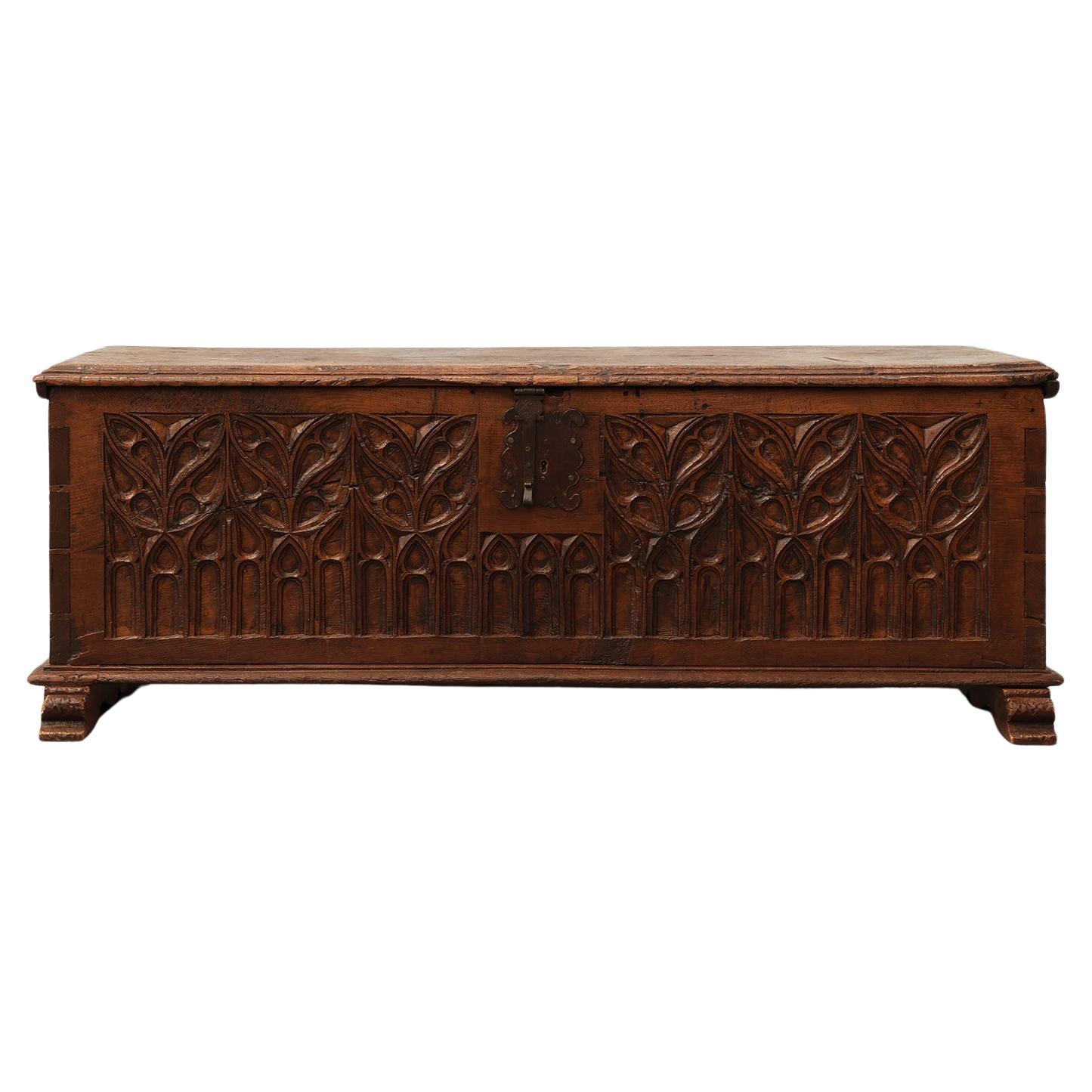
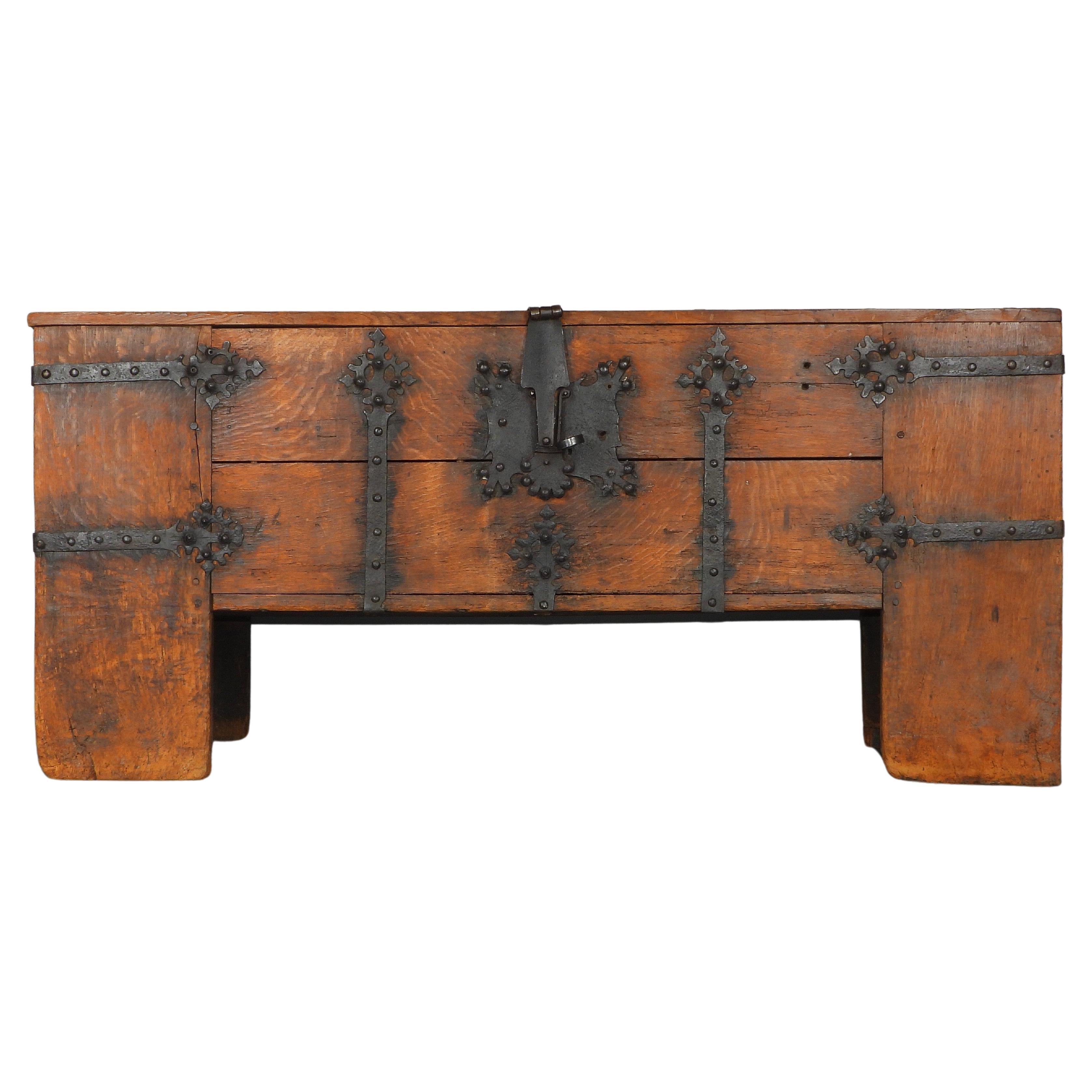
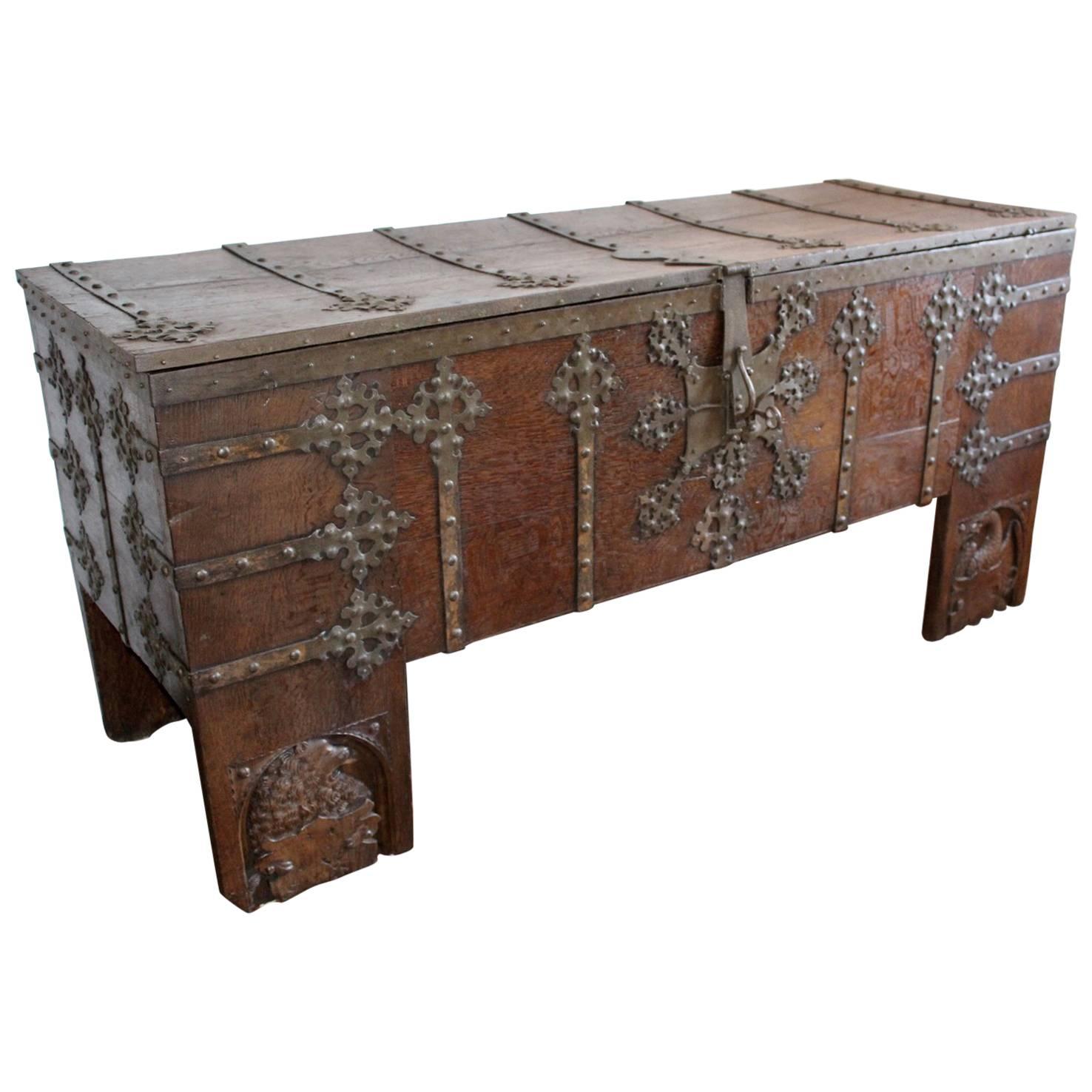
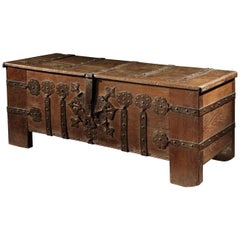
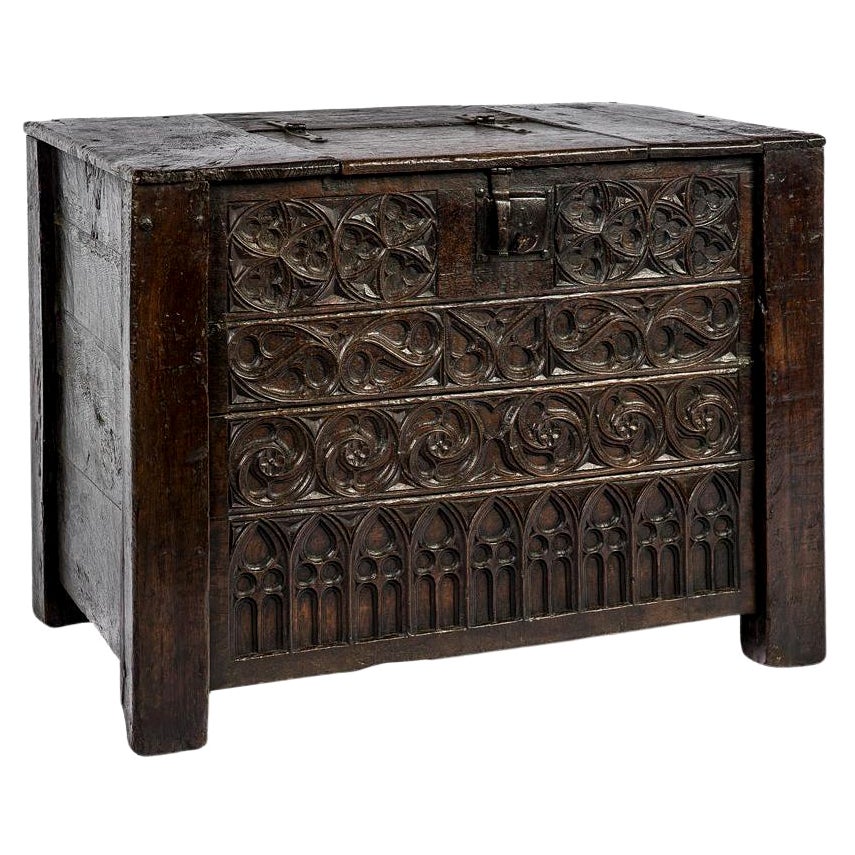
Gothic front gallery chest, Westphalia around 1500 - 1550, oak

$13,574.69
$19,427.0530% Off
£10,062.47
£14,379.3430% Off
€11,550VAT Included
€16,50030% Off
CA$18,934.73
CA$27,064.5630% Off
A$19,260.07
A$27,527.2130% Off
CHF 11,053.32
CHF 15,740.5330% Off
MX$231,528.66
MX$332,964.2330% Off
NOK 128,936.50
NOK 184,426.4530% Off
SEK 130,150.32
SEK 184,382.1630% Off
DKK 88,073.69
DKK 125,813.8330% Off

About the Item

Gothic front gallery chest, Westphalia around 1500 - 1550, wrought iron bands, boxy oak body, partially carved. Monumental star-shaped key plate with original key, feet on the front with carved coat of arms rosettes Dimensions: height 73 cm, width 146 cm, depth 63 cm The lid plate was previously remounted, position of the remounted hinges therefore visible, see photos. Frontal chests (also known as “Stollentruhen” ) are Gothic chests that rest on posts (Old High German: stollo). The construction, which dates back to the 12th century, consists of four upright planks to which the cross planks of the long and side walls are attached. A large number of frontal chests have been preserved in northwest German nunneries. They were brought by the novices and contained their personal possessions. So-called chest corridors still exist in the Wienhausen and Lüne convents. The carved coats of arms on the chest probably belong to the von Lilien and von Papen families, salters (Erbsälzer) in Werl in Westphalia. The first documented mention of the Erbsälzer dates back to 1246, when Archbishop Conrad of Cologne confirmed the special privileges of the Werl Sälzer. Over the centuries, a total of around 44 families were members of the Erbsälzer, families who inherited the right to boil salt.
  • Dimensions:
    Height: 28.75 in (73 cm)Width: 57.49 in (146 cm)Depth: 24.81 in (63 cm)
  • Style:
    Gothic (Of the Period)
  • Materials and Techniques:
  • Place of Origin:
  • Period:
  • Date of Manufacture:
    1500-1550
  • Condition:
    Wear consistent with age and use.
  • Seller Location:
    Münster, DE
  • Reference Number:
    1stDibs: LU9172241933612

More From This Seller

View All
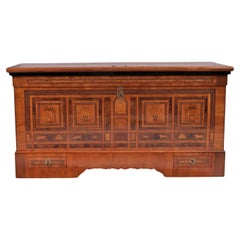
Marburg finch chest Biedermeier around 1800-10 Cherrywood bridal chest

Marburg finch chest Biedermeier around 1800-10 Cherrywood bridal chest

Located in Münster, DE

Marburg finch chest Biedermeier around 1800/10, cherry wood and other precious woods richly veneered and marquetry on an oak body, hunting motif, 2 small drawers in the base area, or...

Category

Antique Early 1800s German Biedermeier Commodes and Chests of Drawers

Materials

Cherry, Fruitwood, Oak

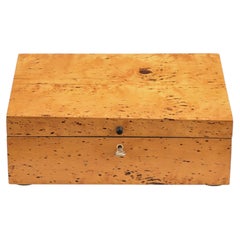
Early 19th Century German Biedermeier Casket Birchwood around 1830

Early 19th Century German Biedermeier Casket Birchwood around 1830

Located in Münster, DE

Casket Biedermeier, circa 1830, birch veneer, lockable, small knob handle, interior lined with handmade paper, shellac finish Dimensions: Height 11 cm, Width 30 cm Depth 20 cm

Category

Antique 1830s German Biedermeier Jewelry Boxes

Materials

Birch

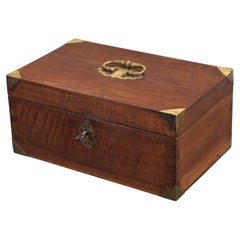
Travel Case  Baroque, ca. 1750/60, mahogany, original brass fittings

Travel Case Baroque, ca. 1750/60, mahogany, original brass fittings

Located in Münster, DE

Travel Case Baroque, ca. 1750/60, mahogany, original brass fittings and handle on the lid, very elaborate and sophisticated interior layout, beautiful patina Dimensions: Heigh...

Category

Antique 1750s German Baroque Jewelry Boxes

Materials

Brass

19th Century Half cabinet, Biedermeier, Rhineland, around 1815/20 cherrywood

19th Century Half cabinet, Biedermeier, Rhineland, around 1815/20 cherrywood

Located in Münster, DE

Half cupboard Biedermeier, Rhineland around 1815/20, cherry veneered on softwood, concealed drawer, ebonized profile, shellac hand polish Dimensions: height 77 cm; width 64 cm; dep...

Category

Antique Early 19th Century German Biedermeier Commodes and Chests of Dra...

Materials

Cherry, Fruitwood

Chest of drawers, Biedermeier, Westphalia around 1825, Ashwood

Chest of drawers, Biedermeier, Westphalia around 1825, Ashwood

Located in Münster, DE

Biedermeier chest of drawers Ash, Westphalia, circa 1825, stepped top, multiple mirrored veneer, three drawers, recessed key plates, hand-polished with shellac Dimensions: Height 8...

Category

Antique 1820s German Biedermeier Commodes and Chests of Drawers

Materials

Wood, Birch

Chest of drawers, Empire around 1800/10, Cherrywood with three drawers

Chest of drawers, Empire around 1800/10, Cherrywood with three drawers

Located in Münster, DE

Empire chest of drawers, circa 1800/10, cherry, plum, and apple wood veneered on oak, three drawers with a central lock in the middle drawer, original hardware and lock. Hand-poli...

Category

Antique Early 19th Century German Empire Commodes and Chests of Drawers

Materials

Wood, Cherry, Fruitwood, Oak

You May Also Like

Rare Gothic German Oak and Iron Chest Known as "Stollentruhe" 16th century

Rare Gothic German Oak and Iron Chest Known as "Stollentruhe" 16th century

Located in Worpswede / Bremen, DE

The large rectangular standing chest on stile feet, extensively mounted with wrought ironwork straps with stylised sixfoil motif. These are fixed with convex head nails: running vert...

Category

Antique 16th Century German Gothic Blanket Chests

Materials

Iron

Chest or Stollentruhe, Early 16th Century, German Gothic, Oak Chest, Original

Chest or Stollentruhe, Early 16th Century, German Gothic, Oak Chest, Original

Located in BUNGAY, SUFFOLK

This standing chest is of clamp-front construction, extensively decorated with long, ironwork straps with quatrefoil finials which ‘wrap’ around it, and has an ornate, central lockplate, and front legs with full, height stiles. The ironwork straps and finials are fixed with convex, headed nails: running along the front, five long straps; the two side straps; and the five straps on the top. On the chest front, centrally placed, is a large, iron lockplate with four outer, radiating spade finals in each corner and three, superimposed spade finials (a symbol of nobility) which are pierced with the initials ‘BB’. The lockplate receives a corresponding, external hasp fitted to the lid. Below the floor of the chest, the two front stile legs retain most of their original height. The lid is supported by substantial iron strap hinges that extend right down the back of the chest. Inside the chest at the left end is a shallow, oak till. Construction The chest is of joined, 'clamp-front' construction, reinforced by the nailed, iron mounts. In total it uses ten, oak boards which were riven and planed. The back and front are each formed from a large single plank held to the full height stiles by long, pegged tenons. The sides are also single boards joined into the stiles using long tenons held by dowels, and extend down below the chest bottom, concealing the ends of the bottom boards. The bottom consists of a single board cut into the sides and shallow rebates in the stiles. The front and back boards are dowelled into the bottom boards. The lid which overhangs the sides has a narrow cleat at each end, and consists of one wide plank which has bowed a little as a result of shrinkage. Ironwork : The wrought ironwork straps, lockplate, hasp and lock all appear all appear to be early, and of the same original manufacture and are fixed with convex headed nails. There is mild dark staining of the oak around the iron mounts, possibly because of low tannin content in the oak. Length 172 cm., 67 ¾ in., Height 71.5 cm., 28 ¼ in., Depth 63 cm., 24 ¾ in., Related to: No 900:2-1904 V&A Museum, London. Stadtmuseum Dusseldorf. Decorative Arts Museum Berlin. Museen Schleswig-Holstein & Hamburg. A related example featuring elaborately-carved feet and formerly in the Horsham Museum, West Sussex, sold at Christie's in 2010 for £97,250 and another example, again with carved feet sold at Sothebys in 2006 for £48,000. Literature: A similar example is illustrated in H. Lüttgens, Alt- Aachener Wohnkultur; Ein Rundgang durch ein altes Aachener Haus im Wohnstil des 18. Jahrhunderts, Aachen, n.d., ill. 12, and another comparable iron-bound chests...

Category

Antique 16th Century German Gothic Blanket Chests
Materials

Oak

Gothic Period Oak Chest 15 Century

Gothic Period Oak Chest 15 Century

Located in Brussels, Brussels

exceptional late 15th century/early 16th century carved oak Gothic period chest from Northern of France. Very fine example of a flamboyant Gothic style chest with a superb carved f...

Category

Antique 15th Century and Earlier French Gothic Blanket Chests

Materials

Oak

Gothic Carved Chest, Handcrafted Solid Wood, Tyrol, 16th-18th Century

Gothic Carved Chest, Handcrafted Solid Wood, Tyrol, 16th-18th Century

Located in ALHAURÍN EL GRANDE, Malaga

Tyrol, Austria, 16th–18th Century A remarkable and truly one-of-a-kind Gothic carved chest from the Tyrol region of Austria, reflecting centuries of craftsmanship, use, and careful ...

Category

Antique 16th Century Austrian Gothic Blanket Chests
Materials

Wood

Rare Late Medieval 16th Century German Wrought Iron Oak Chest or Stollentruhe

Rare Late Medieval 16th Century German Wrought Iron Oak Chest or Stollentruhe

Located in Worpswede / Bremen, DE

A very impressive Westphalian Gothic chest or ‚Stollentruhe’, Westphalia, Germany, circa 1500-1550. Wrought iron mounted oak, partially carved. The monumental rectangular standing chest with full-height stiles, extensively mounted with wrought ironwork straps terminating in quatrefoil finials which ’wrap’ around the chest edges. These are fixed with convex head nails. The ironwork with some remains of an originally red painted surface. In addition, running along the edges of the lid at the front and sides is a plain iron band, close-nailed. The feet of the two front legs are finely carved on the front face, in low relief with a rectangular arched ’panel’ depicting on the left a lion, on the right a dragon holding each a coat of arms. Regarding the age of circa 500 years, this coffer is in exceptionally good condition, with only smaller restorations.  Comparative literature • Baumeier, Stefan, Beschlagene Kisten; Die ältesten Truhen Westfalens, Essen, 2012. • Falke, Otto von, Deutsche Möbel...

Category

Antique 16th Century German Medieval Blanket Chests

Materials

Iron