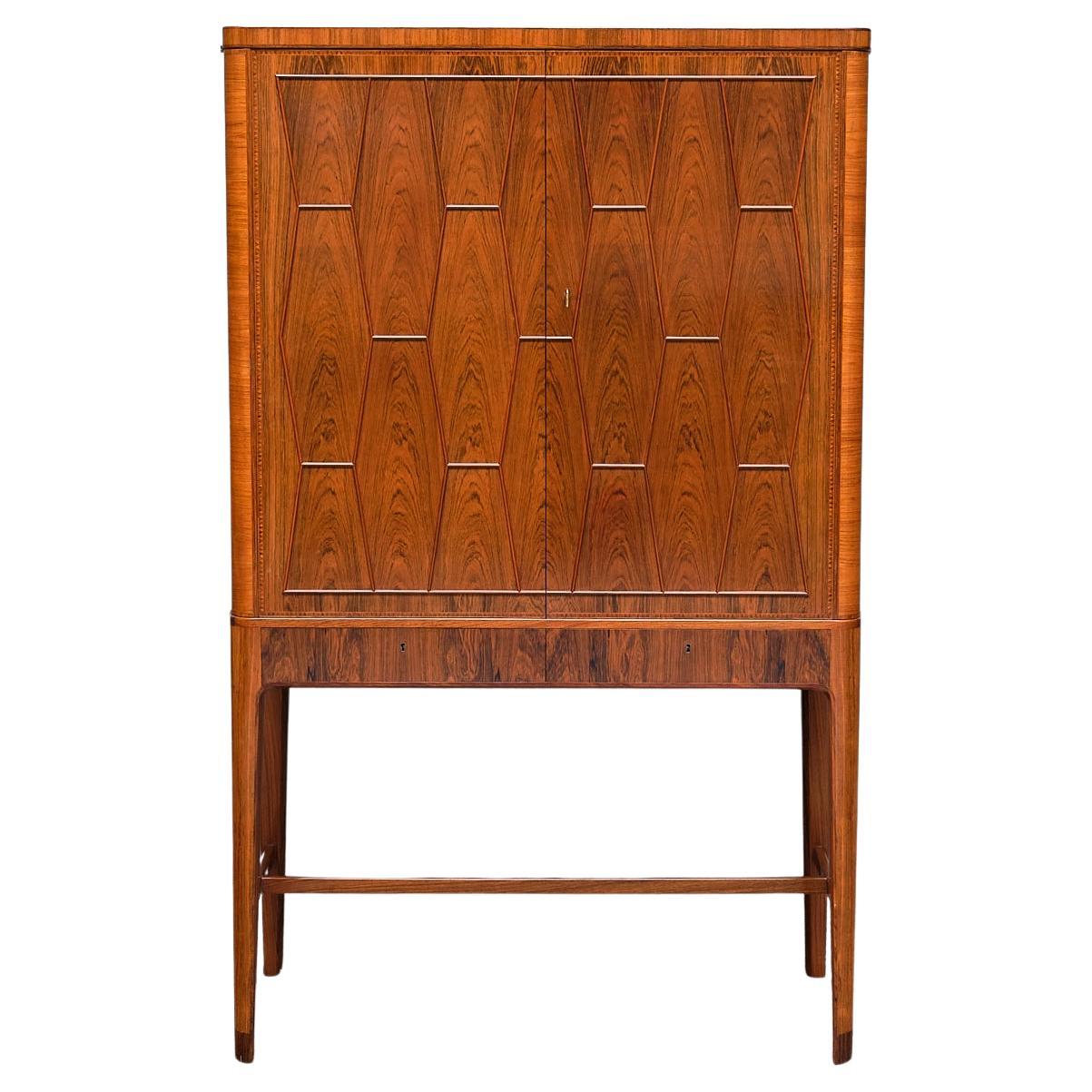
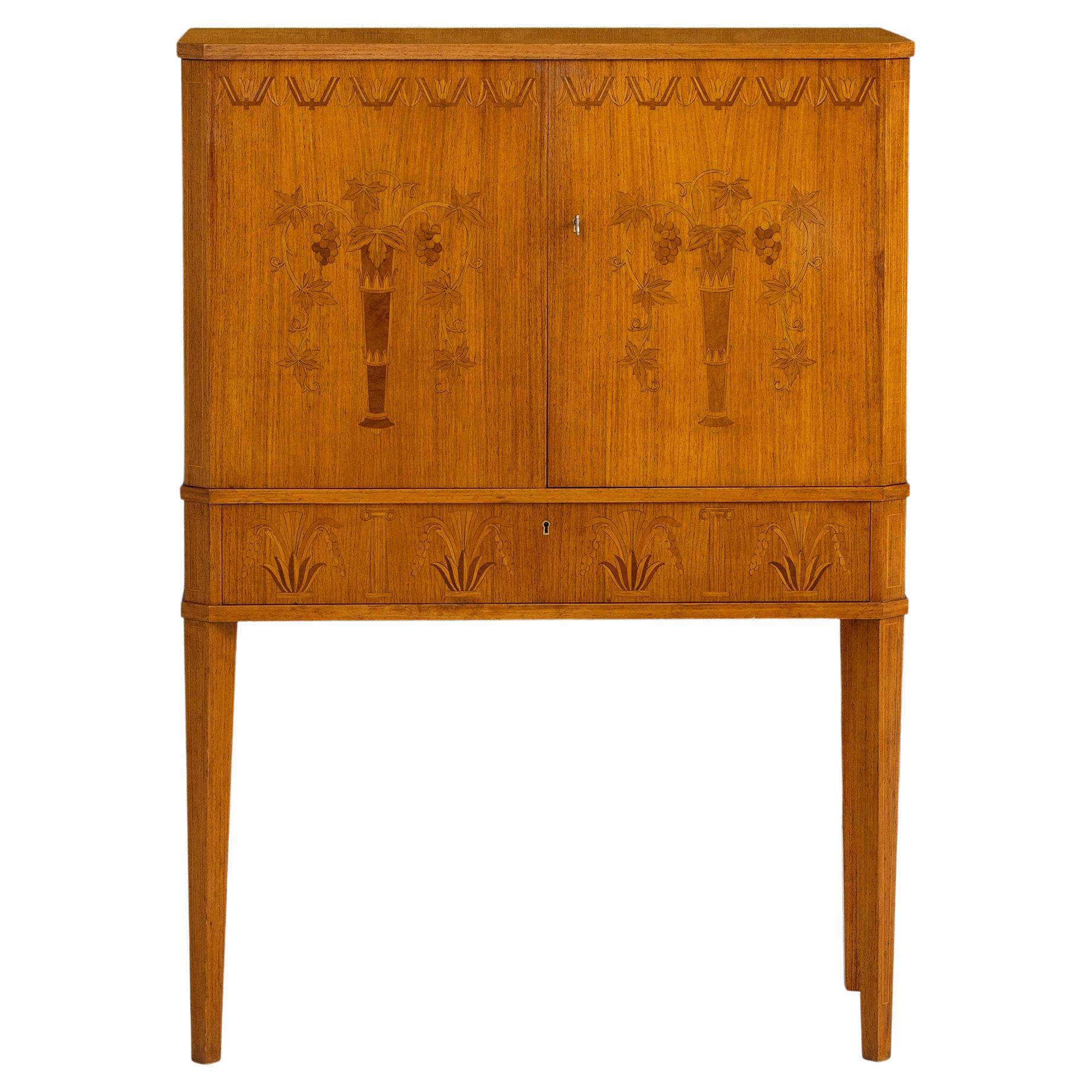
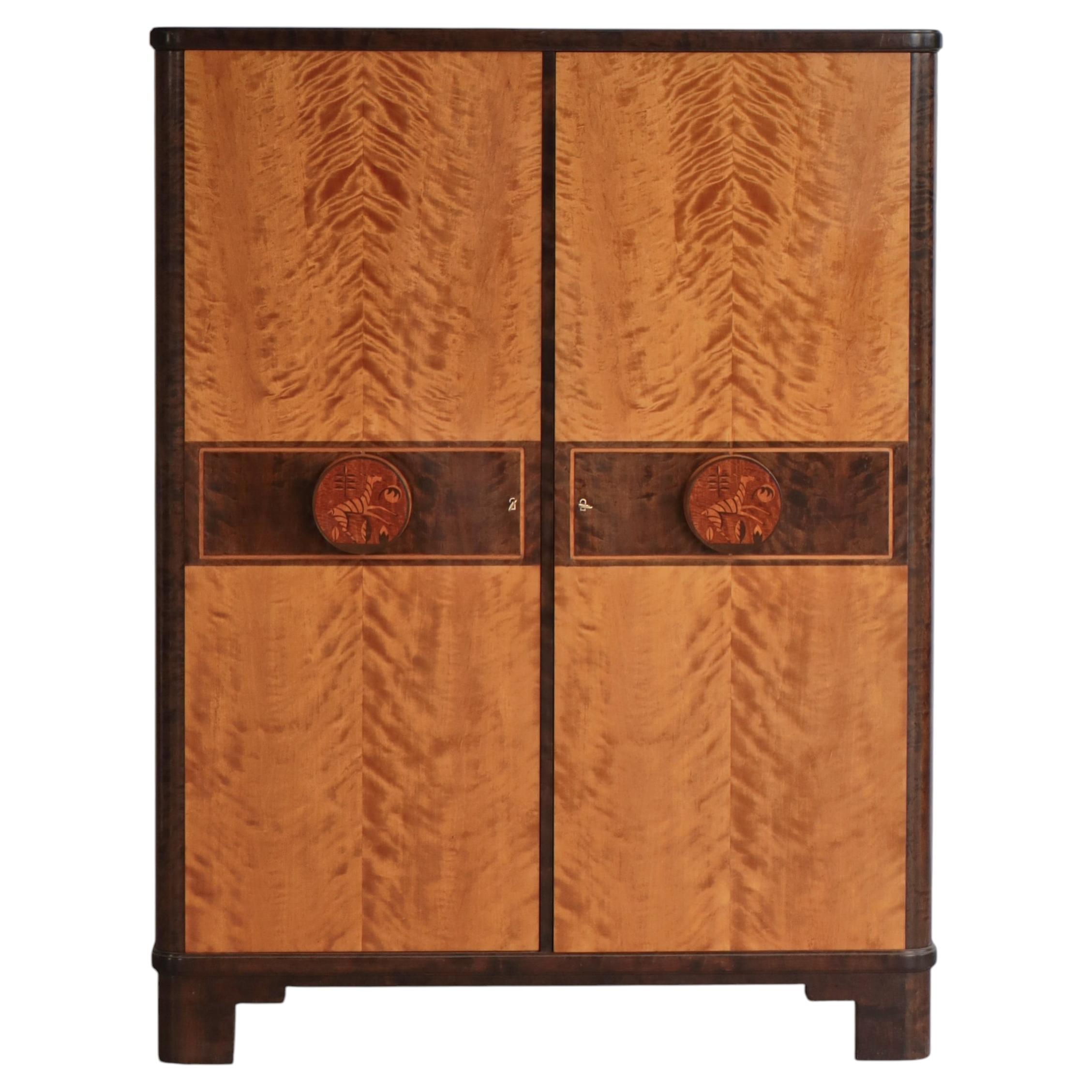
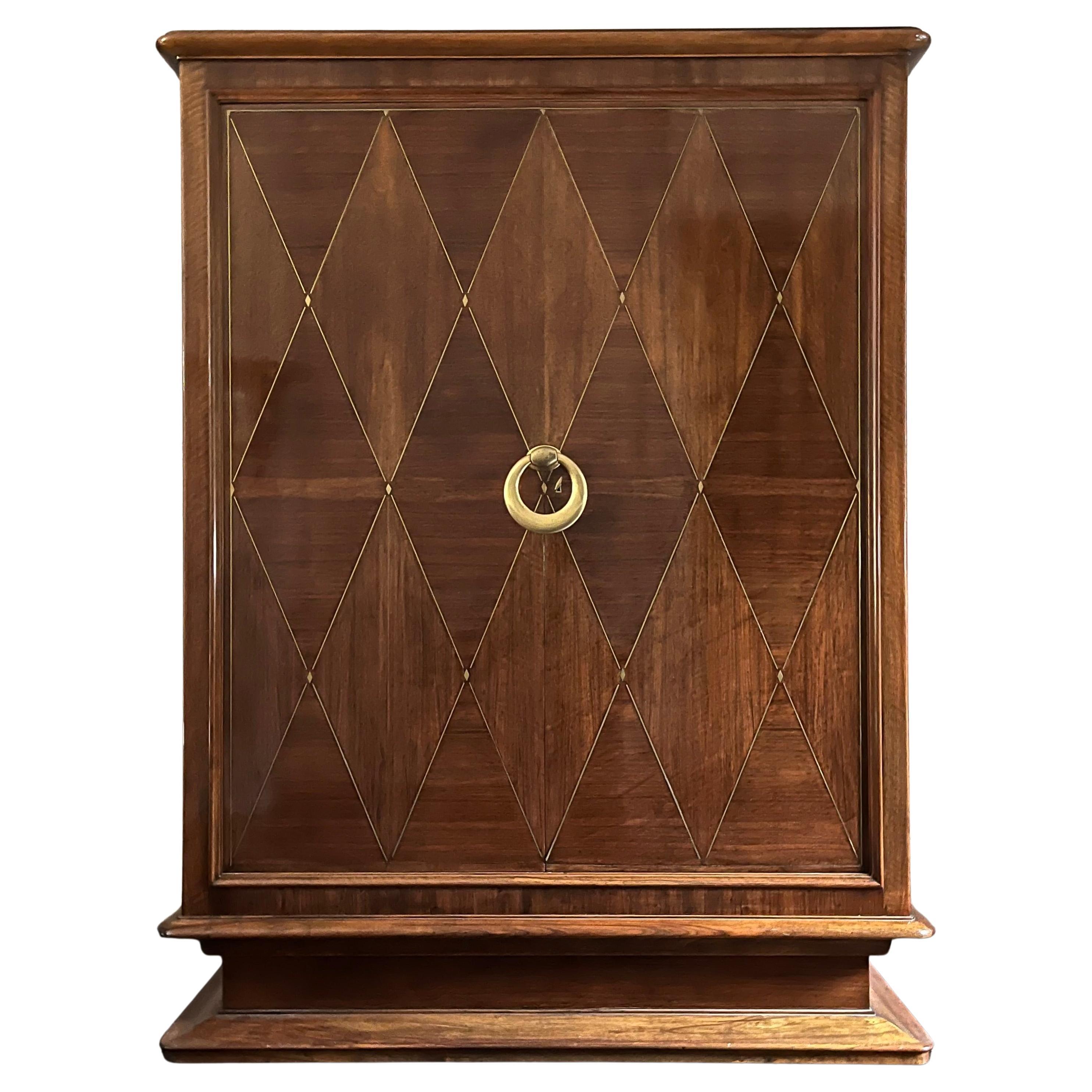
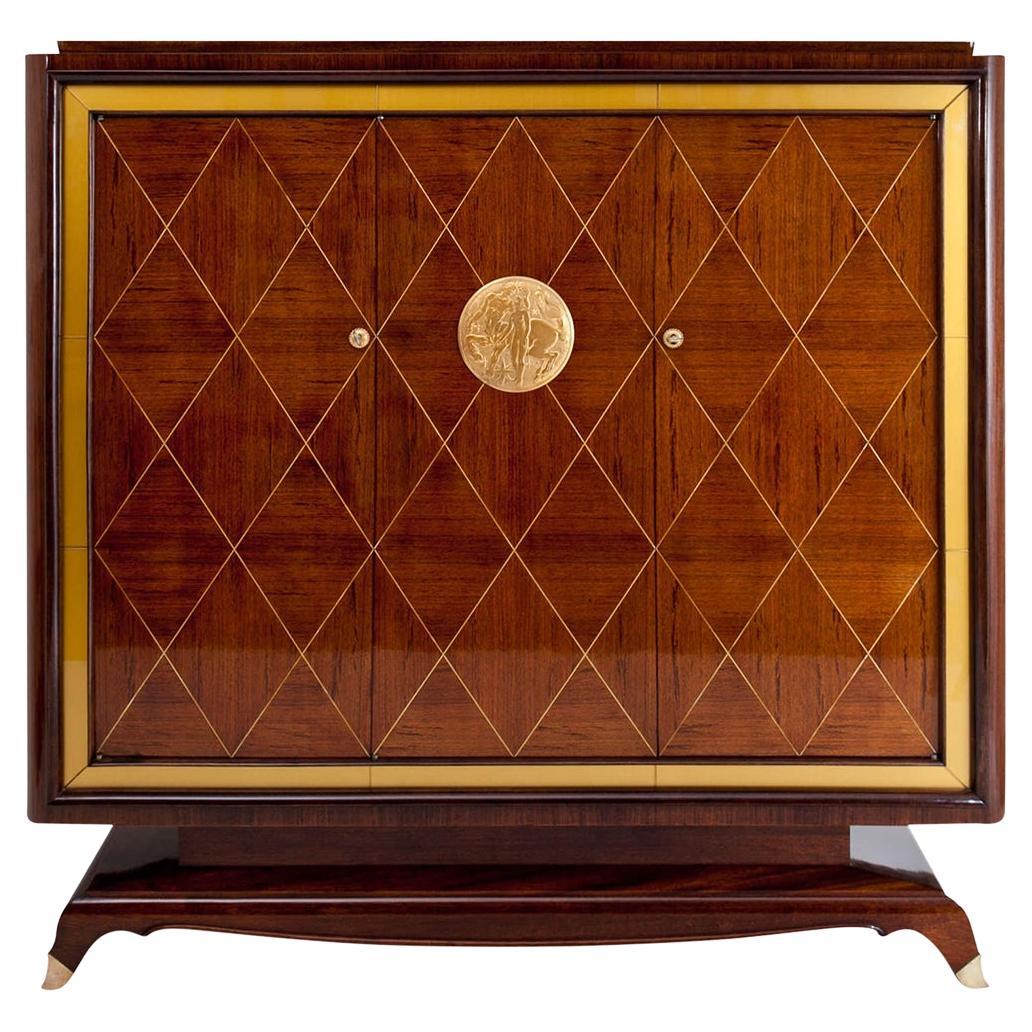
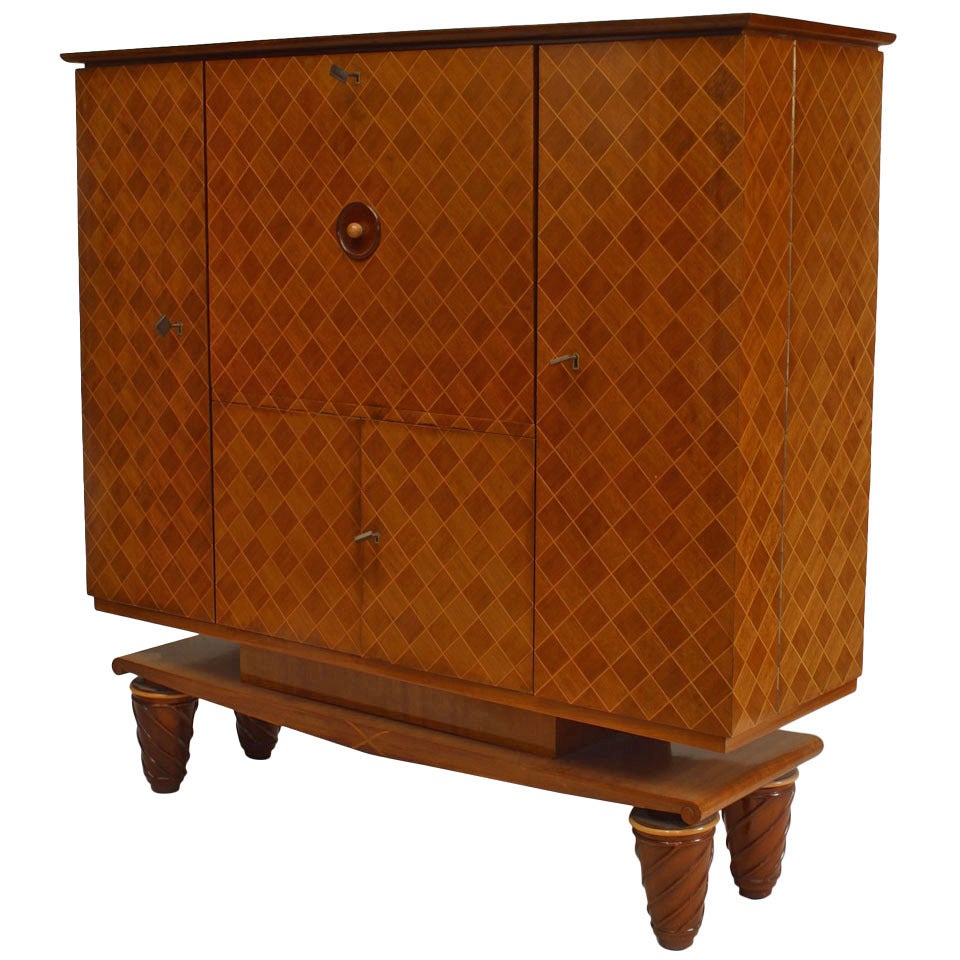
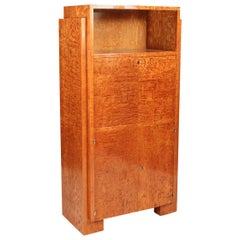
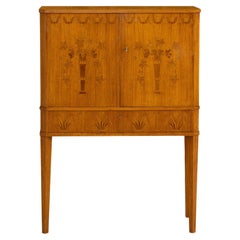
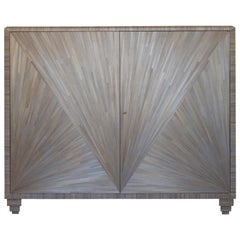
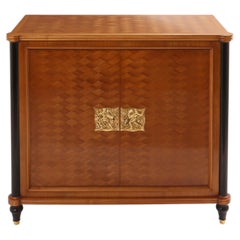
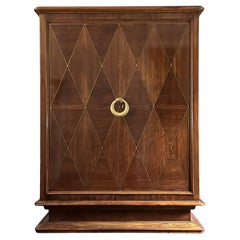
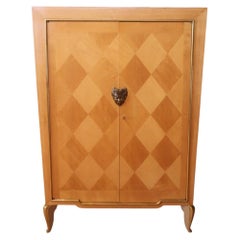
A striking mid-century French armoire whose entire front is composed of straw marquetry (marqueterie de paille) laid in a dense, all-over harlequin/diamond pattern — the split-straw veneer catching the light in alternating warm gold and honey tones as the diamonds shift direction. The two-door front is framed by a scalloped, bracket-cornered reserve outlined in fine inlay, with curling scroll motifs in the upper corners — a refined, hand-drawn border that softens the geometry of the straw lattice below. The doors are fitted with small brass ring pulls and open to reveal an interior fitted for hanging storage and/or shelving. The case sits on elegant wrought and gilt-iron sabre legs, a hallmark of French decorative furniture of the 1940s. The sides and top are finished in book-matched veneer with a warm, glowing lacquer.
Groult favored curving, organic silhouettes covered with delicate and precious materials — exotic woods, lacquer, straw marquetry, ivory, and shagreen, and this cabinet's dense straw-marquetry "harlequin" ground, framed by a hand-drawn scrolling border, is fully consistent with that decorative vocabulary.
VOSGES INC
Condition: Good vintage condition consistent with age; veneer with minor wear and scattered small losses/lifting to the straw marquetry as visible in photos (see detail images), consistent with the fragility inherent to this technique. Brass hardware with original patina.
About the Designer — André Groult (1884–1966)
André Groult was one of the most celebrated furniture and interior designers of the Art Deco period. He attended the Sorbonne while serving as an assistant at L'Acclimatation, a newspaper directed by his father. After receiving his degree in 1906, Groult married Pauline Marie Poiret the following year — better known as the fashion designer Nicole Poiret, sister of the couturier Paul Poiret. Groult moved in a cultivated circle, largely through his well-connected wife, that included Louis Süe, André Derain, Marcel Duchamp, Odilon Redon, and Francis Picabia.
In 1910 Groult made his début at the first edition of the Salon d'Automne, and his work was hailed by critics, placing him at the forefront of a new generation of designers. His language blends voluptuous, rounded silhouettes with an almost couture-like "surface dress" — precious leathers, especially shagreen, lacquer, exotic veneers, and refined metal or ivory mounts — often softening modern volumes with historical allusions while keeping lines uncluttered and exquisitely proportioned.
At his atelier, Groult's designs were executed by a small group of skilled craftsmen, noted for sumptuous materials, especially shagreen and horn; among his collaborators was Adolphe Chanaux, the ébéniste who later created furniture for Jean-Michel Frank. For the Exposition Internationale des Arts Décoratifs et Industriels Modernes in 1925, he designed a celebrated woman's bedchamber ("Chambre de Madame") in pink and gray, with furniture rounded and covered in natural shagreen. In 1935, Groult went on to design the furnishings of the first-class cabins on the ocean liner SS Normandie. Today, French national collections — notably the Musée d'Orsay and the Musée des Arts Décoratifs — preserve important examples of his work.