Want more images or videos?
Request additional images or videos from the seller
1 of 9

Rare Renaissance Cabinet Richly Carved

$105,894.93
£78,409.90
€90,000VAT Included
CA$147,496.61
A$150,058.73
CHF 85,998.65
MX$1,806,800.22
NOK 1,005,165.30
SEK 1,009,576.67
DKK 686,287.48

About the Item

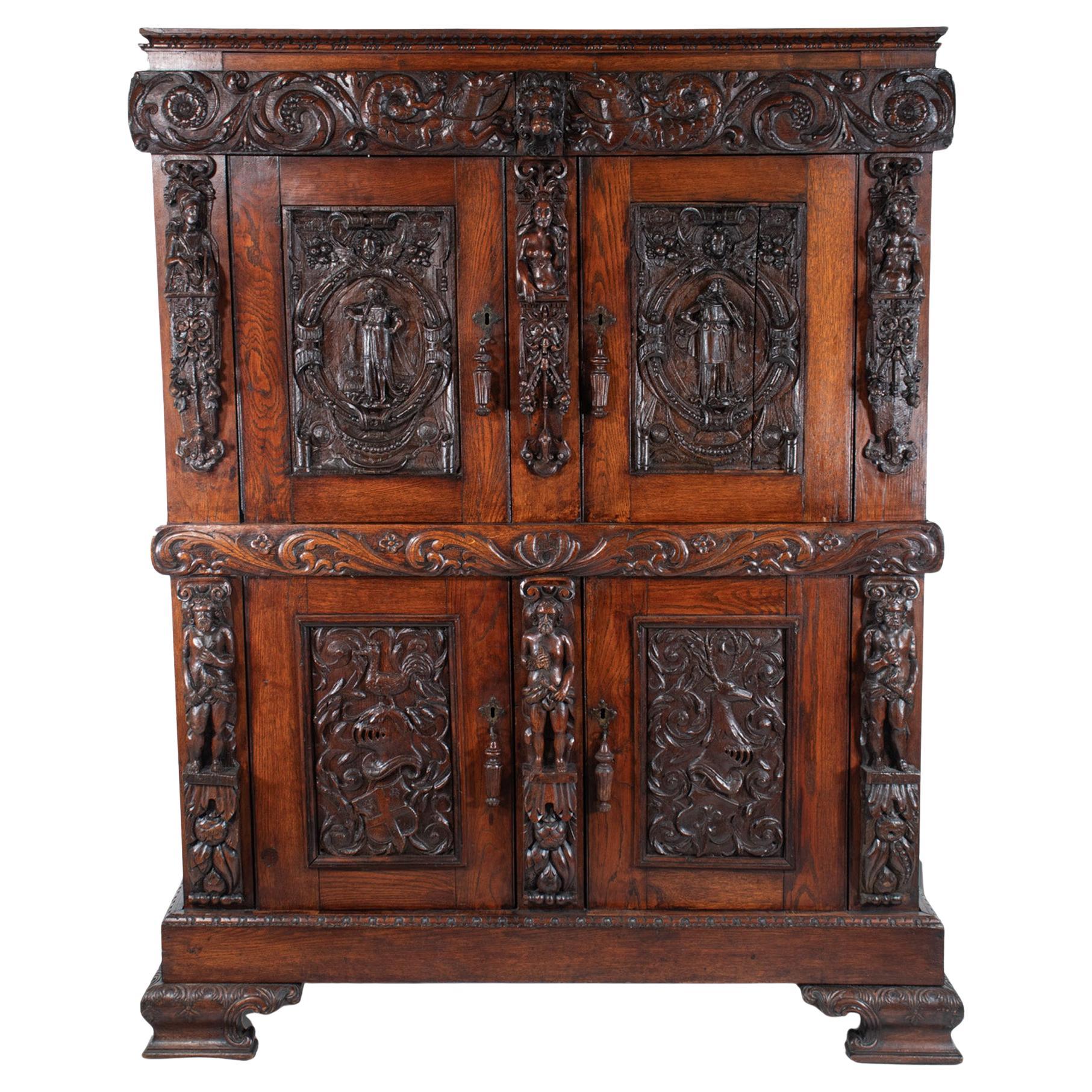
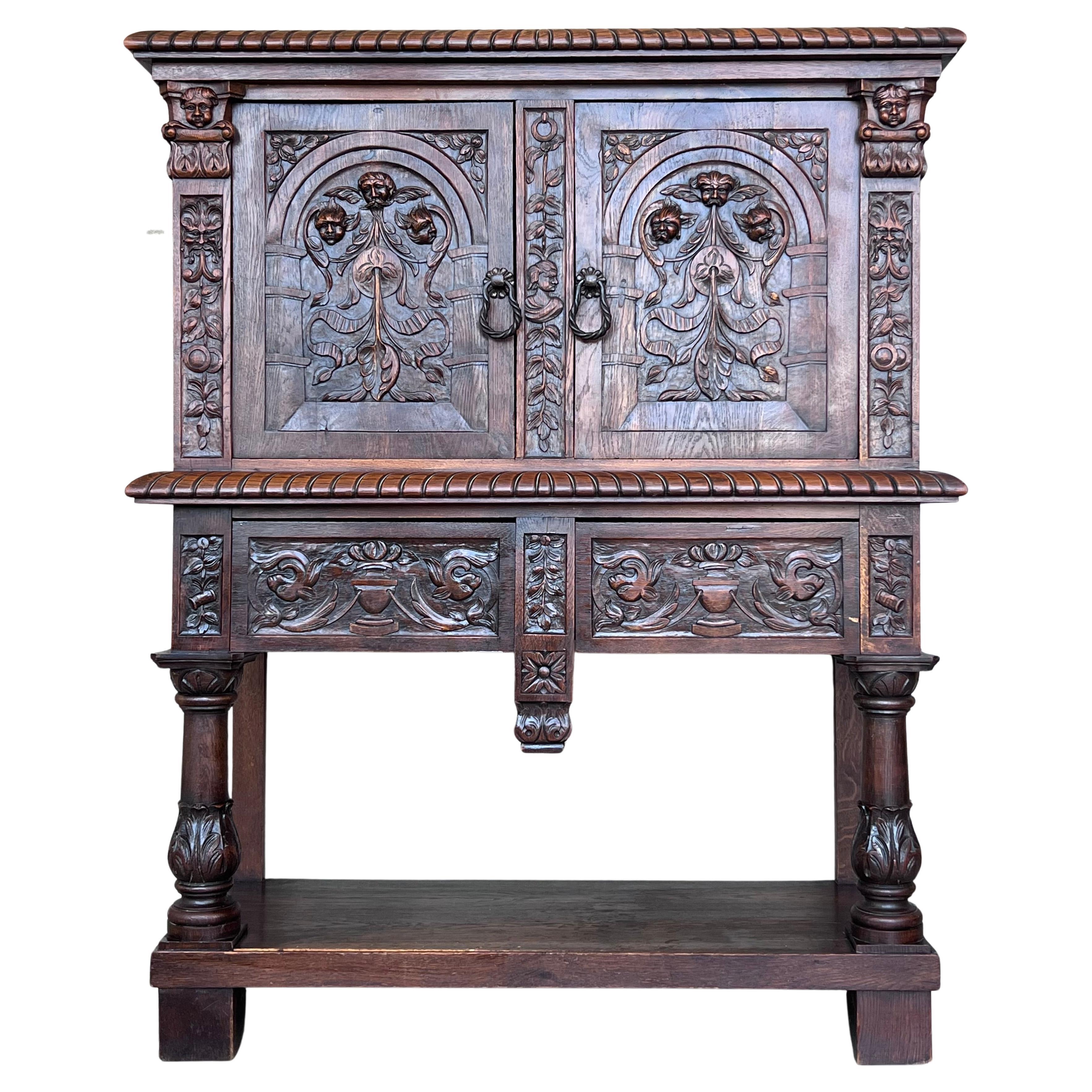
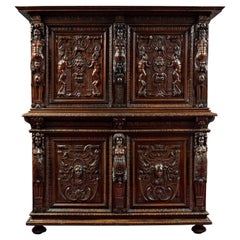
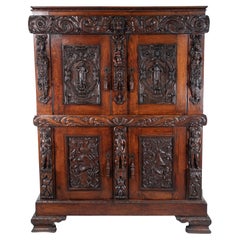
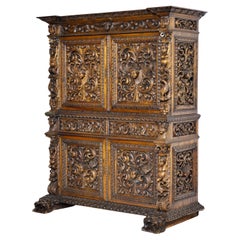
This rare Renaissance cabinet is richly decorated on the doors and drawers with carvings depicting the four seasons, and on the uprights and the entablature, alternating flower bouquets inlaid with mother of pearl. This is a beautifully conceived piece of furniture, representing a crowned portico with its entablature and cornice. The upper body Articulated separately in a ternary rhythm, as with the lower body, the upper part opens with two carved doors. The doors are framed by both the lateral uprights and the casing. There are cartouches carved into the casing in which mythological figures are depicted with flower bouquets. On the doors: On the right: Spring, a female figure crowned with a wreath of leaves, holding a basket full of flowers. She is wearing necklaces and bracelets on each arm, with drapery discretely wrapped around her body and is standing on a winged putti’s head. On each side are depicted a tree and a village with a steepled church. Above her head floats the three signs of the zodiac corresponding to the season: Aries, Taurus and Gemini. On the left: Summer, a bearded man crowned with ears of corn and bearing armfuls of corn. He is standing on a similar winged putti, flanked by a tree and an ear of corn. The following three signs of the zodiac appear: Cancer, Leo and Virgo. On the uprights and the central casing a number of smaller figures seem to represent virtues and vices that newly wedded couples should aspire to and avoid. On each side, at the bottom of the uprights, there is a dog representing fidelity. Above, a lion embodies power, wisdom, and justice. In between, on the left upright, there is a figure of noncombatant Athena wearing a helmet and holding a spear, an arrow pointing down and in her left hand, a shield, symbol of protective power. On the right upright, the goddess Venus controls the arrow of Cupid. The iconography here acts as a clear reminder of the required virtues that both parts of a young couple need to fulfill: fidelity, power, wisdom and justice. For him, the goddess Athena focuses on the power. Whereas for her, it is Venus who shows how to control Cupid’s arrow. On the central casing at the bottom, by way of contrast, there is a peacock, a symbol of pride and at the top, a monkey representing lust and mischief. In between, a woman holding a chain and a cup full of precious stones while on the floor sits a half empty opened casket. This can be interpreted as a symbol of extravagance. Above, the entablature, decorated with male figures resting on leaking urns, may symbolize the passing of time. They are flanked by two consoles decorated with acanthus leaves and separated by flower bouquets (inlaid with mother of pearl). Finally on top, a cornice acts as a crown for the piece of furniture. The lower body The moulded base stands on four round, flattened feet. Represented on the doors: On the left: Autumn, a stocky, naked man crowned with vine leaves, holding fruits in his right hand and with his left, picking a bunch of grapes from a climbing vine. Standing on a mound, he is surrounded by a vine and a hill, at the foot of which a man presses the grapes in a big vat after the harvest. Above the climbing vine appear the signs of Libra, Scorpio and Sagittarius. On the right: Winter, an elderly man wearing a fur cloak and a pointed hat, is warming his hands by holding a blazing vessel. On each side stand a bare tree and some houses. Above, heavy clouds form the heads of two putti who are blowing, referring to the winter wind. Floating in the clouds are the signs of the zodiac: Capricorn, Aquarius and Pisces. The left and right uprights show on the bottom, a goose, another symbol of conjugal fidelity and watchfulness. Above, an eagle is depicted, perhaps a symbol of birds being of superior spiritual state and the primitive figures of paternity. On the uprights, the figures differ from one side to the other. On the left upright stands a figure of a fighting Mars waving his spear. On the right upright, a figure of Mercury god of prosperity, with winged feet, holding in his hand the caduceus, symbol of the balance between opposite forces. That is all for the virtues. On the central casing, at the bottom, is a three headed hydra, image of all vices. Above, a naked man with his pitchfork pointing to the sky that could be Pluto. Finally, at the top, is shown a bear, traditionally used as the emblem of cruelty, wildness and brutality. All the symbols represented on this piece of furniture suggest that the object may have been received as a wedding gift. The richness of the symbols, the iconography and the carving, being firm and robust, and the use of inlaid mother of pearl for the creation of vases and flowers, make this piece of furniture a rare embellished cabinet.
  • Dimensions:
    Height: 72.45 in (184 cm)Width: 50.6 in (128.5 cm)Depth: 20.48 in (52 cm)
  • Style:
    Renaissance (Of the Period)
  • Materials and Techniques:
  • Place of Origin:
  • Period:
  • Date of Manufacture:
    circa 1500
  • Condition:
  • Seller Location:
    Saint-Ouen, FR
  • Reference Number:
    1stDibs: LU3115329553742

More From This Seller

View All
16th Century French Carved Renaissance Cabinet

16th Century French Carved Renaissance Cabinet

Located in Saint-Ouen, FR

Rare carved Renaissance cabinet Period : 2nd half 16th century, ca. 1570 Origin : France, Burgundy or Languedoc This cabinet embody the produ...

Category

Antique 16th Century French Renaissance Cabinets

Materials

Walnut

Renaissance Cabinet form Lyon 'France'

Renaissance Cabinet form Lyon 'France'

Located in Saint-Ouen, FR

Condition : Partly dating from the Renaissance. The backs and the drawer’s insides have been re-done. Historical background The 16th century is a prosperous period for Lyon...

Category

Antique 16th Century French Renaissance Cabinets

Materials

Walnut

Exceptional Cabinet known as the Sumene Cabinet

Exceptional Cabinet known as the Sumene Cabinet

Located in Saint-Ouen, FR

EXCEPTIONAL CABINET KNOWN AS THE SUMÈNE CABINET   ORIGIN : FRANCE, NÎMES PERIOD : 16th CENTURY   Height: 199 cm Width: 180.5 cm Depth: 69 cm   Walnut wood Good state of preservation ...

Category

Antique 16th Century French Renaissance Cabinets

Materials

Wood, Walnut

Small Renaissance Cabinet

Small Renaissance Cabinet

Located in Saint-Ouen, FR

Small renaissance cabinet ORIGIN : FRANCE PERIOD : END OF THE 16th CENTURY Measures: height: 167 cm length: 123 cm depth: 58 cm This small two-part unit with harmonious proportions opens with four front leaves and two belt drawers. It rests on a molded base. The uprights and the central frame of the lower body are adorned with long stylized palmettes. They frame the four leaves on which unfolds a vegetal decoration made of stems and leaves sculpted in symmetry around two mascarons topped with feathers...

Category

Antique 16th Century French Renaissance Cabinets

Materials

Walnut

Exceptional Renaissance Cabinet from Lyon

Exceptional Renaissance Cabinet from Lyon

Located in Saint-Ouen, FR

Exceptional Renaissance Cabinet from Lyon Origin: Lyon, France Period: 1540-1580, Second French Renaissance Measures: Height: 188 cm Length: 132 cm ...

Category

Antique 16th Century Cabinets

Materials

Walnut

Renaissance Cabinet from Burgundy or Lyon Region

Renaissance Cabinet from Burgundy or Lyon Region

Located in Saint-Ouen, FR

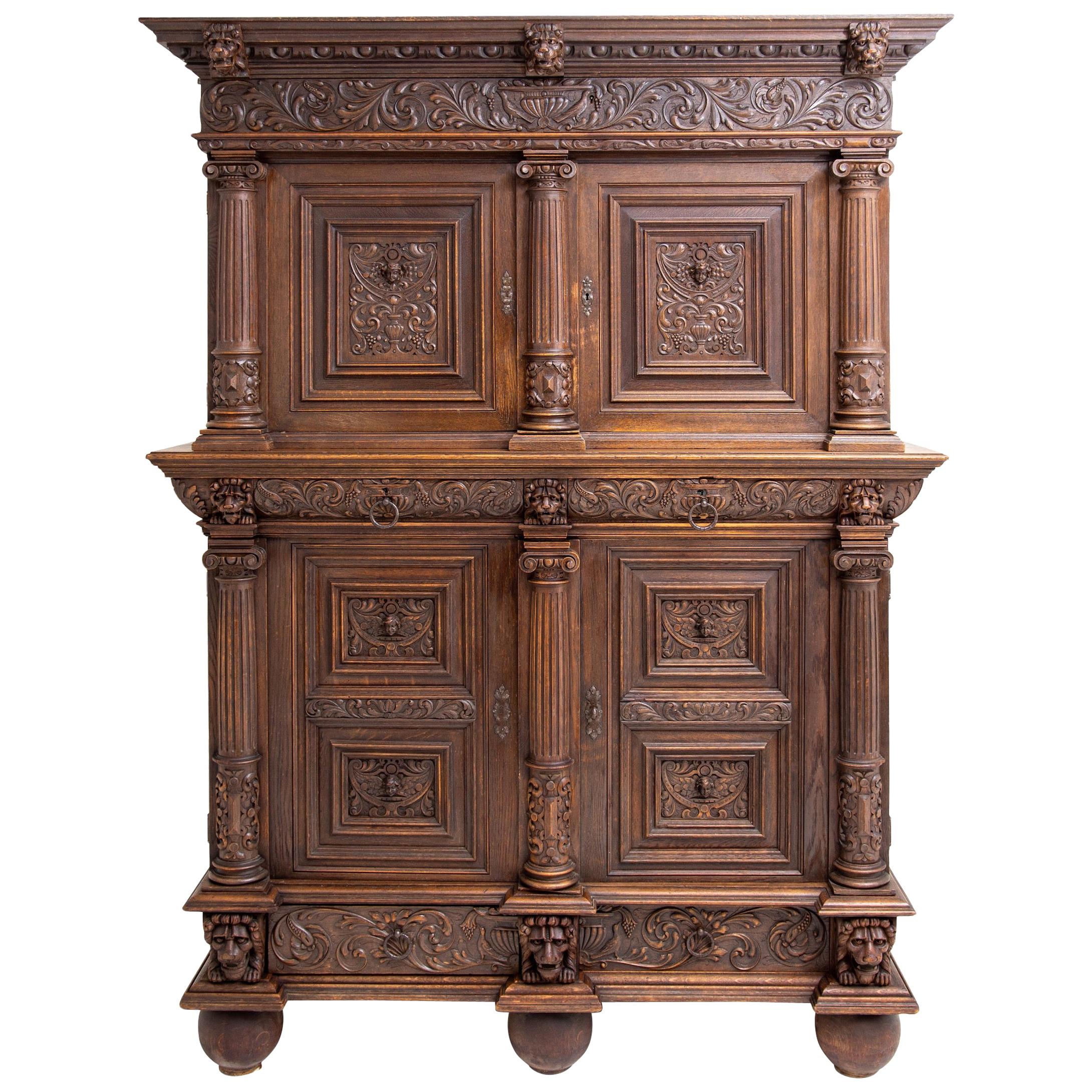
Renaissance cabinet from Burgundy Or Lyon Region Origin : Burgundy Or Lyon, France Period : Second Half 16th Century, C. 1580 Height : 209cm Length : 184cm Depth : 71cm Good condition Walnut wood, original keys and keyholes Around the middle of the 16th century the conception and ornamentation of French furniture evolves. The start of major building projects, such as the castle of Fontainebleau, gives artists a new impulse. Inventive and rich formulas are developed there, before spreading to all of Europe thanks to engravings and printed leaflets. Furthermore, Italian artists working on such construction sites bring French artists and patrons a renewed taste for the Antique. Regarding the art of furnitures, the most complex scenes and figures are drawn from illustrated books, ornament and emblem compendiums and engraving compilations. Rather than copying those images the artisans feed their inspiration and decline the motifs in numerous variations. The ornamental grammar marks a return to the Antique : palm leaf, acanthus, egg-and-dart, greek, scroll, fluted pilaster… It is in Primaticcio’s and Il Rosso’s stuccos made around 1540-1550 that we have to look for the origin of leather cut-outs, masks, chimaeras, harpies, sheathed figures, fruit and flower garlands that soon enrich every pieces of French furniture. The structure of the pieces of furniture also evolve thanks to the re discovery of Antique architectures, rigorously used as a model. This cabinet presents an imposing structure and a rich and original decor exemplifying the production of the late 16th century, infused with Italian, Antique and Fontainebleau influences. It stands on a moulded base ornate with palm leaves. It opens with four door-leaves and two drawers in the belt. Six whimsical terms divide the facade. The lower body is horizontally divided by three sheathed female terms. The two standing on the lateral posts are topped with fruits while the body is covered by acanthus leaves carved with precision, belted at the waist. The term standing on the central door-jamb is crowned with laurel leaves and is draped in the Antique fashion. A wincing mask hides the key hole. The two door-leaves are centred by a beautiful mask carved in a strong relief. They wear stylised feathered headdress and are set on draperies. Straps, leather scrolls, acanthus leaves and a shell are spread around the masks. The recessed panels are secured in frames ornate with acanthus leaves. The belt is flanked by two large mouldings enriched with variations of acanthus leaves. The drawers are carved with choux bourguignons and palm leaf motifs minutely executed. The consoles between each drawer bear tormented wincing masks, showing horns as if they were fauns or imps. The upper body is framed by two male terms characterised by a strong and nervous musculature, their manhood hidden by drapes secured thanks to a winged lion head. The term on the left appears to be younger and is wincing while the one on the right has a beard. The central female term brings contrast with her youth and sensuality. As it is the case on the lower body, the key hole is hidden behind the mouth of a faun’s mask placed on the drapes barely covering the intimacy of the caryatid. The panels of the upper body present an idealised architecture comprising pilasters and sinuous broken pediments. The pilasters are flanked by two satyrs with goat legs. In the centre appears an important lion mask. The terms of the upper body support the cornice. The entablature carries palm leaves and roses alternating as well as an egg-and-dart frieze. The cornice is adorned with acanthus motifs. On the sides, the carving is executed flat. A central rose is surrounded by scrolls, flowers and choux bourguignons. We can admire the variety of the elements employed. The artist vary with great genius many different ornamental motifs : palm leaf, egg-and-dart, laurel leaf, roses, scrolls … But the artist went even further as each profile and each face is individualised and presents different features. You can take a look at the faces of the satyrs flanking the upper body’s panels. The talent of the artist is undeniable. It makes no doubt the patron who commissioned this cabinet was an aesthete looking for the greatest quality. The artist who authored this cabinet had a great mastery of composition both in the general design and in the individual panels. They probably drew inspiration from engravings and drawings made especially for the making of this piece of furniture or not. They seem to be familiar with the style of Jacques Androuet du Cerceau. Indeed, we can find in Du Cerceau’s engravings the same juxtapositions of leather cut-outs, masks and fruits. The terms and caryatids used on the facade could very well be inspired by his work as well. The cabinet-maker was also undoubtedly observant of Hugues Sambin, the most famous cabinet-maker and sculptor in the Burgundy of the time. Like Du Cerceau, Sambin left an important ensemble of models particularly useful for the design of cabinets. His publication De l’Oeuvre de la diversité des termes dont on use en architecture (1572) was an essential book for every artisan. All the motifs testify of the artisan’s high knowledge of forms as well as the precision of their tools : super imposition of ornamental elements, foliages, architectural cut-outs, flat and high reliefs alternating, palm leaves inscribed in circular spaces, wincing faces. It is also a testimony of the artisan’s familiarity with Italian and Fontainebleau productions. Because of the proficiency of the cabinet-maker in so many different models, this cabinet truly is a master-piece authored by the hand of an authentic master. The generous carvings executed with great rigour and virtuosity evoke an origin close to Burgundy and Lyon workshops. This cabinet was made by a master of the region during the Second French Renaissance. Literature BOCCADOR Jacqueline, Le mobilier français du Moyen-Âge à la Renaissance, Édition d’art Morelle Mayot, 1996 BOS Agnès (dir.), Mobilier du Moyen âge et de la Renaissance, La collection du musée du Louvre, Louvre éditions...

Category

Antique 16th Century Renaissance Cabinets
Materials

Walnut

You May Also Like

19th Century Dutch Hand Carved Renaissance Raised Cabinet

19th Century Dutch Hand Carved Renaissance Raised Cabinet

Located in Miami, FL

20th century Spanish hand carved Renaissance raised cabinet was rendered from dense, old-growth quarter sawn walnut, examples of which are on display in museums across Belgium and Ho...

Category

Antique Late 19th Century Spanish Baroque Cabinets

Materials

Walnut

Renaissance Style Carved Cabinet in oak, XIXth century

Renaissance Style Carved Cabinet in oak, XIXth century

Located in Beaune, FR

Cabinet, sideboard or splashback in solid oak in Renaissance style. Richly carved, this piece of furniture offers a very pretty architecture. The decorations are inspired by the Rena...

Category

Antique 19th Century French Renaissance Revival Cabinets

Materials

Oak

19th Century French Renaissance Revival Cabinet with Ornamental Figural Carvings

19th Century French Renaissance Revival Cabinet with Ornamental Figural Carvings

Located in Chicago, IL

This Mid-19th Century French Renaissance Revival oak cabinet showcases a sophisticated combination of two distinct varieties of solid oak, each sourced from different parts of the tr...

Category

Antique Mid-19th Century French Renaissance Revival Wardrobes and Armoires

Materials

Oak

RENAISSANCE TWO BODY CABINET 19th Century

RENAISSANCE TWO BODY CABINET 19th Century

Located in Madrid, ES

RENAISSANCE TWO BODY CABINET 19th Century In oak wood Upper part with two profusely carved doors. Lower part with two drawers and two doors. Decorated with plant motifs, zoomorphic ...

Category

Antique 19th Century Portuguese Baroque Cabinets

Materials

Wood

Neo-Renaissance Cabinet, Late 19th Century

Neo-Renaissance Cabinet, Late 19th Century

Located in Greding, DE

A four-door cabinet in Renaissance style standing on ball feet with lion's head mascarons and half-columns with volute capitals. The doors with panels and vine decoration are separat...

Category

Antique 19th Century German Renaissance Revival Cabinets

Materials

Wood