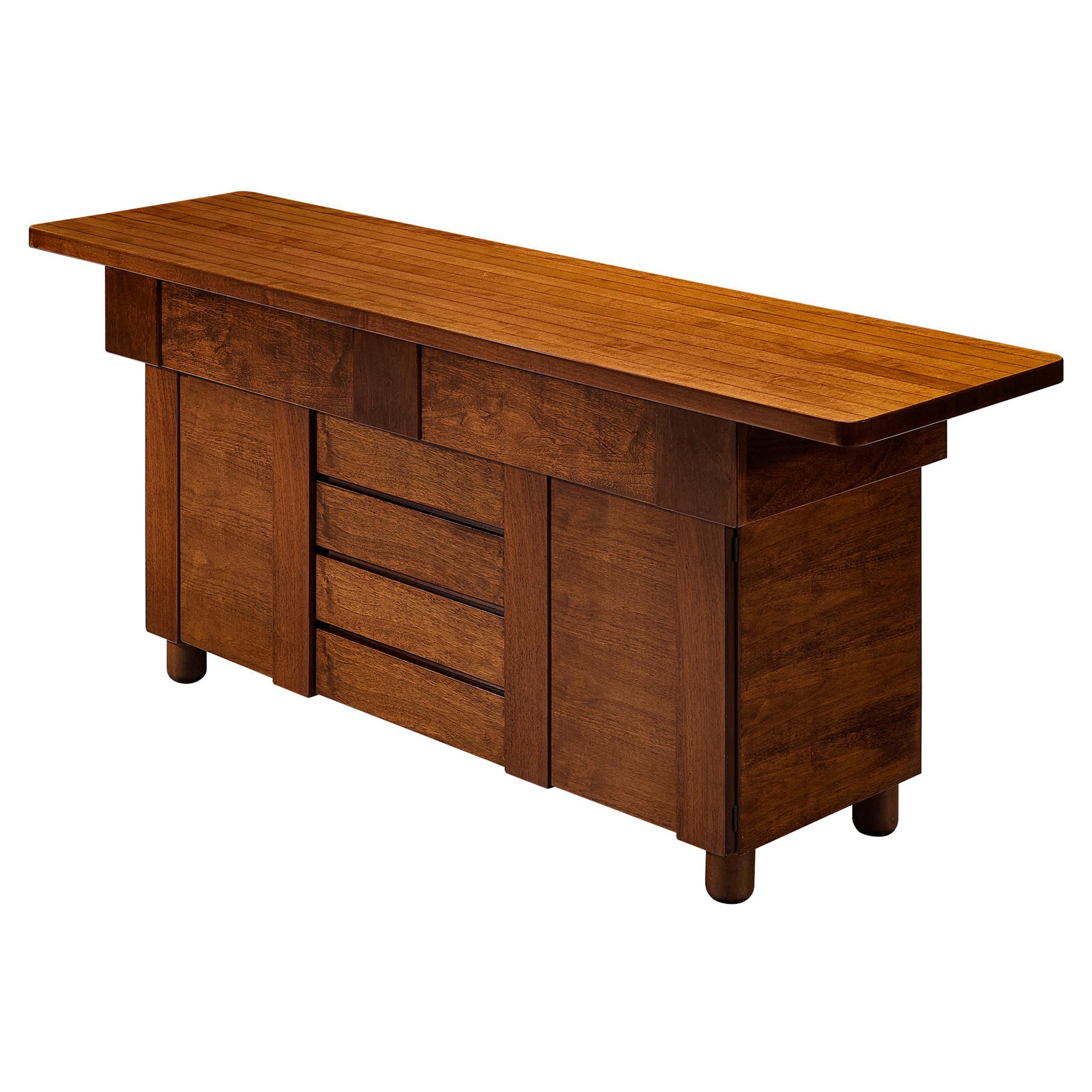
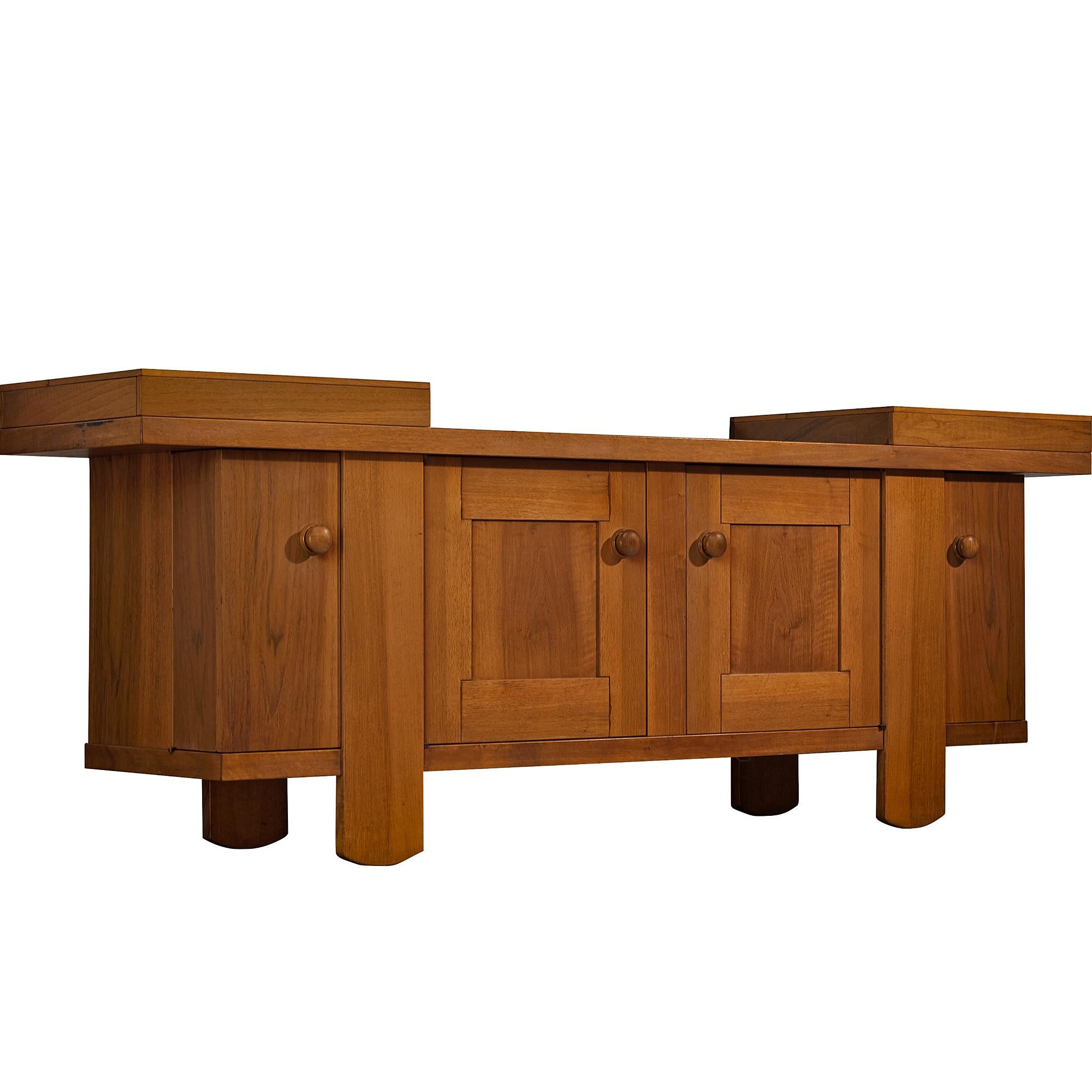
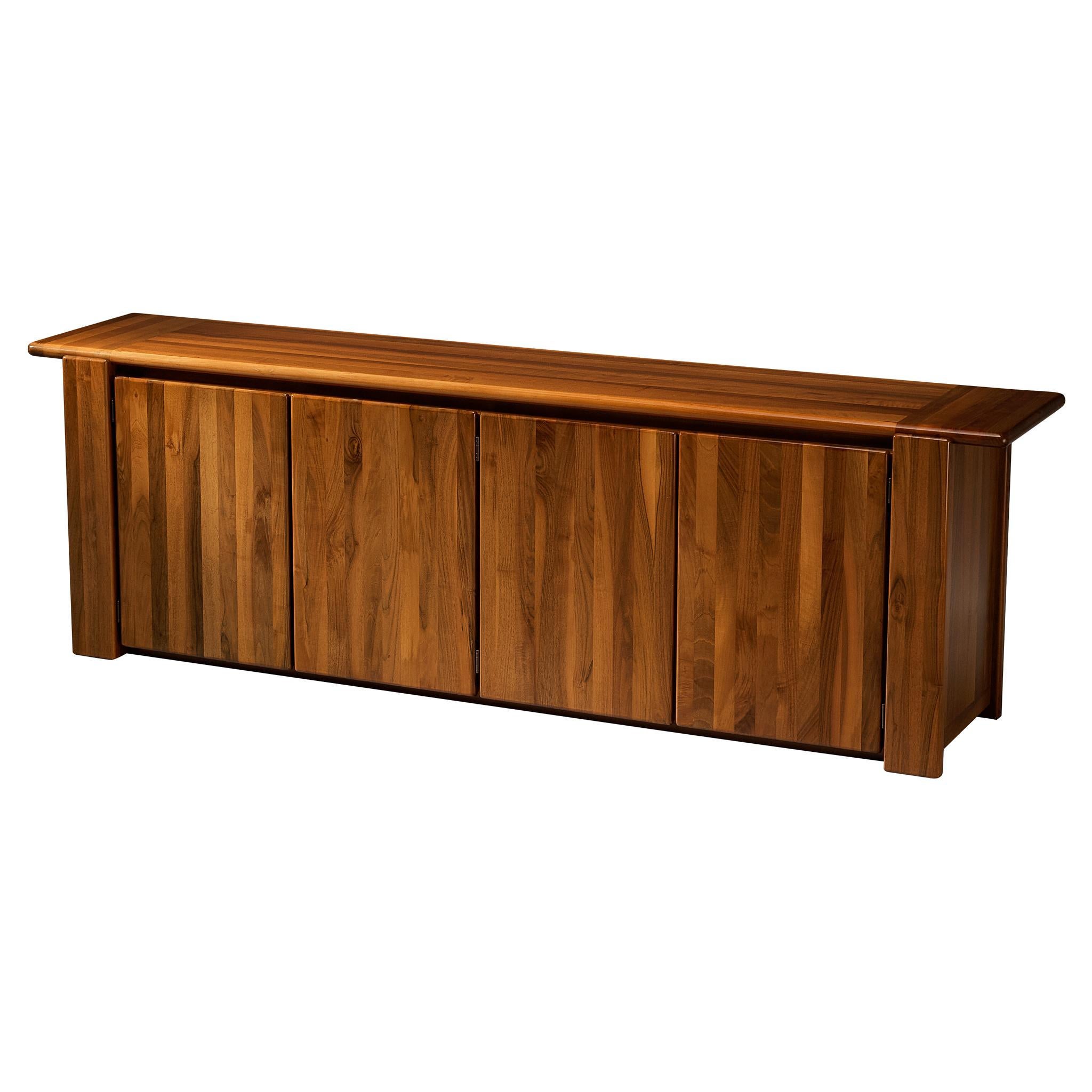
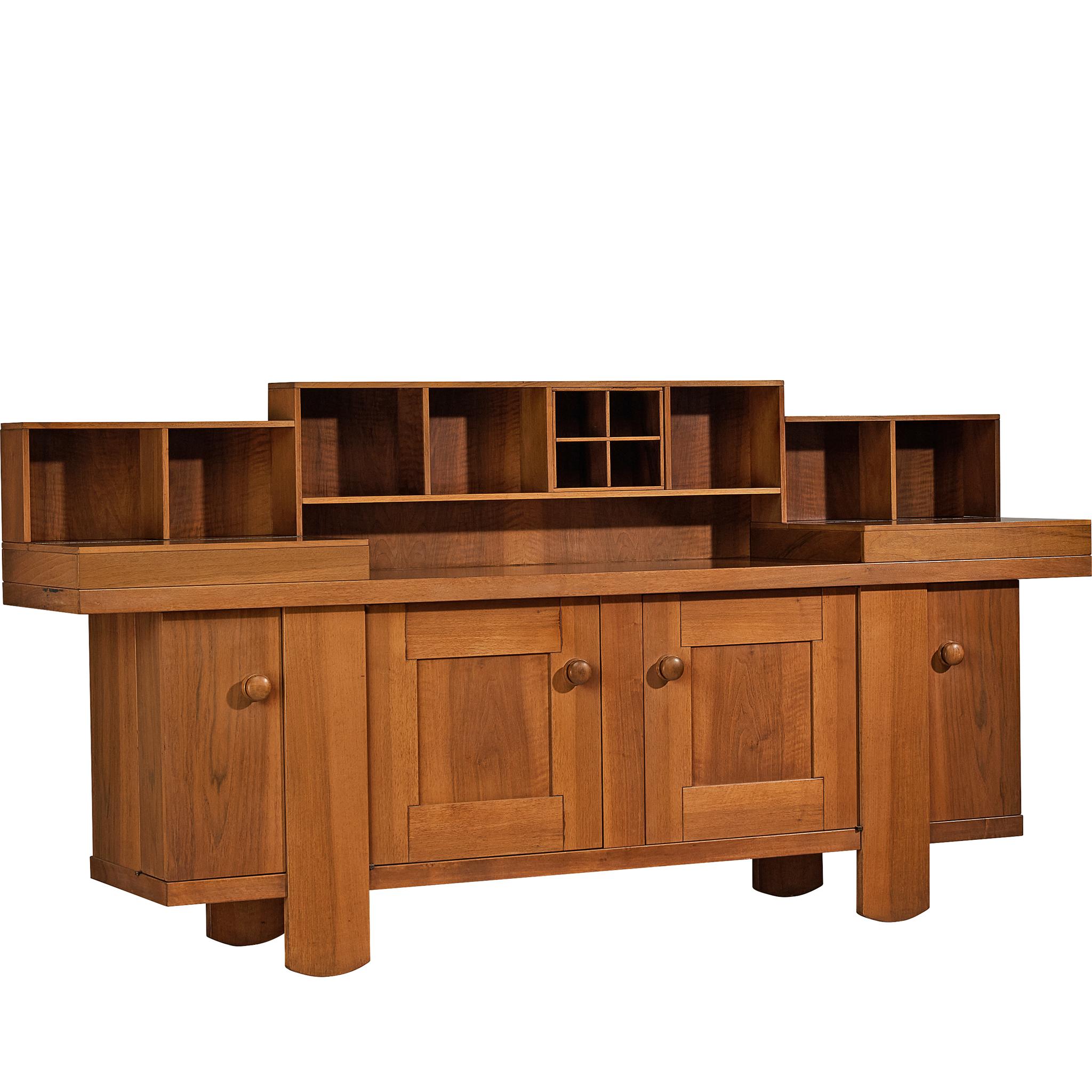
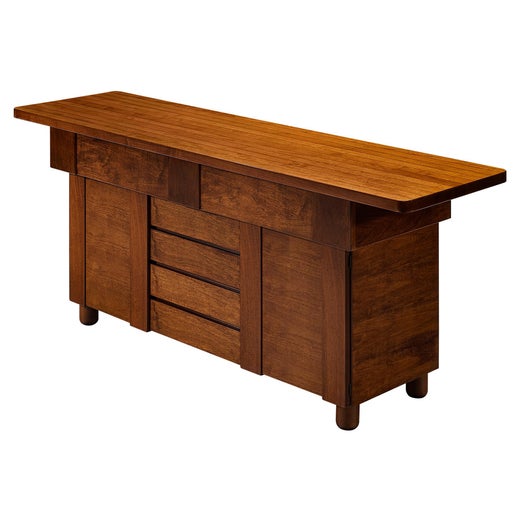
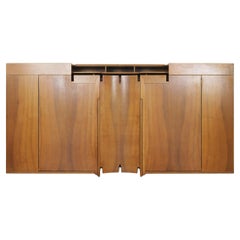
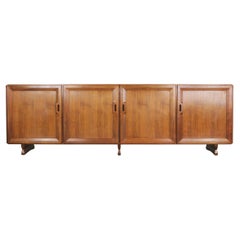
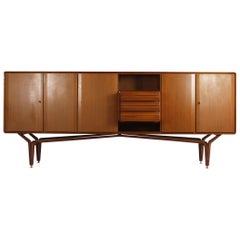
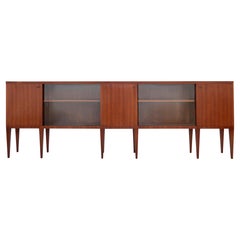
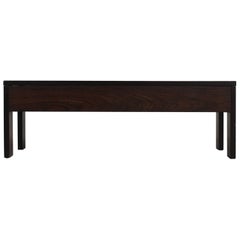
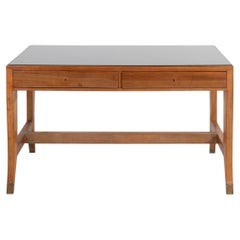
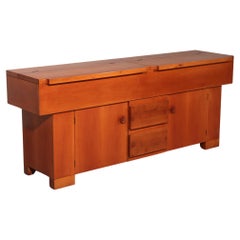
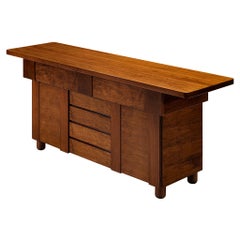
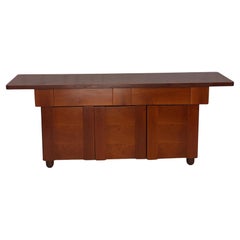
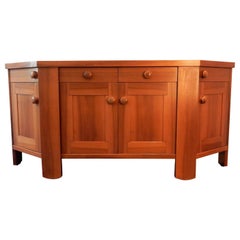
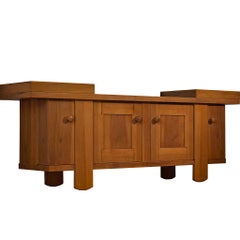
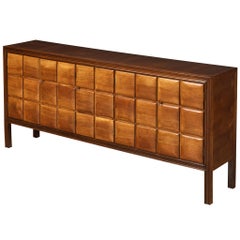
Torbecchia sideboard is entirely realized in solid veneered walnut wood, with two frontal hinging doors, two drawers, and a storage unit under the openable top part.
The signature of Giovanni Michelucci is visible on a sideboard side.
Torbecchia sideboard was designed by the Italian designer Giovanni Michelucci in 1964,and manufactured by Poltronova, Italy in between the late 1960s and the early 1970s.
Giovanni Michelucci, Italian architect, urban planner and designer, was born in Pistoia, Tuscany, on 2 January 1891 and died at his studio-home in Fiesole, in Florence's hills, now the headquarters of his Foundation. He was one of the major Italian architects of that century, known for famous projects such as the Firenze Santa Maria Novella railway station and the San Giovanni Battista church on the Autostrada del Sole.
He came from a family which owned an outstanding workshop for artistic iron craftsmanship and his youthful formative years were spent immersed in that world, after graduating from the Higher Institute of Architecture at the Academy of Fine Arts of Florence. In 1914 he was licensed as a professor of architectural design; so he could teach at the Institute of Architecture of Florence, and became Dean of the Faculty of Architecture in 1944.
During the war Michelucci built his first architectural work, a chapel on the eastern front in Casale Ladra, near Caporetto (today in Slovenia); later he was often forced to face the effects of trauma (the reconstruction of the center of Florence after the Second World War, the church at Longarone after the tragedy of Vajont dam, the plan for the popular Santa Croce district in Florence after the 1966 flood of the Arno).
After World War I he left Pistoia and the family's "Officine Michelucci" and moved to Rome. He met Eloisa Pacini, a refined painter and pianist, and they married in 1928, sharing a strong social awareness during their life together. Life in Rome was experienced as an extraordinary opportunity to study the architecture of the holy city and to build new work experience.
His ability to focus on relationships with contemporary needs was recognized in 1933 when, as coordinator of the Gruppo Toscano (Tuscan Group) with Baroni, Berardi, Gamberini, Guarnieri and Lusanna, he gained first prize in the architectural contest for the Santa Maria Novella new railway station in Florence with a work that won international acclaim not only for its rational and functional qualities but also for the quality of its integration into the historical and urban context. He reaffirmed the value of attention to architectural history and the desire to escape from rhetorical excitement, which was thought to represent an era, confronting modern architectural challenges removed from the feeling of conforming to a current architecture or blindly tied to one style. Between December '45 and January '46 he founded the magazine "La Nuova Città". In that period, from observing the bomb rubble of the destroyed center of Florence, he produced firm ideas and plans for the reconstruction of the area around Ponte Vecchio. These concepts for innovative spaces clashed with the award-winning, elitist trend of reconstruction "like it was where it was" that would deliver a series of historical fakes responsible for the future museification of the city.
The church of San Giovanni Battista, Highway A11, called "Church of the Motorway" (1960-64) photographed by Paolo Monti
Michelucci's thesis was innovative but not accepted, this defeat heavily influencing his teaching at the Faculty of Architecture, where he was now Dean. In fact, in 1948, Michelucci left the Faculty in Florence, and became a professor at the Faculty of Engineering in Bologna, where he remained until the conclusion of his teaching activity and where he found a more fertile ground for the development of his themes.
The first turning point work after the war, a small church in the countryside of Pistoia, is a manifesto against the fashionable rhetoric and focused on the human dimension, using the language of rural architecture in order to restore the main religious and civil meeting center of a small and poor community, marking definitively the real role of architecture in the service of his idea of "The New City".
Many later works included social housing, workers' villages, public buildings, banks, churches, museum, social spaces for prisons, hospitals, schools and other projects, always developed around the idea of a friendly, supportive, democratic community-city, where architecture is open to the city, people-oriented and far from disciplinary boundaries of styles and languages.
Sadly leaving the university because of his age, he dedicated his work to rigorous research with which he prepared, singularly but not limited to, a new revolution in the language of architecture: the concept of space wherever accessible, variety, the refusal of formulaic and technocratic diagrams, a new relation between ancient and modern, which was also expressed through combining stones, bricks, concrete, steel, glass and new materials used architecturally, but mainly in a symbolic way.
During the '60s, with the church of San Giovanni Battista, Highway A11, called "Church of the Motorway", near Florence and the Church in the San Marino Republic, Michelucci fulfilled his earlier premises and completed his revolutionary designs, based on a search for the uniqueness between structure and architecture, with space developed as an architectural path.
Enthusiastic and tireless promoter of cultural initiatives and activities even in his later years, he participated with great passion in the fundamental issues of the debate about the city and always with innovative and unconventional positions.