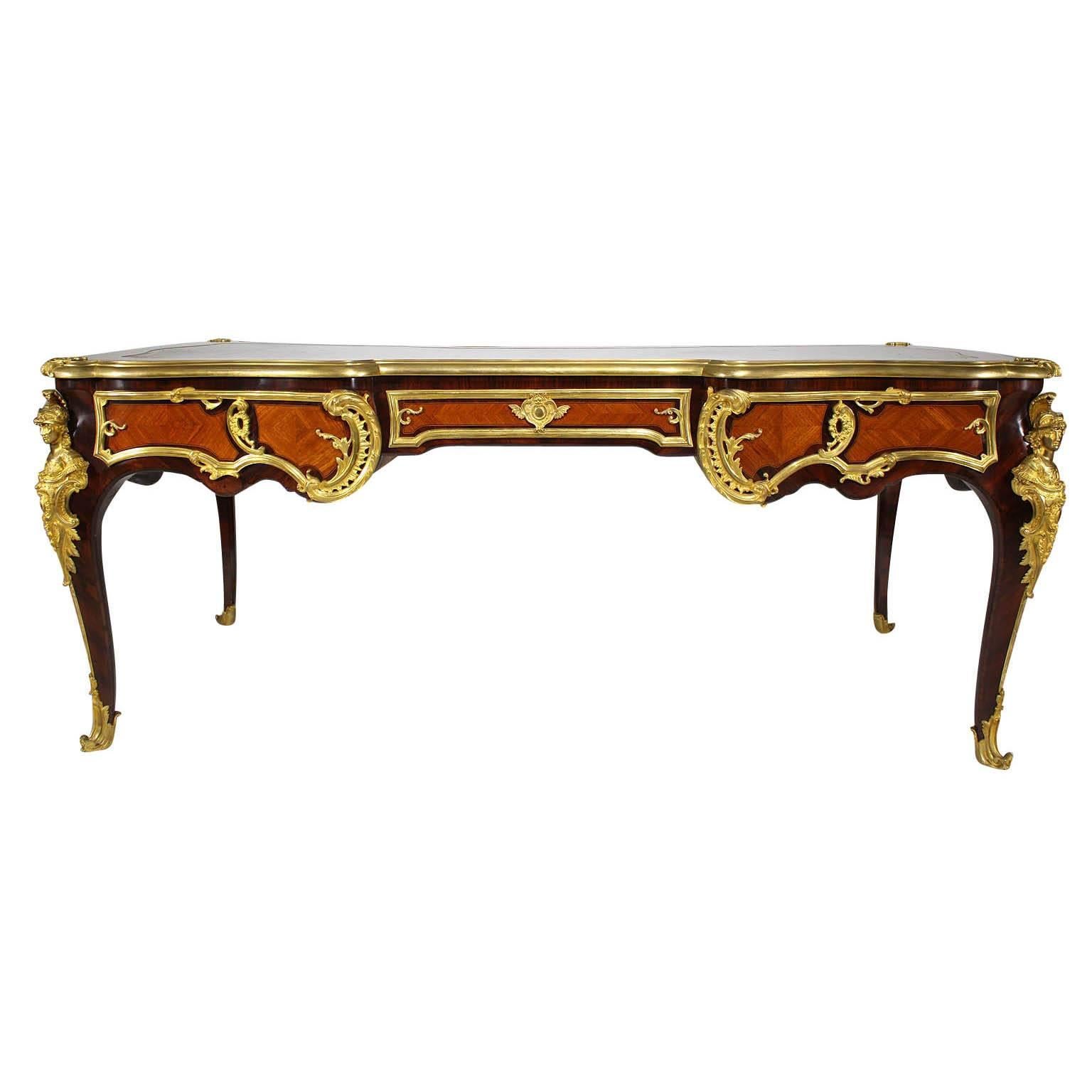
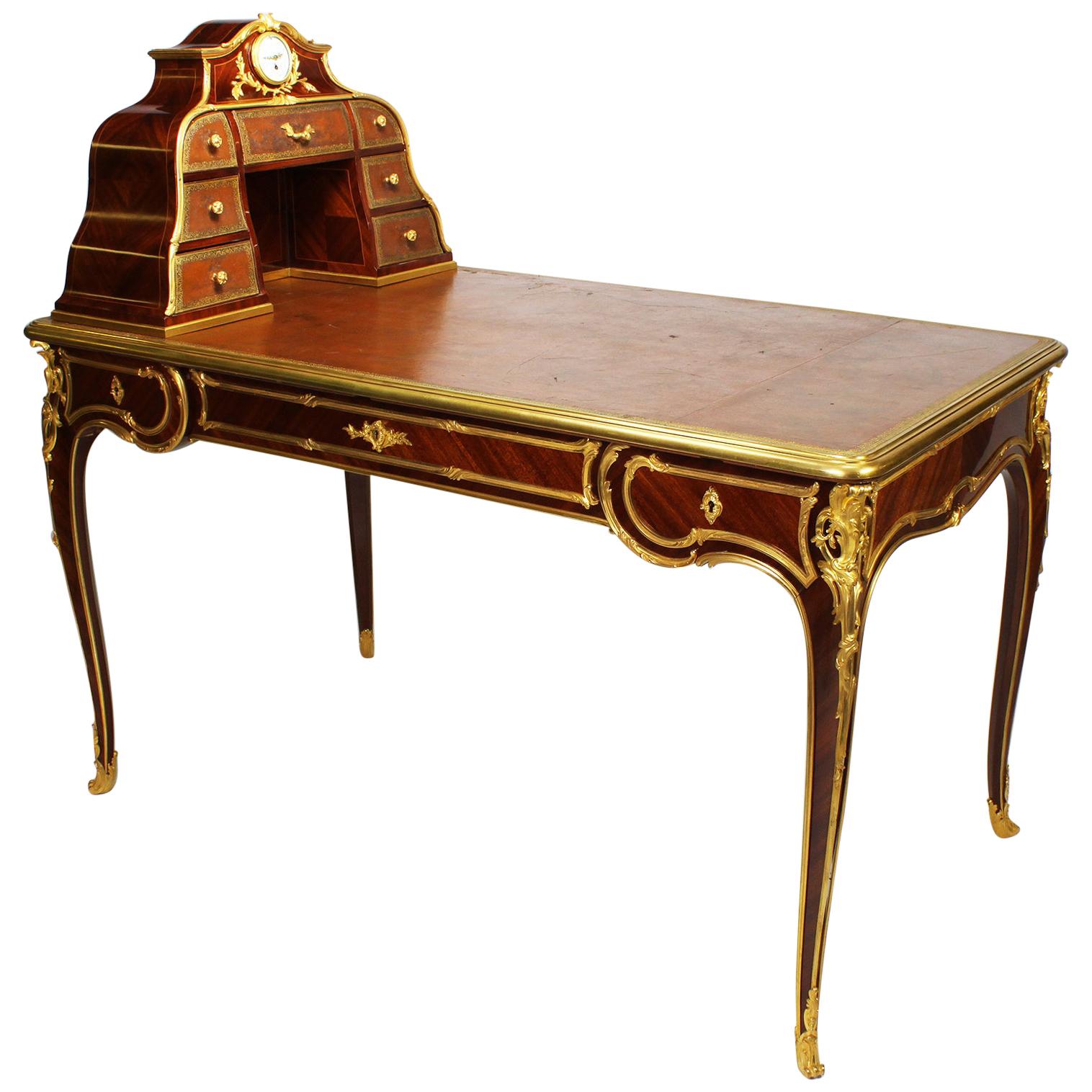
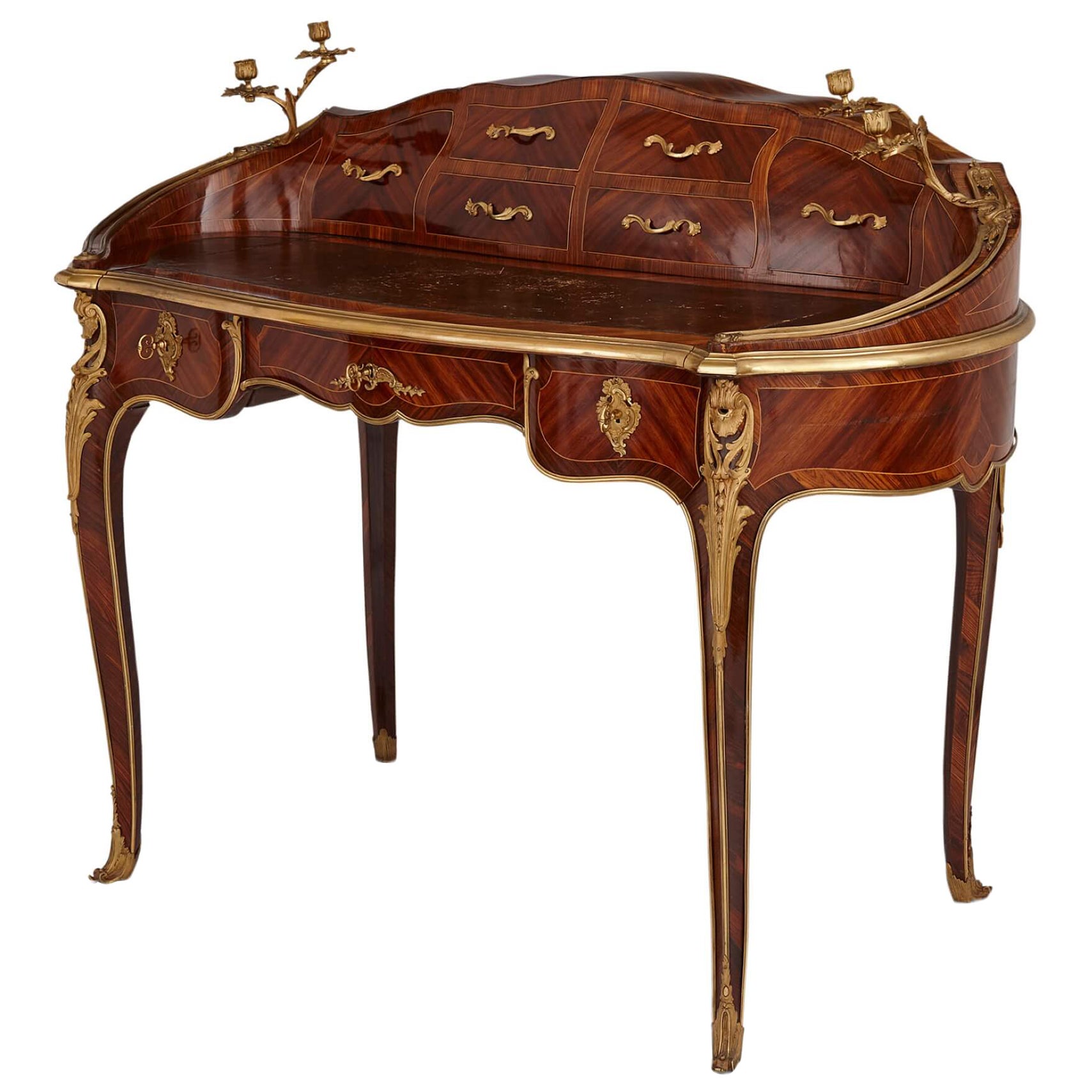
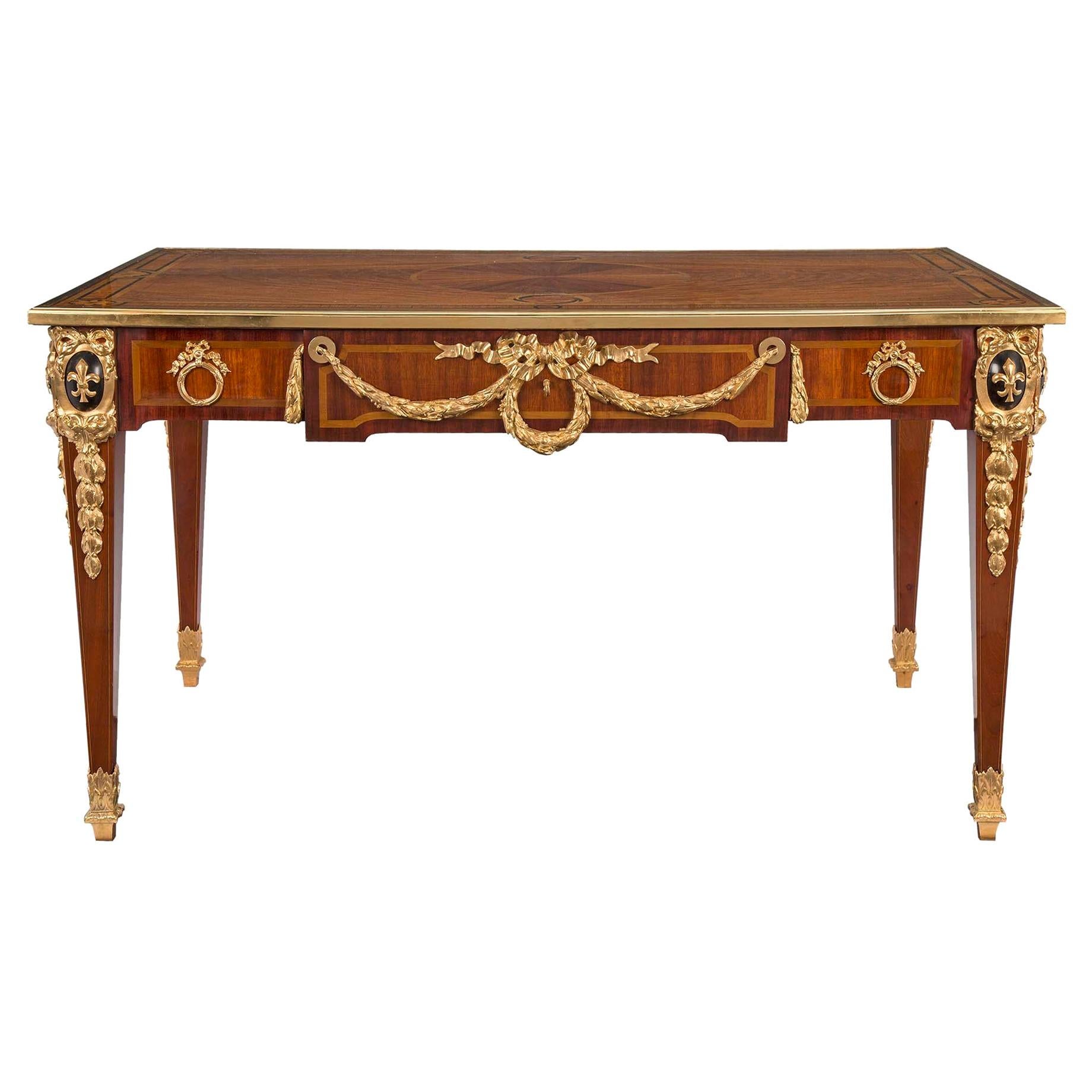
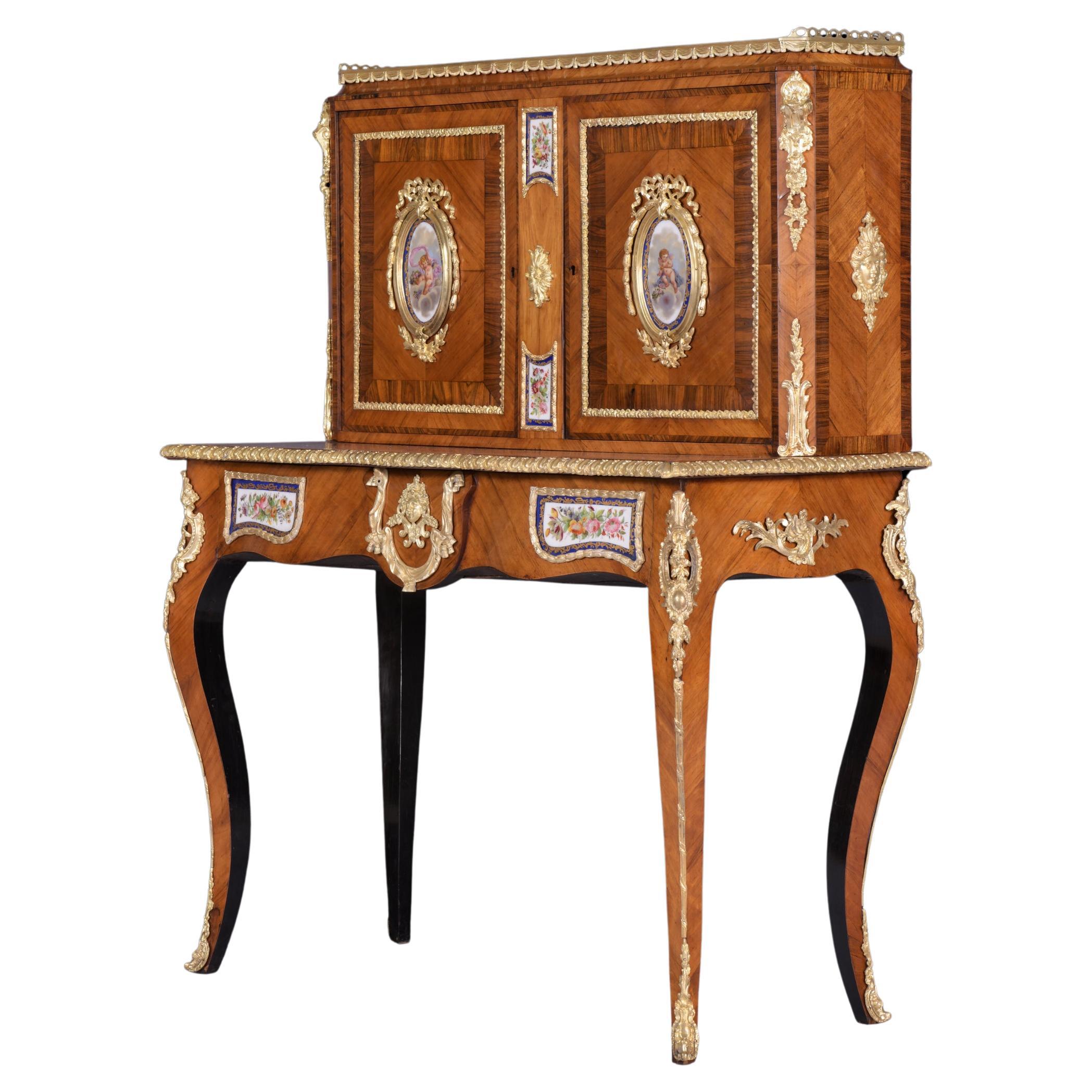
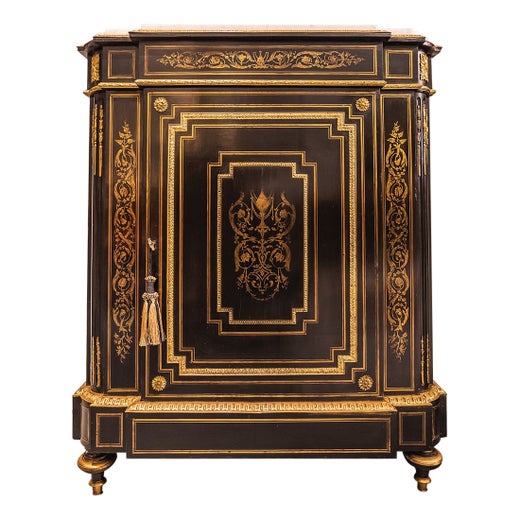
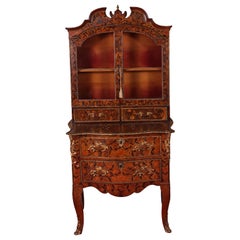
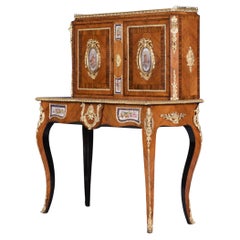
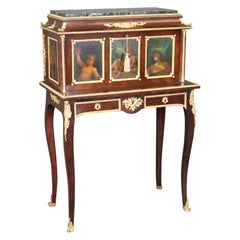
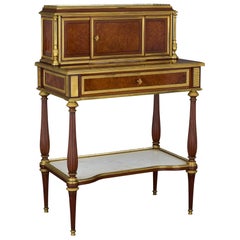
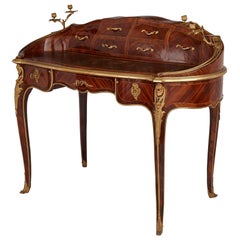
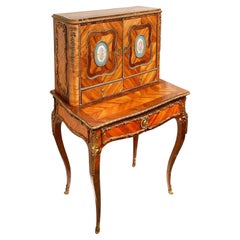
Highly important and palatial Napoleon III Louis XV Revival Ormolu-Mounted Marquetry Bonheur Du Jour by Charles Guillaume Diehl, Designed by Jean Brandely, The Marquetry by E. Varlot, Paris. The rarity & importance of this magnificent piece cannot be overstated, it is without question one of the finest examples you will see. Originally commissioned for European nobility as a statement of love and marital grandeur. Incorporating the finest & rarest veneers and timbers of the time, including Harewood, Thuya, Purpleheart, palm wood and tulipwood.
The beautifully shaped ormolu gallery on the top, gracefully curving outwards inset with fretted heart shapes highlight the incredible attention to detail that flow throughout this majestic piece. The upper section set either side with ormolu mounted fluted pilasters, aside two doors both individually set with masculine & feminine central marquetry panels of the most supreme quality, as you would expect from the master E. Varlot. The colors incorporated in the inlay are outstanding to behold, simply perfection. Opening to reveal the double top & bottom lock, engraved with Diehl's mark and address. Internally veneered in Rosewood of the richest color with one shelf. With two drawers below the doors, both veneered on the inside with Sycamore, one fitted for inkwells. The ormolu edged writing flap again centrally set with both a male & female figure now seated, holding hands with the lady holding a Mandoline, a true sign of happiness & love. The writing flap opening to reveal the original richly tooled velvet leather surface. The stand with one central frieze drawer, again lined inside with rosewood and with a top and bottom lock. On ormolu-mounted fluted legs.
This grand Museum Quality masterpiece is in excellent condition for its age.
Charles Guillaume Diehl (1811-1885) was of Germanic origins, he is considered among the most important & influential of cabinetmakers of the 19th century. He was born in Steinbach, Germany later moving to France, establishing his atelier in Paris in 1840, at the 3, Rue de Thorigny and then at the 170, Rue Saint-Martin, but he was only listed in the Commerce Almanach starting from 1850. At this date, his business settled at the 16, rue Michel-le-Comte. Due to his success he expanded his business to number 21 of this same street and at finally at number 19 from 1853 until his death in 1885. His workshops were situated at the 39, rue Saint-Sébastien, where by 1870 due to his incredible success he employed six hundred workers. Diehl participated in the Great Exhibition in 1851 and in all the major international exhibitions during the middle of the 19th Century thereafter. At the 1867 Universal Exposition, Diehl was awarded a silver medal, and the winning cabinet he presented that year is one of the pieces of furniture most often cited and reproduced of the period. He exhibited it in 1873 at the Universal Exposition of Vienna and obtained a medal of progress. Diehl became a naturalized French citizen in 1872. Parisians and international clientele alike desired the superbly designed and crafted luxury objects he produced. Diehl added to his incomparable savoir-faire a science of decorum, without hesitating to use the priciest elements of the time: rare woods, finely chiselled bronzes or the finest tapestries. He also added a unique cultural dimension by taking the time to pursue elaborate historical research to perfect his work. And thanks to the different Universal Exhibitions to which he participated, he entered into the history of the French Decorative Arts. One must also remember about Diehl that his chief ébéniste, Kowalewski, was without question the best cabinetmaker of his era. His most important pieces were designed by Jean Brandely. Described as "a bold, strange artist, an enterprising man with spontaneity" ( Auguste Luchet in L'Art Industrielle à l'Exposition Universelle de 1867: Mobilier, vêtements, aliments, Paris, 1868 ), Brandely provided plans for furniture and designs for both marquetry and bronze applications. As with this masterpiece, it would undoubtedly been conceived my Jean Brandely with the marquetry designed by the renowned E. Varlot. Diehl’s furniture pieces are regularly stamped & or engraved but not often dated. His pieces reside in European Palaces & in such prestigious Museums as the Musée d’Orsay, Paris - Musée des Arts Décoratifs, Paris - Metropolitan Museum of Art, New York - Musée de l’Ermitage, Saint Petersburg - Rijksmuseum, Amsterdam - Philadelphia Museum of Art, Philadelphia & Château de Compiègne, France.
Critically acclaimed as one of the most innovative artists of the 19th century, Diehl enlisted the partnership of his designers to challenge the rigid hierarchy that relegated the decorative arts, beneath that of the major arts of architecture, painting and sculpture. The result was a series of furniture and small items of remarkable sophistication, created with a wealth of detail and of exceptional quality, of which this Bonheur Du Jour is a fine and rare example. His output was described during the 1878 Exposition Universelle as some of the most important of its time.
Approximate Size:
Height: 54.5 inches
Width: 32.65 inches
Depth: 18.75 inches
A truly magnificent, palatial & important masterpiece.