Want more images or videos?
Request additional images or videos from the seller
1 of 20

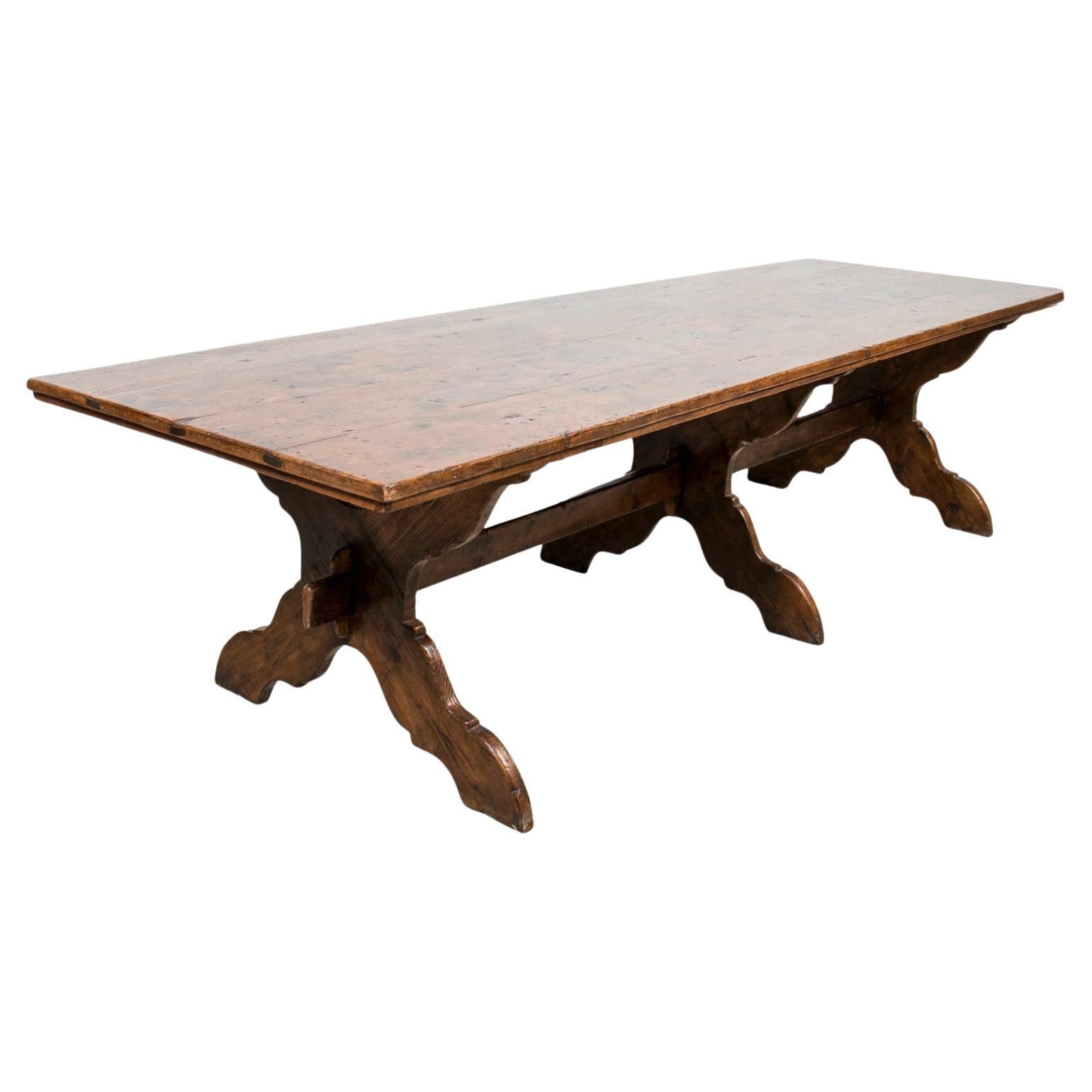
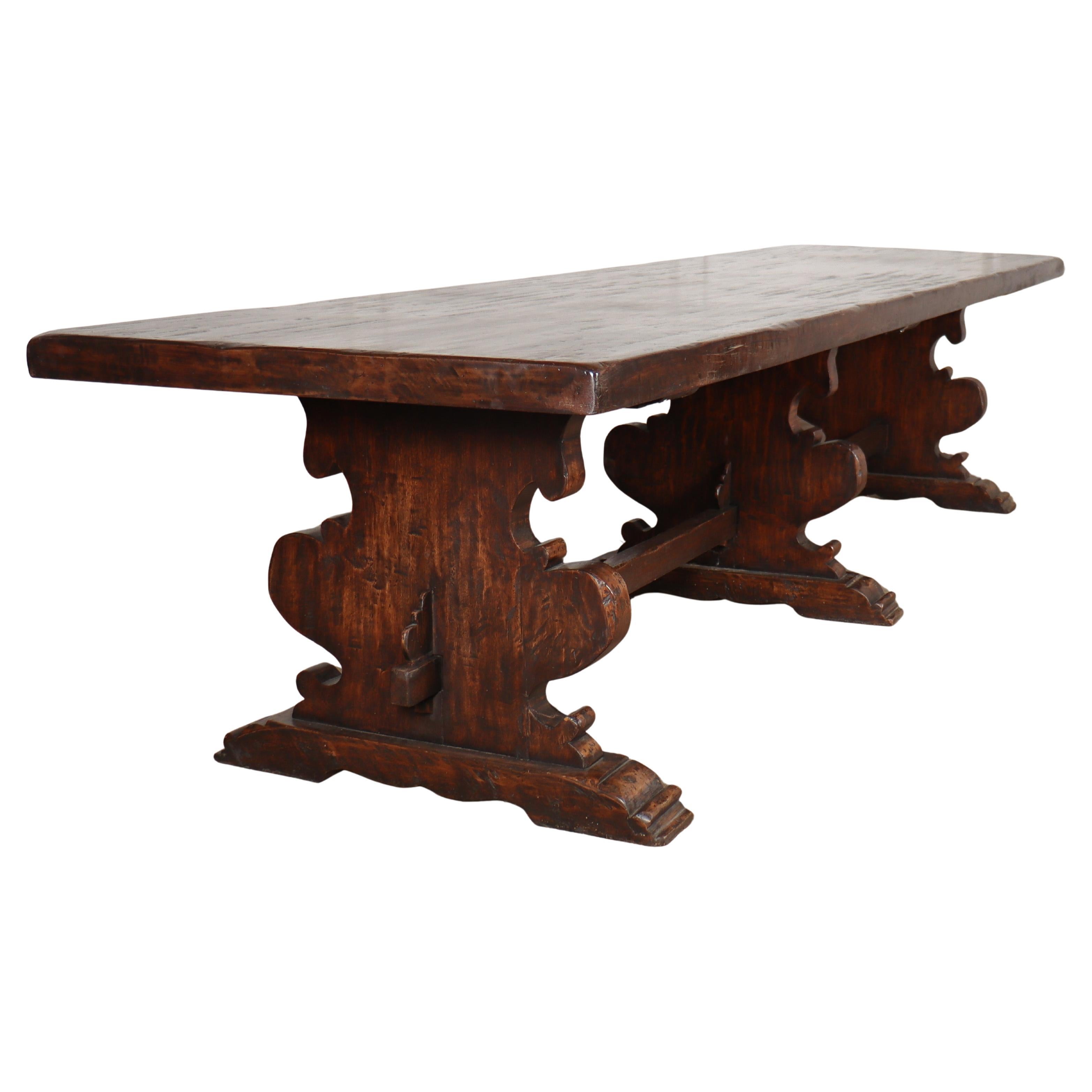
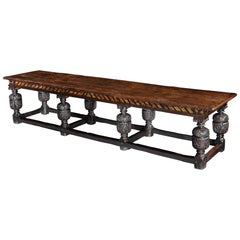
Monastery Trestle Table One Plank Walnut Biscione Milan Armorial 14-16 seat 10ft

$62,633.64
£45,000
€53,558.90
CA$86,225.86
A$87,709.90
CHF 50,083.61
MX$1,060,899.53
NOK 584,001.22
SEK 592,949.25
DKK 400,392.07

About the Item

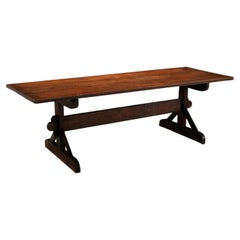
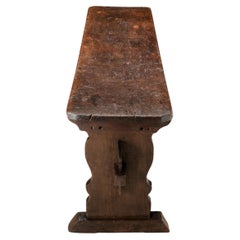
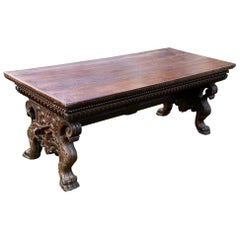
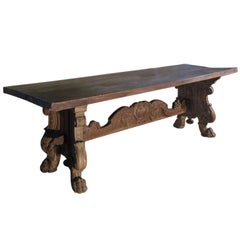
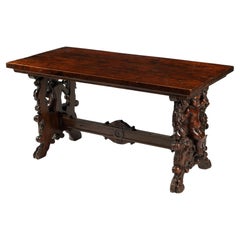
A massive, 14-16 seater, antiquarian, milanese, renaissance-revival, monastery, trestle table with 10ft long, 4 ¼” thick, single plank walnut top & oak trestles carved with an armorial, the heraldic charge of the dukes of milan & heraldic shields. Monastery tables are long tables with thick, one-piece tops used originally for dining in the Medieval refectory which evolved into banqueting and feasting tables. They are a rare form. I have handled half a dozen over the last 35 years which have all been made from oak and this is the most outstanding and impressive for the following reasons : - The single plank, 10ft long, 4 ¼” thick walnut top is outstanding oozing character and tacticity. It has old repairs from worm damage and knots falling out. The walnut tree that was felled to make it must have been many hundreds of years old. - The massive trestles are exceptionally rare, possibly unique. I have never seen and do not know of another table carved with a coat of arms particularly in conjunction with an heraldic charge of the significance of the Biscione. They are crisply carved and made from oak for practicality. - The trestle form is the most practical and comfortable for seating. Not only is this table 10ft long but it is 34 inches wide which is not common in period tables. The table is the ideal height for a traditional backstool. - These table are renowned for being ‘as fixed as the freehold’ and the reputed three family ownership provenance of this table supports this. - Almost certainly made in Italy most likely in Milan, this table is very hard to date and it could be 18th century - When I acquired the table it was covered in black stain which was very popular in the 19th century. This has been carefully removed revealing the original patina which is a rich, walnut brown with a lustrous surface. One carved trestle front depicting the Biscione, the heraldic charge of a dragon eating or giving birth to a child which is the symbol of the Visconti family, the Dukes of Milan, who gained control over the city in 1277. The Biscione is a reference to Milan and should be interpreted in conjunction with the coat of arms. Legend suggests that, around the XIIth century, Tarantasio the dragon arrived in Milan. Many knights tried to free the territory from the unwanted guest, but they all ended up devoured. The news spread with terror among the inhabitants. One day the dragon was about to devour a child, Uberto Visconti defeated the dragon by cutting off its head and saved the child. The Duke thus decided to depict the dragon about to swallow the child on the family crest. The Biscione has become a symbol for Milan found around the city, such as the door of Castello Sforzesco, Milan’s most famous landmark, built in the 14th century by the Duke of Milan. It is exceptionally rare, possibly unique, to find a coat of arms carved on a trestle table. The Biscione carved on the opposing trestle undoubtedly indicates that the coat of arms is from a Milanese family. Research is underway. The reverse trestle fronts depict a large shield with three bendlets, also being researched Provenance : Private Collection, Rhineland, acquired 1979 from a Private Collection, Cologne reputedly bought in Italy possibly Milan in the 1920’s from the Palazzo it was made for. Length 305cm., 120 inches Width 84cm., 33 inches Height Overall 82cm., 32” Height, Underside of top 72cm., 28 /8” Top thickness 10.5cm., 4¼ inches Trestle width 33cm., 13 inches Stretcher thickness 12cm., 4¾ inches
  • Dimensions:
    Height: 32.29 in (82 cm)Width: 120.08 in (305 cm)Depth: 33.08 in (84 cm)
  • Style:
    Renaissance Revival (Of the Period)
  • Materials and Techniques:
    Oak,Walnut,Joinery
  • Place of Origin:
  • Period:
  • Date of Manufacture:
    circa 1800
  • Condition:
    Repaired: old repairs to worm damage and where knots have fallen out. Wear consistent with age and use.
  • Seller Location:
    BUNGAY, GB
  • Reference Number:
    1stDibs: LU3867331818382

More From This Seller

View All
Table Refectory Dining Seats18 Antiquarian Parquetry Elm Oak Box 368cm 145" long

Table Refectory Dining Seats18 Antiquarian Parquetry Elm Oak Box 368cm 145" long

Located in BUNGAY, SUFFOLK

A MASSIVE, 18 SEATER, LATE-19TH CENTURY, ANTIQUARIAN, REFECTORY TABLE, with an elm top, boxwood and parquetry frieze and oak base 3.68m 145" long - It is virtually impossible to source C17 and earlier dining tables with integrity which are more than 274cm., 108 inches long & period models are narrow around 70cm or 27.50 inches wide - It is very rare to find a table of this size with parquetry decoration which was only used on the finest pieces and is sophisticated elevating its status. - The massive elm top is made from over 10" wide, beautifully figured boards, 1 1/4" thick - The bulbous legs on this table are typical of those found on drawleaf tables that were made in the third quarter of the 16th century. The bulbous or vase-shaped legs were of Flemish and German origin, introduced into England by immigrant craftsmen and through published designs such as those of Dietterlein and De Vries. In early Elizabethan examples, the vase-shape is very pronounced, the bulbs generally being carved with acanthus and gadroons, and terminating at the junction with the frame in Ionic volutes as in this example. - The top is detachable and unusually the base of table can easily be dismantled unlike the 16th century examples whose immovable nature caused them to descend through many generations in the same family, and Evelyn observes in a familiar passage that both in hall and parlour long tables " were as fixed as the freehold " '. Consequently drawleaf tables still survive today in situ some of the great collections, such as Hardwick Hall, while others have passed into the hands of museums such as the Treasurer's House, York - Provenance : Private Collection UK. The Estate Of Wendy Vanderbilt Lehman, USA. Wendy was born in California to Manuela Hudson and Alfred Gwynne Vanderbilt II, a pioneer in thoroughbred racing, who’s father had gone down on the Lusitania. She was great, great granddaughter of Cornelius Vanderbilt, the historic tycoon known as The Commodore. Like many wealthy children of her generation, Wendy grew up largely in the care of nannies, and throughout her childhood she was shuffled between Palm Beach and the Plaza Hotel. Wendy experienced her first sense of belonging at boarding school, where she cultivated life-long loving friendship with her art teacher Betty Klein. She later attended Sarah Lawrence College. In her early 20s Wendy was widely sought after and photographed as a debutant. She was featured in one of Lilly Pulitzer’s first advertising campaigns and attended the Truman...

Category

Antique 1880s British Gothic Revival Dining Room Tables

Materials

Boxwood, Elm, Oak

Table, 18th Century, Italian, Baroque, Walnut, Narrow, One Piece Top

Table, 18th Century, Italian, Baroque, Walnut, Narrow, One Piece Top

Located in BUNGAY, SUFFOLK

A rare, narrow, Italian, baroque, walnut, cabinet or sidetable. This table has unusual, narrow proportions and was probably originally conceived as a stand for a table cabinet or ...

Category

Antique Early 18th Century Italian Baroque Center Tables

Materials

Walnut

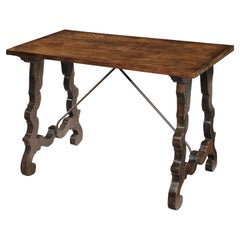
16th Century Spanish Walnut Campaign Table Fluted Carving Windsor Castle Label

16th Century Spanish Walnut Campaign Table Fluted Carving Windsor Castle Label

Located in BUNGAY, SUFFOLK

A Fine, Late-16th Century Spanish Walnut, Campaign Table With Rare, Fluted Carving Bearing a Windsor Castle Label just purchased more information to follow The fluted carving of ...

Category

Antique 16th Century Spanish Renaissance Center Tables

Materials

Iron

10-12 Seater Folk Trestle Table oak pine 244 cm (8 ft) long; 87 cm (34 in) wide

10-12 Seater Folk Trestle Table oak pine 244 cm (8 ft) long; 87 cm (34 in) wide

Located in BUNGAY, SUFFOLK

A Characterful and Unusually Wide, 10-12 Seater, Vernacular Trestle Table oak and pine, England, 19th century 244 cm (8 ft) long; 87 cm (34 in) wide; A substantial and highly charac...

Category

Antique 1850s English Gothic Revival Dining Room Tables

Materials

Pine

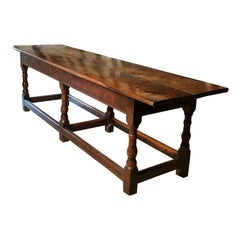
Table Refectory Reversible Top Patinated & Unpatinated Oak 6 Turned Legs

Table Refectory Reversible Top Patinated & Unpatinated Oak 6 Turned Legs

Located in BUNGAY, SUFFOLK

- In wonderful original condition from a West Country farmhouse where it has reputedly been all its life - The top is rare because it reversible with a patinated surface on one side...

Category

Antique 17th Century English Baroque Dining Room Tables

Materials

Oak

8-10 Seater English Tavern Trestle Table oak, England 17century 217cm 7ft1" long

8-10 Seater English Tavern Trestle Table oak, England 17century 217cm 7ft1" long

Located in BUNGAY, SUFFOLK

A Characterful, 8-10 Seater, English Tavern Trestle Table oak, England, 17th century, 217 cm (7 ft 1 in) long; A rare and highly characterful 17th-century English oak tavern trestle...

Category

Antique 17th Century English Folk Art Dining Room Tables

Materials

Oak

You May Also Like

17th-Early 18th Century Tuscan Baroque Walnut Trestle Table

17th-Early 18th Century Tuscan Baroque Walnut Trestle Table

Located in Richmond, VA

Incredible 17th-early 18th century Italian Baroque walnut trestle table from Tuscany. Hand carved throughout, this table features massive paw feet, scrolled knees and carved apron. E...

Category

Antique 17th Century Italian Baroque Farm Tables

Materials

Walnut

Italian 19th Century Renaissance Style Walnut Refectory Table

Italian 19th Century Renaissance Style Walnut Refectory Table

Located in Troy, NY

Italian 19th Century Renaissance Style Walnut Refectory Table with a massive two-inch thick 17th century two-plank top above a 19th century associated boldly carv...

Category

Antique 17th Century Italian Renaissance Dining Room Tables

Materials

Walnut

Walnut Spanish Trestle Table, 18th-19th Century

Walnut Spanish Trestle Table, 18th-19th Century

Located in El Monte, CA

An impressive late 18th/early 19th century finely carved walnut trestle table with unusual intricately carved puttis on the sides. Meticulous attention is given to the carving, stur...

Category

Antique Early 19th Century Spanish Renaissance Tables

Materials

Walnut

19th Century Spanish Walnut Console or Writing Table on Carved Trestle Base

19th Century Spanish Walnut Console or Writing Table on Carved Trestle Base

Located in Dallas, TX

This impressive antique Spanish table was crafted circa 1880 from solid walnut and features a substantial 3" thick top with softly rounded ends. Its elongated and narrow form, measur...

Category

Antique Late 19th Century Spanish Baroque Console Tables

Materials

Wrought Iron

Italian Walnut Trestle Dining Table, Polished Finish, 20th Century

Italian Walnut Trestle Dining Table, Polished Finish, 20th Century

Located in Leamington Spa, Warwickshire

Early 20th century copy of an 18th century Italian walnut trestle table. Wonderful one piece 2 3/4-inch thick walnut top. 1910. This table comes apart from transport and delivery W...

Category

20th Century Italian Dining Room Tables

Materials

Walnut