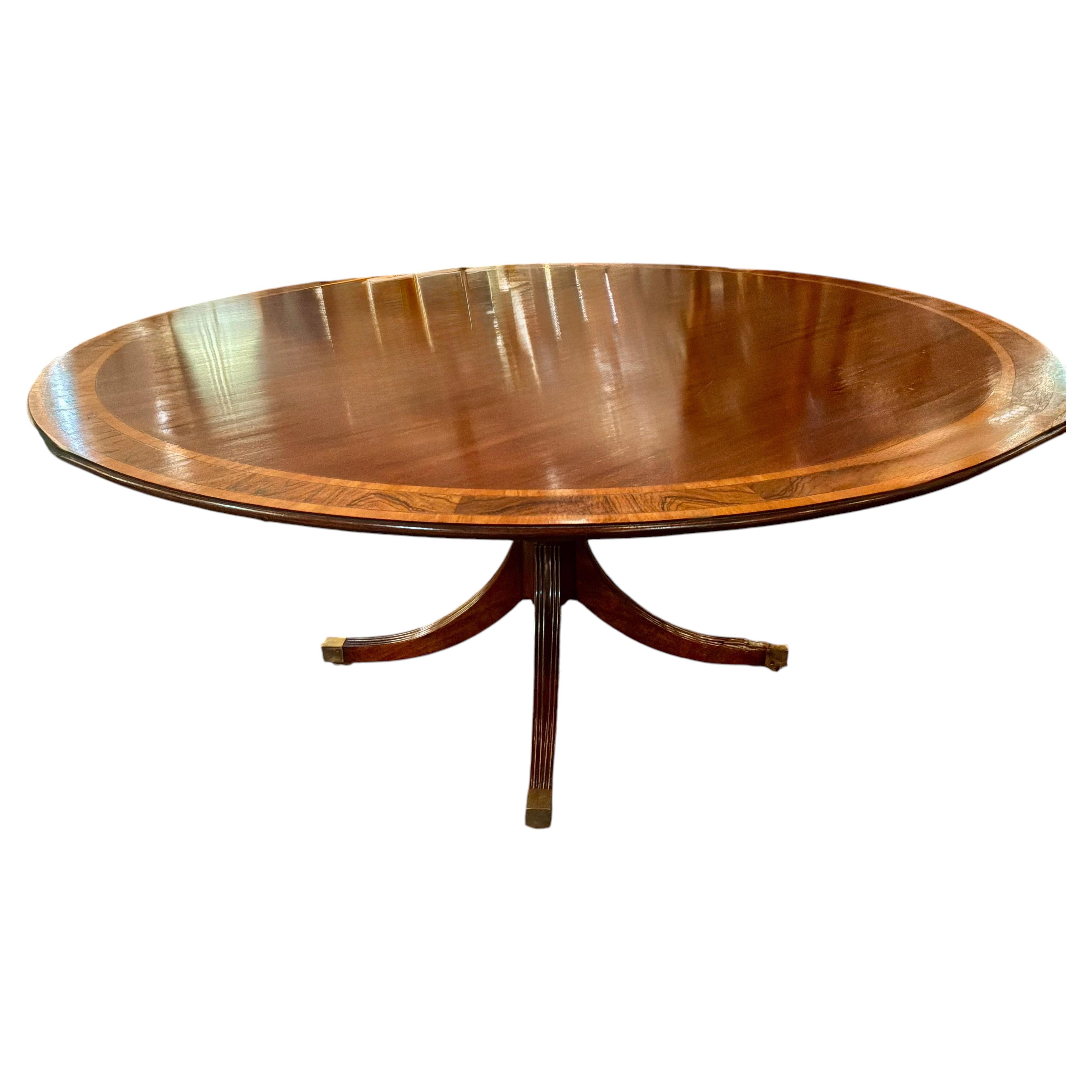
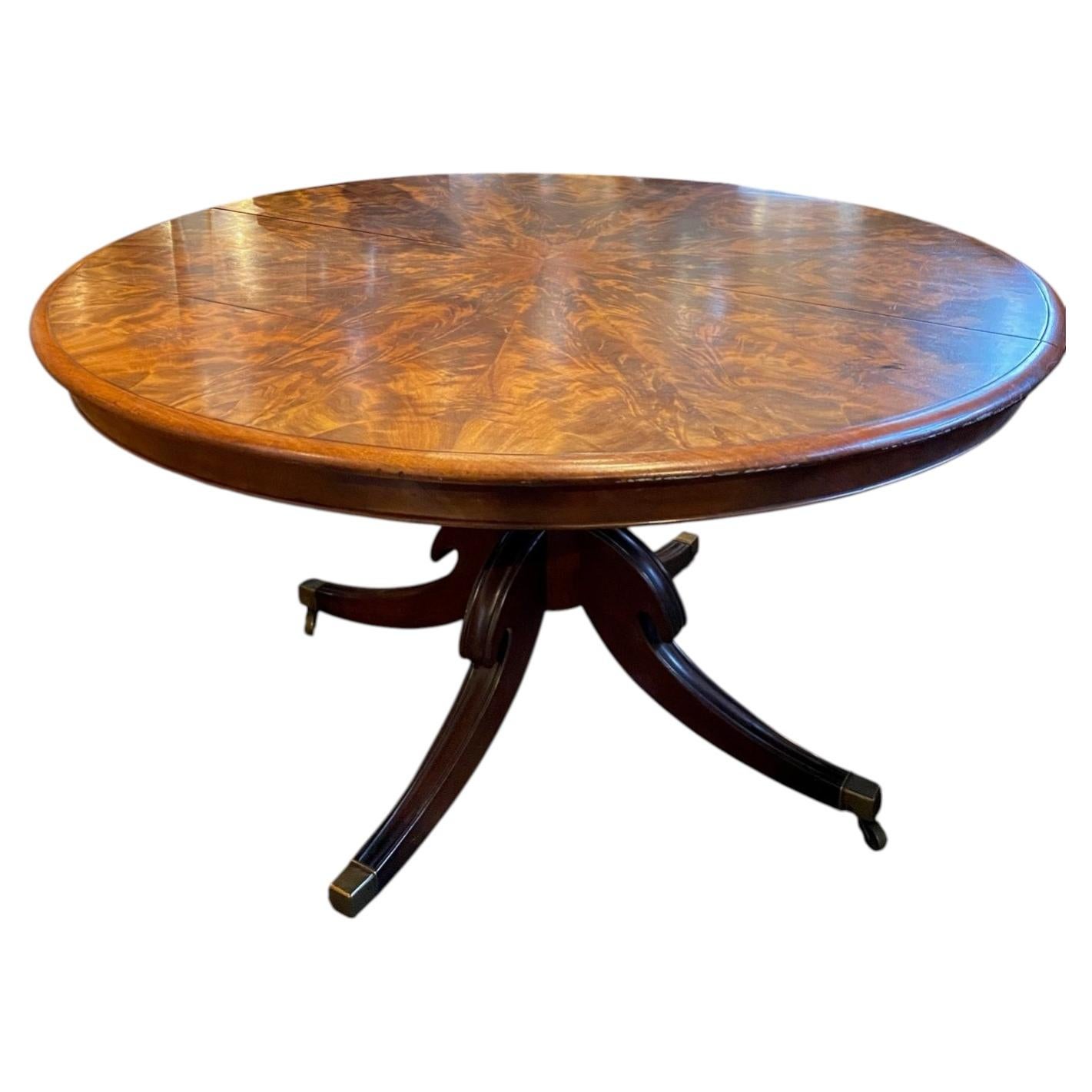
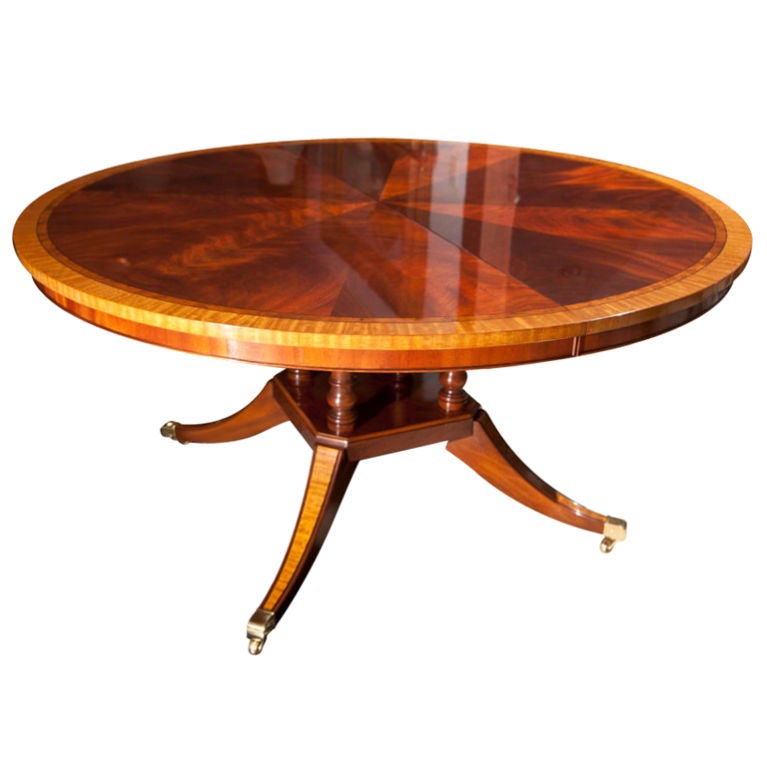
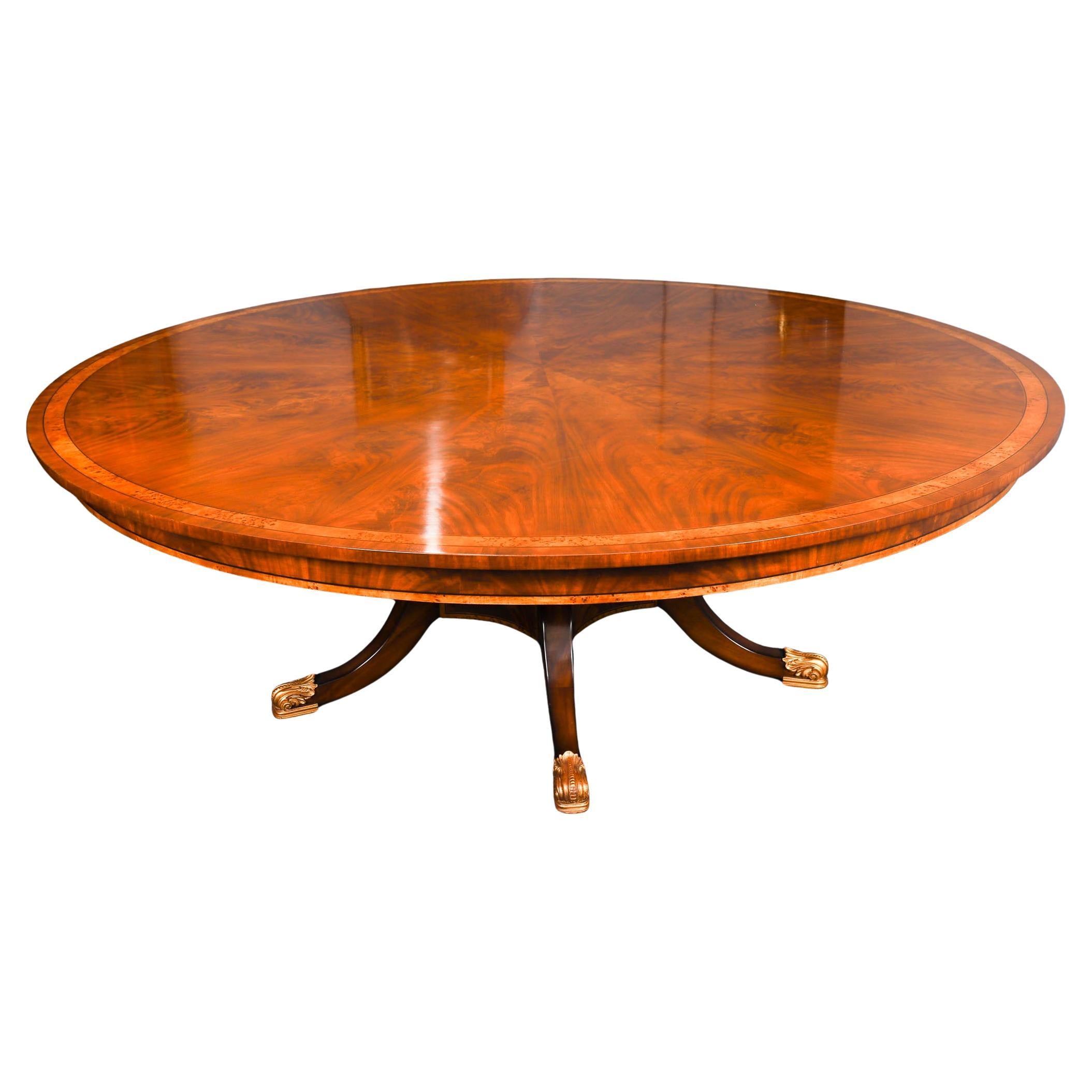
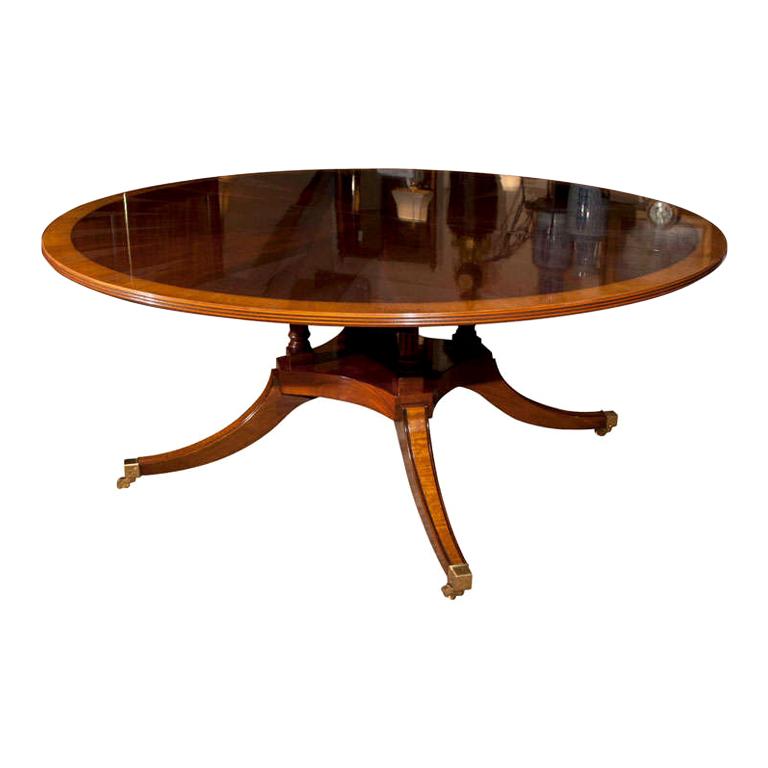
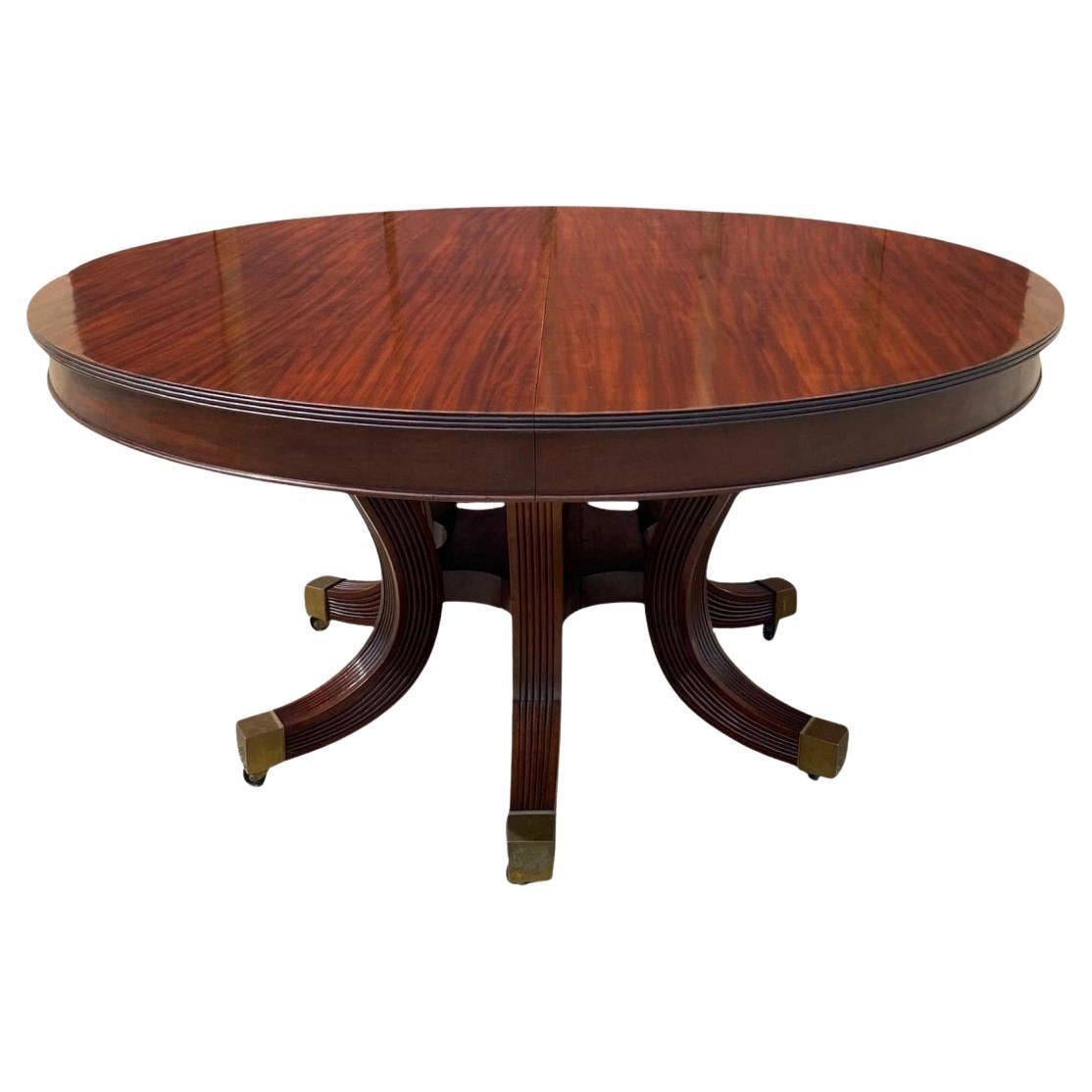
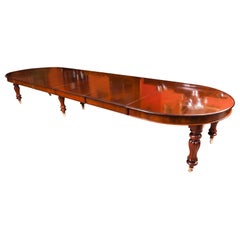
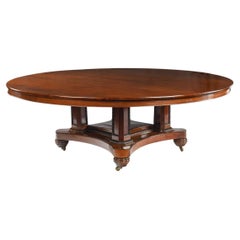
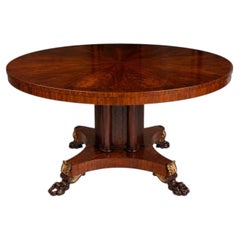
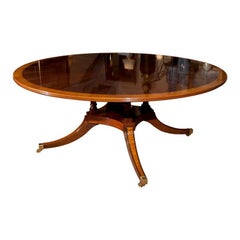
This is a wonderful quality 20th-century example of Robert Jupe's flame mahogany circular extending dining table. It was purchased at great expense from the world-renowned department store Harrods in the late 20th century.
The table has a superb decorative satin wood crossbanded flame mahogany sunburst top with six peripheral leaves around the circumference that can be added or removed to suit the occasion. The table is raised on four gun barrel turned pillars to the octagonal plateau with four curved supports terminating with bronze caps and castors, and that gives this table its superb stability
The table can comfortably seat twelve when extended and eight when the peripheral leaves are removed.
The table was made by the prestigious furniture maker Restall Brown & Clennell for Harrods and bears their label. It is complete with a custom-made fitted gold tablecloth with a pleated skirt that complements the chairs.
There is no mistaking the fine craftsmanship of this handsome table, which is certain to become a treasured addition to your furniture collection and a talking point with guests at meal times.
This fascinating table illustrates all the very best elements of English cabinet-making combined with the remarkable burst of inventiveness of the Industrial Revolution. It was not until John Johnstone and Robert Jupe patented their ingenious design in March 1835 for an expanding round table,that round dining tables, which had suffered from the problem of not offering flexibility of seating, could compete with the established rectangular extending dining tables.
THE BOTANICAL NAME FOR THE MAHOGANY THAT THIS ITEM IS MADE OF IS SWIETENIA MACROPHYLLA AND THIS TYPE OF MAHOGANY IS NOT SUBJECT TO CITES REGULATION AND DOES NOT CONTAIN ANY RESTRICTED MATERIALS.
Condition:
In excellent condition having been beautifully cleaned and polished in our workshops, please see photos for confirmation.
Dimensions in cm:
Height 73.5 cm x Width 231 cm x Depth 231 cm - Fully extended
Height 73.5 cm x Width 168 cm x Depth 168 cm - Leaves removed
Dimensions in inches:
Height 2 foot, 5 inches x Width 7 foot, 7 inches x Depth 7 foot, 7 inches - Fully extended
Height 2 foot, 5 inches x Width 5 foot, 6 inches x Depth 5 foot, 6 inches - Leaves removed
Harrods founder Charles Henry Harrod first established his business in 1824, aged 25. The business was located south of the River Thames in Southwark. The premises were located at 228 Borough High Street.
He ran this business, variously listed as a draper, mercer and a haberdasher, certainly until 1831. During 1825 the business was listed as 'Harrod and Wicking, Linen Drapers, Retail', but this partnership was dissolved at the end of that year. His first grocery business appears to be as ‘Harrod & Co.Grocers’ at 163 Upper Whitecross Street, Clerkenwell, E.C.1., in 1832. In 1834 in London's East End, he established a wholesale grocery in Stepney, at 4, Cable Street, with a special interest in tea.
In 1849, to escape the vice of the inner city and to capitalise on trade to the Great Exhibition of 1851 in nearby Hyde Park, Harrod took over a small shop in the district of Brompton, on the site of the current store. Beginning in a single room employing two assistants and a messenger boy, Harrod's son Charles Digby Harrod built the business into a thriving retail operation selling medicines, perfumes, stationery, fruit and vegetables. Harrods rapidly expanded, acquired the adjoining buildings, and employed one hundred people by 1880.
However, the store's booming fortunes were reversed in early December 1883, when it burnt to the ground. Remarkably, in view of this calamity, Charles Harrod fulfilled all of his commitments to his customers to make Christmas deliveries that year—and made a record profit in the process. In short order, a new building was built on the same site, and soon Harrods extended credit for the first time to its best customers, among them Oscar Wilde,Lillie Langtry, Ellen Terry, Charlie Chaplin, Noël Coward, Gertrude Lawrence, Laurence Olivier and Vivien Leigh, Sigmund Freud, A. A. Milne, and many members of the British Royal Family.
On Wednesday, 16 November 1898, Harrods debuted England's first "moving staircase" (escalator) in their Brompton Road stores; the device was actually a woven leather conveyor belt-like unit with a wood and "silver plate-glass" balustrade. Nervous customers were offered brandy at the top to revive them after their 'ordeal'. The department store was purchased by the Fayed brothers in 1985.
In 2010 Harrods was sold to Qutar Holdings.
Harrods was the holder of royal warrants from 1910 till 2000 from the following:
* Queen Elizabeth II (Provisions and Household Goods)
* The Duke of Edinburgh (Outfitters)
* The Prince of Wales (Outfitters and Saddlers)
* The late Queen Elizabeth, the Queen Mother (China and Glass)
The store occupies a 5-acre (20,000 m2) site and has over one million square feet (90,000 m2) of selling space in over 330 departments making it the biggest department store in Europe.
The UK's second-biggest shop, Selfridges, Oxford Street, is a little over half the size with 540,000 square feet (50,000 m2) of selling space, while the third largest, Allders of Croydon had 500,000 square feet (46,000 m2) of retail space.
By comparison Europe's second-largest department store the KaDeWe in Berlin has a retail space of 650,000 square feet (60,000 m2).
Restall Brown & Clennell
Were prestigious English fine furniture makers. The quality and finish of each piece of furniture they crafted displays the expertise and passion of their team of designers and craftsmen. Established in 1905 in London, Restall Brown & Clennell produced elite furniture for over 100 years. They worked with Harrods, Interior Designers and private clients and their furniture stands proud in Private Residences, Yachts, Luxury Hotels, Offices and Boardrooms the world over.
Their handcrafted furniture is of the highest quality, using only the most traditional and authentic methods and the highest levels of skills from inception to creation.
Our reference: A5229