Li Yuan-chia
Cosmic 'Point' Multiple
1929–1994
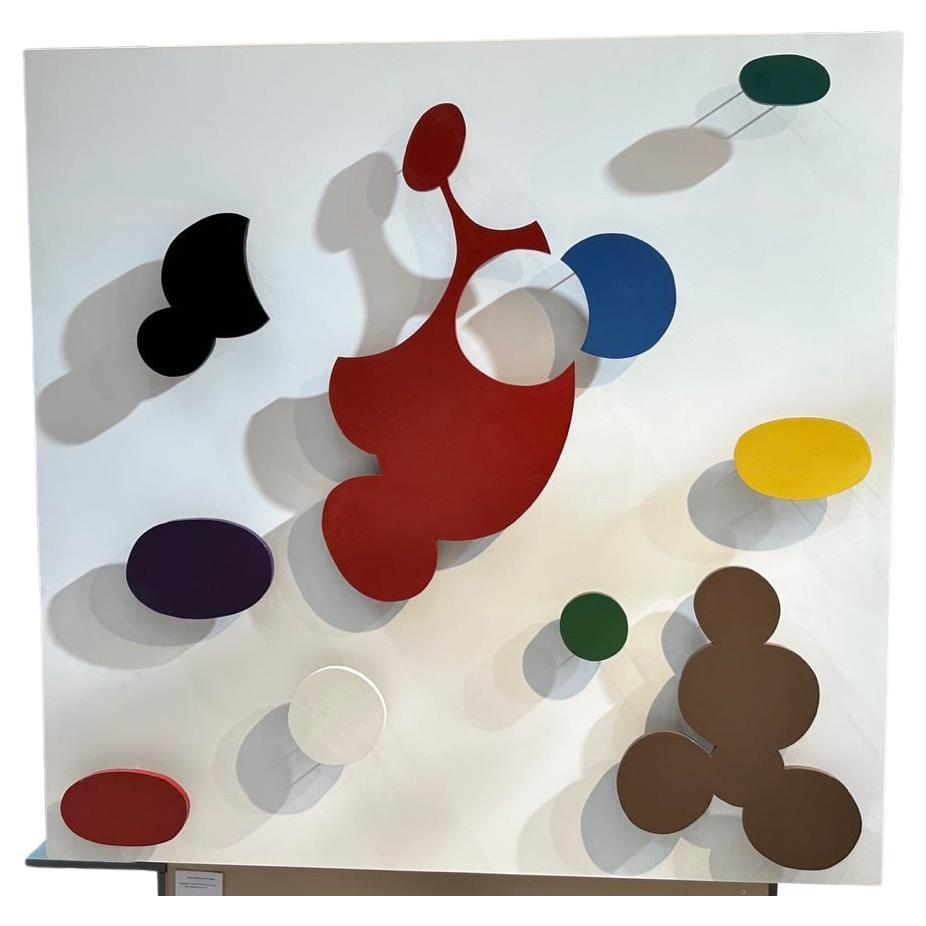
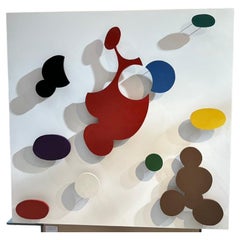
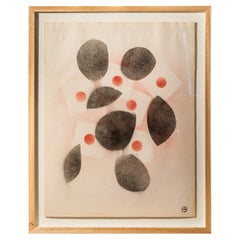
This Original piece from Lisson Gallery London 1968 Exhibition features a painted white lacquered steel panel with 4 magnetic points plastic 2 white, 1 black and 1 red circles. The magnetic points represent magnetic points – Black: Origin + End, Red: Life + Blood, and White: Purity. (THE BLACK POINT IS NOT ORIGINAL - IT IS A REPLACEMENT).
Below is auction results for a similar piece information provided by © 2024 MutualArt Services, Inc.
Cosmic Point by Li Yuan-Chia
Sold Lot #0228
Magnets on lacquered metal panel
24.02 x 35.83 in
edition of 200
Realized Price
Exclusive of Buyer's Premium
13,000 EUR*
(15,401 USD)
Auction Venue/Sale
Ferraton – Damien Voglaire — Modern and Contemporary Art
Sale Date
Sep 12, 2020
More about the artist and piece from Aram Blog May 9, 2014
Li Yuan-chia (1929-1994)
"Increasingly recognised as one of the outstanding artists of the second half of the 20th century, Li Yuan-chia was a highly sensitive artist/poet and audacious experimenter. He produced a very special syncretic art, convincingly combining Chinese traditions of thought and European abstraction, to propose something individual and new. He brought together the concrete, open space we associate with Malevich or Mondrian, with a symbolic use of colour. Li habitually used only four colours: black, which stood for origin and end, red for blood and life, gold for nobility and white for purity. But he was not dogmatic. In his late hand-coloured photographic prints he employed the subtlest nuances of colour.
Li’s guiding concept, artistic and philosophical, was the Cosmic Point. Emerging first out of brush-marks on folding scrolls, the Point later became a solid object, round, square or triangular, about 7cm across, with a magnetic base. It could be moved about on any metallic surface and, with typical generosity, Li opened his work to the participation of others: viewers could move the points about to make new networks, hubs and relationships. Li always wanted the spectator to be the creator.
The Cosmic Point stood for the universe, the origin and the end of all creation, and for the individual’s life journey. To begin with the solid Point objects were monochromatic, using the four symbolic colours – as in the Cosmagnetic Multiple. Later, words were added on the Points and small photographic images, fragments of life and experience, sometimes in the form of ‘points within points’.
At once an artist, curator and poet, Li Yuan-chia’s inclusive approach to art and life anticipated the attitude and practice of many of today’s contemporary artists. He wrote: “You can look at my work symbolically. You can think of it conceptually. You can play with it as a toy or game. Or you can appreciate it for its own beauty.”
Artist Biography and description of Cosmic Point taken from COBO SOCIAL Market News & Reports from November 14, 2016 article titled:
"Spotlight on Li Yuan-chia: The Father of Chinese Abstraction Is on View in London"
Li Yuan-chia (b.1929) was an innovative post-war artist whose creative practice was infused by ordinary daily sources as well as inspired by narratives from the cosmic sphere. Li was born and raised in Kwangsi, South China, and studied in Taiwan. Although he was concentrated on abstract art, Li also developed a strong interest in the western modernism that was pervaded into his art practices too. Moreover, the artist’s working progress was driven by his involvement in a wide range of other creative arts, such as calligraphy, photography, sculpture or even kinetic installations.
In the 1950s, the artist became one of the founding members of the pioneering Taiwanese abstract group Ton Fan (Eastern in English) in which Li and other artists, such as Wu Hao, Ho Kan or Chen Tao Ming, were keen on producing an elaborate identity of Chinese abstraction. Regardless of their commitment to Chinese abstract practices, the Ton Fan group demonstrated a crucial interest in Western modern art, too. In the early 1960s, Li decided to travel to Europe and particularly he visited Bologna, London and Cumbria in the north west of England. Li managed to build a strong art relationship with the UK, where he established a long-term career and founded the YLC Museum. He spent the rest of his life in Cumbria until his death in 1994.
It was a great surprise to see Li’s characteristic mark, the famous “cosmic point”. Having been influenced by the principals of Zen Buddhist and Taoism, Li developed a small distinctive calligraphic circle, usually seen as an adhesive mark on the surface of his paintings. According to the artist, the symbol of the circle – the cosmic point – incites a spiritual approach towards life as well as it employs a philosophical allusion regarding the beginning and the end of things. Furthermore, Li was attracted to colourful hues, such as red, white, black and gold. Favouring these colours, his minimal monochromatic paintings and participatory kinetic installations reflect the meaningful notions of nobility and purity and let these hidden qualities come through to the viewer’s eyes.
Second Biography from Sotheby's Contemporary Art June 6, 2017
Li Yuan-CHi - The Cosmic Point
L i Yuan-Chia was one of Taiwan's earliest pioneers in abstract and conceptual art who made an extraordinary journey from an orphanage in rural China to the avant-garde world of 1960s London. He lived a life that critic Guy Brett concluded was "characterised by abrupt change". From the beginning of his artistic career, he stroke against the restrictions of traditional definition of art and forms, his conservative training and martial law in Taiwan, and later the strange climes after immigrating to Europe. Constantly relocating, he embraced waves of culture shock and transformed them into sources of inspiration and creative freedom.
Li Yuan-Chia first incorporated Eastern philosophy such as Chan Buddhist and Taoist thinking into Western modernism and abstraction, creating his unique stream of conceptualism. Later he founded LYC, a free-form community of creators in the English countryside that anticipated artistic trends of participation and collaboration decades earlier. The LYC was 'the most unexpected and unusual museum' in 'the northernmost part of England' as described by the prominent art historian and critic Paul Overy in The Times on September 4, 1974.
Born into a peasant family in rural Guangxi Province, Li Yuan-Chia was a gifted child and won a scholarship to a boarding school some distance away from home at the age of eight, little did he expect that it was the farewell with his parents and hometown. Three years later, with hopes of getting access to better education, Li was adopted by his aunt and maternal uncle who served in the Republican army. Li Yuan-Chia moved to Taiwan with the Nationalists retreat after the Chinese civil war in 1949. He later lived in Italy, then London before eventually settling in Cumbria, in the north of England, for his last 22 years.
In 1968, Li Yuan-chia's poet friend Nicholas Sawyer, then a student at the Courtauld Institute of Art in London, invited him to visit his family home at Boothby in Banks, Cumberland. He was immediately captivated by Boothby's rural beauty, and saw that it was strangely similar to his hometown Cha Dong village in Guangxi province, mainland China. Like Li's natal village at the edge of the country, Banks also "lies within an elemental otherworldly mountainous landscape, renowned for its peculiar qualities of light, for which the wider region of Cumbria has been acclaimed by artists and poets for centuries." Li eventually settled and never left again except a few visit back to Britain and Europe for exhibitions.
Fascinated by the pursuit of the beginning of all things, he developed the Cosmic Point — a visual element which represented the symbolic image of the universe (or 'allness') — from a small calligraphic mark to a small circle. He used only four colours: black for the origin and the end of all things, red for blood and life, gold for nobility, white for purity, and the 'Cosmic Point' later became the major creative concept for half of his life.