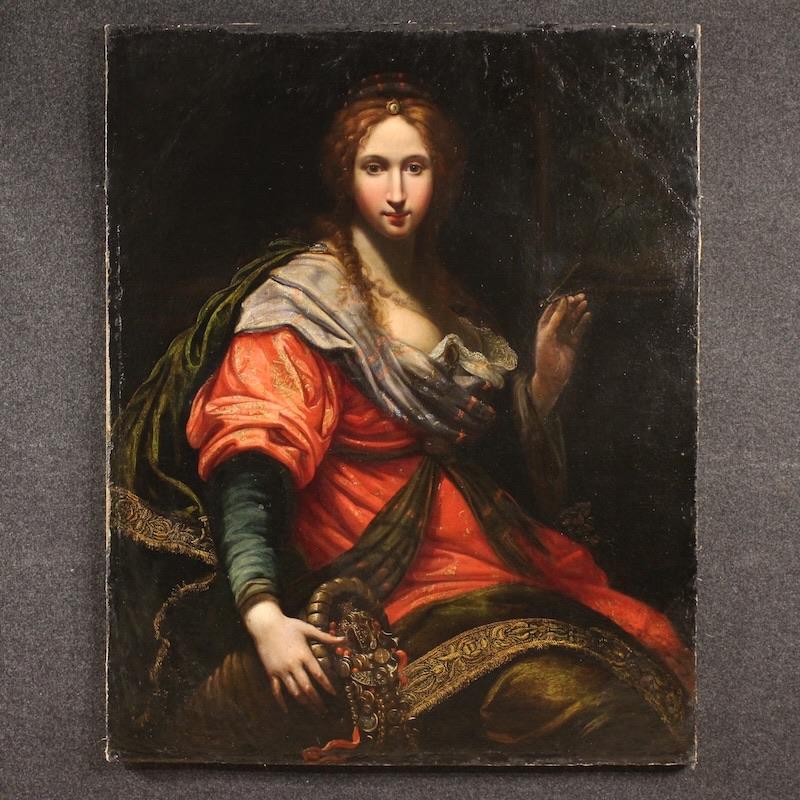
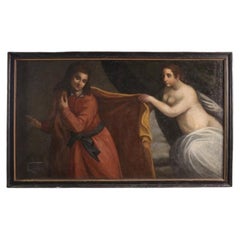
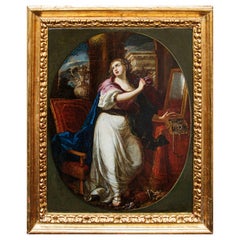
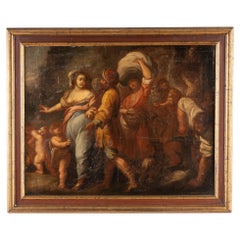
An important Florentine painting from the mid-17th century. This oil-on-canvas painting, attributed to the great Italian painter Vincenzo Dandini (1609–1675), depicts a refined allegorical figure, likely identified as the Allegory of Magnificence or Liberality.
The young woman is depicted seated, lavishly dressed, and facing directly toward the viewer. In her raised hand, she holds a small compass, a symbol of measure, proportion, and discernment, while a cornucopia—a symbol of abundance—lies in her lap, filled with coins, pearls, coral, and precious jewels. The combination of these two attributes appears to allude to wealth governed by reason and managed with balance, in accordance with a complex symbolism typical of 17th-century allegorical culture.
The figure stands out strikingly against the dark background, bathed in a soft light that highlights her face and hands. Her pale complexion, enlivened by the rosy hues of her cheeks, is rendered through delicate chiaroscuro effects, while her intense gaze lends the woman a surprising psychological presence.
The rendering of the clothing is of extraordinary quality. The red dress, featuring wide folds and embellished with delicate gold motifs, is paired with a blue-green sleeve and overlapping drapes in gray, green, and brown. The painter depicts the varying textures of the silks, velvets, embroidery, and metallic ornaments with particular sensitivity, achieving effects of great textural richness. The gold-embroidered border that runs along the lower part of the composition is magnificent, designed as a refined ornamental element.
Vincenzo Dandini was one of the most important figures in 17th-century Florentine painting. Trained by his brother Cesare, he completed his education in Rome in the studio of Pietro da Cortona. Upon returning to Florence, he worked for the Medici court, blending Roman Baroque monumentality and Tuscan naturalistic sensibility into his own style. His drawings and works are housed in the Uffizi Gallery, the Art Institute of Chicago, and the British Museum in London, among other institutions. (The painting is not currently accompanied by an expertise, but one can be requested upon payment of the relevant additional costs.)
A work of considerable charm and decorative appeal, it is ideal for a stately home or a prestigious professional studio. The quality of the skin tones, the exquisite fabrics, and the unusual iconography make it a particularly interesting collector's item.
The painting, originally designed as an octagon, was later enlarged at the four corners to achieve its current rectangular format. The work has already been restored through relining, replacement of the stretcher, and repainting in some areas. Overall, it is in good condition.