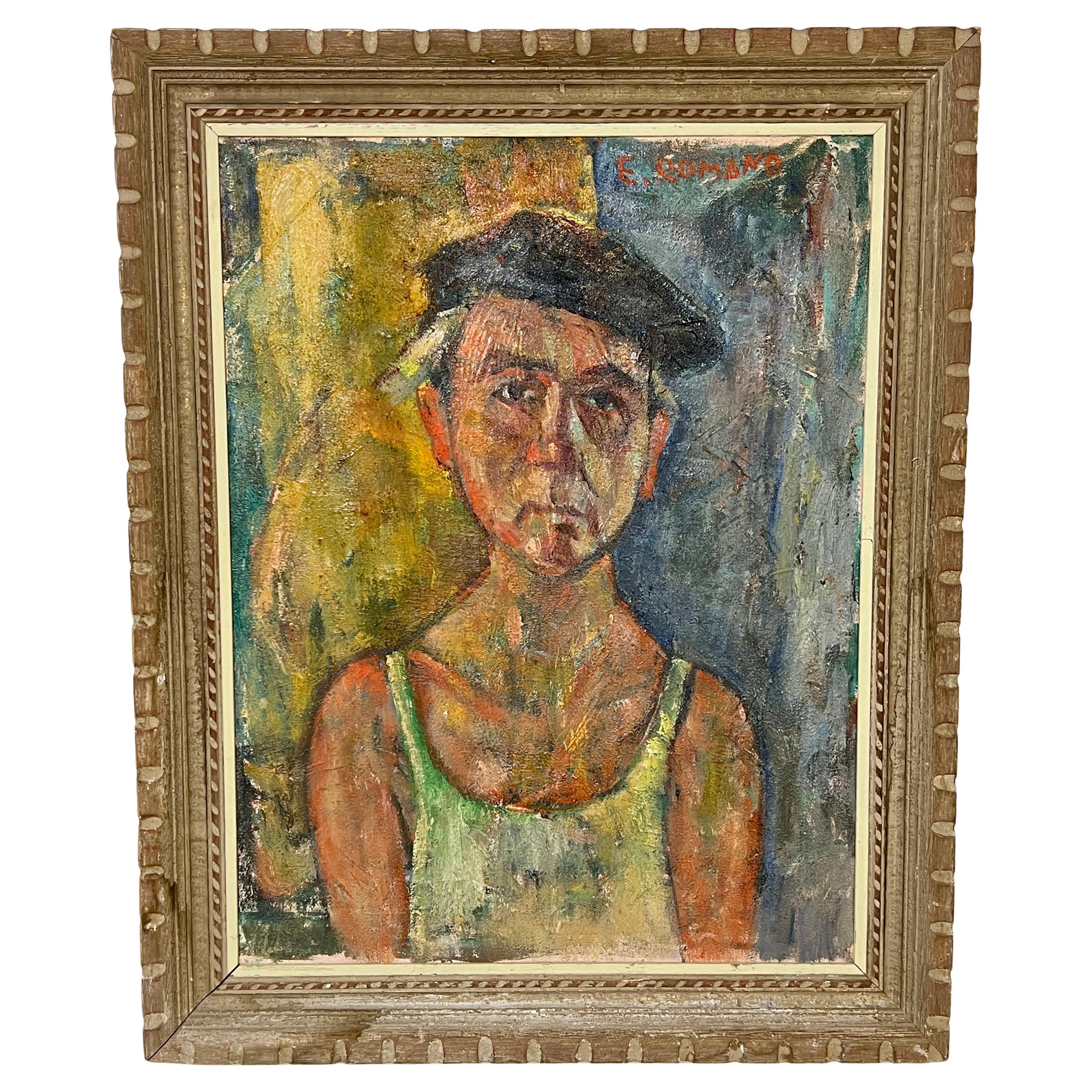
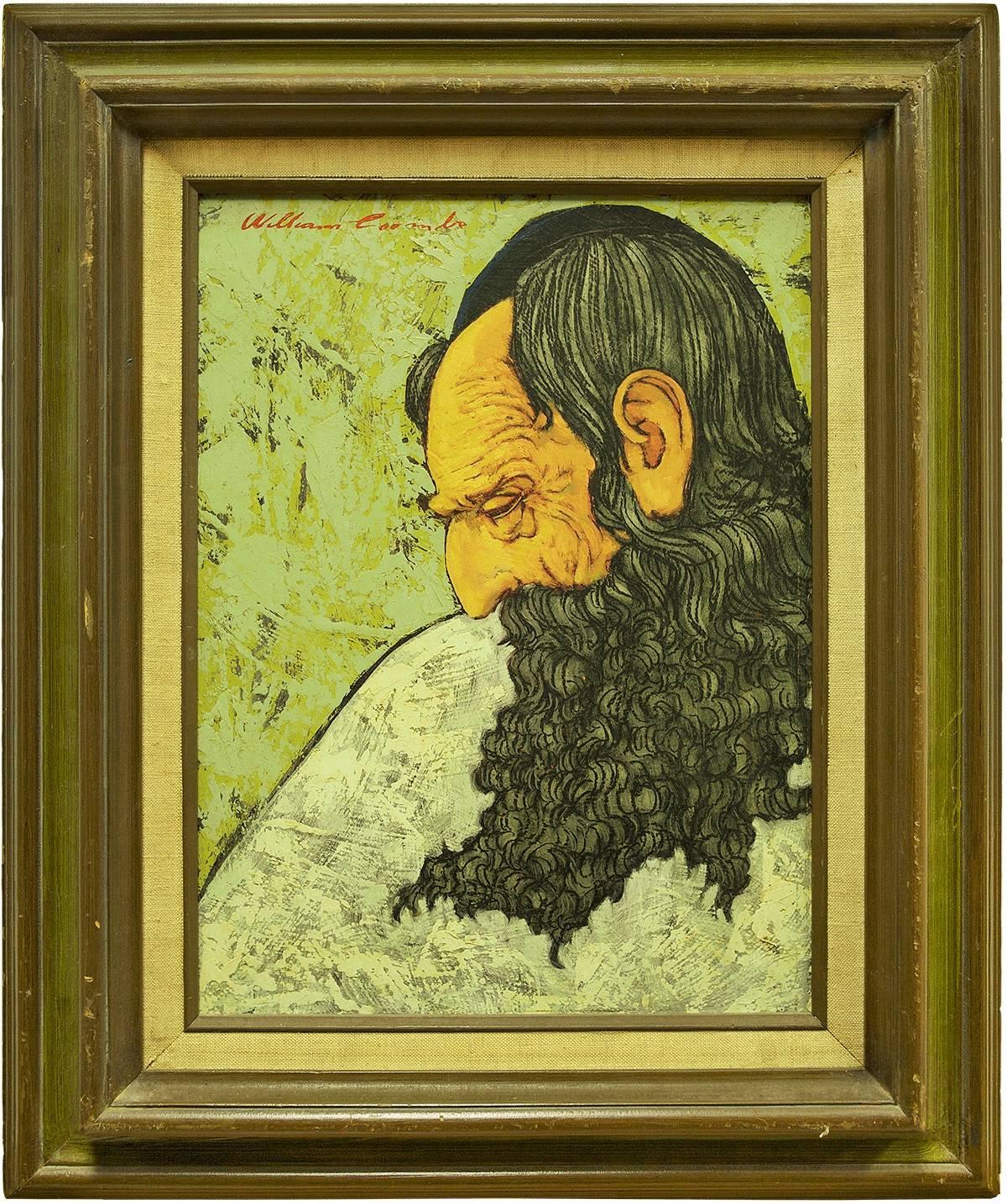
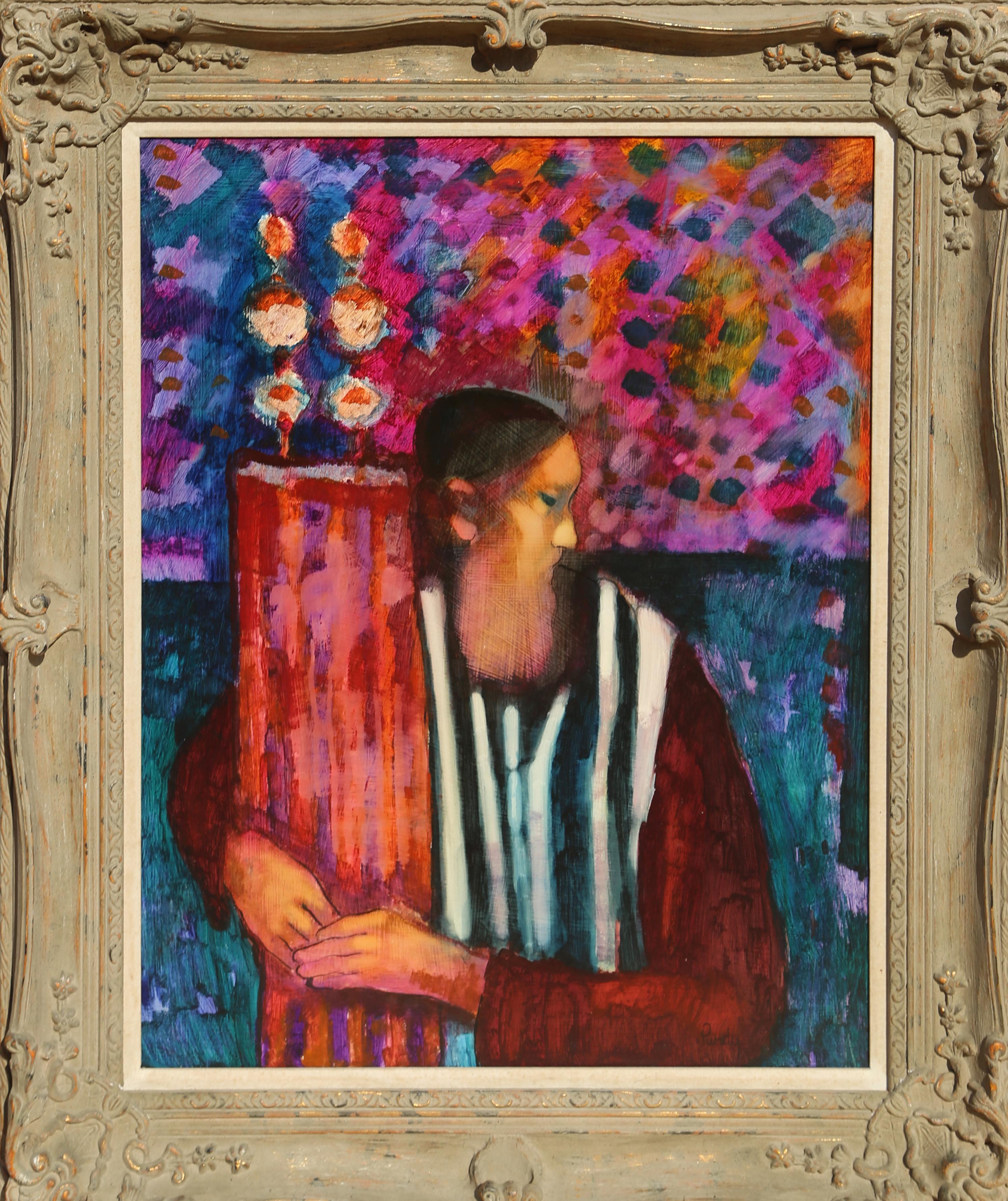
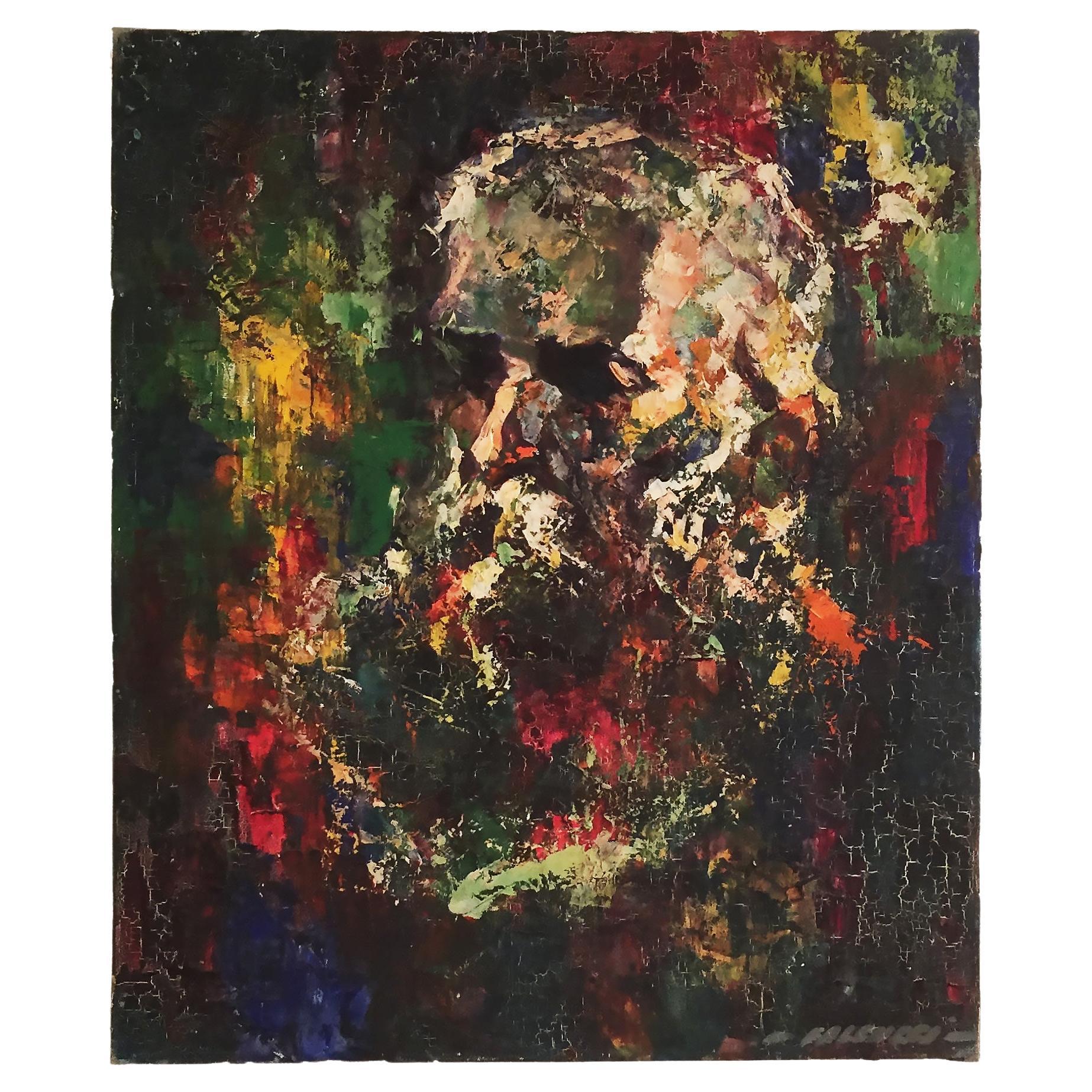
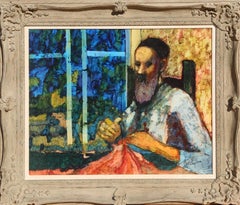
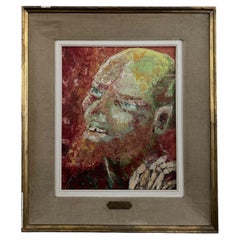
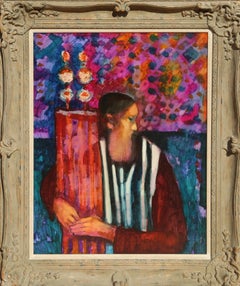
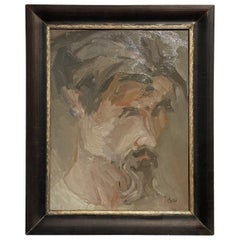
There is a gravity to this painting that announces itself immediately — the bowed head, the absorbed hands, the world outside fallen entirely away. Robert Van Cleef, the French post-war painter long associated with the artistic milieu of the Côte d'Azur, here turns his considerable expressive gifts to one of the most enduring subjects in European figurative art: the devout elder, lost in prayer or study, rendered with an urgency that only impasto oil painting can truly convey.
The figure — a white-bearded rabbi, head inclined, hands cradling what appears to be a sacred object — emerges from a dark, charged ground with the drama of a Rembrandt and the painterly freedom of the mid-century School of Paris. Van Cleef's brushwork is at once vigorous and precise: thick ridges of ochre and cream describe the face and beard with sculptural force, while streaks of deep crimson and raw umber animate the figure's clothes. Behind him, loosely suggested hints of yellow and flashes of deep green prevent the darkness from becoming oppressive, offering instead a sense of life continuing quietly around an island of contemplation.
The work belongs to a distinguished tradition of Judaica painting that flourished in European art from the late 19th century through the post-war decades — a genre that attracted serious collectors on both sides of the Atlantic. Van Cleef brings to it not sentimentality but presence: this is a man, not a type, and the painting rewards long looking.
Sourced in Alsace, France, the work retains its gilt frame (although reduced in size) from a framer in Cannes — a provenance detail that places the painting on the French Riviera, consistent with Van Cleef's known association with Vallauris and the Galerie Valdoria. The signature — Van Cleef — appears boldly in black paint, lower left.
Robert Van Cleef (1914–2006) was a French figurative painter whose work has appeared at auction at Bonhams, Eric Pillon Enchères, Lacy Scott & Knight, and John Nicholson's Fine Art Auctioneers, among others. He was associated with the Galerie Valdoria in Vallauris — the Provençal town made famous by Picasso's ceramics — and exhibited in London through Gladwell & Patterson. His subjects ranged from portraits and nudes to genre scenes and still-lifes, all executed with the confident draughtsmanship and tonal richness characteristic of the mid-century French figurative tradition.
This mid-century work displays a complex surface history characteristic of heavy impasto on board. The surface exhibits age-related craquelure with associated losses and flaking, particularly in some of the darker pigments (i.e. upper shoulder). A notable challenge in the assessment of this piece is distinguishing between mechanical wear and the artist’s deliberate "non-finito" technique; for instance, the areas of exposed hardboard around the head appear to be intentional stylistic choices. Ultimately, this ambiguity serves as an advantage, as the wear blends seamlessly into the artist's rugged execution, ensuring the painting maintains its full aesthetic appeal and decorative impact. The original gilt frame shows authentic oxidation and abrasions consistent with its age. Minor gappings are visible at the corner joints. This work is sold "as is," and potential buyers are encouraged to consult the high-resolution photographs carefully to evaluate the specific areas of surface loss. Untouched and without evidence of restoration, the painting remains a striking and ready-to-hang period piece.
Dimension: height 53 cm/ 20 3/4", width 45 cm/ 17 3/4", depth 3 cm/ 1 1/4".
Weight: 1200 g/ 2.65 lb