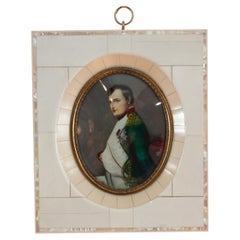
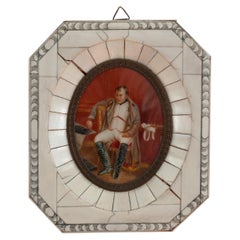
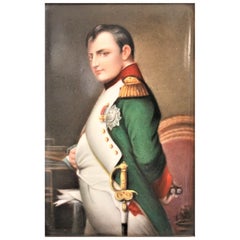
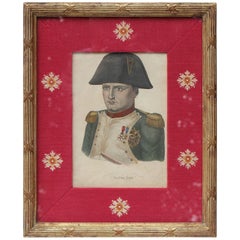
By Manufacture Nationale de Sèvres
Located in Missouri, MO
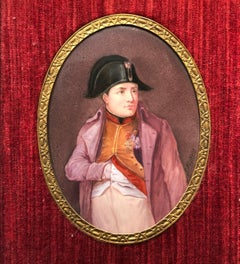
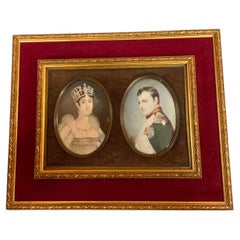
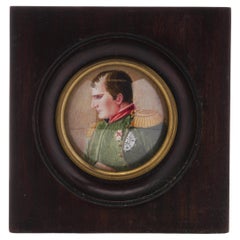
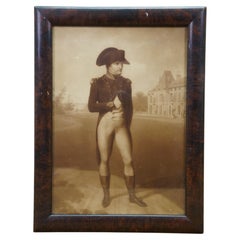
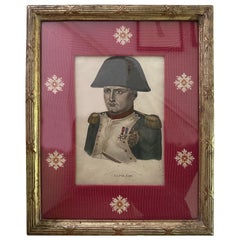
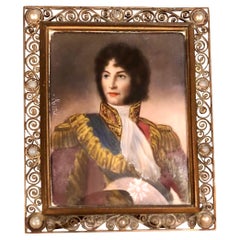
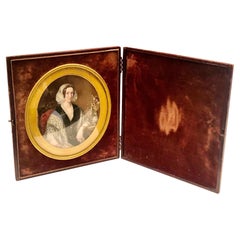
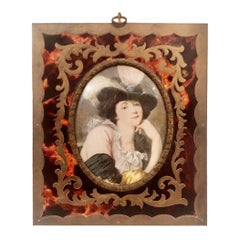
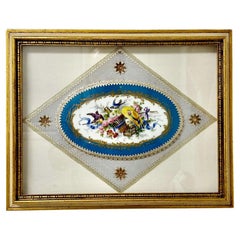
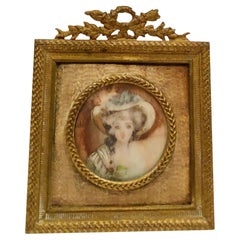
Sevres 19th C.
Original Hand Painted Porcelain
Signed "G Poitevin"
approx 9 x 5 inches/15 x 12 framed
The vast and diverse production of the Sèvres factory in the nineteenth century resists easy characterization, and its history during this period reflects many of the changes affecting French society in the years between 1800 and 1900. Among the remarkable accomplishments of the factory was the ability to stay continuously in the forefront of European ceramic production despite the myriad changes in technology, taste, and patronage that occurred during this tumultuous century.
The factory, which had been founded in the town of Vincennes in 1740 and then reestablished in larger quarters at Sèvres in 1756, became the preeminent porcelain manufacturer in Europe in the second half of the eighteenth century. Louis XV had been an early investor in the fledgling ceramic enterprise and became its sole owner in 1759. However, due to the upheavals of the French Revolution, its financial position at the beginning of the nineteenth century was extremely precarious. No longer a royal enterprise, the factory also had lost much of its clientele, and its funding reflected the ruinous state of the French economy.
However, the appointment in 1800 of Alexandre Brongniart (1770–1847) as the administrator of the factory marked a profound shift in its fortunes. Trained as both an engineer and a scientist, Brongniart was both brilliant and immensely capable, and he brought all of his prodigious talents to the running of the troubled porcelain factory. He directed the Sèvres factory as administrator until his death in 1847, and during those five decades influenced every aspect of its organization and production. Much of the factory’s old, undecorated stock was immediately sold off, and new forms—largely in the fashionable, more severe Neoclassical style—were designed to replace out-of-date models. The composition for hard-paste porcelain was improved, and the production of soft paste, for which the factory had been famous in the previous century, was abandoned in 1804. New enamels colors were devised, and Brongniart oversaw the development of a new type of kiln that was both more efficient and cost-effective.
Much of the factory’s output during Brongniart’s first decade reflected the prevailing Empire taste, which favored extensive gilding, rich border designs, and elaborate figural scenes (56.29.1–.8). Backgrounds simulating marble or a variety of hardstones were employed with greater frequency (1987.224); the new range of enamel colors developed under Brongniart made it easier to achieve these imitation surfaces, and it is thought that his interest in mineralogy provided the impetus for this type of decoration.
For objects produced in sets, such as dinner, tea, and coffee services, and even garnitures of vases, Brongniart preferred decorative schemes that linked the objects in terms of subject matter as well as stylistically. Dinner services were given coherence by the use of an overall theme, in addition to shared border patterns and ground colors. One of the best examples of this can be found in the “Service des Départements,” which was conceived by Brongniart in 1824 (2002.57). Each of the plates in the service was decorated with a famous topographical view of the département (administrative unit) of France that it represented, and its border was painted with small cameo portraits of figures from the region, as well as symbols of the major arts, industries, and products of the area. This same type of thematic unity is found on a coffee service produced in 1836 (1986.281.1ab–4). All of the pieces of the service are decorated with scenes depicting the cultivation of cacao, from which chocolate is made, or various stages in the preparation of chocolate as a beverage. The compositions were conceived and executed by Jean Charles Develly, a painter at Sèvres who was responsible for many of the most ambitious dinner services produced at the factory during Brongniart’s tenure.
The range of objects produced in the first half of the nineteenth century was enormous, as were the types of decoration that they employed. A recent exhibition catalogue devoted to Brongniart’s years at Sèvres indicates that ninety-two new designs for vases were introduced, as were eighty-nine different cup models, and the types of objects produced by the factory included every sort of form required by a dinner or dessert service, coffee and tea wares, decorative objects such as vases, and functional objects such as water jugs, basins, and toiletry articles. A new form rarely replaced an older one; the range of production simply increased.
The same was true with types of decoration, as the factory was working in a wide variety of styles at any given time. From the earliest years of the Sèvres factory, its painters had copied not only contemporary compositions but also prints and paintings from earlier periods. However, under Brongniart, the factory sought to copy famous paintings with the specific intention of recording the “true” appearance of works increasingly perceived to be fragile. Works by a wide variety of artists were copied, but those by Raphael were especially popular. Raphael’s stature is reflected in a vase of 1834 in which a cameo-style portrait of the artist decorates the primary reserve, while on the back an artist’s palette is encircled by the names Titian, Poussin, and Rubens (1978.373).
Just as works by earlier artists were copied, so too were decorative techniques of previous centuries. The interlace patterns of so-called Saint-Porchaire ceramic ware of the sixteenth century served as the inspiration for the decoration on a cup of 1837 (2003.153). The form of the cup itself derives from Renaissance silver forms made in Italy and France. However, the palette of vibrant reds, greens, blues, and yellows contrasts markedly with the muted browns and off whites of Saint-Porchaire wares and reflects the reinterpretation of historical styles that was characteristic of so much of nineteenth-century decorative arts.
Interest in the Gothic style emerged early in Brongniart’s tenure at Sèvres and remained popular for much of the nineteenth century. Strict adherence to Gothic motifs was rarely observed, however, and the Gothic style was more evoked than faithfully copied. This tendency is reflected in a pair of vases (1992.23.1) for which the model was designated vase gothique Fragonard (named after the vase’s designer, Alexandre Evariste Fragonard [1780–1850]. The Gothic elements lie more in the painted decoration than in the form itself, and the style of the painting reflects a Renaissance technique rather than a medieval one. The palette of grays and whites on a blue ground instantly recalls the enamel-on-copper wares produced in Limoges, France, in the sixteenth century, and its use on these vases indicates the willingness to freely mix artistic styles and techniques of different periods in order to achieve new aesthetic effects.
The eclecticism and historicism that characterized so much of the production during Brongniart’s tenure continued after his death in 1847. The factory’s output reflected an ongoing desire for technical innovation as well as a wide embrace of diverse decorative styles that were employed simultaneously. A tea and coffee service of 1855–61 (69.193.1–.11) embodies the selective borrowing of forms and motifs that is found so frequently in Sèvres production of the middle decades of the nineteenth century. The shapes used for the different components of the service evoke both China and the Near East, an obvious allusion to the origins of the two beverages. The openwork decoration refers directly to Chinese ceramics made in this technique, and the decoration employs a variety of Chinese emblems. However, the palette of pink and gold, entirely European in character, serves to neutralize the Asian aspects of the service.
Perhaps the only thread that can be said to run through much Sèvres production of the nineteenth century is the proclivity to borrow freely from various historical styles and then to either reinterpret these styles or combine them in unprecedented ways. A standing cup of 1879 (1990.238a,b) draws upon silver cups of the Renaissance for its form, but in this instance the size of the porcelain cup dwarfs any of its metal prototypes. Its style of decoration derives from Limoges painted enamels of the sixteenth century, but the prominent use of gilding throughout reflects its wholly nineteenth-century character. This cup was presented by the French government to one of the first-prize winners at the 1878 Exposition Universelle.
It was with the advent of the Art Nouveau style at the very end of the nineteenth century that historicism lost its grip at Sèvres, and indeed throughout the decorative arts, and forms inspired by nature and often characterized by asymmetry become dominant. This reliance upon natural forms is fully evident in a coffee service of 1900–1904 (1988.287.1a,b). The designer, Léon Kann...
Category
Late 19th Century Figurative Paintings