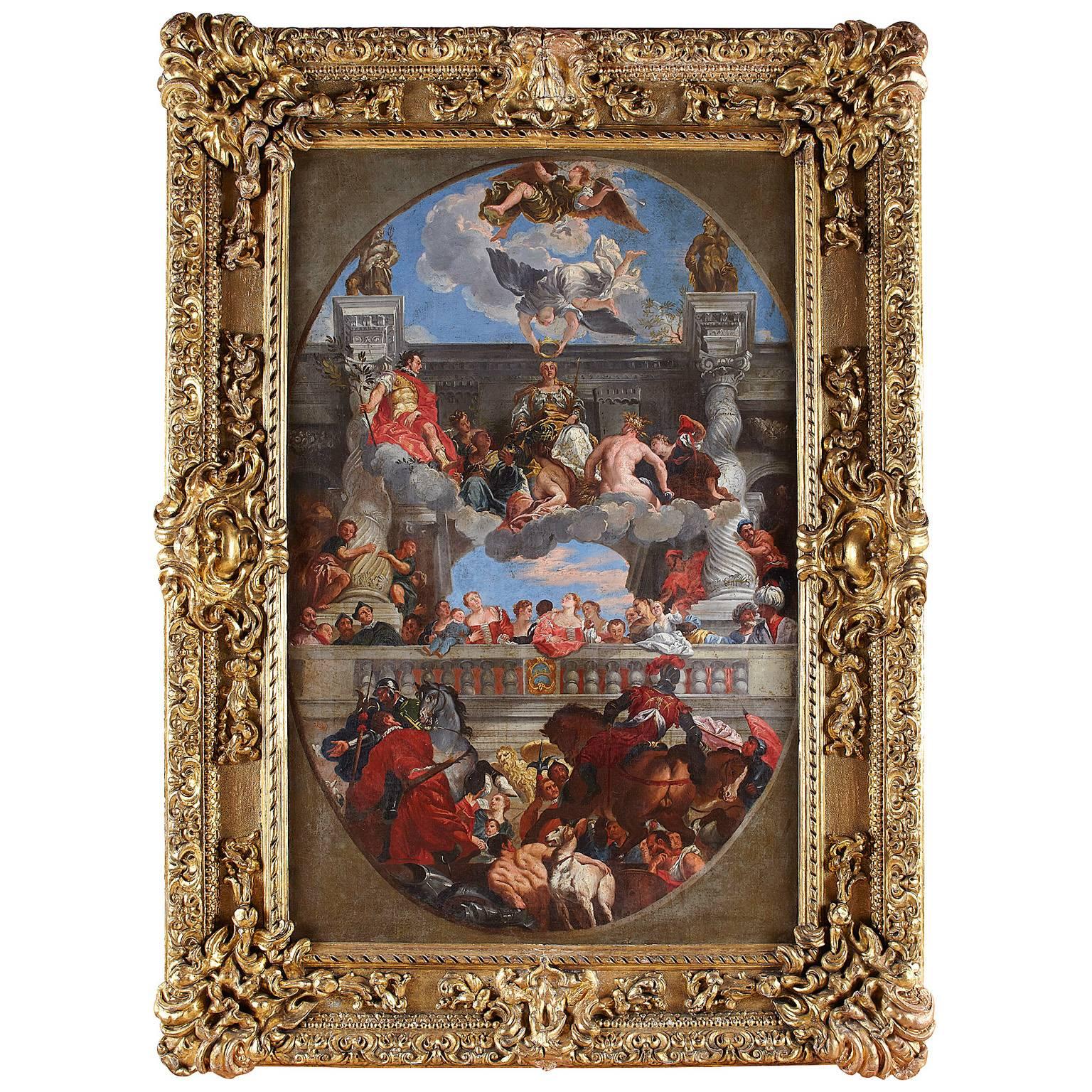
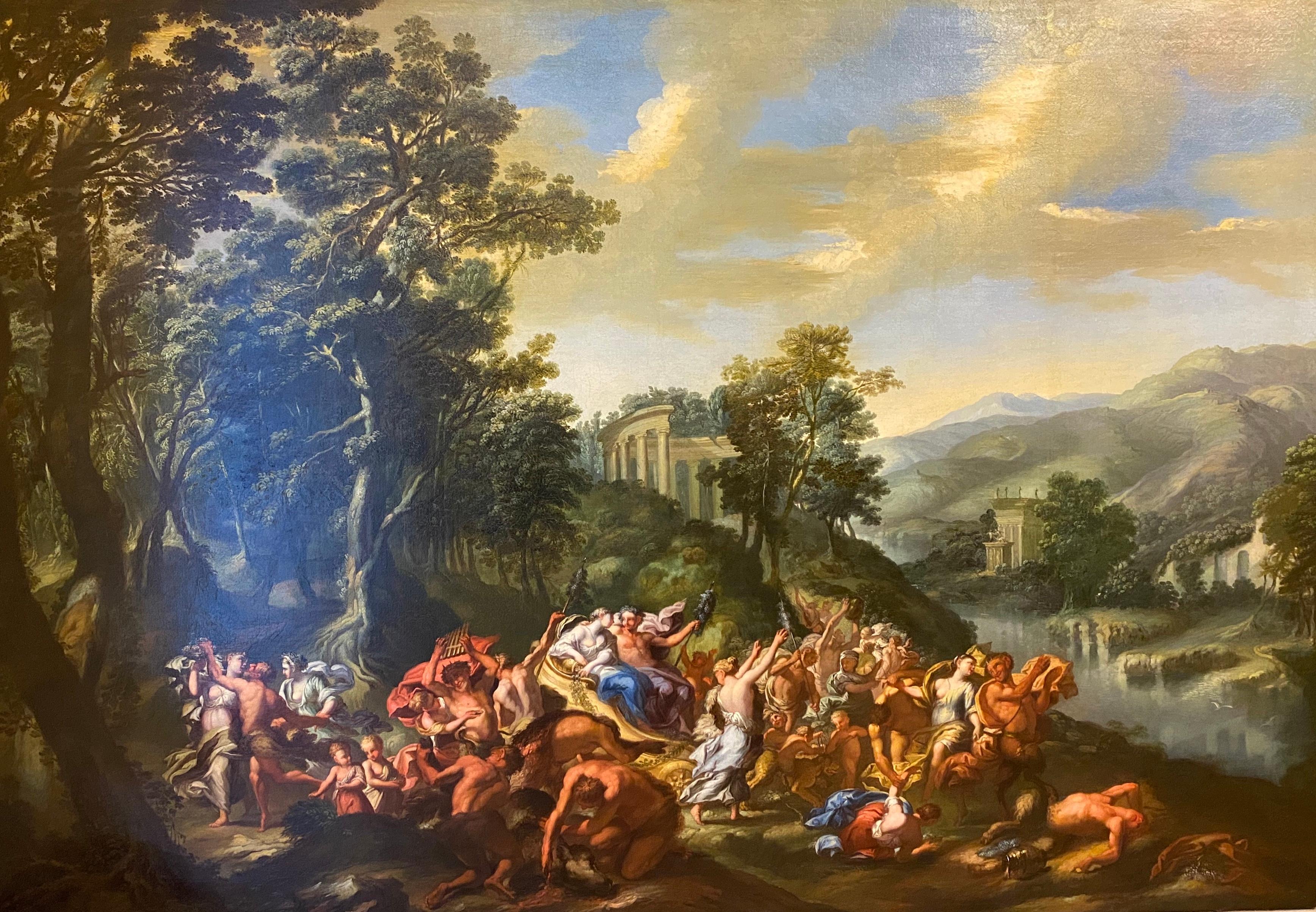
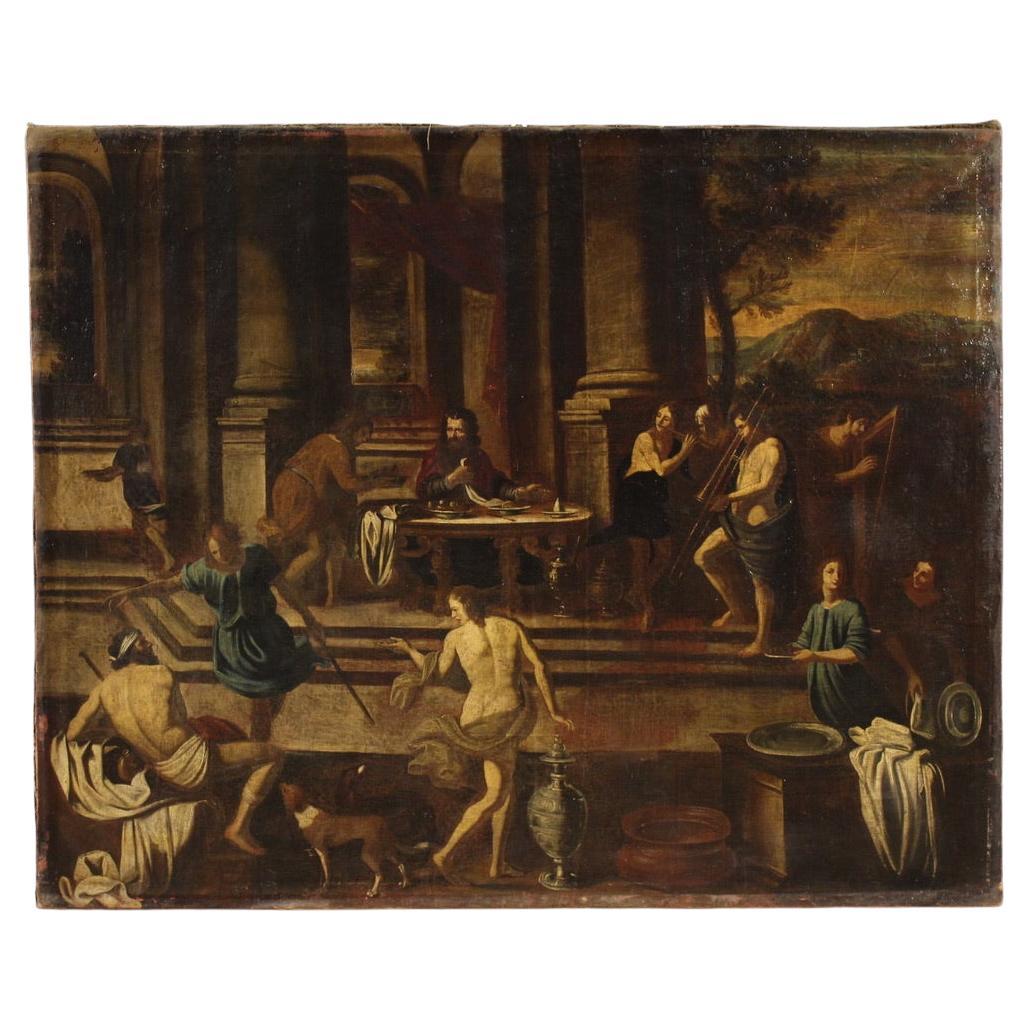
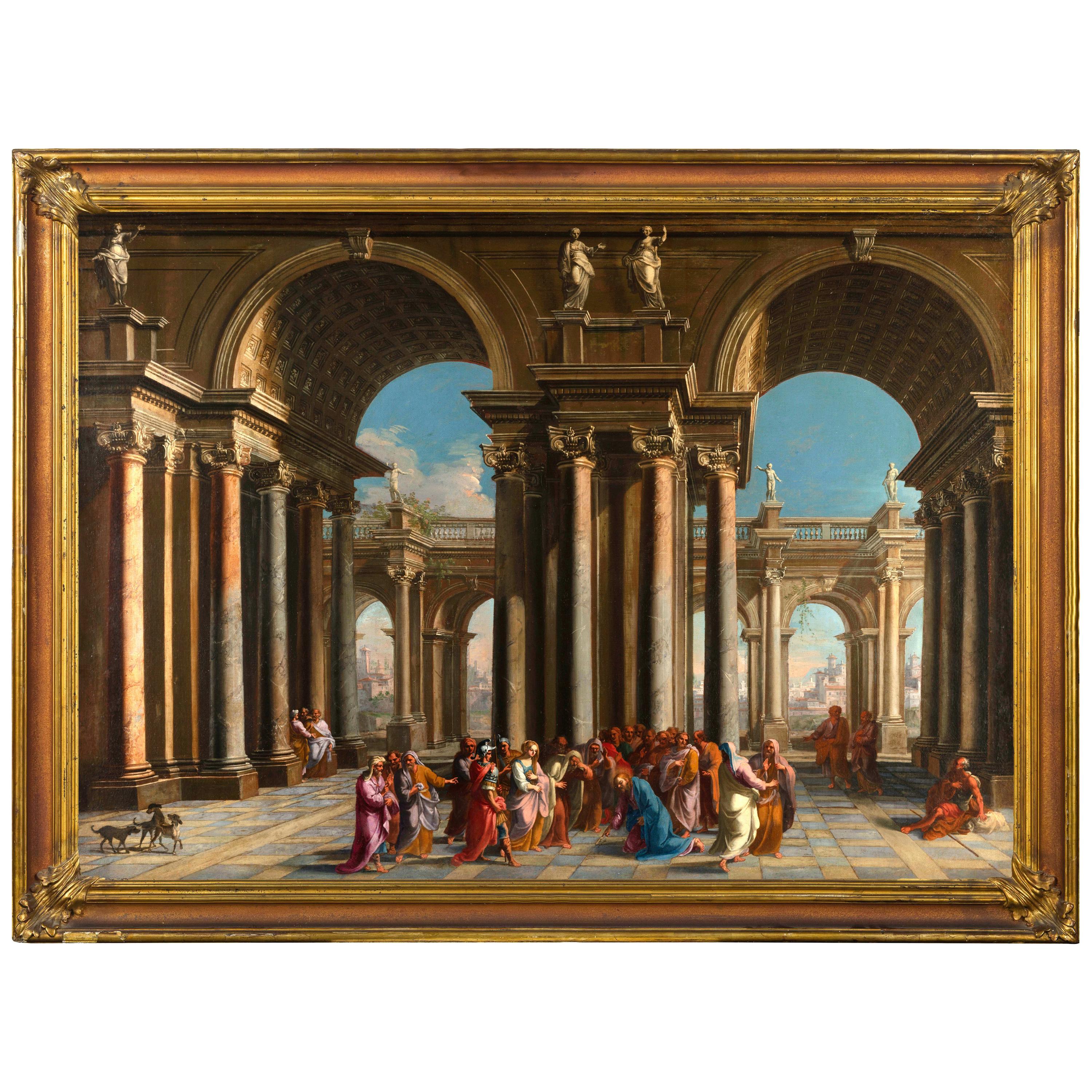
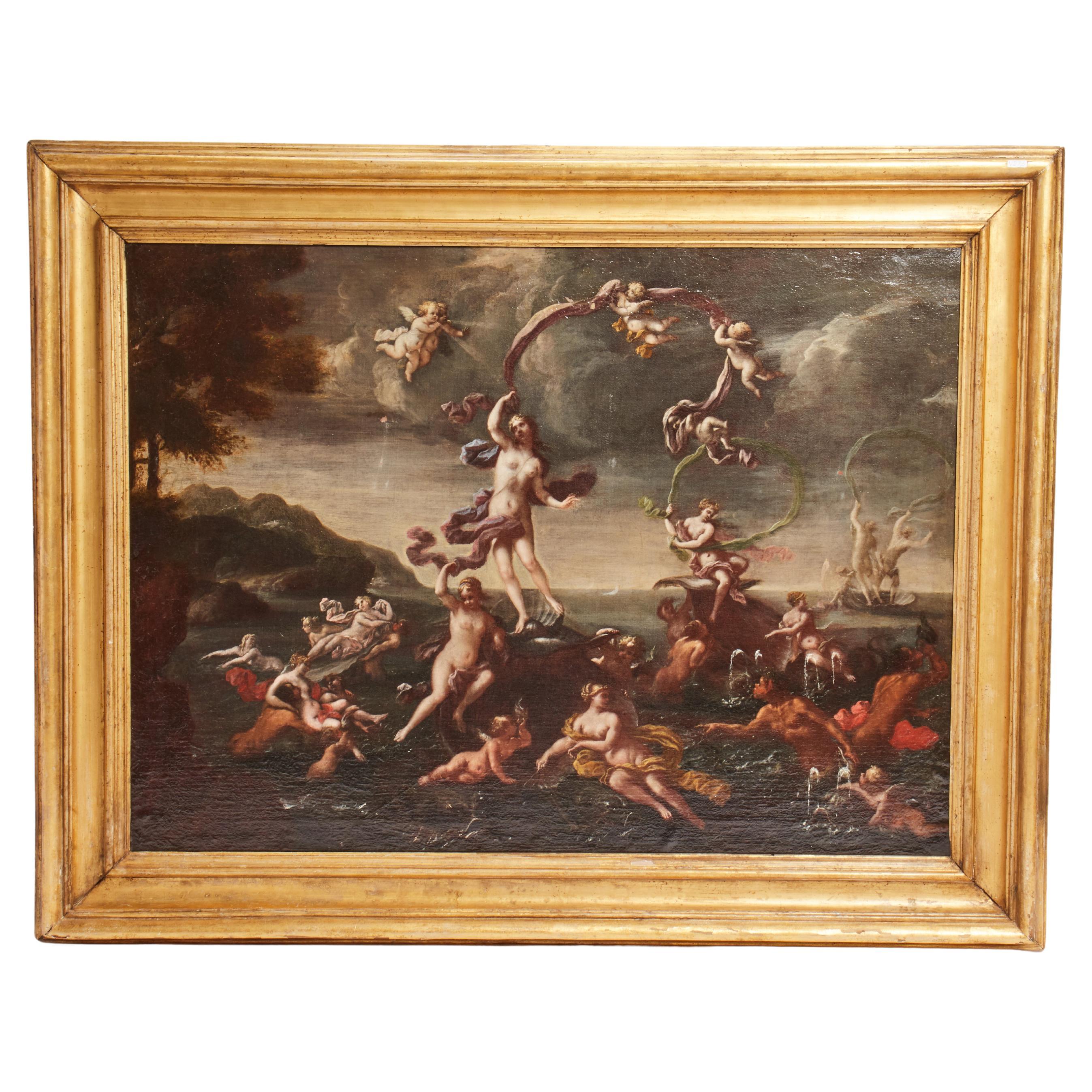
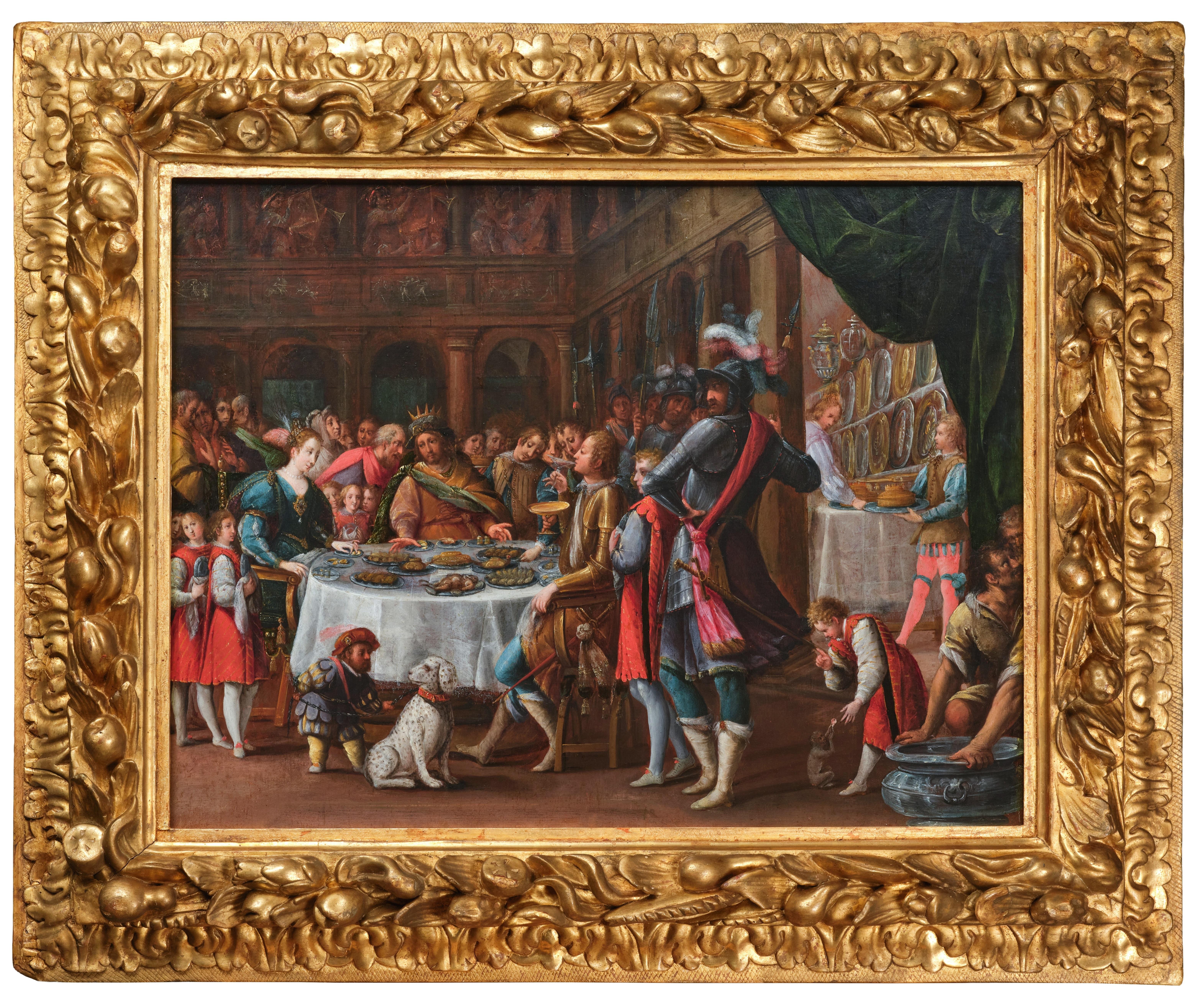
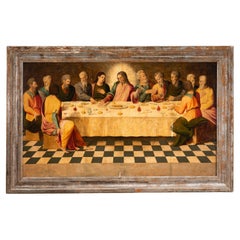
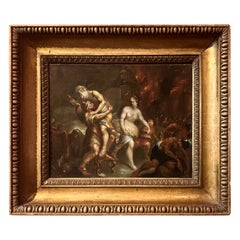
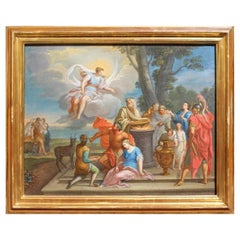
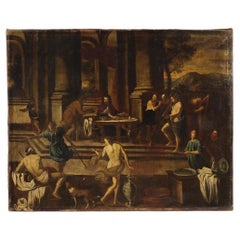
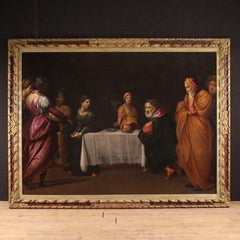
"Wedding of Tethys and Peleus". Oil on canvas. School of Madrid, 17th century. Corte, Juan de la (Antwerp, circa 1585 - Madrid, 1662) circle.
This work describes the weddings of the Nereid Thetis and the prince Peleo, parents of Achilles. It was celebrated on Mount Pelion, and all the deities came, although Eris, the goddess of discord, was not invited. In revenge, she threw a golden apple in which she said "for the most beautiful", that caused the dispute between Athena, Aphrodite and Hera that led to the Trial of Paris, to finally bring about the Trojan War. The banquet is depicted with a composition worked in depth, located in a rich interior of classical architecture illuminated by the light of Apollo, which is situated at the far end of the viewer. At the head of the table, in the foreground, appears Zeus, accompanied by the eagle and Hera, queen of the gods, to his left. In the lower right corner we see a group of satyrs serving the wine, accompanied by rich metal vessels worked with a detailed and descriptive brushstroke. The rest of the gods appear clearly differentiated, with Athena in the foreground to the right and, following an agile rhythm in zigzag, typically baroque, Aphrodite with Eros, Hermes and the grooms, to the left, and to the right Poseidon. Formally it is a work perfectly framed within the 17th century school of Madrid, developed around the court.
Thus, we see a sumptuous, allegorical classicist baroque, where the studies of light and color are especially relevant, revealing the exalted and luminous tone typical of this school's maturity. In particular, we can relate this painting to the circle of Juan de la Corte, painter of Flemish origin. We know nothing of his first formation today, for Palomino's assertion of his birth in Spain was documented, quoting in his testament that he was born in Antwerp. Also conserved documents in which the painter declares his apprenticeship in Flanders, where "it exerted his office by many years". For all this he has been associated with Flemish artists of the time who, due to personal knowledge or the study of his works, strongly influenced the configuration of his personal language. We know of his establishment in Spain at least since 1613. His work at the court encouraged him to ask for the place of royal painter who left vacant Bartolomé González in 1627, a goal he did not get. There is no documentary proof, therefore, that endorses the affirmation of Palomino when citing him like painter of the king. Nevertheless, it enjoyed a moderate success in the capital of the kingdom, being found his works in numerous noble inventories of the time. In turn, he enjoyed royal commissions, such as the cycle of biblical stories he painted for the Buen Retiro palace. His activity, according to his own confession, focused on "architectures, battles and countries", genres in which he was excellently valued by his contemporaries. One of the most interesting features of his style is the fact that he has often dealt with mythological subjects which, taken to the canvas in different cycles, offer us a singularly majestic panorama of a theme not frequent in the painting of Spain of the time. Another outstanding aspect of his work was the proliferation of architectural perspectives of evident linkage with the Nordic writers, most notably Vredeman de Vries. His pictorial style remained anchored in earlier traditions, demonstrating an obvious modesty and archaism, but the uniqueness of the issues he dealt made him worthy of the memory. Juan de la Corte is represented in the Museo del Prado, the Maritime of Barcelona, the Cerralbo and the Municipal of Madrid, among others .
· Size: 97 x 122 cm; 116 x 143 cm (marco). 7 cm (Depth).