Want more images or videos?
Request additional images or videos from the seller
1 of 6

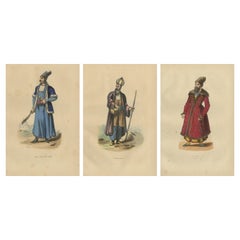
1844 Persian Elegance: From Smoking Nobility to Warfare in Art

$226.85per set
$283.21per set20% Off
£167.39per set
£209.33per set20% Off
€192per setVAT Included
€240per set20% Off
CA$314.54per set
CA$393per set20% Off
A$319.48per set
A$400.07per set20% Off
CHF 184.10per set
CHF 230.39per set20% Off
MX$3,857.19per set
MX$4,821.21per set20% Off
NOK 2,138.55per set
NOK 2,674.23per set20% Off
SEK 2,156.39per set
SEK 2,698.13per set20% Off
DKK 1,463.97per set
DKK 1,829.70per set20% Off

About the Item

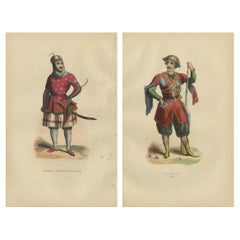
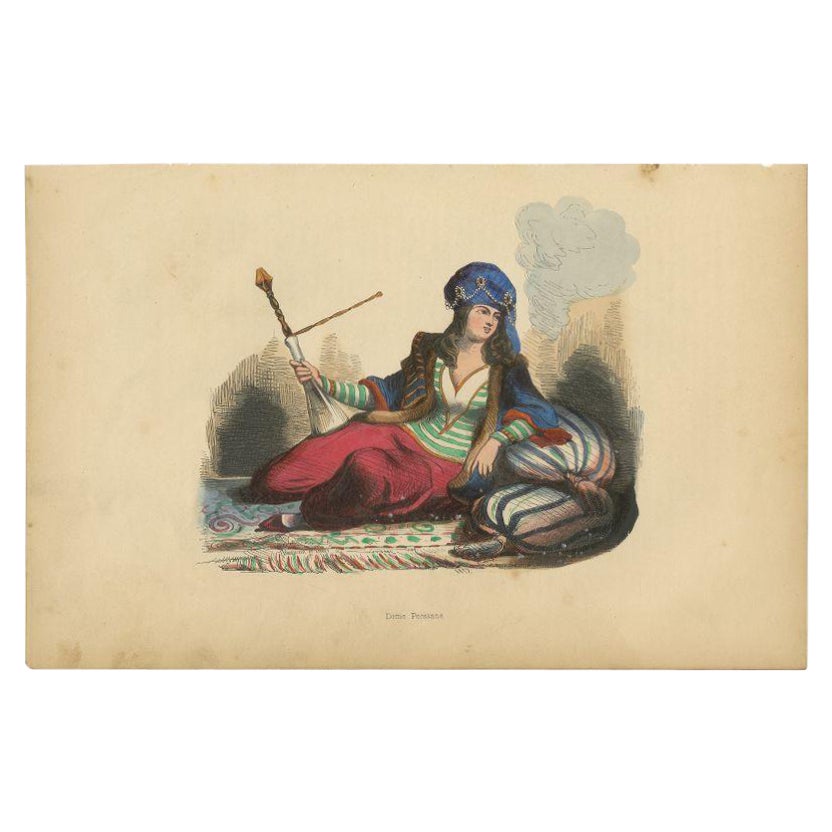
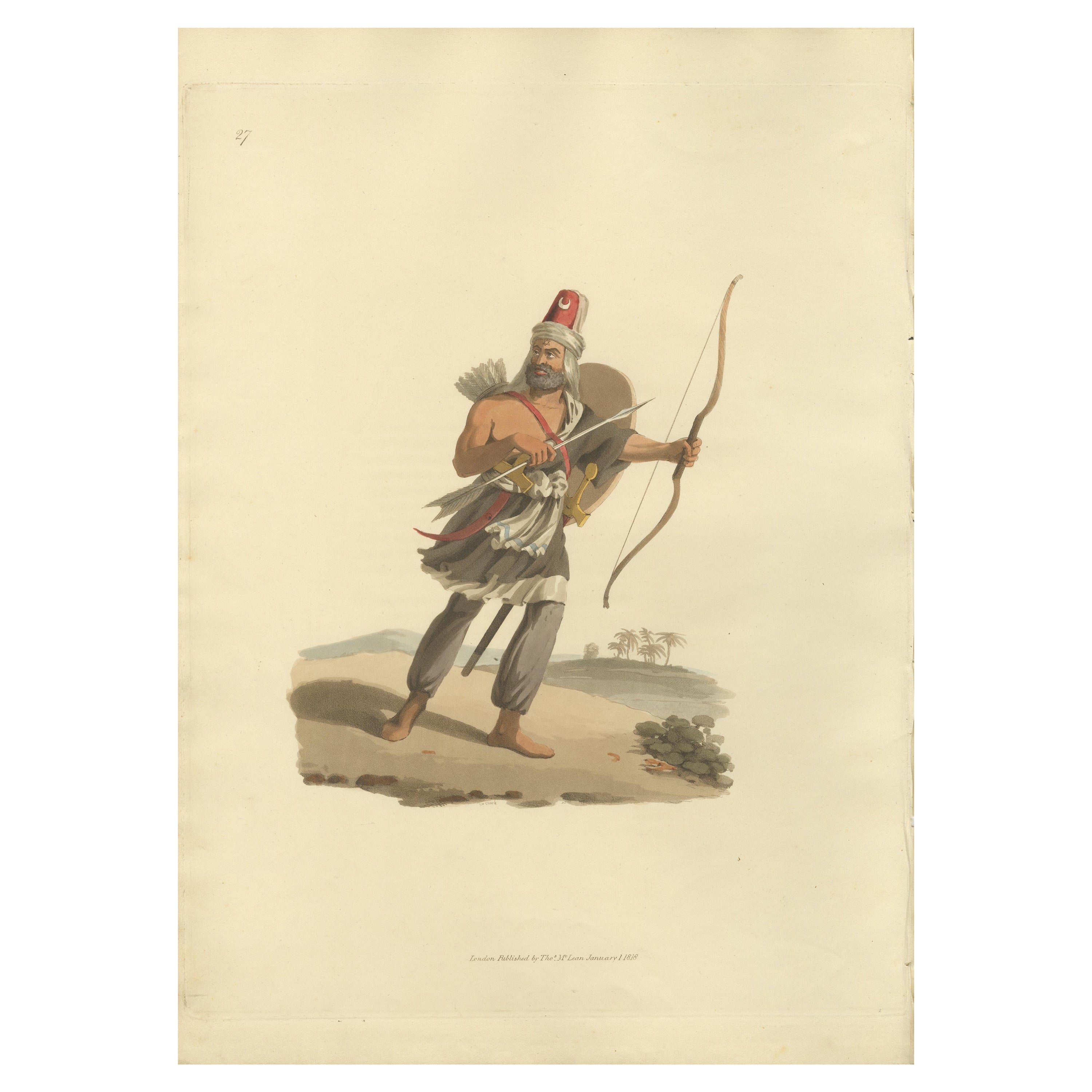
"1844 Persian Elegance: Exquisite Handcoloured Lithographs of Cultural Icons" Description: Delve into the opulence of Persian culture with these striking 1844 handcoloured lithographs from "Moeurs, Usages et Costumes de tous les Peuples de Monde," authored by Auguste Wahlen and published in Paris. Crafted using lithography and enhanced with Arabic gum on wove (vellin) paper, these prints captivate with their vivid colors and meticulous details, bringing historical Persian life vividly to the fore. Their allure lies in the intricate depiction of traditional costumes and everyday life, making them invaluable to collectors and enthusiasts of Middle Eastern historical art. In the lithographs depicting Persian figures, there are some interesting details that reflect cultural and historical aspects: 1. Dame Persane (Persian Lady): - Smoking Instrument: The Persian lady is depicted with a hookah (also known as shisha or water pipe), which is a traditional smoking device used widely across the Middle East and South Asia. The hookah is used to smoke flavored tobacco, often mixed with molasses or honey. It's a cultural artifact, often associated with social gatherings and leisure in Persian and broader Middle Eastern society. Smoking hookah has been a part of the social fabric, representing hospitality and a relaxed social status. 2. Cannonier Persan (Persian Cannoneer): - Cannon Details: The cannon depicted with the Persian cannoneer is interestingly mounted on the back of a camel. This reflects a historical method of warfare used in desert regions, where camels were employed for mobility over sandy and difficult terrains. Camel artillery units were a strategic advantage in desert warfare due to their ability to move quickly and efficiently across vast desert landscapes. The combination of camels and artillery was used in various historical contexts, including by Ottoman and Persian empires. These details not only add depth to the prints but also provide a glimpse into the technological and social advancements of the time. The inclusion of a hookah and a camel-mounted cannon in these prints illustrates the intricacies of Persian lifestyle and military tactics during the 19th century, showcasing the blend of daily life and the necessities of warfare. Keywords: - Antique Persian lithographs - Handcoloured prints - 19th-century cultural prints - Traditional Persian costumes - Historical Persian society - Auguste Wahlen prints - Middle Eastern art collection - Vintage lithographic art - Collectible Persian prints - Ethnographic art prints These keywords cater to art collectors, historians, and cultural enthusiasts searching for detailed and authentic representations of 19th-century Persian life and attire.
  • Dimensions:
    Height: 6.7 in (17 cm)Width: 10.12 in (25.7 cm)Depth: 0 in (0.02 mm)
  • Sold As:
    Set of 2
  • Materials and Techniques:
  • Period:
  • Date of Manufacture:
    1844
  • Condition:
    Condition: Good, given age. Faintly browned, and with some small stains. Some glue remains (from binding) in the far left margin (not affecting image). General age-related toning and/or occasional minor defects from handling. Please study the scans.
  • Seller Location:
    Langweer, NL
  • Reference Number:
    Seller: BG-12722-36, BG-12722-371stDibs: LU3054341384042

More From This Seller

View All
1844 Persian Cultural Figures: Engraved Prints of Traditional Attires

1844 Persian Cultural Figures: Engraved Prints of Traditional Attires

Located in Langweer, NL

Title: "1844 Persian Cultural Figures: Engraved Prints of Traditional Attires" Description: This compilation features three handcoloured lithographs representing traditional Persian figures: a common man, a dervish, and a noble, from the esteemed 1844 collection "Moeurs, Usages et Costumes de tous les Peuples de Monde" by Auguste Wahlen. Published in Paris, these prints are crafted through lithography, a popular 19th-century technique, and are enhanced with Arabic gum on wove (vellin) paper. The vivid depiction of their cultural attire and the distinct portrayal of each social stratum make these prints particularly captivating. They offer a glimpse into the historical socio-cultural fabric of Persia, making them highly sought after by collectors and enthusiasts of Middle Eastern art and history. In the three prints you provided of Persian figures, each character holds something distinct that signifies their role or status within their culture: 1. Persé - Homme du Peuple (Common Man): - Holding: This figure holds a walking stick or cane, which is a common accessory that could be used for practical purposes like walking support or herding animals. - Outfit: He wears traditional attire with a long coat and a large hat, indicative of a common man's clothing in historical Persian society. His outfit and the stick both emphasize his everyday, practical life. 2. Derviche Persan (Dervish): - Holding: The Dervish holds a stick and a begging bowl. Dervishes are known for their ascetic piety, often connected with Sufism in Islam. The stick (or staff) symbolizes their travels and spiritual journey, while the bowl is used to receive alms, reflecting their vow of poverty. - Interesting Fact: Dervishes are part of a mystical spiritual ascetic practice within Islam, focusing on the universal values of love and service. Their clothing and accessories reflect simplicity and spiritual richness. 3. Noble Persan (Nobleman): - Holding: The nobleman carries a sword, which is a symbol of power, authority, and martial prowess. It is commonly featured in depictions of nobility as a sign of their status and ability to command. - Outfit: His clothing is significantly more elaborate and colorful compared to the others, with fur trim and decorative patterns, signifying wealth and high social status. These accessories and their attire provide a deep insight into the roles and societal positions of each figure within Persian culture, reflecting a wide range of personal and social identities from the common man to spiritual seekers and the ruling elite. Each element, from the practical walking stick to the symbolically rich begging bowl and the authoritative sword, offers a narrative about their life, status, and societal roles during that historical period. Keywords: - Antique Persian prints...

Category

Antique 1840s Prints

Materials

Paper

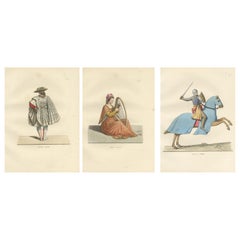
Noble Grace and Martial Power: Italian Aristocrats & French Knight - 1845 Print

Noble Grace and Martial Power: Italian Aristocrats & French Knight - 1845 Print

Located in Langweer, NL

Noble Grace and Martial Power: Italian Aristocrats and a French Knight Description: This exquisite set of three hand-colored costume prints from 1845 brings together the elegance of...

Category

Antique Mid-19th Century French Prints

Materials

Paper

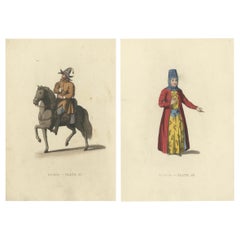
Kirghiz Elegance Engraved: A Study of 19th Century Central Asian Attire, 1814

Kirghiz Elegance Engraved: A Study of 19th Century Central Asian Attire, 1814

Located in Langweer, NL

The two engravings vividly capture the traditional attire of the Kirghiz, a group native to the steppes of Central Asia. 1. The first engraving portrays a Kirghiz man mounted on hor...

Category

Antique 1810s Prints

Materials

Paper

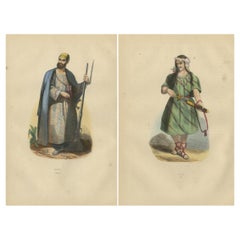
Cultural Warriors: Traditional Attire of Iranian and Afghan Tribes, 1844

Cultural Warriors: Traditional Attire of Iranian and Afghan Tribes, 1844

Located in Langweer, NL

Handcoloured lithographs, heightened with Arabic gum on wove (vellin) paper. From the Asia volume of “Moeurs, Usages et Costumes de tous les Peuples de Monde” by Auguste Wahlen. Thi...

Category

Antique 1840s Prints

Materials

Paper

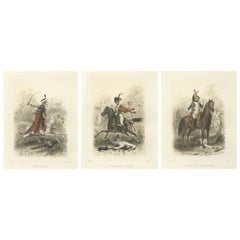
Napoleonic Battle Cavalry – Mameluke, Chasseur, and Empress Dragoon, 1859

Napoleonic Battle Cavalry – Mameluke, Chasseur, and Empress Dragoon, 1859

Located in Langweer, NL

Napoleonic Battle Cavalry – Mameluke, Chasseur, and Empress Dragoon, 1859 This compelling set of three hand-colored lithographs captures elite cavalry units of Napoleon’s Imperial G...

Category

Antique 1850s Prints

Materials

Paper

Circassian and Imeretian Princes in Traditional Attire, 1844 Lithographs

Circassian and Imeretian Princes in Traditional Attire, 1844 Lithographs

Located in Langweer, NL

Title:"Circassian and Imeretian Princes in Traditional Attire, 1844 Lithographs" This horizontal compilation features two lithographs from Auguste Wahlen's 1844 series, "Moeurs, Usages et Costumes de tous les Peuples de Monde," depicting princes from Circassia and Imeretia in traditional attire. These prints, made using handcoloured lithography, highlight the distinctive cultural dress and accessories of these regions in Asia. The Circassian prince is adorned in a decorative military-style outfit, complete with armor and a bow, symbolizing his warrior status. The Imeretian prince's attire is similarly martial but incorporates more vivid colors and a less formal style, reflecting the different ceremonial and functional aspects of his region's attire. The attractiveness of these prints lies in their vibrant coloration and meticulous detail, which not only make them visually striking but also serve as valuable historical records of cultural heritage and traditional dress. The technique of handcoloured lithography allows for precise detail and rich hues, enhancing the visual impact and historical authenticity of each figure. Keywords: - Antique Circassian prints - Imeretian historical attire - Handcoloured lithographs - 19th-century cultural costumes - Auguste Wahlen artwork - Collectible historical prints - Traditional warrior attire lithographs - Asian prince...

Category

Antique 1840s Prints

Materials

Paper

You May Also Like

French Orientalist Engraving GENIUS OF MUSIC & GENIUS OF PEACE 1808 DE GUIGNES

French Orientalist Engraving GENIUS OF MUSIC & GENIUS OF PEACE 1808 DE GUIGNES

Located in Rochester, NY

Antique engraved plate showing the genius of Fire and the genius of Peace, drawn by Chrétien Louis de Guignes (1759-1845), copper engraved by Jacques Eustache Deseve or De Seve (1790...

Category

Antique Early 19th Century French Prints

Materials

Paper

Le Impératrice Eugénie Lithograph, c.1850s

Le Impératrice Eugénie Lithograph, c.1850s

Located in Savannah, GA

A large hand-colored lithograph entitled “Le Impératrice, Compiegne,” after the painting by Jean Victor Adam (1801-1866), circa 1850s. Depicted is the Empress Eugénie de Montijo, wi...

Category

Antique Mid-19th Century French Other Prints

Materials

Glass, Wood, Paper

English Victorian Print of 4 Scottish Noble Attires

English Victorian Print of 4 Scottish Noble Attires

Located in Queens, NY

English Victorian prints featuring four styles of Scottish noble attires from historical periods in a carved silver/gilt frame with a mat (Similar items: NWL6149A-F) Good condition...

Category

Antique 19th Century British Victorian Prints

Victorian Orientalist Etching with Arabic Inscription

Victorian Orientalist Etching with Arabic Inscription

Located in Worcester, GB

Victorian Orientalist Etching with Arabic Inscription, Giltwood Frame, 19th Century A finely executed Victorian etching depicting a richly detailed Orientalist scene, showing two ma...

Category

Antique 19th Century European Prints

Materials

Paper

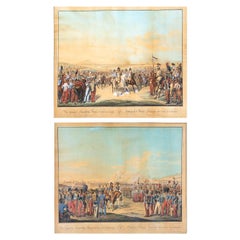
Engravings Hand-Coloured Pair “Tableau de l’Armée Française” Rare

Engravings Hand-Coloured Pair “Tableau de l’Armée Française” Rare

Located in Kastrup, DK

Beautiful set of two hand-colored copper engravings depicting the French Imperial Army during the Napoleonic and Restoration periods. The subjects respectively show the cavalry (1re Section, La Cavalerie – Nouvelle Organisation) and the infantry (2e Section, L’Infanterie – Nouvelle Organisation), both executed after paintings by Louis-François Lejeune (1775–1848) – French general, diplomat, and artist, renowned for his precise and dramatic depictions of the Napoleonic Wars. The engravings were published by Louis de Kleist in Dresden around 1830–1840, with text in both French and German: “Die Königl. Französische Armee” / “Tableau de...

Category

Antique Mid-19th Century French Empire Paintings

Materials

Glass, Wood, Paper

C1830. Pair of French Colored Engravings Amusing Francouis

C1830. Pair of French Colored Engravings Amusing Francouis

Located in Scottsdale, AZ

C1830. Pair of French Colored Engravings Amusing Francouis. Beautiful piece purchased in France. Age appropriate wear, see detailed photos or message us with questions.

Category

Antique 19th Century French Napoleon III Paintings

Materials

Wood, Paint