Title: Antique Exotic Crabs & Fiddler Crab Engraving – Bertuch, c. 1813
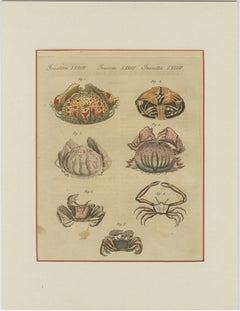
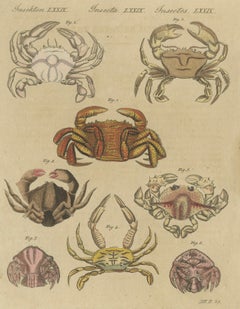
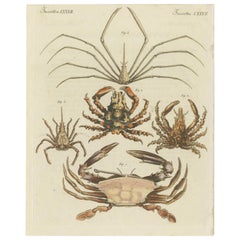
Original antique hand-colored copper engraving depicting seven unusual and highly decorative crabs, published in Friedrich Justin Bertuch’s celebrated “Bilderbuch für Kinder” in Weimar in the early 19th century.
The plate is headed “Insekten LXXVIII / Insecta LXXVIII / Insectes LXXVIII” and presents seven different crab forms, ranging from the spectacular large-clawed specimen at the top to a series of smaller tropical shore and marine crabs below.
As was customary in zoological literature of Bertuch’s period, crustaceans were included within the broad historical category of “Insects.” Under modern zoological classification, all of the animals represented here are crustaceans.
Fig. 1 – Fiddler Crab / Calling Crab Type
The spectacular principal figure shows a long-legged crab with prominently raised red claws.
Crabs with enlarged or conspicuously displayed claws became popularly known as fiddler crabs or calling crabs. The exaggerated claws are used for display, communication and competition between individuals.
Its almost symmetrical pose and bright red claws make this the visual centerpiece of the engraving.
Fig. 2 – Red Shore Crab
A compact and particularly colorful crab with a rounded red carapace, yellow-green legs and contrasting red claws.
Fig. 3 – Pale Tropical Crab
A delicately colored crab with a pale yellow-orange body, elongated legs and prominent claws.
Fig. 4 – Spotted Crab
A small decorative crab with a beautifully patterned orange-red carapace and contrasting darker legs.
Fig. 5 – Horned / Spiny Crab
A remarkable small crab distinguished by its strongly sculpted body and projecting points or spines. Its unusual shape reflects the extraordinary diversity of tropical crab species that fascinated European naturalists.
Fig. 6 – Long-Legged Crab
A pale crab with a compact central body and comparatively long, slender legs.
Fig. 7 – Dark Shore Crab
A dark reddish-brown crab with angular claws and legs, represented in a characteristically defensive or elevated stance.
The exact scientific classification of many crabs illustrated in early natural-history works has changed substantially since Bertuch’s time. For that reason, the descriptive common names above are preferable to assigning modern species names where the historical illustration alone does not permit a secure identification.
Friedrich Justin Bertuch (1747–1822) was a German publisher, writer and patron of the arts. His monumental “Bilderbuch für Kinder” (Picture Book for Children), first published in Weimar in 1790, became one of the great illustrated educational encyclopedias of the late 18th and early 19th centuries.
Its hundreds of engraved and hand-colored plates introduced readers to animals, plants, geography, science, technology, antiquity and cultures from around the world.
This is an especially attractive marine natural-history plate. The seven crabs are presented almost like specimens in a cabinet of curiosities, while the restrained but varied original coloring in red, pink, yellow, green and brown gives the composition considerable decorative appeal.
The companion Bertuch plate “Insekten LXXVII,” illustrating Calappa or box crabs, is also available separately and makes an especially attractive pairing with this engraving.
Technique: Original hand-colored copper engraving
Publisher: Friedrich Justin Bertuch / Industrie-Comptoir
Publication: Bilderbuch für Kinder
Place: Weimar, Germany
Date: early 19th century, circa 1813
Plate: Insekten LXXVIII / Insecta LXXVIII / Insectes LXXVIII
Subject: Exotic Crabs / Marine Crustaceans
Number of figures: Seven
Condition:
Good antique condition with overall age-related toning, scattered foxing and spotting and some visible show-through or offsetting from printed text. Minor marks and imperfections are present consistent with a print more than 200 years old. The original hand coloring remains attractive, particularly the red and pink coloring of the claws and shells. Please study the photographs carefully as they form part of the condition description.
The engraving is loosely inserted in an acid-free matting board.
Please note: This is an original antique hand-colored copper engraving from the early 19th century, not a modern reproduction. The print is sold unframed. Framed images or interior views, if shown, are for presentation and inspiration only.
Other companion marine-life, crustacean and natural-history plates from Bertuch’s “Bilderbuch für Kinder” are also available separately.
Keywords: Friedrich Justin Bertuch, Bilderbuch für Kinder, antique crab print, crab engraving, fiddler crab, calling crab, shore crab, tropical crab, exotic crabs, marine crustaceans, crustacean engraving, marine life, ocean life, marine zoology, antique zoology, natural history illustration, cabinet of curiosities, Wunderkammer, hand-colored copper engraving, early 19th century natural history, German engraving, Weimar, original antique print, coastal decor, seaside decor