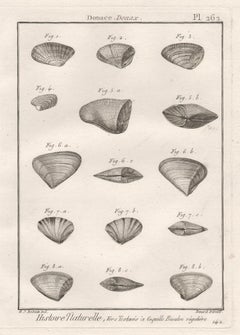
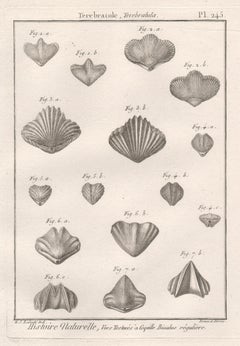
Antique Exotic Seashells & Cone Shells Engraving – Bertuch, c.1800
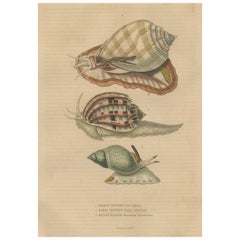
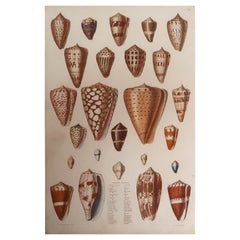
Original antique hand-colored copper engraving depicting seven remarkable and highly decorative seashells, published in Friedrich Justin Bertuch’s celebrated “Bilderbuch für Kinder” around the turn of the 19th century.
The plate is headed “Conchilien III / Conchylia III / Coquilles III” and presents a fascinating selection of marine shells chosen for their unusual shapes, structures and patterns.
Fig. 1 – Winged / Hammer-Shaped Marine Shell
The spectacular shell dominating the upper part of the composition is an unusually elongated and irregular marine shell with dramatic wing-like extensions.
Its extraordinary sculptural form makes it the most visually striking specimen on the plate and reflects the fascination of early naturalists and collectors with unusually formed tropical shells.
Fig. 2 – Patterned Cone Shell
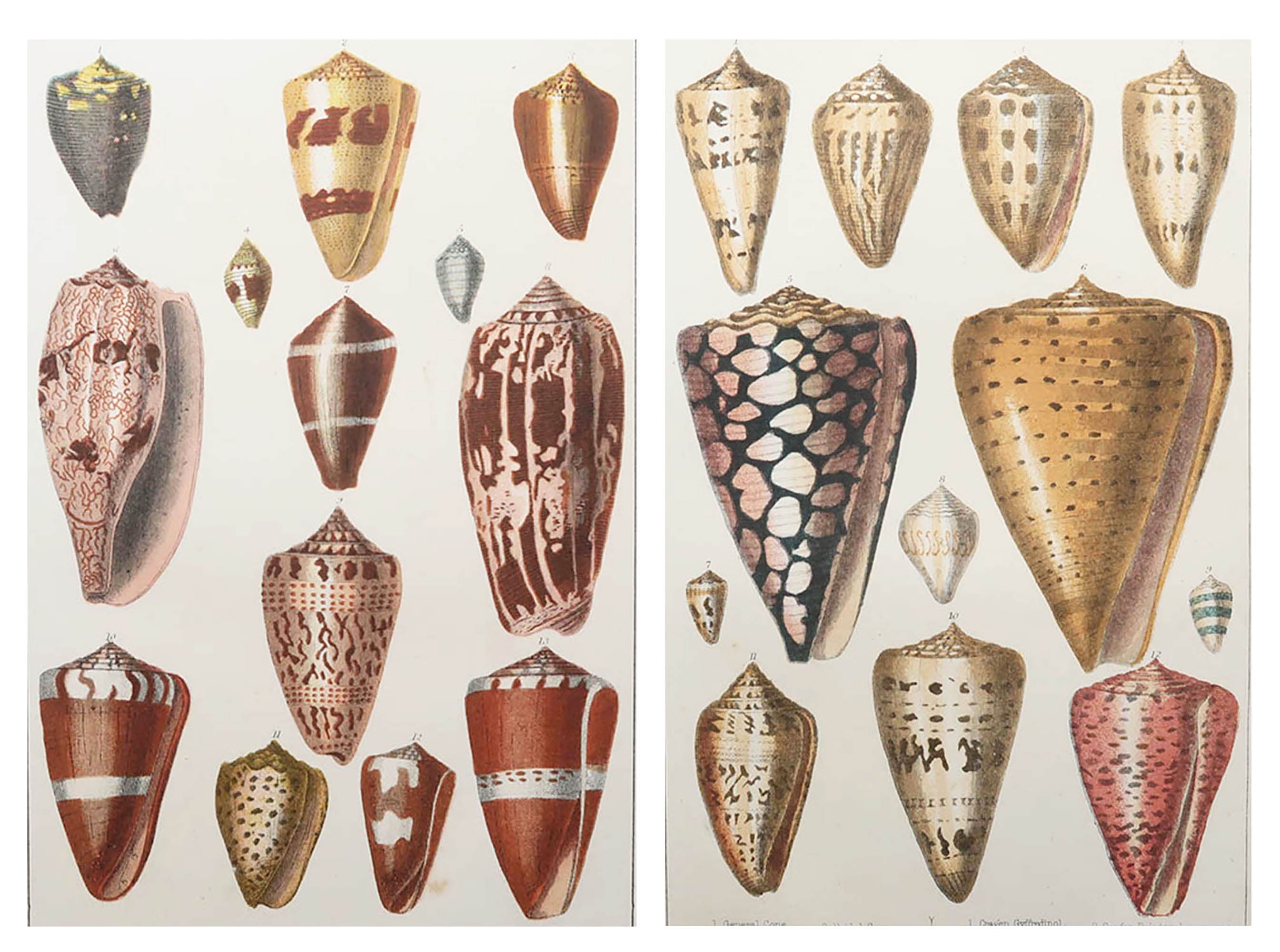
A beautifully patterned cone-shaped marine gastropod, decorated with delicate mottled markings in yellow, green, brown and reddish tones.
Cone shells belong to the large and highly diverse family Conidae and were among the most prized shells in historical European natural-history collections.
Fig. 3 – Banded Cone-Type Shell
An elongated conical shell decorated with numerous fine horizontal bands in shades of pink, brown and cream.
Fig. 4 – Variegated Cone-Type Shell
A richly patterned shell with an attractive combination of brown, red, green and cream markings.
Fig. 5 – Dark Banded Cone Shell
A particularly decorative dark shell ornamented with contrasting horizontal yellow and reddish bands and irregular pale markings.
Fig. 6 – Clustered Spiral Shell Form
An unusual elongated shell composed visually of a succession of rounded chambers or whorls. Its delicate structure contrasts strongly with the heavier cone shells surrounding it.
Fig. 7 – Small Spiral Shell Form
A smaller related shell with a narrow tapering profile and numerous clearly defined whorls.
The Art and Science of Shell Collecting
Seashells occupied a special place in European natural-history collecting during the 18th and early 19th centuries.
Their extraordinary shapes, colors and patterns made them prized objects in cabinets of curiosities and early scientific collections. Rare tropical shells arriving in Europe through expanding maritime trade and exploration could be admired simultaneously as scientific specimens and as beautiful natural objects.
Conchology – the study and collection of shells – consequently became an important branch of natural history.
The beautifully patterned cone shells were particularly attractive to collectors, who developed elaborate systems for distinguishing and naming the many different varieties.
Friedrich Justin Bertuch (1747–1822) was a German publisher, writer and patron of the arts. His monumental “Bilderbuch für Kinder” (Picture Book for Children), first published in Weimar in 1790, became one of the great illustrated educational encyclopedias of the late 18th and early 19th centuries.
Its hundreds of engraved and hand-colored plates introduced readers to animals, plants, geography, science, technology, antiquity and cultures from around the world.
The engraving bears the name J. B. Schmuzer at lower right and is marked VIII B. 5.
This is an especially decorative Bertuch natural-history plate. The combination of the extraordinary large shell at the top with six smaller, intricately patterned specimens gives the composition the appearance of an early museum or cabinet-of-curiosities display.
Technique: Original hand-colored copper engraving
Publisher: Friedrich Justin Bertuch / Industrie-Comptoir
Publication: Bilderbuch für Kinder
Place: Weimar, Germany
Date: circa 1800
Plate: Conchilien III / Conchylia III / Coquilles III
Engraver: J. B. Schmuzer
Plate reference: VIII B. 5
Subject: Exotic Seashells / Marine Gastropods / Cone Shells
Condition:
Good antique condition with overall age-related toning, scattered foxing and spotting and some visible show-through or offsetting from printed text. Minor marks and imperfections are present consistent with the age of the engraving. The original hand coloring remains attractive, with delicate shades of pink, yellow, green, brown and ochre.
The print is currently loosely inserted in a light matting board. The decorative ruled and gilt borders visible around the plate belong to the presentation matting and are not part of the original engraving.
Please study the photographs carefully as they form part of the condition description.
Please note: This is an original antique hand-colored copper engraving from around 1800, not a modern reproduction. The print is sold unframed. Framed images or interior views, if shown, are for presentation and inspiration only.
Other companion shell, marine-life and natural-history plates from Bertuch’s “Bilderbuch für Kinder” are also available separately.
Keywords: Friedrich Justin Bertuch, Bilderbuch für Kinder, antique shell print, seashell engraving, cone shell, Conus, Conidae, exotic seashells, marine shells, shell collection, conchology, antique conchology, cabinet of curiosities, Wunderkammer, marine natural history, ocean life, tropical shells, molluscs, gastropods, hand-colored copper engraving, J B Schmuzer, German engraving, Weimar, circa 1800, antique natural history, original antique print, coastal decor, seaside interior