Want more images or videos?
Request additional images or videos from the seller
1 of 9

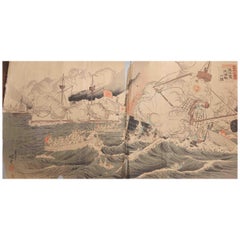
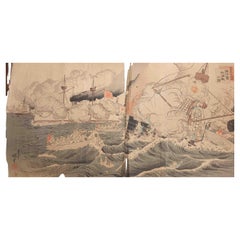
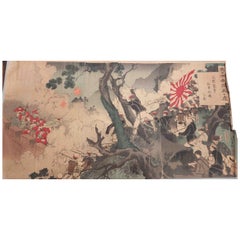
Battle of Port Arthur, Russo-Japanese War Woodblock Triptych, 1904

$825.88
£609.42
€699VAT Included
CA$1,145.12
A$1,163.09
CHF 670.26
MX$14,042.60
NOK 7,785.65
SEK 7,850.61
DKK 5,329.76

About the Item

1904 Battle of Port Arthur, Russo-Japanese War Woodblock Triptych Description: A dramatic original Japanese color woodblock triptych depicting the naval battle of Port Arthur during the opening stages of the Russo-Japanese War. Published in 1904 and signed by the artist Matahei, this striking composition captures one of the most significant naval engagements of the early twentieth century and reflects the patriotic wartime imagery that became immensely popular in Meiji Japan. The title, Nichiro Ryojunkō Daikaisen, translates as "The Great Battle of Port Arthur in the Russo-Japanese War." The scene presents a powerful vision of modern naval warfare, with Japanese warships advancing through turbulent seas while enemy vessels are engulfed in flames and smoke. Towering waves dominate the foreground, emphasizing the violence of both nature and battle. Thick clouds of black smoke rise from steam-powered warships as artillery fire and explosions illuminate the horizon. The Russo-Japanese War of 1904–1905 marked the first major military victory of an Asian power over a European empire in the modern era. The Japanese attack on Port Arthur, located in present-day Lüshunkou, China, was a pivotal event that announced Japan's emergence as a major world power. Artists responded quickly to public demand for visual news reports, producing vividly colored triptychs that documented battles, military heroes, and wartime victories. Matahei's composition demonstrates the influence of traditional ukiyo-e design combined with modern military subject matter. The dramatic curling waves recall the great maritime prints of earlier Japanese masters, while the steamships, naval flags, and artillery represent the technological realities of twentieth-century warfare. The contrast between the cool blue-grey sea and the brilliant reds of fire and explosions creates a particularly dynamic visual effect. Today, Russo-Japanese War prints are highly sought after by collectors of military history, naval art, Japanese prints, and Meiji-period material. This example is especially attractive for its panoramic composition and strong depiction of naval combat. An original 1904 Japanese woodblock print and not a later reproduction. Condition Report: Complete oban triptych. Creasing to the left and right margins. Margins slightly trimmed short in places. Hole and associated tears in the upper left corner. Backed or reinforced on the reverse. General age toning and handling wear consistent with age. Despite these condition issues, the image remains visually strong and displays well. Framing Tips: This triptych is ideally suited for panoramic framing. A dark walnut, black lacquer, or ebonized frame paired with an ivory museum mat would complement the dramatic maritime subject and the print's original colors. UV-protective glazing is recommended. Technique: Color woodblock print (Nishiki-e), oban triptych Maker: Matahei, Japan, 1904
  • Dimensions:
    Height: 14.1 in (35.8 cm)Width: 27.84 in (70.7 cm)Depth: 0.01 in (0.2 mm)
  • Materials and Techniques:
    Paper,Engraved
  • Place of Origin:
  • Period:
  • Date of Manufacture:
    circa 1904
  • Condition:
    Complete oban triptych. Creasing to the left and right margins. Margins slightly trimmed short in places. Hole and associated tears in the upper left corner. Backed or reinforced on the reverse. General age toning and handling wear.
  • Seller Location:
    Langweer, NL
  • Reference Number:
    Seller: BG-143101stDibs: LU3054350574692

More From This Seller

View All
Meiji-Era Triptych of the Battle of Pyongyang in the Sino-Japanese War, 1894

Meiji-Era Triptych of the Battle of Pyongyang in the Sino-Japanese War, 1894

Located in Langweer, NL

Meiji-Era Triptych of the Battle of Pyongyang in the Sino-Japanese War, 1894 This striking 1894 woodblock triptych by Ogata Gekko (1859–1920) depicts the dramatic Battle of Pyongyan...

Category

Antique 1890s Japanese Prints

Materials

Paper

Fortress Assault Triptych – 1894 Japanese Meiji War Woodblock by Gekko

Fortress Assault Triptych – 1894 Japanese Meiji War Woodblock by Gekko

Located in Langweer, NL

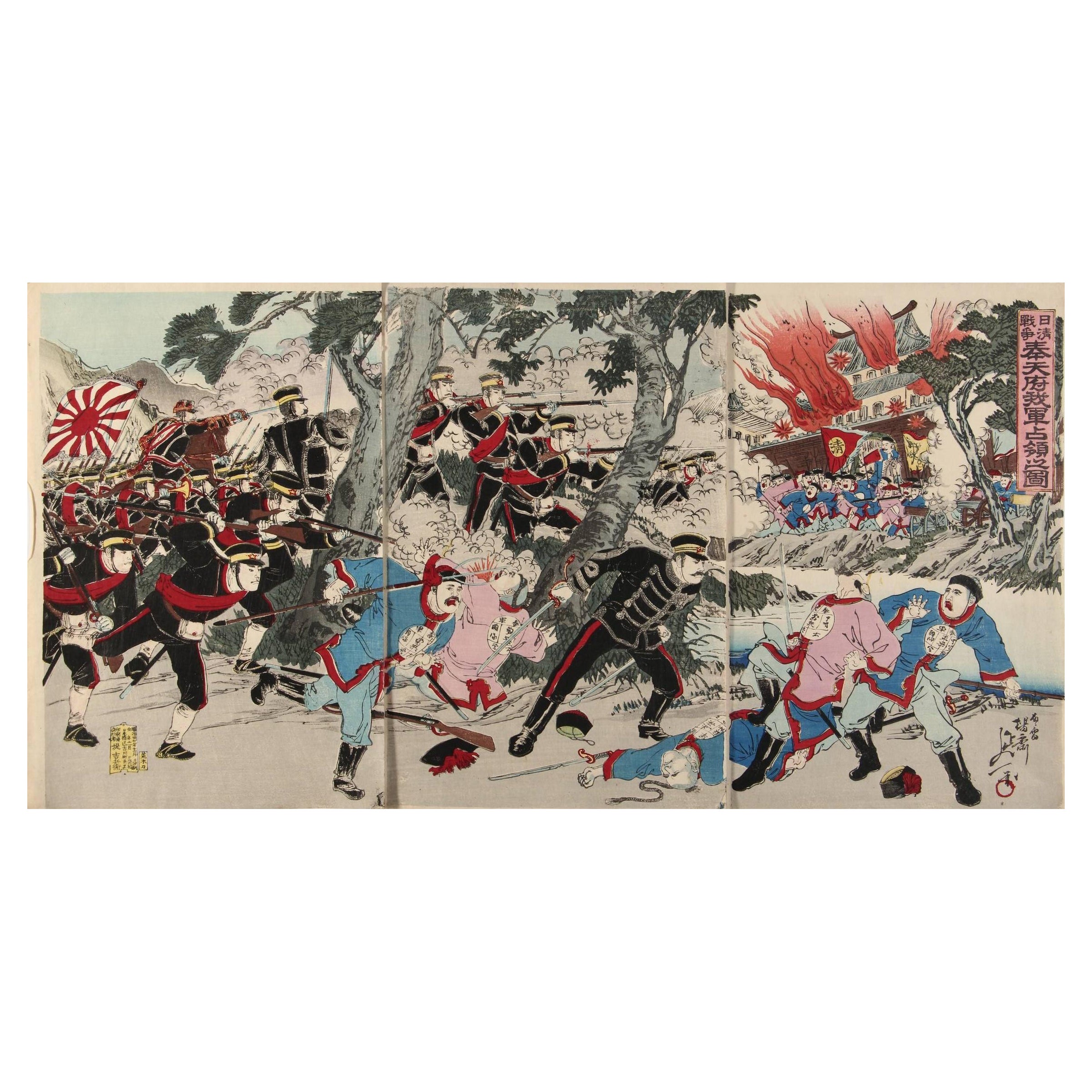
Fortress Assault Triptych – 1894 Japanese Meiji War Woodblock by Gekko This powerful Meiji-era woodblock triptych by Ogata Gekko (1859–1920) depicts the dramatic assault on a Chines...

Category

Antique 1890s Japanese Prints

Materials

Paper

Emperor Meiji Silver Wedding Jubilee, Nobukazu Japanese Triptych, 1894

Emperor Meiji Silver Wedding Jubilee, Nobukazu Japanese Triptych, 1894

Located in Langweer, NL

Emperor Meiji Silver Wedding Jubilee, Nobukazu Japanese Triptych, 1894 Description: An impressive original Japanese color woodblock triptych by Yosai Nobukazu depicting the grand ce...

Category

Antique Late 19th Century Japanese Prints

Materials

Paper

Chikanobu Triptych – Shogun Returns from the Hunt in Koganehara, c.1897

Chikanobu Triptych – Shogun Returns from the Hunt in Koganehara, c.1897

Located in Langweer, NL

Chikanobu Triptych – Shogun Returns from the Hunt in Koganehara, c.1897 This powerful and dynamic triptych by Toyohara Chikanobu (1838–1912) depicts the Shogun and his retinue returning from a falconry hunt across the vast grasslands of Koganehara. The print is part of the celebrated Meiji-era series Chiyoda no Omote (Outer Palace of Chiyoda), which portrayed ceremonial and military scenes from the life of the Tokugawa shogunate. This series blends historical reverence with a modern Meiji sensibility, celebrating Japan’s warrior heritage at a time of rapid transformation. Rendered in rich color and vivid linework, the triptych shows a noble procession in motion: the mounted Shogun at center turns back toward the viewer, while falconers and warriors in elaborate dress surround him. Attendants carry game and falconry equipment, and a dense forest line marks the horizon behind them. The sweeping composition emphasizes both movement and status, with the central figure visually dominant and placed against a pale, open sky. The triptych is signed by Chikanobu with the toshidama cartouche and published by Fukuda Hatsujirō around 1897. Chikanobu, one of the last great ukiyo-e masters, was celebrated for his ability to capture imperial ceremony, samurai culture, and the feminine elegance of the court — often in triptych format for dramatic impact. While the work shows some age-related signs, it retains strong visual appeal and is a compelling historical document of samurai-era tradition as imagined through Meiji eyes. Condition report: Good overall condition considering age. The three sheets are mounted together on old Japanese paper backing (verso), which is loosening slightly along the joins. Light overall toning and minor wrinkling across the panels. Colors remain well preserved with strong impression and no major losses or tears. Margins present, minor handling wear visible. A stable and attractive display piece. Framing tips: We recommend float mounting the full triptych in a custom horizontal frame, allowing the slight backing and joins to remain visible as part of its historical charm. Use a dark walnut or black lacquer frame with an off-white or light beige acid-free mat. Proper archival mounting can help preserve the integrity of the backing while enhancing its display quality. Technique: Woodblock print (ōban triptych) Maker: Toyohara Chikanobu, Japan, c.1897 Publisher: Fukuda Hatsujirō Keywords: Chikanobu triptych, samurai falconry print, Japanese woodblock print, Meiji print, Chiyoda no Omote, shogun artwork, Koganehara, antique Japanese triptych...

Category

Antique 1890s Japanese Prints
Materials

Paper

Tonkin War Battle Scene, Défense de Tuyen-Quan, Épinal Print, 1885

Tonkin War Battle Scene, Défense de Tuyen-Quan, Épinal Print, 1885

Located in Langweer, NL

Défense de Tuyen-Quan Tonkin 1885 French Colonial Battle Épinal Print This vivid French color lithograph depicts the heroic defense of Tuyen-Quan during the Tonkin Campaign, fought ...

Category

Antique 1880s French Prints

Materials

Paper

You May Also Like

Antique Woodblock Print by Sino Japan War Naval Battle Haiyang Island, 1894

Antique Woodblock Print by Sino Japan War Naval Battle Haiyang Island, 1894

Located in Amsterdam, Noord Holland

Fantastic depiction of the naval Battle of Haiyang Island during the Sino-Japanese War. An explosion rocks a Chinese ship at right, severing the mast and sending enemy sailors tumbli...

Category

Antique 19th Century Japanese Prints

Materials

Paper

Antique 19th c Woodblock Print by Sino Japan War Naval Battle Haiyang Island

Antique 19th c Woodblock Print by Sino Japan War Naval Battle Haiyang Island

Located in Amsterdam, Noord Holland

A very strong woodblock print - Fantastic depiction of the naval Battle of Haiyang Island during the Sino-Japanese War. An explosion rocks a Chinese ship at right, severing the mast...

Category

Antique 19th Century Chinese Meiji Paintings and Screens

Materials

Bronze

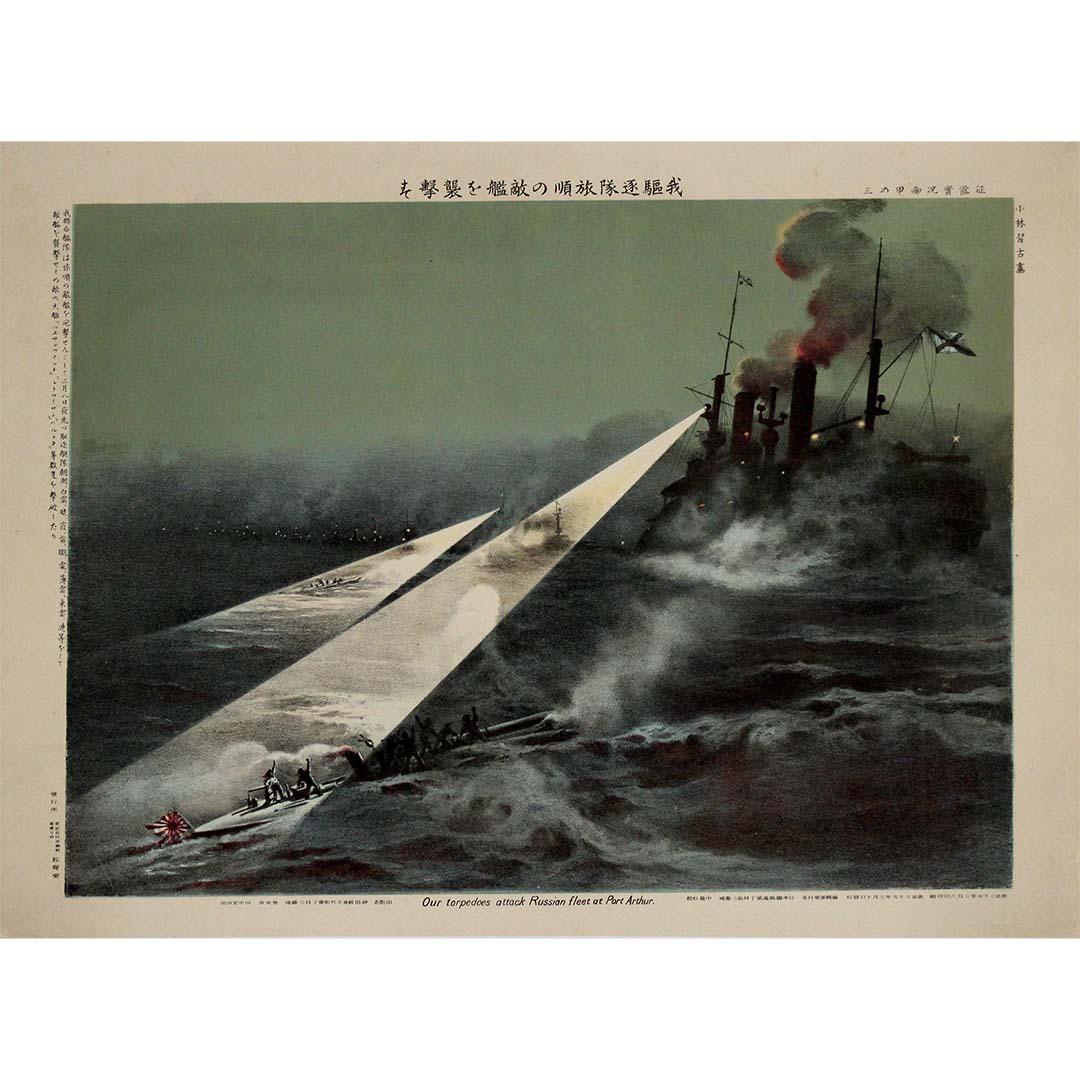
Russo-Japanese War Our torpedoes attack Russian fleet at Port Arthur

Russo-Japanese War Our torpedoes attack Russian fleet at Port Arthur

Located in PARIS, FR

The Russo-Japanese War (1904–1905) marked a pivotal moment in naval warfare, and this circa 1900 original print vividly captures the intensity of battle. Titled "Our Torpedoes Attack...

Category

1910s Prints and Multiples

Materials

Linen, Paper, Lithograph

Antique Woodblock Print by Mizuno Toshikata- Sino Japan Battle of Songhwan

Antique Woodblock Print by Mizuno Toshikata- Sino Japan Battle of Songhwan

Located in Amsterdam, Noord Holland

A very strong woodblock print Long live the Great Japanese Empire! Our army’s victorious attack on Seonghwan, Mizuno Toshikata 1866-1908. or Hurrah and Hurrah Again for the Great...

Category

Antique 19th Century Japanese Prints

Materials

Paper