Want more images or videos?
Request additional images or videos from the seller
1 of 9

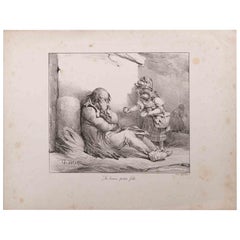
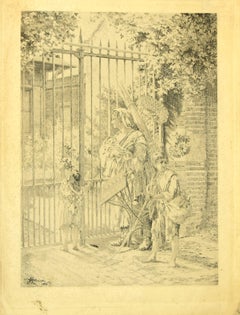
Beggar with Children Asking for Alms, Bellangé Social Scene Lithograph, 1828

$340.10
£252.01
€289VAT Included
CA$473.44
A$481.66
CHF 276.77
MX$5,791.94
NOK 3,231.20
SEK 3,250.54
DKK 2,203.63

About the Item

Beggar with Children Asking for Alms, Bellangé Social Scene Lithograph 1828 This evocative early nineteenth-century lithograph depicts a touching scene of poverty and charity in rural France. The print was created by the French artist Joseph Louis Hippolyte Bellangé (1800–1866), one of the most important Romantic-era illustrators of everyday life and military subjects. The work was published in Paris in 1828 by Gihaut frères as plate number 8 from the series Album pour 1828. The scene centers on a traveling beggar who has stopped at the window of a modest rural house to ask for alms. The man carries a walking stick and a worn pack slung over his shoulder, suggesting the life of a wandering poor man moving from village to village. His raised hand and upward gaze toward the window indicate a polite appeal for help. Beside him stand two children, reinforcing the emotional weight of the scene. One child stretches an arm upward while the other stands quietly, emphasizing the vulnerability of the group and the dependency on the kindness of strangers. At the window above them a woman looks out from the house, creating a moment of human interaction that forms the narrative focus of the composition. Bellangé was particularly skilled at portraying expressive social scenes like this one. While he became famous for his depictions of soldiers and military life, he also produced many genre scenes that reflected the realities of nineteenth-century French society. Rural poverty, traveling laborers, and wandering beggars were common sights during the period, and artists of the Romantic era often explored such subjects with sympathy and narrative depth. The composition is carefully arranged. The stone wall of the house and the small window frame the central interaction between the figures, while the surrounding countryside and rustic architecture place the event within a modest village environment. Bellangé’s confident lithographic technique creates soft tonal transitions and finely rendered details, particularly in the textures of clothing, masonry, and foliage. Lithography was still a relatively new printing technique during the 1820s, and Paris quickly became one of the most important centers for its development. Publishers such as Gihaut frères issued numerous illustrated albums that combined art, storytelling, and social commentary, making prints like this accessible to a broad audience. The printed title below the image identifies the scene simply as “The Beggar,” emphasizing the universal theme of poverty and charity that would have been immediately recognizable to contemporary viewers. Today the work is appreciated as a compelling example of early Romantic lithography and as a vivid record of social life in nineteenth-century France. This original antique print is offered unframed, allowing the buyer full freedom of framing choice. Condition report: Good condition with light age toning and scattered foxing mainly visible in the wide margins, typical for lithographs of this period. The printed image remains clear with good contrast. Framing tips: This lithograph displays beautifully in a dark walnut or ebonized frame with a generous ivory or cream mat. The wide margins allow for a refined museum-style presentation that highlights the delicate tonal range of the lithograph. Technique: Lithograph Maker: Joseph Louis Hippolyte Bellangé, France, 1828 Keywords: antique lithograph, Bellange lithograph, Joseph Louis Hippolyte Bellange, beggar scene print, social realism print, nineteenth century France print, French genre scene, rural poverty scene, charity scene artwork, romantic era lithograph, Album pour 1828 print, Gihaut frères Paris publisher, early lithography, antique social scene print, French village life artwork, historical genre print, collectible French lithograph
  • Dimensions:
    Height: 14.3 in (36.3 cm)Width: 10.91 in (27.7 cm)Depth: 0.01 in (0.2 mm)
  • Materials and Techniques:
  • Place of Origin:
  • Period:
  • Date of Manufacture:
    circa 1828
  • Condition:
    Good condition with light age toning and scattered foxing mainly visible in the wide margins, typical for lithographs of this period. The printed image remains clear with good contrast.
  • Seller Location:
    Langweer, NL
  • Reference Number:
    Seller: BG-14273-381stDibs: LU3054349206372

More From This Seller

View All
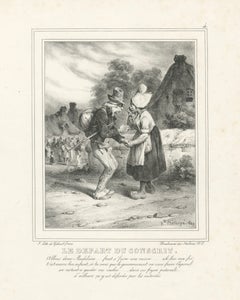
Young Soldier Saying Farewell to Sweetheart, Romantic French Lithograph c.1830

Young Soldier Saying Farewell to Sweetheart, Romantic French Lithograph c.1830

Located in Langweer, NL

Young Soldier Saying Farewell to Sweetheart, Romantic French Lithograph c.1830 This expressive early nineteenth-century lithograph depicts a touching farewell scene between a young ...

Category

Antique Early 19th Century French Prints

Materials

Paper

Antique Print of a Young Beggar, 1835

Antique Print of a Young Beggar, 1835

Located in Langweer, NL

Antique print titled 'The Young Beggar'. Old print of a young beggar made after the painting by Murillo. It shows a beggar boy seated on the floor of a simp...

Category

Antique 19th Century British Prints

Materials

Paper

1835 Hand-Colored Lithograph: Poor Children - A Scene of Poverty and Compassion

1835 Hand-Colored Lithograph: Poor Children - A Scene of Poverty and Compassion

Located in Langweer, NL

Description of the Print This print, titled "De Arme Kinderen" (The Poor Children), depicts a poignant scene of poverty and hardship. The central figures are a woman and a young boy...

Category

Antique 1830s Prints

Materials

Paper

Medieval French Merchants in Discourse, Original Antique Engraving of 1847

Medieval French Merchants in Discourse, Original Antique Engraving of 1847

Located in Langweer, NL

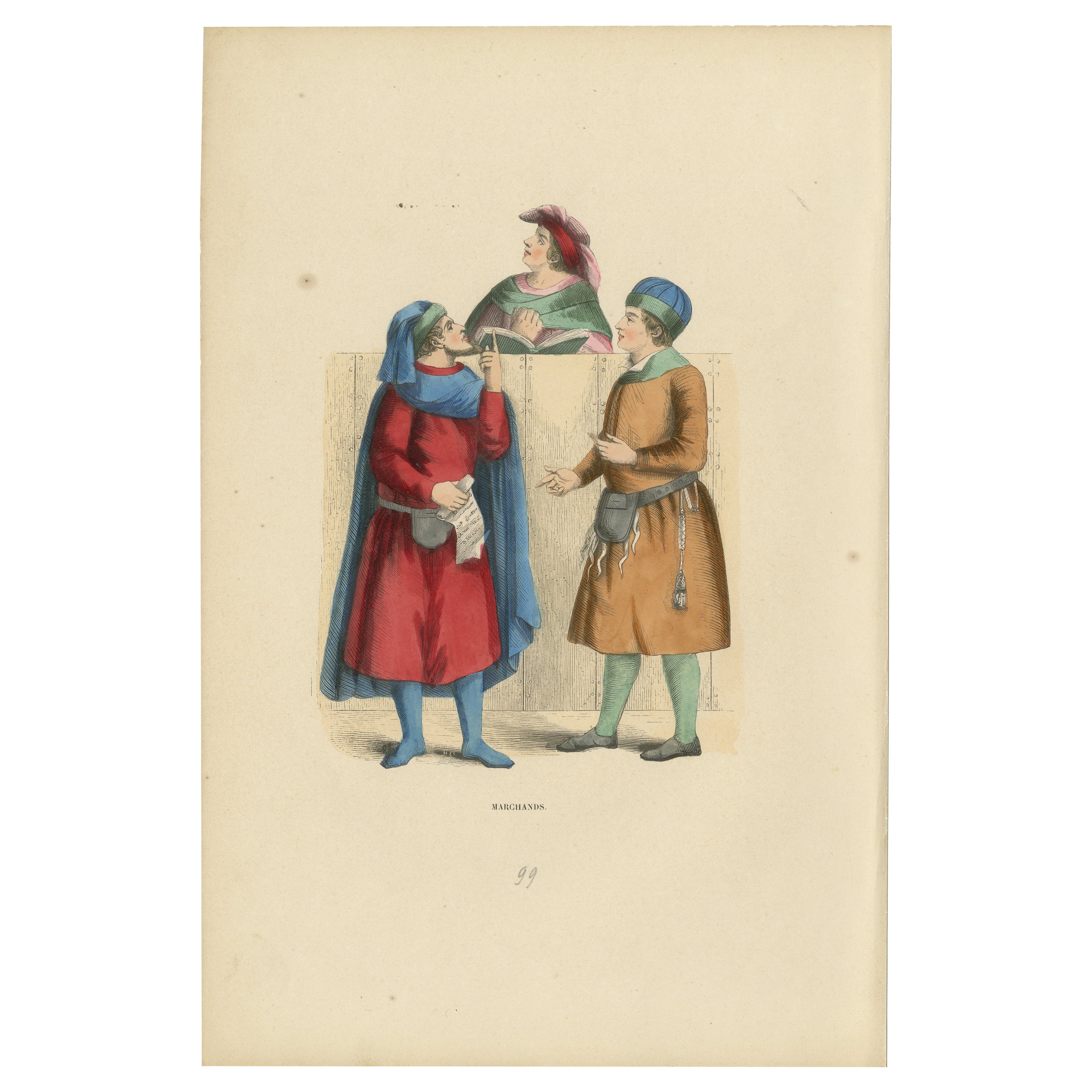
Title: "Medieval Merchants in Discourse" Description: This colorful print is titled "Marchands," which means "Merchants" in French, suggesting that it portrays a scene of merchants ...

Category

Antique 1840s Prints

Materials

Paper

Neapolitan Pilgrims Etching - 1819 Pinelli & Bridgens Print

Neapolitan Pilgrims Etching - 1819 Pinelli & Bridgens Print

Located in Langweer, NL

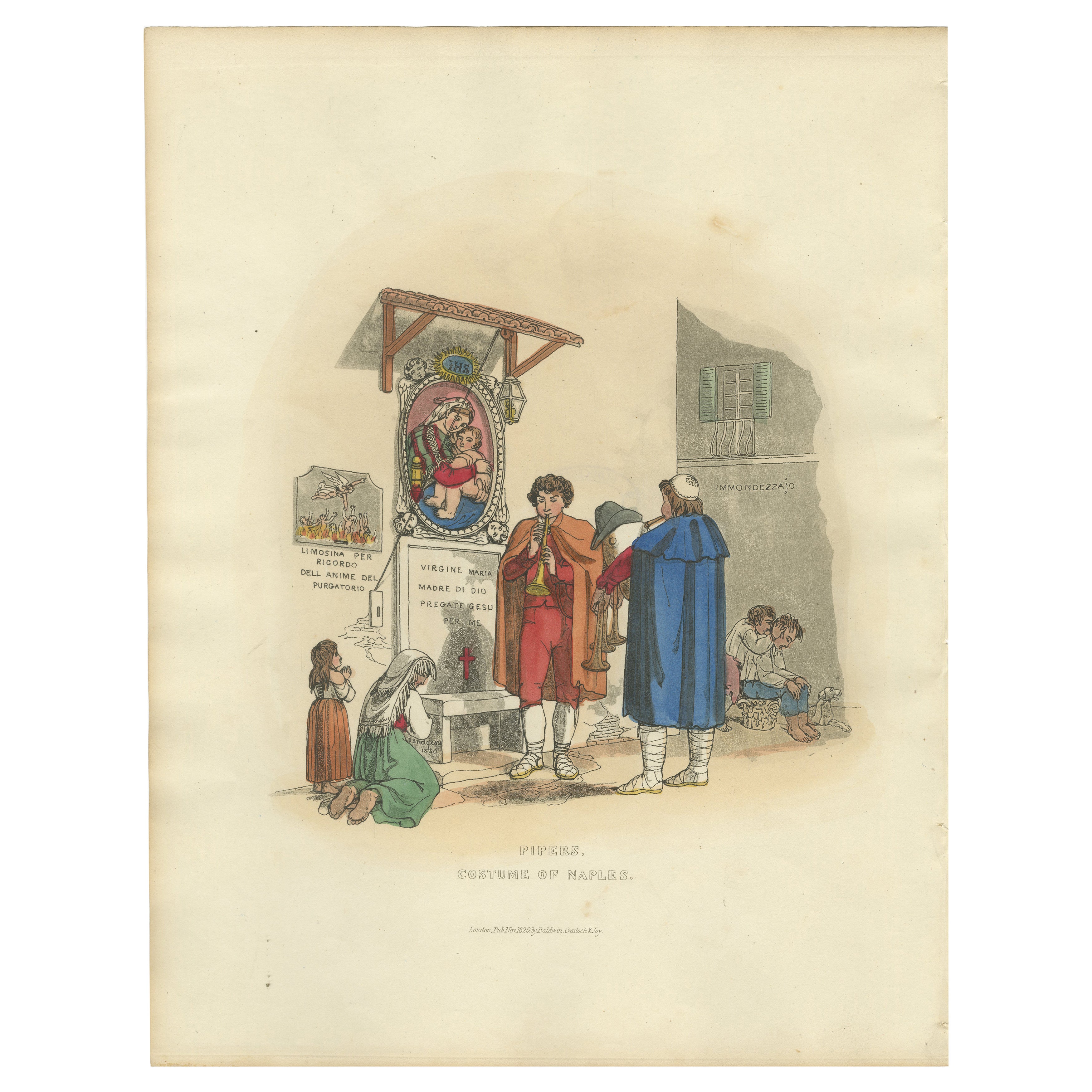
Title: Neapolitan Pilgrims Etching - 1819 Pinelli & Bridgens Print Description: This evocative 1819 etching, titled "Pilgrims, Costumes of Naples," captures a poignant moment of devotion in 19th-century Naples, masterfully illustrated by Italian artist Bartolomeo Pinelli with contributions from British artist Richard Bridgens. The scene centers on a group of pilgrims gathered around a roadside shrine dedicated to the Virgin Mary, as indicated by the Italian inscriptions like "Vergine di Maria Pregate Gesu per Me" (Virgin Mary, Pray to Jesus for Me). The pilgrims, dressed in traditional Neapolitan attire, embody the region’s deep Catholic faith. A figure in a red robe stands solemnly with a staff, while another in a blue cloak kneels in prayer, joined by children who add a sense of familial unity. The shrine features a framed image of the Virgin and Child, adorned with symbolic elements like a cross and a depiction of souls in purgatory, reflecting the spiritual fervor of the time. Bartolomeo Pinelli (1781–1835), born in Rome, was renowned for his detailed etchings of Italian...

Category

Antique 1810s Prints
Materials

Paper

Old Antique Engraving of a Woman and Children of Amsterdam, Holland, 1817

Old Antique Engraving of a Woman and Children of Amsterdam, Holland, 1817

Located in Langweer, NL

Antique costume print titled 'Woman & Children of Amsterdam'. Old costume print depicting a woman and children from Amsterdam. This print originates from 'The Costume of the Netherla...

Category

Antique 19th Century Prints

Materials

Paper

You May Also Like

Pauvres Enfants!! - Lithograph by Auguste Raffet - 1830s

Pauvres Enfants!! - Lithograph by Auguste Raffet - 1830s

By Auguste Raffet

Located in Roma, IT

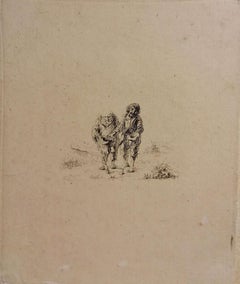
Lithograph on wove paper, realized between 1830s and 840s. Signed in the plate. Pronounced foxing across sheet, heavier toward the edges; scattered water stains and one dark spot a...

Category

1830s Modern Figurative Prints

Materials

Lithograph