Want more images or videos?
Request additional images or videos from the seller
1 of 6

Devout Reflection: A Medieval Bourgeoise in Prayer, 1847

$120.68
$150.8520% Off
£90.61
£113.2620% Off
€104VAT Included
€13020% Off
CA$170.19
CA$212.7420% Off
A$172.90
A$216.1220% Off
CHF 98.78
CHF 123.4720% Off
MX$2,110.03
MX$2,637.5320% Off
NOK 1,155.77
NOK 1,444.7120% Off
SEK 1,172.90
SEK 1,466.1220% Off
DKK 793.40
DKK 991.7520% Off

About the Item

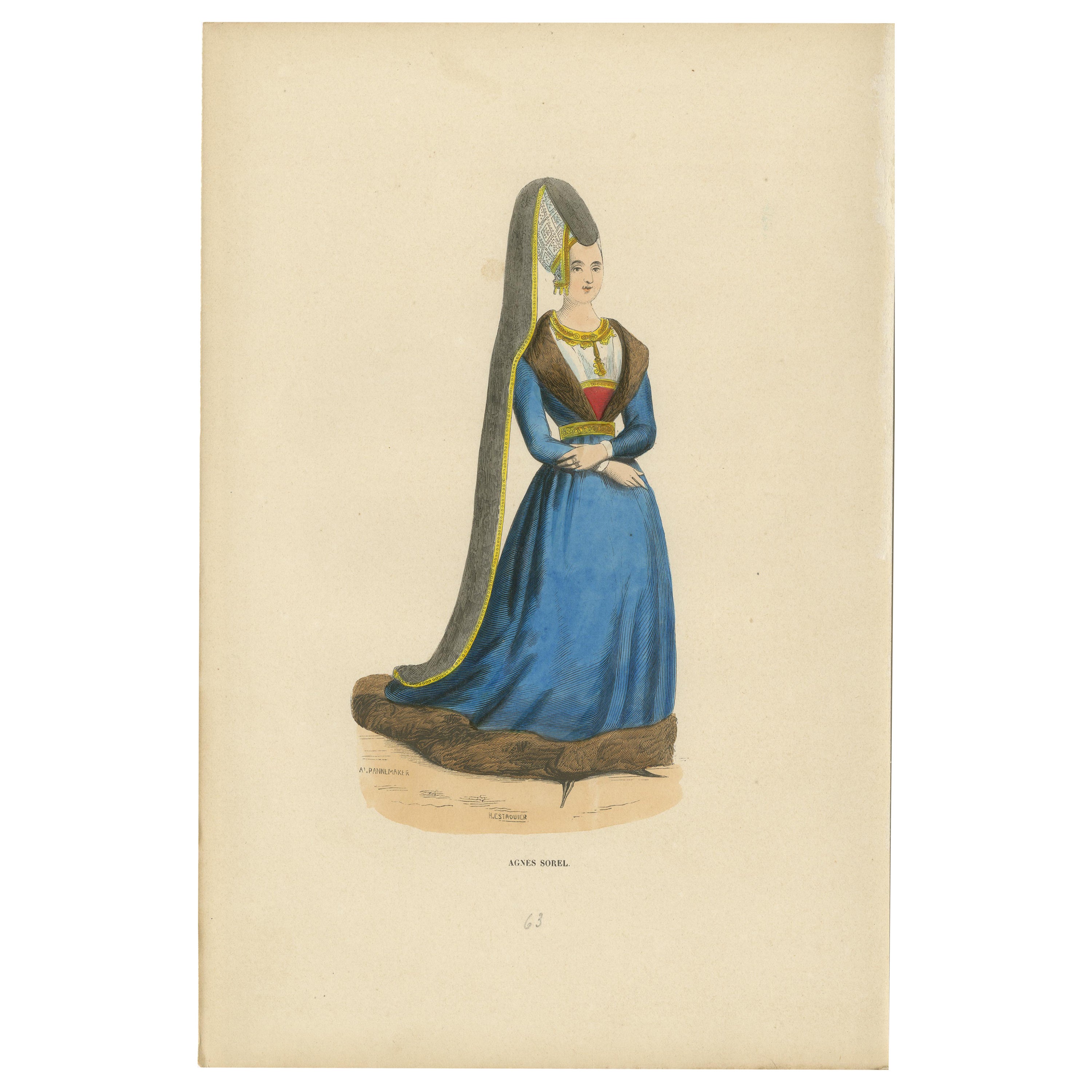
Title: "Devout Reflection: A Medieval Bourgeoise in Prayer" Description: This print presents a serene image of a woman, labeled as a bourgeoise, engaged in an act of devotion. Her attire reflects a modest yet refined status, suitable for a woman of the middle class in medieval society. She is clothed in a full-length robe or gown of a gentle hue, which falls softly to the ground, conveying a sense of simplicity and humility. The gown is cinched at the waist, creating a graceful silhouette that is both modest and becoming of her status. Over her gown, she wears a mantle or cloak that drapes around her shoulders and flows down, with visible detailed edging that adds a subtle decorative element to her outfit. The cloak's texture is finely rendered, suggesting a quality fabric that denotes her respectable position in society. Her head is covered with a wimple and veil, traditional head coverings for women of the time, which symbolize modesty and piety. The wimple frames her face, directing focus to her calm and contemplative expression. Her hands are clasped in front of her chest, holding a string of beads, likely a rosary, which serves as a focal point for prayer and meditation. The beads provide a stark contrast against her pale attire, with their red color symbolizing passion and the suffering of Christ, common themes in devotional practice. Her posture and the closed eyes indicate a moment of quiet introspection or prayer, reflecting the importance of personal faith and devotion in the lives of the medieval laity. The image captures a moment of spirituality and the inward focus of a woman finding solace and strength in her faith. The colors have a nice glow over them. Historically, egg whites, known as glair, and sometimes egg yolk were indeed used in illumination and painting, particularly in manuscripts, to give colors a brighter appearance and to add a sheen or gloss to the work. This technique was quite common during the Middle Ages and into the Renaissance. Egg whites can be applied as a varnish over pigments to enhance their brightness and to protect the colors. This application could make the colors appear more vivid and also add a slight glossy sheen to the surface of the image. Egg yolk, on the other hand, was commonly used as a binding agent in paint. It forms the basis of tempera paint, a medium that was widely used before the advent of oil painting. Egg yolk helps to create a durable and long-lasting color that adheres well to various surfaces. In the context of the print from 1847, it's less likely that egg whites or yolks were used directly on the print, as by that time, commercial printing processes would have been more advanced and less reliant on such manual methods. However, if this print is a representation of an earlier style or is meant to mimic the appearance of hand-painted manuscripts, the original artists might have employed techniques or materials that gave a similar effect to those achieved with egg-based binders and varnishes.
  • Dimensions:
    Height: 10.63 in (27 cm)Width: 7.09 in (18 cm)Depth: 0 in (0.02 mm)
  • Materials and Techniques:
  • Period:
  • Date of Manufacture:
    1847
  • Condition:
    Good. Overal light toning and light soiling but the image itself clean and hand-colored almost 200 years ago and still in expliciet colors. Aged paper with typically warm, yellowish-brown hue, mostly around the edges. Study the image carefully.
  • Seller Location:
    Langweer, NL
  • Reference Number:
    Seller: BG-13635-511stDibs: LU3054337895002

More From This Seller

View All
The Noble's Plea: A German Aristocrat in Supplication, 1847

The Noble's Plea: A German Aristocrat in Supplication, 1847

Located in Langweer, NL

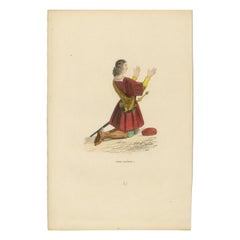
The image depicts a figure labeled as "Noble Allemand," which means "German Noble." The nobleman is shown kneeling on one leg, with his hands raised in what could be a gesture of exc...

Category

Antique 1840s Prints

Materials

Paper

Scholar of the Arts: The Medieval Academic, 1847

Scholar of the Arts: The Medieval Academic, 1847

Located in Langweer, NL

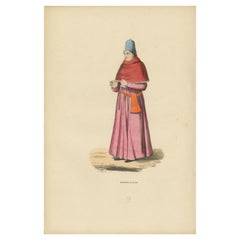
Title: "Scholar of the Arts: The Medieval Academic" Description: This print illustrates a learned individual, likely a doctor of the arts or a scholar, from the medieval period. The...

Category

Antique 1840s Prints

Materials

Paper

Religious Costume c.1400 – Antique 1845 Print of Ecclesiastical Figure

Religious Costume c.1400 – Antique 1845 Print of Ecclesiastical Figure

Located in Langweer, NL

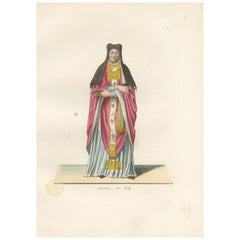
Ecclesiastical Figure in Ceremonial Robes, circa 1400 This elegant hand-colored engraving, plate number 83 from the renowned 1845 publication Costumes Historiques des XIIIe, XIVe et...

Category

Antique Mid-19th Century French Prints

Materials

Paper

Everyday Grace: A Common Woman of the Past, 1847

Everyday Grace: A Common Woman of the Past, 1847

Located in Langweer, NL

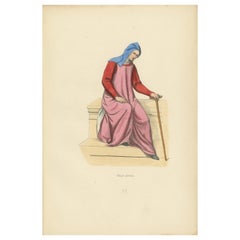
The original antique print shows a seated figure labeled "Muger plebeia," which translates from Spanish to "Plebeian Woman" or "Common Woman." The woman is dressed in a simple yet elegant manner, indicative of the common people of the time. She is wearing a long dress in a pinkish hue with a red overdress or tunic, which drapes gracefully around her. On her head, she wears a blue hood that covers her hair, which was typical for women during various historical periods to denote modesty or as a fashion statement. Her seated position and the presence of the cane suggest rest or perhaps age. The simplicity of her clothing, without elaborate jewelry or adornments, signifies her status as part of the lower social class, although her clothing is neat and well-kept. Egg whites can be applied as a varnish over pigments to enhance their brightness and to protect the colors. This application could make the colors appear more vivid and also add a slight glossy sheen to the surface of the image. Egg yolk, on the other hand, was commonly used as a binding agent in paint. It forms the basis of tempera paint, a medium that was widely used before the advent of oil painting. Egg yolk helps to create a durable and long-lasting color that adheres well to various surfaces. In the context of the print from 1847, it's less likely that egg whites or yolks were used directly on the print, as by that time, commercial printing processes would have been more advanced and less reliant on such manual methods. However, if this print is a representation of an earlier style or is meant to mimic the appearance of hand-painted manuscripts...

Category

Antique 1840s Prints

Materials

Paper

Dignified Poise of a Spanish Noblewoman in an Original Lithograph Published 1847

Dignified Poise of a Spanish Noblewoman in an Original Lithograph Published 1847

Located in Langweer, NL

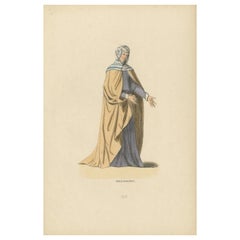
Title: "Dignified Poise of a Spanish Noblewoman: A Lithographic Study from 'Costume du Moyen Âge'" Description: This striking lithograph from the historic 1847 anthology "Costume du Moyen Âge" portrays a Spanish noblewoman in traditional attire, captured with an essence of nobility and refined grace. The noblewoman is depicted in a three-quarter stance, her gaze gently directed towards the viewer, which creates an intimate connection with the audience. Her dress is a harmony of practicality and elegance, characterized by a full-length, tan cloak that wraps around her figure, edged with a subtle blue stripe that adds a touch of color to the otherwise muted palette. The noblewoman's headdress, a distinctive feature of her ensemble, is a beautifully patterned headscarf, its intricate design suggesting a status of wealth and sophistication. The scarf is secured around her head and beneath her chin, framing her face and highlighting her serene and composed expression. Beneath the cloak, glimpses of a dark undergarment can be seen, suggesting layers that were typical of the era's fashion. Her right hand extends gracefully, perhaps in a gesture of communication or to display her ring, indicative of her marital status and her family's coat of arms. The lithograph demonstrates an exquisite attention to textile and pattern, which not only conveys the fashion of the period but also the cultural identity and social stature of the noblewoman. As with other pieces in the collection, the background is deliberately left blank, focusing all attention on the subject and her costume. This lithographic work serves as both an artistic and historical document, offering insight into the lifestyle and status of noblewomen in medieval...

Category

Antique 1840s Prints
Materials

Paper

You May Also Like

Uses and Customs - Prayer - Lithograph - 1862

Uses and Customs - Prayer - Lithograph - 1862

Located in Roma, IT

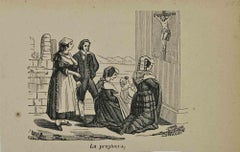
Uses and Customs - Prayer is a lithograph on paper realized in 1862. The artwork belongs to the Suite Uses and customs of all the peoples of the universe: " History of the governmen...

Category

1860s Modern Figurative Prints

Materials

Lithograph

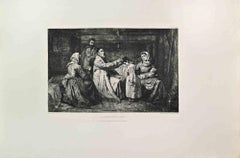
La. Benediction de l'Aieul - Etching by Edouard Moyse - 1860s

La. Benediction de l'Aieul - Etching by Edouard Moyse - 1860s

Located in Roma, IT

La. Benediction de l'Aieul is a black and White etching realized by Edouard Moyse in the 1860s.  Titled in the lower. Image size:23x31. Very good impression with wide margins and ...

Category

1860s Modern Figurative Prints

Materials

Etching

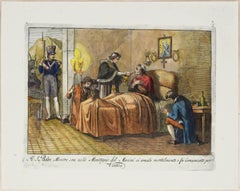
The Holy Father -  Etching - 19th Century

The Holy Father - Etching - 19th Century

Located in Roma, IT

The Holy Father is an original etching hand-watercolored on paper, realized by an Anonymous italian artist in 19th Century. With description on the lower in Italian. In good condit...

Category

19th Century Modern Figurative Prints

Materials

Etching

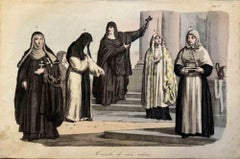
Uses and Customs - Nuns - Lithograph - 1862

Uses and Customs - Nuns - Lithograph - 1862

Located in Roma, IT

Uses and Customs - Nuns is a lithograph on paper realized in 1862. The artwork belongs to the Suite Uses and customs of all the peoples of the universe: " History of the government,...

Category

1860s Modern Figurative Prints

Materials

Lithograph

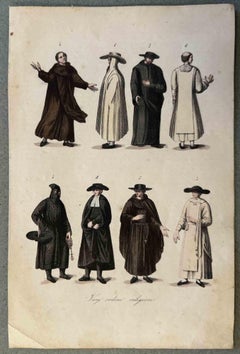
Uses and Customs - Various Religion Orders - Lithograph - 1862

Uses and Customs - Various Religion Orders - Lithograph - 1862

Located in Roma, IT

Uses and Customs - Various Religion Orders is a lithograph on paper realized in 1862. The artwork belongs to the Suite Uses and customs of all the peoples of the universe: " History...

Category

1860s Modern Figurative Prints

Materials

Lithograph