Want more images or videos?
Request additional images or videos from the seller
1 of 6

Exotic Botanicals Unveiled: The Ginger Plant in Art and Science, 1845

$270.80
£200.44
€230VAT Included
CA$377.26
A$383.71
CHF 219.41
MX$4,641.32
NOK 2,570.79
SEK 2,570.18
DKK 1,753.77

About the Item

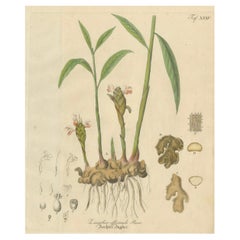
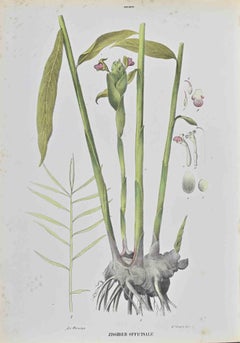
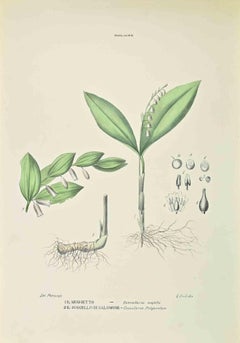
Antique botanical engraving of Amomum zinziber, better known as ginger. The engraving shows various parts of the ginger plant in a detailed, scientific illustration style typical of historical botanical texts. At the center is the mature plant, with long, slender leaves growing from a central stalk. Below the plant, the underground parts are depicted, including the rhizome which is the part commonly used as a spice. The rhizome is shown with shoots and roots extending from it. To the left of the rhizome, there's a section showing the flower of the ginger plant, labeled '1', with its parts dissected and numbered '2'. To the right of the plant, there's an illustration of the fruit, which is not commonly seen in culinary contexts, labeled '3'. Also displayed are cross-sections of the rhizome '4', a seed capsule '5', and individual seeds '6'. The text at the bottom of the engraving provides the Latin name of the plant, "Amomum zinziber", and another name, "Amome gingembre", which seems to be a variant of the French name for ginger, "amome de gingembre". The artwork is highly detailed, with careful attention to the form and texture of each part of the plant, which would have been essential for botanical studies and plant identification before the advent of color photography. More info on the book in which it was published: The 'Dictionnaire Classique des Sciences Naturelles' by Pierre Auguste Joseph Drapiez stands as a remarkable testament to 19th-century natural sciences. Published in Brussels in 1845, this work represents an expansive collation of knowledge, building upon the pioneering works of Buffon, Daubenton, Lacepede, Cuvier, de Jussieu, and other influential naturalists. The prints within this compendium likely showcase a rich amalgamation of artistic precision and scientific accuracy. Drapiez, himself a Belgian naturalist, would have aimed for detailed representations of flora, fauna, and scientific phenomena, mirroring the illustrative styles prevalent during his time. Given the era's emphasis on illustration, these prints were likely engraved meticulously, possibly portraying intricate anatomical details or lifelike depictions of the natural world. With Drapiez's background in natural history, the prints might bear testament to his commitment to scientific authenticity, aiming to educate and inspire scholars and enthusiasts alike. These engravings would have complemented the text, offering visual aids that elucidate the concepts and specimens discussed in the volume. Overall, the prints of 'Dictionnaire Classique des Sciences Naturelles' likely serve as both artistic representations and invaluable scientific resources, encapsulating the essence of 19th-century natural history exploration and documentation.
  • Dimensions:
    Height: 10.44 in (26.5 cm)Width: 6.7 in (17 cm)Depth: 0 in (0.02 mm)
  • Materials and Techniques:
    Paper,Engraved
  • Period:
  • Date of Manufacture:
    1845
  • Condition:
    Condition: Good. Overal toning and light soiling but he images itself clean and hand-colored in expliciet fresh colors. Left side cut short with tiny tears but leaving enough margins to frame this print nicely. Please study scan carefully.
  • Seller Location:
    Langweer, NL
  • Reference Number:
    Seller: BG-13261-481stDibs: LU3054337752282

More From This Seller

View All
Antique Ginger Botanical Print, Zingiber Officinale, c.1831

Antique Ginger Botanical Print, Zingiber Officinale, c.1831

Located in Langweer, NL

Antique Ginger Botanical Print, Zingiber Officinale, c.1831 Description: This bold botanical engraving depicts Zingiber Officinale, the ginger plant, shown with its characteristic r...

Category

Antique 1830s German Prints

Materials

Paper

A Rare Botanical Study of Exotic Flora by Hoola van Houten, 1847

A Rare Botanical Study of Exotic Flora by Hoola van Houten, 1847

Located in Langweer, NL

A Rare Botanical Study of Exotic Flora by Hoola van Houten* This beautifully hand-colored botanical illustration by Hoola van Houten features an exotic flowering plant, carefully ...

Category

Antique 1840s Prints

Materials

Paper

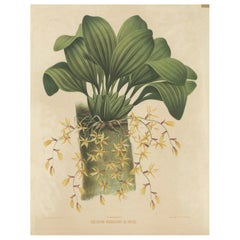
Large Orchid Illustrations of the Dutch East Indies: A Botanical Heritage, 1854

Large Orchid Illustrations of the Dutch East Indies: A Botanical Heritage, 1854

Located in Langweer, NL

A large and rare original chromolithographic plate from a significant 19th-century botanical work on orchids from the Dutch East Indies (now Indonesia). It is taken from the book t...

Category

Antique 1850s Dutch Prints

Materials

Paper

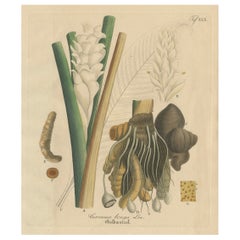
Antique Turmeric Botanical Print, Curcuma Longa, Hand Colored, c.1831

Antique Turmeric Botanical Print, Curcuma Longa, Hand Colored, c.1831

Located in Langweer, NL

Antique Turmeric Botanical Print, Curcuma Longa, Hand Colored, c.1831 Description: This vibrant botanical engraving depicts Curcuma Longa, the turmeric plant, including its distinct...

Category

Antique 1830s German Prints

Materials

Paper

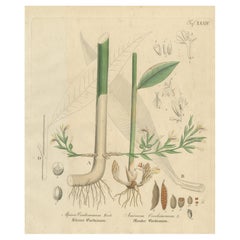
Antique Cardamom Botanical Print, Elettaria & Amomum Species, c.1831

Antique Cardamom Botanical Print, Elettaria & Amomum Species, c.1831

Located in Langweer, NL

Antique Cardamom Botanical Print, Elettaria & Amomum Species, c.1831 Description: This complex botanical engraving illustrates two cardamom species, including Elettaria cardamomum a...

Category

Antique 1830s German Prints

Materials

Paper

You May Also Like

Early 19th Century Botanical Engraving by John Curtis

Early 19th Century Botanical Engraving by John Curtis

Located in Seaford, GB

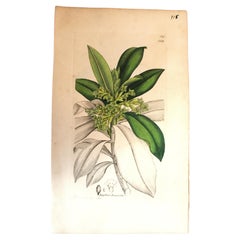
Early 19th Century Botanical Engraving by John Curtis – Hand Coloured Natural History Plate An original early 19th-century hand-coloured botanical engraving from the celebrated natural history publications of John Curtis (1791–1862), one of Britain’s most respected botanical and entomological illustrators. This beautifully detailed plate illustrates a flowering plant in scientific profile, showing bloom structure, leaves, buds, and root system with precision typical of early Victorian natural history illustration. Curtis’s work bridges science and art — created for study, yet prized today for its elegance and balance. These engravings formed part of the golden age of British botanical publishing, when artists collaborated with engravers and colourists to produce plates that were both accurate and visually refined. Each impression was printed from an engraved plate and then carefully coloured by hand, meaning no two examples are ever exactly identical. The composition has the clarity collectors seek: • Central botanical specimen • Naturalistic colour palette • Fine line engraving • Period scientific titling This makes it ideal as a single framed piece or as part of a gallery wall of antique botanical studies. About John Curtis John Curtis was a leading figure in British natural history illustration. He is best known for British Entomology and botanical works that combined taxonomic accuracy with graceful composition. His engravings are held in major museum collections and remain highly collectable in the decorative arts market. Period Early 19th century, circa 1820–1840. Technique Copperplate engraving with original hand colouring on laid paper. Condition Good antique condition consistent with age. Light toning and minor handling marks may be present, as expected with early 19th-century works on paper. Please see the images. Why Collect Curtis Botanical Prints...

Category

Antique Early 19th Century British George III Prints

Materials

Paper

Early 19th Century Botanical Engraving by John Curtis

Early 19th Century Botanical Engraving by John Curtis

Located in Seaford, GB

Early 19th Century Botanical Engraving by John Curtis – Hand Coloured Natural History Plate An original early 19th-century hand-coloured botanical engraving from the celebrated natural history publications of John Curtis (1791–1862), one of Britain’s most respected botanical and entomological illustrators. This beautifully detailed plate illustrates a flowering plant in scientific profile, showing bloom structure, leaves, buds, and root system with precision typical of early Victorian natural history illustration. Curtis’s work bridges science and art — created for study, yet prized today for its elegance and balance. These engravings formed part of the golden age of British botanical publishing, when artists collaborated with engravers and colourists to produce plates that were both accurate and visually refined. Each impression was printed from an engraved plate and then carefully coloured by hand, meaning no two examples are ever exactly identical. The composition has the clarity collectors seek: • Central botanical specimen • Naturalistic colour palette • Fine line engraving • Period scientific titling This makes it ideal as a single framed piece or as part of a gallery wall of antique botanical studies. About John Curtis John Curtis was a leading figure in British natural history illustration. He is best known for British Entomology and botanical works that combined taxonomic accuracy with graceful composition. His engravings are held in major museum collections and remain highly collectible in the decorative arts market. Period Early 19th century, circa 1820–1840. Technique Copperplate engraving with original hand colouring on laid paper. Condition Good antique condition consistent with age. Light toning and minor handling marks may be present, as expected with early 19th-century works on paper. Please see the images. Why Collect Curtis Botanical Prints...

Category

Antique Early 19th Century British George III Prints

Materials

Paper

Zingiber Officinale - Lithograph by Vincenzo Tenore - 1870s

Zingiber Officinale - Lithograph by Vincenzo Tenore - 1870s

By Vincenzo Tenore

Located in Roma, IT

Lithograph hand watercolored. Belongs to the Series "Atlante di Botanica popolare ossia Illustrazione di Piante Notevoli di ogni famiglia" (Atlas of popular botany or illustration o...

Category

1870s Modern Figurative Prints

Materials

Lithograph

19th C. Hand Colored Botanical "Alpinia Nutans Rosc." Lithograph

19th C. Hand Colored Botanical "Alpinia Nutans Rosc." Lithograph

Located in San Francisco, CA

19th C. hand colored Botanical "Alpinia Nutans Rosc." Lithograph Fine antique hand colored lithograph The color is still strong after all these years The lithograph comes un...

Category

Antique Late 19th Century English Prints

Materials

Paper

Early 19th Century Botanical Engraving by John Curtis – Hand Coloured

Early 19th Century Botanical Engraving by John Curtis – Hand Coloured

Located in Seaford, GB

Early 19th Century Botanical Engraving by John Curtis – Hand Coloured Natural History Plate An original early 19th-century hand-coloured botanical engraving from the celebrated natural history publications of John Curtis (1791–1862), one of Britain’s most respected botanical and entomological illustrators. This beautifully detailed plate illustrates a flowering plant in scientific profile, showing bloom structure, leaves, buds, and root system with precision typical of early Victorian natural history illustration. Curtis’s work bridges science and art — created for study, yet prized today for its elegance and balance. These engravings formed part of the golden age of British botanical publishing, when artists collaborated with engravers and colourists to produce plates that were both accurate and visually refined. Each impression was printed from an engraved plate and then carefully coloured by hand, meaning no two examples are ever exactly identical. The composition has the clarity collectors seek: • Central botanical specimen • Naturalistic colour palette • Fine line engraving • Period scientific titling This makes it ideal as a single framed piece or as part of a gallery wall of antique botanical studies. About John Curtis John Curtis was a leading figure in British natural history illustration. He is best known for British Entomology and botanical works that combined taxonomic accuracy with graceful composition. His engravings are held in major museum collections and remain highly collectable in the decorative arts market. Period Early 19th century, circa 1820–1840. Technique Copperplate engraving with original hand colouring on laid paper. Condition Good antique condition consistent with age. Light toning and minor handling marks may be present, as expected with early 19th-century works on paper. Please see the images. Why Collect Curtis Botanical Prints...

Category

Antique Early 19th Century George III Prints

Materials

Paper

Smilaceae - Lithograph by Vincenzo Tenore - 1870s

Smilaceae - Lithograph by Vincenzo Tenore - 1870s

By Vincenzo Tenore

Located in Roma, IT

Lithograph hand watercolored. Belongs to the Series "Atlante di Botanica popolare ossia Illustrazione di Piante Notevoli di ogni famiglia" (Atlas of popular botany or illustration o...

Category

1870s Modern Figurative Prints

Materials

Lithograph