Madame Knip Cloven-Feathered Dove Engraving, Colombe Vlouvlou, Les Pigeons
Description
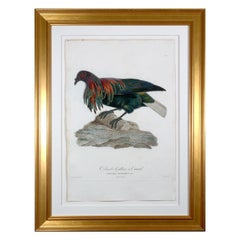
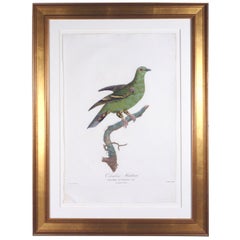
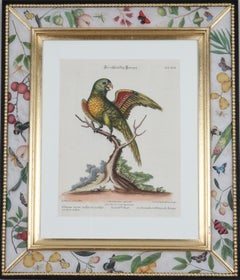
This large-scale engraving, printed in color and finished by hand, depicts the Cloven-Feathered Dove of New Caledonia, lettered beneath the image with its French title Colombe Vlouvlou and the Linnaean name Columba holosericea. The plate comes from Les Pigeons, the celebrated Paris folio issued in fifteen livraisons between 1808 and 1811, with the birds painted by Pauline Knip, née Rifer de Courcelles, and the text supplied by the Dutch zoologist Coenraad Jacob Temminck.
The dove is rendered in deep emerald and silvery greens, the breast finely scaled, with a crisp black-and-white band across the flank, a broad saffron-yellow belly and undertail, and a piercing crimson eye. It perches on a lichened branch, and a single detached wing feather is figured below — a scientific detail rather than a decorative one, since the species is distinguished by its curiously notched primaries, from which it takes its English name. Engraved by Jean César Macret after Knip's painting and printed in color by the Imprimerie de Millevoy, the sheet was then finished by hand, a laborious process that gives the plumage a velvety depth and luminosity flat hand-coloring cannot achieve. The species, endemic to New Caledonia and the Isle of Pines, is known today as Ptilinopus holosericeus.
The engraving is float-mounted within a white mat and a gallery-quality giltwood frame, glazed with Tru Vue UV-filtering conservation glass to protect the pigments.
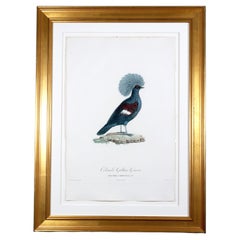
Further plates from the same publication, framed to match, are available.
Dimensions
Frame height: 28¾ inches (73.0 cm)
Frame width: 21¾ inches (55.3 cm)
Frame depth: 1¼ inches (3.2 cm)
Sight height: 20¾ inches (52.7 cm)
Sight width: 13¼ inches (33.7 cm)
Inscriptions
Lettered beneath the image in script, Colombe Vlouvlou, and below it in capitals, COLUMBA HOLOSERICEA. Lettered in the lower margin, at left "Pauline de Courcelles Fem. Knip Pinx.", at center "de l'Imprimerie de Millevoy.", and at right "César Macret sculp."
Provenance
Earle D. Vandekar of Knightsbridge
Condition
Good antique condition, the hand-finished coloring fresh and strong and the image clean. The sheet retains its deckle edges and shows a horizontal crease across the lower margin below the lettering, with light cockling along the right edge. Scattered spots of foxing in the lower margin and light overall toning to the paper, as is usual with sheets of this date and size. Minor scuffs to the gilt frame.
References
Coenraad Jacob Temminck and Pauline Knip, Les Pigeons (Paris, 1808–1811), p. 73, plate 32.
Edward C. Dickinson, Normand David, Leslie K. Overstreet, Frank D. Steinheimer and Justin Jansen, "Histoire naturelle des pigeons or Les pigeons: Coenraad Jacob Temminck versus Pauline Knip," Archives of Natural History 37, no. 2 (2010), pp. 203–220.
Alexandra K. Neuman, "Publishing, Pretense, and Pigeons: The Case of Madame Knip," Smithsonian Libraries and Archives, March 31, 2017.
Historical Context
This is the plate on which the species was first made known to science: Columba holosericea was described by Temminck in Les Pigeons in 1809, and the plate stands as the original figure for the name, which is why it carries no authority abbreviation after the Latin. Temminck, then among the foremost ornithologists in Europe, commissioned Knip to paint the birds and, living in Leiden, left her to supervise the engraving and color printing in Paris. Knip — newly appointed natural history painter to the Empress Marie Louise — used that position to give her own name precedence on the title page issued with the final parts in 1811, suppressing Temminck's introduction and substituting a dedication to the Empress. He republished his text separately between 1813 and 1815, and taxonomists have since credited the new species names to him. The plates have never been in question, and remain among the most beautiful bird illustrations ever produced.
(Ref: NY10541-prrx)